Most MOTS-C dosing advice starts with the wrong question. It asks for the “standard” dose, as though a prescribing label or large confirmatory trial had already settled the matter. It hasn’t. MOTS-c remains investigational, and no approved human dosage or universally accepted schedule exists, so copying a forum protocol without checking its math, frequency, cycle length, and tracking method is a reliable way to create confusion.
A workable MOTS-C dosing schedule starts somewhere else. Define the outcome you’re tracking, choose the smallest practical exposure that fits your adherence capacity, calculate the injection volume independently, and decide in advance when you’ll pause or stop. The framework below is designed for research-use planning, not self-prescribing. Anyone considering MOTS-c should involve a qualified clinician, particularly when metabolic disease, medication use, pregnancy, or competitive sport is relevant.
Table of Contents
- Why There Is No Universal MOTS-C Dose
- Choosing Your Target Dose and Cycle Length
- Converting Micrograms to Injection Volume
- Setting Frequency and Pause Periods
- Logging Doses and Staying on Track
- Safety Monitoring and When to Stop
Why There Is No Universal MOTS-C Dose
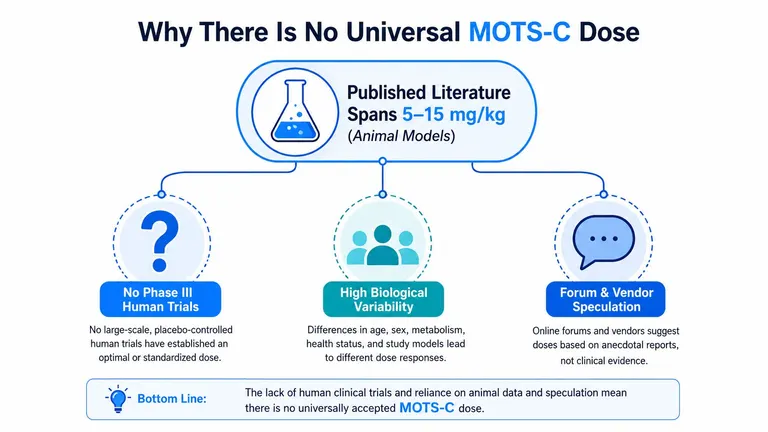
Most MOTS-C dosing advice leads with a number, the “standard” dose, as though a prescribing label had already settled the matter. The evidence does not support that assumption. MOTS-c was identified in 2015 as a mitochondrial-derived peptide, making it a comparatively recent research target rather than a long-established therapy (the review literature on MOTS-c). Animal experiments, early human-focused material, analog studies, and anecdotal protocols address different questions, so their doses cannot be combined into one human standard.
The clearest human regimen cited in research summaries came from a small pilot study involving postmenopausal women with metabolic syndrome. Twenty participants received 5 mg subcutaneously three times weekly for 8 weeks, creating a structured 56-day protocol with defined endpoints. That history is useful for comparison, not as a personal prescription.
Practical rule: A published regimen can serve as a research reference without establishing a validated individual dose.
Where the conflicting numbers come from
Research-use summaries commonly group protocols around 5 mg to 10 mg per subcutaneous dose, administered 2 to 5 times weekly, often within 4- to 12-week cycles (protocol history and development summary). These schedules are researcher-constructed and empirical. They do not come from an approved dosing label, so the numbers should be treated as planning references rather than settled instructions.
The evidence gap matters more than the range itself. The Alzheimer’s Association review states that MOTS-c dosing has not been established in humans and reports that no clinical trials are currently testing MOTS-c or MOTS-c analog peptides (Alzheimer’s Association cognitive vitality review). Other summaries describe human studies of the analog CB4211, including 25 mg once daily for 4 weeks in adults with obesity and NAFLD. An analog protocol should not be converted directly into a MOTS-c dose (human study summary).
A workable decision starts with three variables, recorded in a protocol sheet or tracking app:
- Per-injection amount, expressed in milligrams or micrograms.
- Injection frequency, based on the selected research pattern and your ability to follow it.
- Total cycle length, including the planned pause and the measures used to review results.
For organizing peptide calculations, review this peptide dosage guide. For comparison with medically supervised options, explore peptide treatments.
Choosing Your Target Dose and Cycle Length
Choose the target dose according to the question your protocol needs to answer. “I want better mitochondrial function” is too broad for reliable tracking. A workable objective could be steadier training energy, a metabolic marker monitored with clinical support, or more consistent recovery. Record that objective in a protocol sheet or tracking app, then define the measurements and review date before selecting a schedule.
Research-use summaries commonly describe 5 mg to 10 mg per injection, while some experimental planning material discusses higher exposure in other settings. Treat each increase as a change in total exposure and uncertainty, rather than automatically choosing the highest tier.
A decision table for planning
| Dose Tier | Per-Injection Dose | Typical Cycle Length | Monthly Cost Estimate | Adherence Burden |
|---|---|---|---|---|
| Conservative | 5 mg | 4 weeks | Depends on vial price and frequency | Lower per-dose exposure, but frequency still matters |
| Moderate | 10 mg | 8 weeks | Depends on vial price and frequency | Greater calculation and injection burden |
| Higher experimental exposure | 15 mg | 12 weeks | Depends on vial price and frequency | Highest uncertainty and planning burden |
The table organizes your inputs. Use it to compare dose, cycle length, cost, and adherence burden, then revise the plan using actual response and missed-dose data. The 5 mg and 10 mg figures represent a commonly reported research-use range. 15 mg belongs to higher experimental exposure described in research summaries, so it should not be treated as an established human protocol. Public protocols also vary in cycle length. A longer cycle does not by itself show better results.
Use an exposure index
Enter the intended schedule in your tracking tool:
Exposure index = dose per injection × injections per week × weeks on treatment
Keep the units consistent. Recalculate the full index whenever you alter a dose, frequency, or cycle length. This prevents a common planning error: selecting a “moderate” per-injection amount, then pairing it with frequent injections that produce a much larger total exposure.
Cycle length should match the quality of the data you can collect. A shorter cycle may reduce the time and adherence burden required for an initial test. A longer cycle creates more opportunities to observe consistency, but also increases the consequences of missed entries, side effects, or a poorly chosen exposure. Record the planned pause and the review criteria in the same sheet.
Adherence often decides whether the resulting data are useful. A schedule that looks tidy on paper but leads to repeated missed injections gives you little basis for judging response. For comparison, this explanation of how Wegovy dosage works shows why dose, timing, and escalation should be handled as separate planning decisions, although Wegovy and MOTS-c are different compounds.
Before preparing a vial, log your intended dose per injection and the planned cycle length. Choose frequency separately, then use the known concentration to determine the liquid volume.
Converting Micrograms to Injection Volume
Translating a protocol dose into an injection volume requires three numbers: vial strength, reconstitution volume, and syringe scale. Record all three in your tracking sheet before preparing a dose. Mixing milligrams with micrograms is a common source of calculation errors.
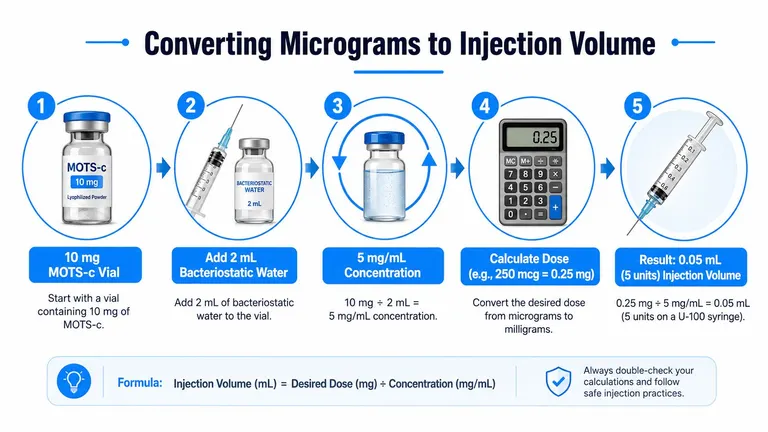
Consider a 10 mg vial reconstituted with 2 mL of bacteriostatic water. The resulting concentration is 5 mg/mL, or 5,000 mcg/mL (reconstitution example and calculation guidance). Use:
Volume in mL = target dose in mcg ÷ concentration in mcg/mL
With a U-100 insulin syringe:
Syringe units = volume in mL × 100
A 250 mcg target equals 0.25 mg. At 5 mg/mL, that dose requires 0.05 mL, equal to 5 U-100 syringe units. The formula applies to other targets when you use the final concentration, rather than the vial’s total content, in the calculation.
Per-injection volume also affects whether a plan is practical. A 10 mg target from a solution containing 5 mg/mL requires 2 mL. That may be an inconvenient volume for one subcutaneous injection, prompting discussion of a more concentrated preparation or division across injection sites. Confirm those choices with a qualified professional and follow the product’s preparation and sterility instructions.
Run this checklist before drawing
- Confirm the vial content. Record the total milligrams.
- Record the added liquid. Use the actual reconstitution volume.
- Calculate concentration. Divide total milligrams by total milliliters.
- Convert units once. Write milligrams and micrograms side by side.
- Check the syringe type. U-100 markings represent 100 units per mL.
- Review the volume. Stop if the result seems unusually large or small.
- Account for device limitations. Dead space can affect delivery at small volumes.
Use this mcg-to-mL calculation guide to check the arithmetic, then copy the final volume and syringe units into your dose log. Keep preparation and storage instructions separate from dose calculations. The semaglutide preparation and storage example shows why handling guidance should come from an appropriate clinical or pharmacy source, not a copied peptide spreadsheet.
Setting Frequency and Pause Periods
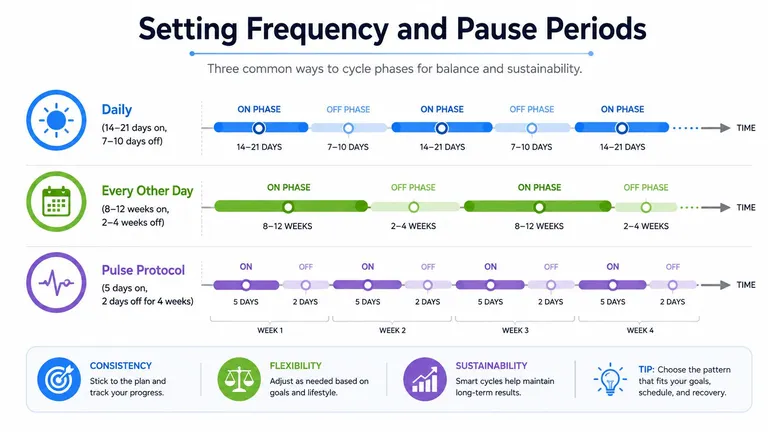
Daily dosing is popular online because it’s easy to describe, not because human evidence has established it as optimal. Public protocols vary widely, including daily, every other day, two or three times weekly, once weekly, and schedules based on every fifth day. The available material explicitly acknowledges that there’s no definitive human research establishing the best frequency (MOTS-c dosing guide).
Frequency changes both exposure and adherence. Daily injections create the most reminders and the greatest opportunity for schedule drift. Every-other-day dosing reduces injection count while preserving a regular rhythm. Three-times-weekly dosing can work well for people who prefer fixed calendar days, such as Monday, Wednesday, and Friday, but it demands discipline around weekends and travel.
Design the calendar before starting
Choose the frequency first, then put every planned injection on a calendar. A Monday, Wednesday, Friday schedule is easier to audit than “three times weekly” because each intended dose has a visible location. Add the start date, the final active date, and the pause period before the first injection.
Longer-cycle summaries describe 8 to 12 weeks on treatment followed by 4 weeks off, while other public material discusses shorter cycles and washouts (protocol history and development summary). These are experimental planning frameworks, not approved standards. A conservative calendar should include a pause rather than allowing the active phase to continue indefinitely by default.
The decision after a missed dose should be written in advance:
- Missed near the next scheduled dose: Skip it and resume the normal calendar.
- Missed with several days remaining in the active phase: Shift the schedule only if doing so doesn’t compress doses.
- Missed near cycle end: Shorten the cycle rather than extending it automatically.
Never double the next dose to “catch up.” Record the missed injection, preserve the spacing you intended, and note the reason in your log. The objective is clean information, not a perfect-looking calendar.
Logging Doses and Staying on Track
A dosing schedule fails when the plan and the actual injections drift apart. A reliable system needs only three parts: a written dose log, a reminder, and a weekly review. The tool can be paper, a spreadsheet, a calendar app, or a dedicated tracker. Consistency matters more than branding.
Set the reminder for 30 minutes before the planned injection, then log the dose immediately after it happens. Record enough detail to identify patterns without turning the process into a second job.
| Date | Day | Dose (mcg) | Injection Site | Energy (1-5) | Notes |
|---|---|---|---|---|---|
| Planned date | Monday | Planned amount | Left or right site | Baseline score | Sleep, training, symptoms |
| Actual date | Wednesday | Actual amount | Opposite site | Current score | Missed, delayed, or normal |
| Actual date | Friday | Actual amount | Rotated site | Current score | Injection response |
Use the energy score as a consistent personal measure, not as proof of efficacy. Keep the wording stable, such as “morning energy before caffeine,” so a busy day doesn’t become an apparent treatment effect.
Review the week, not just the injection
At the weekly checkpoint, compare planned versus actual doses. Look for dose creep, where you increase the amount because you haven’t noticed anything, and schedule compression, where you squeeze missed injections into the remaining days. Both problems become harder to interpret once they continue across a full cycle.
Rotate sites using a simple left-right-left pattern, and follow the preparation and injection instructions supplied by your clinician or pharmacy. If you want a structured place to manage reminders and dose history, use this guide to stay on track and choose a system you’ll open after every injection.
Safety Monitoring and When to Stop
MOTS-c doesn’t have the human safety record needed to support a universal monitoring protocol. The responsible approach is therefore goal-tied and conservative. Define what success means before starting, and define the stop conditions before motivation, sunk-cost thinking, or excitement takes over.
Choose two or three baseline markers that match your goal. These might include resting heart rate, fasting glucose when clinically appropriate, and a simple energy score. Review them at the midpoint and end of the cycle, while seeking medical advice for interpretation rather than treating a home log as a diagnosis.
Pause the protocol and contact a qualified healthcare professional if you experience:
- Persistent local reaction: An unexplained injection-site reaction lasting more than 48 hours.
- Sustained heart-rate change: Resting heart rate more than 10 bpm above baseline for 3 consecutive days.
- Unexplained symptoms: Any new symptom you can’t reasonably attribute to another variable.
These thresholds are conservative decision rules for personal risk management, not validated MOTS-c clinical stopping criteria. The Alzheimer’s Association review’s conclusion that human dosing is not established reinforces why users shouldn’t interpret online schedules as medical standards (neutral MOTS-c safety review).
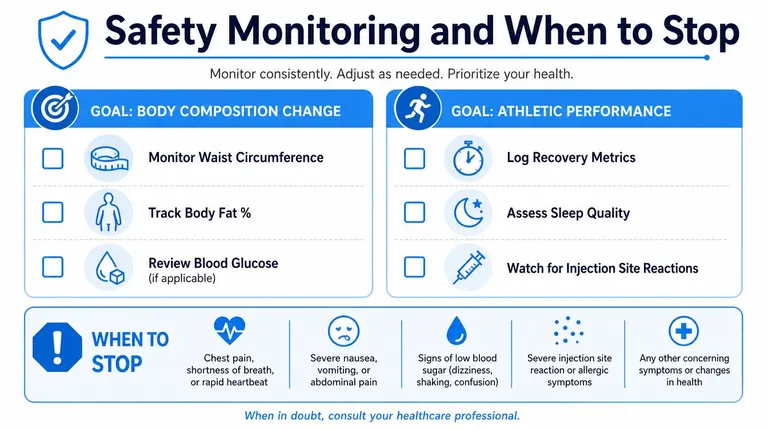
Before starting, document the baseline and stop rules. Mid-cycle, compare actual exposure with the calendar and review symptoms. At the end, decide whether the objective was met, unchanged, or worsened. If the protocol isn’t delivering a meaningful, measurable result, stopping is a valid outcome. You don’t owe an experimental cycle a finish because you already prepared it.
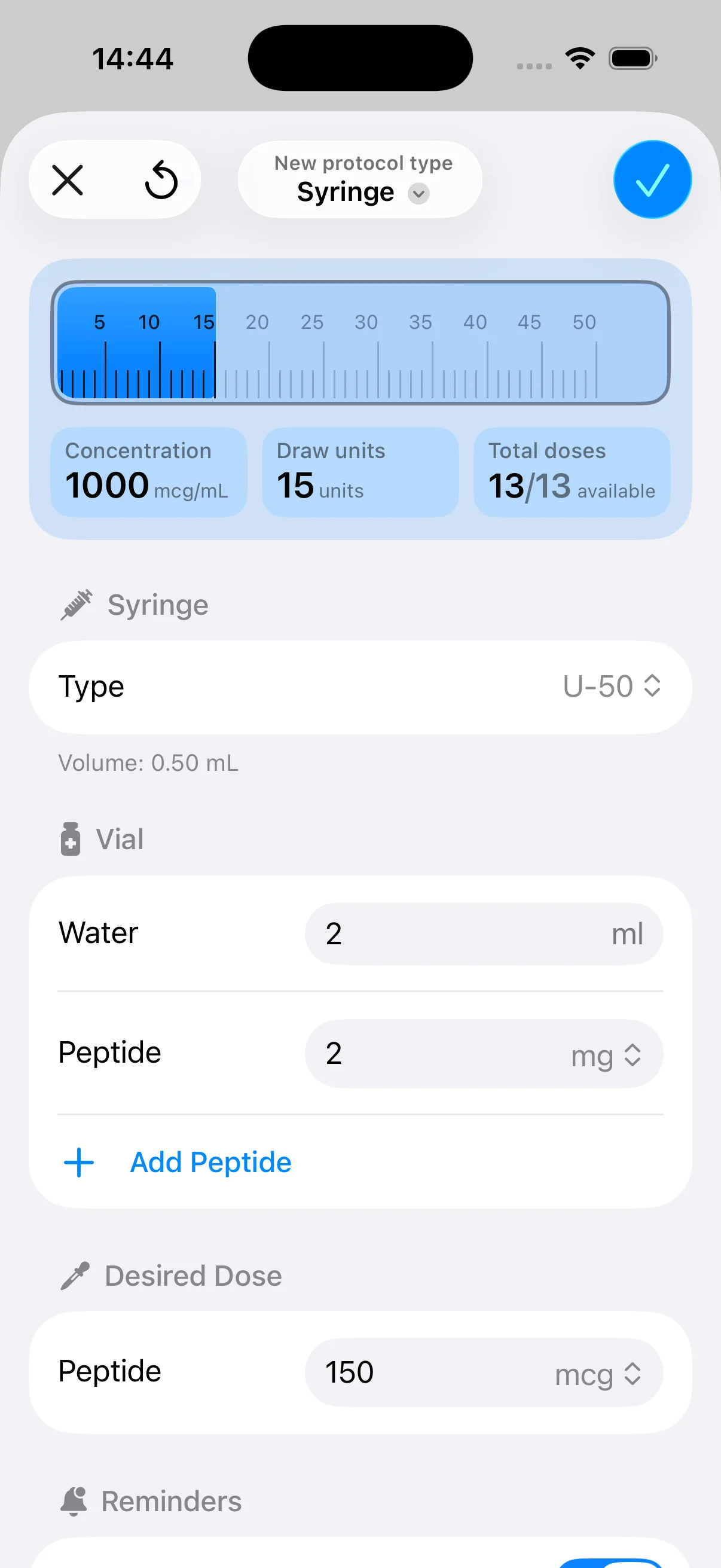
PepFlow helps organize this kind of plan with a dosage calculator for converting microgram targets into syringe units, cycle scheduling with pause periods, reminders, and dose-history logging. Visit PepFlow to turn your chosen MOTS-C schedule into a trackable calendar, then review the final protocol and safety plan with a qualified healthcare professional before proceeding.