A medication-order dataset covering 643,151 medication errors from 682 facilities found that 29,974 errors, or 4.7%, were attributed to medical abbreviations during 2004 through 2006, as documented in NCBI’s medication-safety reference. That figure changes how dosing frequency abbreviations should be viewed. They aren’t harmless shorthand. They’re compressed instructions that can alter the interval between doses, shift a medication from daytime use to overnight use, or turn “every other day” into “every day” when someone reads the order too quickly.
For a meticulous biohacker, peptide user, caregiver, or patient managing several products, the important skill isn’t memorizing a Latin glossary. It’s translating an abbreviation into an unambiguous clock-time schedule, confirming whether the prescriber intended waking-hours dosing or strict spacing, and recording the result in a way another person can understand. The examples below use representative times for explanation only. Your medication, formulation, condition, meals, sleep pattern, and prescriber’s instructions determine the schedule you should follow.
Table of Contents
- Why Dosing Frequency Abbreviations Still Cause Errors
- How Frequency Abbreviations Are Built
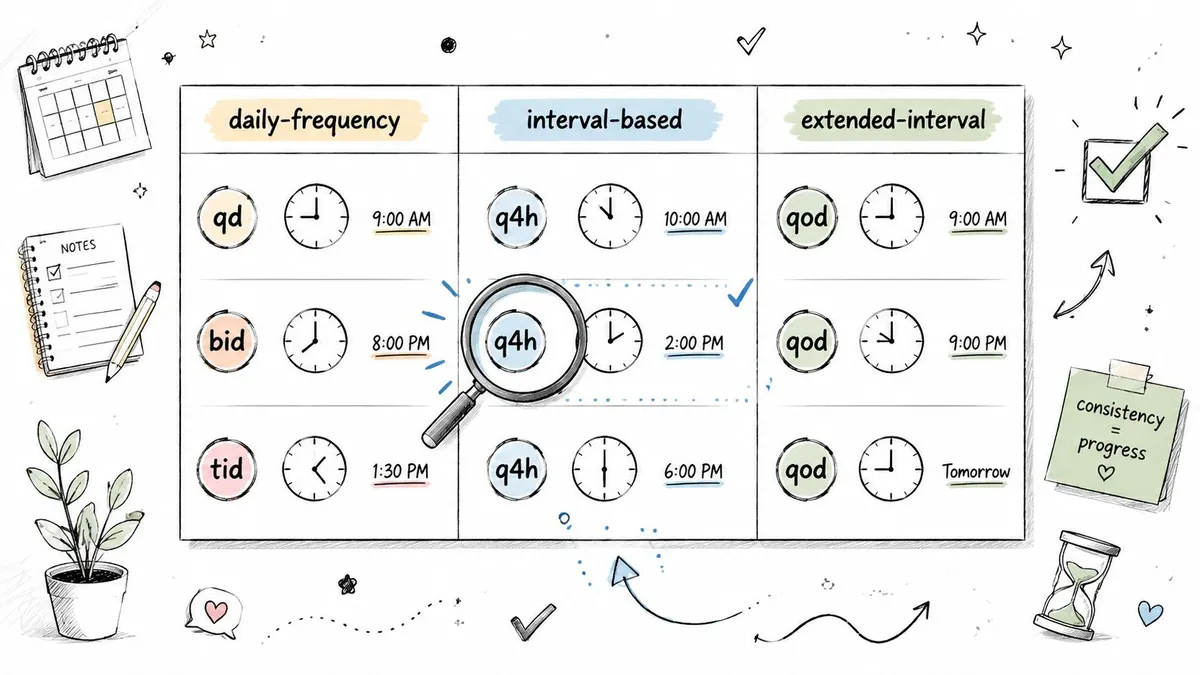
- Daily Frequency Abbreviations and Their Schedules
- Interval-Based Abbreviations and Hourly Spacing
- Dangerous Abbreviations You Should Never Use
- Converting Abbreviations Into Exact Dose Times
- Managing Dosing Schedules with PepFlow
- Quick Reference Table for All Abbreviations
- Common Questions About Dosing Abbreviations
Why Dosing Frequency Abbreviations Still Cause Errors
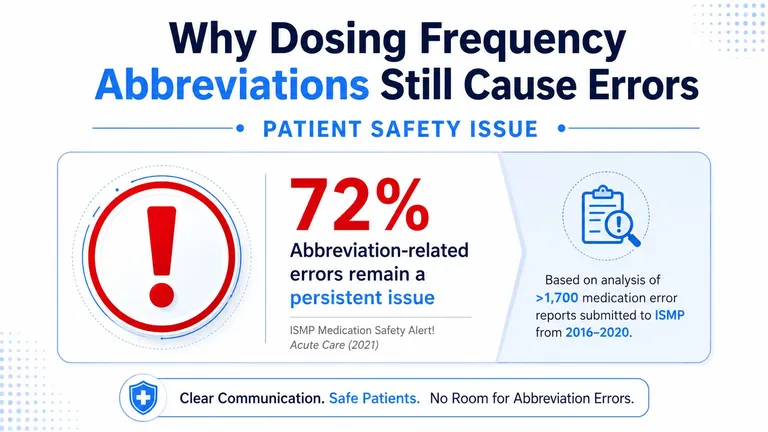
72 percent of medication errors are related to dosing frequency abbreviations, according to the infographic below. That figure should be treated as an illustration rather than verified evidence for this article. The reliable safety lesson is narrower and more useful: compact dosing shorthand can change how a person spaces doses, especially when handwriting, electronic formatting, or transcription is unclear.
Medical abbreviations remain familiar in clinical practice, yet the same short form may be read differently by a prescriber, pharmacist, nurse, patient, or caregiver. Patient-safety guidance warns that QD and QOD can be mistaken for more frequent schedules, which is why many systems prefer plain-language instructions such as “daily” and “every other day.” The NCBI overview of medication abbreviations and safety describes the role of controlled terminology in preventing medication errors.
Why frequency is especially vulnerable
Frequency shorthand can encode two different scheduling rules:
- Count-based dosing, such as “three times daily”
- Interval-based dosing, such as “every eight hours”
Both may produce several doses in one day, but they generate different clock-time schedules. “Three times daily” might be entered as breakfast, lunch, and dinner. “Every eight hours” may require a dose overnight to preserve the interval. Treating those instructions as interchangeable can create excessively long gaps or doses that are too close together.
For a person managing medication or research compounds outside direct clinical supervision, translation is the practical safety step. Convert the abbreviation into plain language, then into exact times that can be entered into an alarm or calendar. Record whether the schedule follows waking hours or a fixed interval, and define what to do after a missed dose.
Any abbreviation that could reasonably have more than one meaning should be confirmed with a pharmacist or prescriber before use. The goal is a schedule another person can follow without interpreting the shorthand again.
How Frequency Abbreviations Are Built
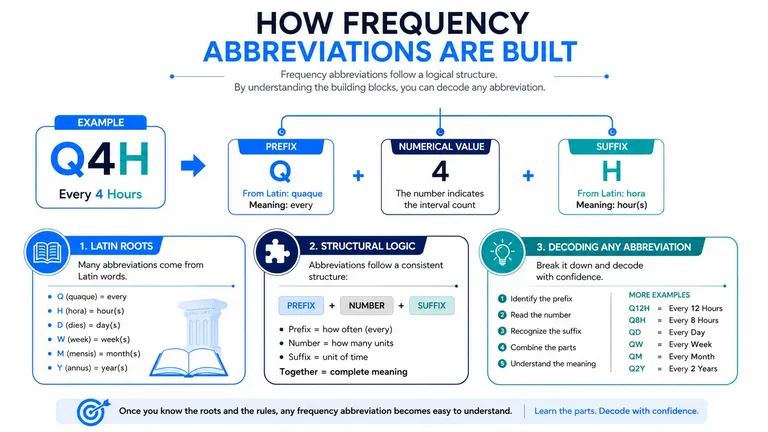
Many dosing abbreviations come from Latin, but their practical meaning becomes clearer when you treat them like a compact scheduling formula. Decode the parts first, then translate the result into plain language and, if needed, exact clock times for an alarm or medication app.
A useful model has three components:
- The frequency or interval marker, often
q, meaning “every.” - The number, which states the interval when one appears.
- The time unit or daily-count ending, such as
hfor hours ordfor day.
q8h means every eight hours, so an app should calculate repeating eight-hour intervals from the first dose. q4h means every four hours. tid means three times daily, a count across the day rather than an instruction to create perfectly equal eight-hour gaps. The distinction matters because a count-based schedule may follow waking hours, while an interval-based schedule can continue overnight.
Read the whole order, not just the frequency
Frequency is only one field in a medication instruction. Route, strength, formulation, food timing, and “as needed” conditions can change the schedule. ac and pc connect administration to meals, while qhs and hs refer to bedtime rather than a simple daily dose count.
Formatting can also obscure meaning. Periods, capitalization, handwriting, and spacing affect how quickly a reader identifies an abbreviation. Controlled terminology guidance supports limited uppercase forms such as BID, TID, QID, and HS without periods, and may permit compact forms such as q4h under institutional policy. Use approved shorthand, then write the interpreted instruction with a first dose, interval or daily timing, and stopping rule.
A video can reinforce the vocabulary, but an unclear order still requires confirmation from a pharmacist or prescriber.
Practical rule: If an abbreviation cannot become a plain-language instruction with clear dose times and boundaries, do not schedule it yet.
Daily Frequency Abbreviations and Their Schedules
Daily-frequency abbreviations describe how many times a medication is taken within the day, but they don’t always define equal spacing across a full 24-hour period. That difference is the central issue. The table below gives representative schedules to show the logic, not to prescribe dose times.
| Abbreviation | Latin origin | Plain meaning | Example schedule |
|---|---|---|---|
| QD | quaque die | Once daily | 8:00 AM |
| BID | bis in die | Twice daily | 8:00 AM and 8:00 PM |
| TID | ter in die | Three times daily | 7:00 AM, 3:00 PM, and 11:00 PM |
| QID | quater in die | Four times daily | 7:00 AM, 1:00 PM, 7:00 PM, and 1:00 AM |
BID often fits a roughly twelve-hour pattern, but a prescriber may tie doses to meals or waking hours instead. TID can mean three practical administration points during a person’s day, or it may be used in a context where the clinician expects closer interval control. Don’t infer the intended clock times from the abbreviation alone.
QID creates the same problem with greater intensity. Four daily doses can be distributed across waking hours, or they can be spaced at approximately six-hour intervals if continuous coverage matters. The medication’s pharmacokinetics, formulation, indication, and clinical protocol determine which interpretation is appropriate.
Food instructions add another constraint. If a label says to take a dose with food, before meals, or after meals, the schedule must fit the person’s actual eating pattern rather than an abstract clock. For peptide protocols, half-life and injection timing may matter more than meal convenience, so users shouldn’t convert a daily count into a schedule without checking the written instructions.
If you’re reviewing a stimulant prescription and need a separate, medication-specific explanation, you can check Adderall availability with FindMyScript. Availability and dosing are separate questions, and neither should be inferred from an abbreviation alone.
Interval-Based Abbreviations and Hourly Spacing
An interval abbreviation states the time elapsed between doses. That makes it different from a daily count. q8h means every eight hours, while TID means three times daily. Both may result in three administrations during a calendar day, but only the interval form directly specifies the spacing.
Consider a first dose at 6:00 AM:
| Abbreviation | Type | Doses per 24h | Example schedule | Overnight dose required |
|---|---|---|---|---|
| TID | Daily frequency | 3 | 6:00 AM, 2:00 PM, 10:00 PM | Not necessarily |
| Q8H | Hourly interval | 3 | 6:00 AM, 2:00 PM, 10:00 PM | Not necessarily with this anchor, but the sequence continues |
| Q6H | Hourly interval | 4 | 6:00 AM, 12:00 PM, 6:00 PM, 12:00 AM | Yes |
| Q12H | Hourly interval | 2 | 6:00 AM and 6:00 PM | No, if those times are intended |
| Q4H | Hourly interval | 6 | 6:00 AM, 10:00 AM, 2:00 PM, 6:00 PM, 10:00 PM, 2:00 AM | Yes |
The table shows why “four times daily” and q6h shouldn’t be treated as interchangeable. The first may be implemented around waking hours. The second maintains a repeating interval across the day and night unless a clinician explicitly changes the plan.
For antibiotic regimens, UCL’s prescription-writing guide recommends explicit hourly spacing where even distribution matters. Its example contrasts an evenly spaced eight-hour pattern with a three-times-daily schedule that can create uneven gaps.
Scheduling insight: Store the interval and the clock-time plan as separate pieces of information. One describes the rule, and the other tells a human what to do today.
A short-half-life compound may be more sensitive to uneven spacing, but you shouldn’t assume that from a product category alone. If you’re researching how duration relates to repeat dosing, the PepFlow guide to HGH half-life can provide background, but a prescriber must determine the clinically appropriate interval.
Dangerous Abbreviations You Should Never Use
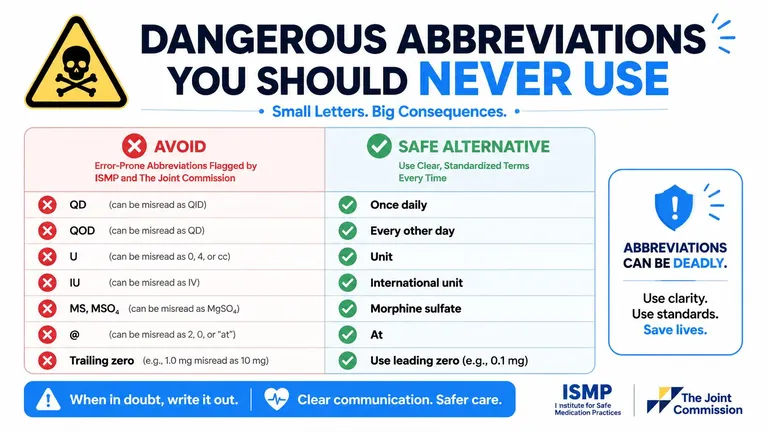
Some forms are risky enough that modern safety programs recommend replacing them with plain language. QD can be mistaken for QID or read as another once-daily abbreviation such as OD. QOD, intended to mean every other day, can be misread as daily or as a more frequent schedule. The PSNet review of abbreviation-related patient-safety events describes how safety organizations treated these forms as a formal “do not use” concern, while errors continued despite broad dissemination of warnings.
Replace ambiguity with explicit wording
| Risky form | Safer wording |
|---|---|
| QD | Once daily |
| QOD | Every other day |
| OD | Once daily, if that’s the intended meaning |
| TIW | State the exact days or write three times weekly |
| HS or QHS | At bedtime, when that’s the intended instruction |
| U | Units |
Trailing zero, such as 1.0 mg | 1 mg |
Missing leading zero, such as .5 mg | 0.5 mg |
The ISMP list of error-prone abbreviations and dose expressions highlights confusion involving daily and non-daily patterns, including TIW, which can be interpreted as three times daily or twice weekly. The same resource notes that frequency shorthand continues to appear in real prescriptions, including orders containing at least one error-prone abbreviation and a subset judged high risk for significant harm.
A visual misread can become a schedule error without anyone changing the medication name. If “every other day” becomes “daily,” exposure increases. If q6h becomes four times during waking hours, overnight spacing changes. If a decimal is missed, the dose itself can change.
Never solve an ambiguous order by choosing the interpretation that fits your routine. Ask the prescriber or pharmacist to rewrite it.
Converting Abbreviations Into Exact Dose Times
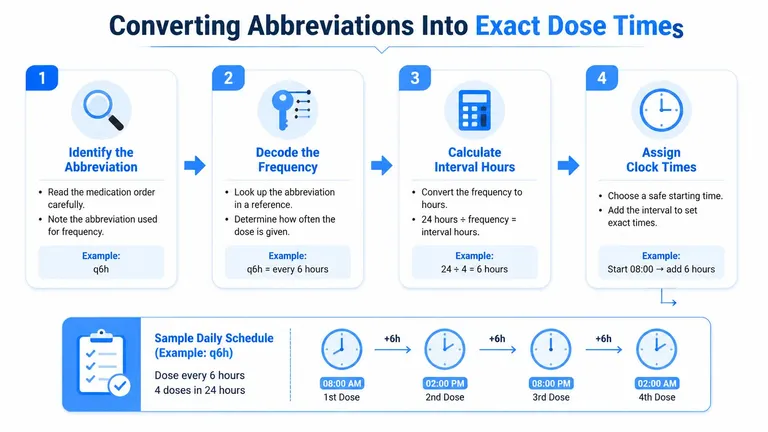
Use a repeatable conversion process, but treat it as a communication tool, not authorization to alter a prescription.
- Identify the frequency form. Determine whether the instruction is count-based, such as BID or TID, interval-based, such as q8h, or pattern-based, such as every other day.
- Translate it into plain language. Write “twice daily,” “every eight hours,” or “every other day.” If the abbreviation supports multiple interpretations, stop here and clarify.
- Find the scheduling rule. Ask whether doses should be evenly spaced across 24 hours, limited to waking hours, linked to meals, or placed at bedtime.
- Assign clock times and document them. Choose the first dose time specified by the prescriber, then calculate subsequent times without changing the interval.
For example, a TID instruction might be represented as 7:00 AM, 2:00 PM, and 9:00 PM when a waking-hours schedule is intended. A q8h order might be represented as 6:00 AM, 2:00 PM, and 10:00 PM, but the continuing eight-hour rule means the next dose would occur at 6:00 AM. Don’t add an overnight alarm or remove one without confirming the intended plan.
Handle conflicts before they reach your reminders
Meals, sleep, reconstitution limits, refrigeration, injection-site rotation, and multiple medications can create competing constraints. Put the clinical rule first, then fit convenience around it. If two products have different interval requirements, don’t merge them only because one alarm is easier to remember.
A dosing app can help once the instructions are confirmed. A routine schedule app for medication and protocol planning may help organize recurring times, but the user still needs to enter the correct rule and verify the first dose.
Managing Dosing Schedules with PepFlow
A scheduling tool should do more than repeat a notification. It should distinguish daily frequency from elapsed-hour intervals, preserve exact timestamps, and make ambiguous input visible before it becomes a saved routine.
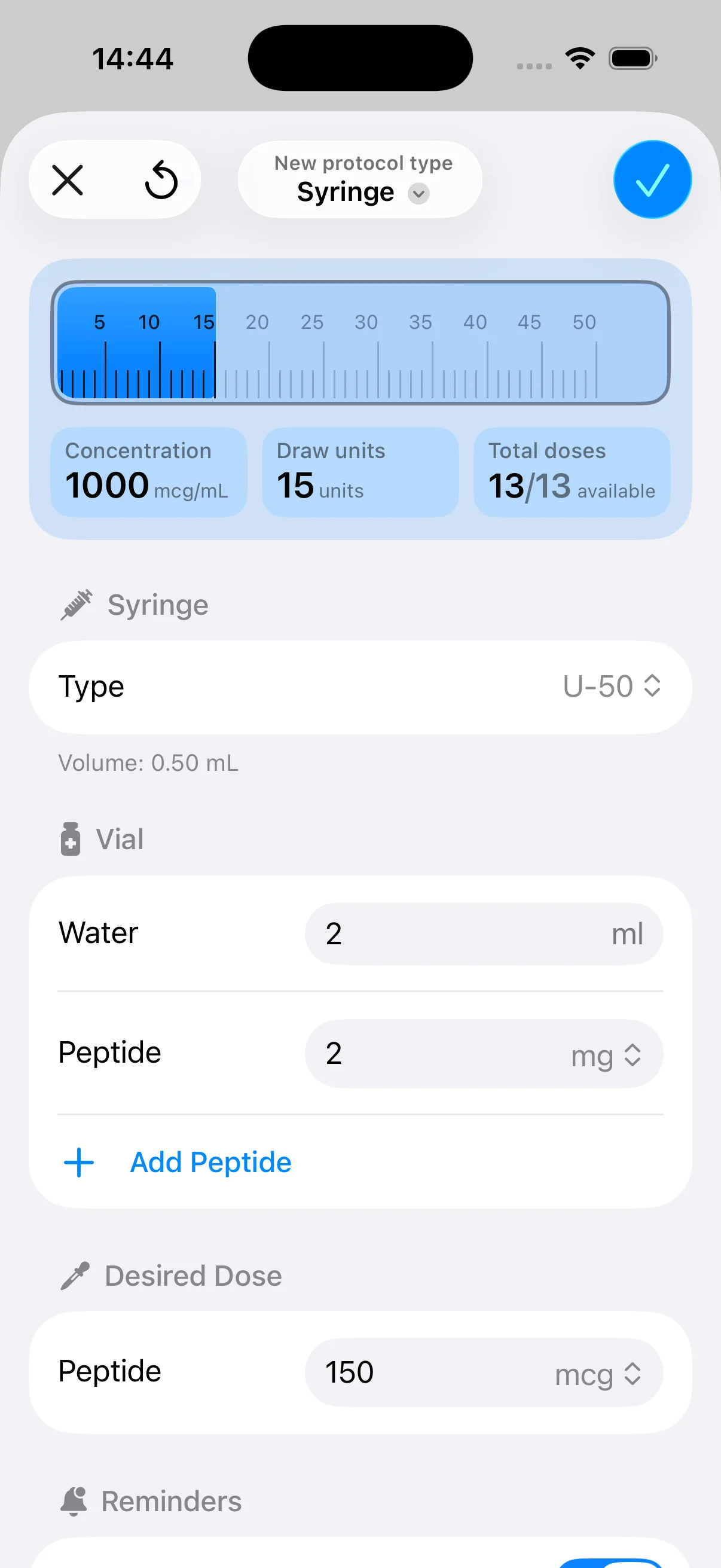
PepFlow is one option for organizing peptide protocols. It supports recurring schedules, flexible start dates, pause periods, reminders, dose-history logging, cycle management, countdowns, widgets, and dose logging. Its purpose is planning and organization, not diagnosis or prescriber-level interpretation.
Features that matter for abbreviation-heavy routines
- Rule separation: A tool should keep “twice daily” distinct from “every twelve hours.”
- Explicit timestamps: Reminders should show the actual time, not only BID or Q12H.
- Confirmation prompts: Ambiguous or potentially unsafe shorthand should trigger a request for clarification.
- History records: Each logged dose should include when it was recorded, so missed or delayed doses are visible.
- Protocol flexibility: Cycled regimens need start dates, pauses, and repeat patterns rather than a single daily alarm.
For broader adherence planning, this medication-adherence guide provides useful context on turning instructions into repeatable routines. Whatever tool you use, keep the original prescription and the translated schedule together, and ask a pharmacist about missed-dose decisions, substitutions, or timing changes.
Quick Reference Table for All Abbreviations
Use this table as a recognition aid, not as a stand-alone prescribing guide. If an abbreviation isn’t clear, or if the label conflicts with the table, follow the label only after confirming the intended meaning with a pharmacist or prescriber. For documenting a visit, a doctor visit notes guide can help you capture the exact wording, start time, and clarification you received.
| Abbreviation | Latin expansion | Plain meaning | Example schedule | Safety note |
|---|---|---|---|---|
| QD | quaque die | Once daily | 8:00 AM | Prefer “once daily.” |
| BID | bis in die | Twice daily | 8:00 AM, 8:00 PM | Confirm whether meals or intervals control timing. |
| TID | ter in die | Three times daily | 7:00 AM, 2:00 PM, 9:00 PM | Don’t assume exact eight-hour spacing. |
| QID | quater in die | Four times daily | 7:00 AM, 1:00 PM, 7:00 PM, 1:00 AM | Confirm whether overnight coverage is intended. |
| Q4H | quaque 4 hora | Every four hours | 6:00 AM, 10:00 AM, 2:00 PM, 6:00 PM, 10:00 PM, 2:00 AM | Interval continues through the night. |
| Q6H | quaque 6 hora | Every six hours | 6:00 AM, 12:00 PM, 6:00 PM, 12:00 AM | Usually requires an overnight dose. |
| Q8H | quaque 8 hora | Every eight hours | 6:00 AM, 2:00 PM, 10:00 PM | Keep the eight-hour interval explicit. |
| Q12H | quaque 12 hora | Every twelve hours | 6:00 AM, 6:00 PM | Anchor both doses consistently. |
| QOD | quaque altera die | Every other day | Monday, Wednesday, Friday | Spell out the calendar pattern. |
| QHS | quaque hora somni | At bedtime | 10:00 PM | Use “at bedtime” when possible. |
| QW | Every week | Once weekly | Monday at 8:00 AM | Confirm the chosen weekday. |
| BIW | Twice weekly | Twice weekly | Monday and Thursday | Write the exact days. |
Common Questions About Dosing Abbreviations
Is QD acceptable on a modern prescription?
It may still appear, but safety guidance favors once daily or daily because QD can be misread. Ask for a rewritten instruction rather than relying on visual context.
Why do some countries prefer plain English?
Terminology standards differ by country and institution. Australian guidance formalizes terms such as once daily, twice a day, every eight hours, every twelve hours, and once a week, illustrating a preference for explicit language. The Australian safe-medicine-terminology guidance is a useful example.
Are AC and PC frequency abbreviations?
No. They’re meal-timing modifiers. AC means before meals, while PC means after meals, and neither tells you how many doses occur in a day.
What should you do with an unfamiliar pharmacy abbreviation?
Don’t guess. Ask the dispensing pharmacist to write the instruction in plain language, including the dose times or interval.
How should you explain the schedule to a caregiver?
Say the medication name, amount, route, exact times, food instruction, and missed-dose instruction aloud. Plain language is safer than asking someone to remember Latin shorthand.
PepFlow can turn a confirmed dosing instruction into organized reminders, dose logs, and cycle schedules that make exact timing easier to follow. Visit PepFlow to see how it can support a clear, clock-based routine, then confirm every medication or peptide schedule with your prescriber or pharmacist.