
A peptide cycle before and after comparison requires more than two photos. The most popular advice often treats a visible change as proof that the compound caused it, but photos can’t show training load, sleep, diet, injury treatment, missed doses, or what happened after stopping. The examples below are illustrative tracking scenarios, not clinical evidence, guaranteed outcomes, or individualized medical guidance.
Use the same framework for every cycle: record baseline symptoms, functional measures, body-composition observations, subjective changes, schedule adherence, contextual factors, and post-cycle follow-up. A consistent record makes it easier to distinguish a genuine change from normal fluctuation. The same principle applies to other before-and-after health comparisons, including what to expect from hyperbaric oxygen sessions.
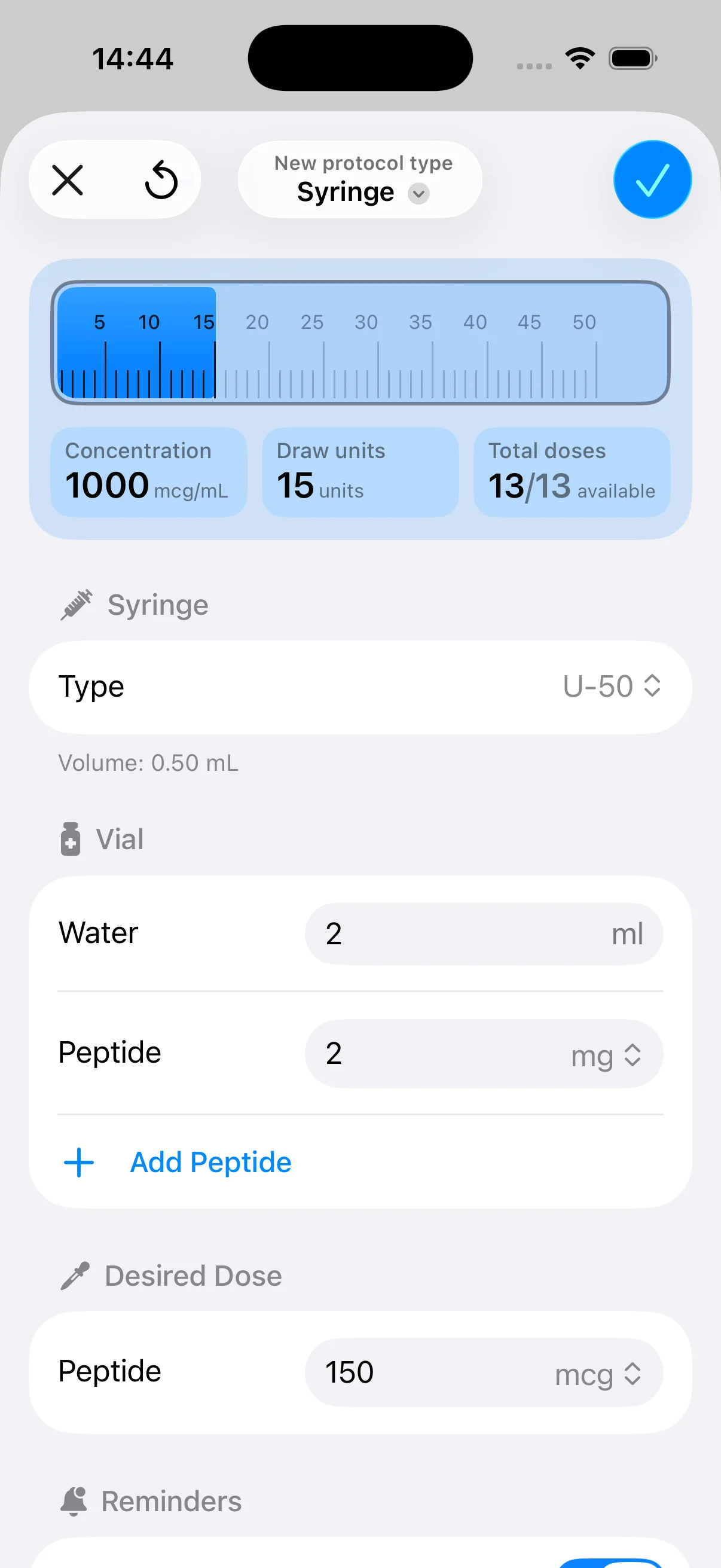
PepFlow can help organize protocol dates, reminders, concentration settings, pause periods, and dose history. It doesn’t validate a peptide, replace medical supervision, or tell you whether a protocol is suitable. That decision belongs with a qualified professional.
Table of Contents
- 1. BPC-157 Recovery Protocol
- 2. Sermorelin Growth Hormone Secretagogue
- 3. TB-500 Wound Healing and Tissue Regeneration
- 4. Ipamorelin Appetite and Lean Mass Cycle
- 5. CJC-1295 With DAC
- 6. Hexarelin Acute Strength and Performance Protocol
- 6-Protocol Peptide Cycle Before & After Comparison
- Turn Any Cycle Example Into a Trackable Review
1. BPC-157 Recovery Protocol
A recovery cycle is easier to assess when the baseline is functional, not visual. Record pain during defined movements, range of motion, swelling, training tolerance, sleep disruption, and any clinician-provided findings before starting. A runner with patellar tendon pain, for example, can log stair pain and a repeatable running distance instead of relying on how the knee looks.
The supplied scenario uses an 8-week recovery window, but it should be treated as an illustrative schedule. Protocol references describe cycling patterns that vary by compound and purpose, with active periods of 4 to 12 weeks and rest periods of 2 to 8 weeks according to peptide protocol guidance. That range makes a fixed healing promise hard to support.
What to track before and after
A useful record separates recovery signals from changes happening at the same time:
- Pain and mobility: Use the same movement tests and rating method each week.
- Training exposure: Note whether workload, rest, physical therapy, or technique changed.
- Visible findings: Photograph the same angle and lighting, but do not treat appearance as proof of tissue repair.
- Adherence: Log every planned administration, missed entry, and schedule interruption.
- Clinical review: Record imaging or examination results separately from personal impressions.
PepFlow’s BPC-157 wound-healing information can sit alongside the log while a professional assesses the injury itself. The strongest post-cycle review asks whether function held up under comparable conditions after the active period.
2. Sermorelin Growth Hormone Secretagogue
A useful before-and-after review starts by limiting confounders. If resistance training, calorie intake, sleep time, and a peptide change at once, later shifts in body composition cannot be assigned to one cause with much confidence. The cleaner approach is to record training volume, eating patterns, sleep, body weight, waist measurement, and performance before the first entry, then keep those measures consistent through the cycle.
Sermorelin schedules are usually framed as bounded exposure windows, not open-ended use. The supplied scenario cites a 16 to 20-week escalation from 0.25 mg to 2.4 mg maintenance, while other protocol discussions describe 8 to 12-week active phases with planned breaks. In the scenario material, PepFlow serves as a reminder and log-keeping aid, while Sermorelin dosage information for weight loss should not be read as individualized dosing advice. The point is not that one calendar is superior, but that the dosing calendar and the measurement calendar must be matched.
Compare signals, not impressions
Sleep and recovery matter, but they are subjective unless they sit beside repeatable measures.
- Sleep record: Log bedtime, wake time, interruptions, and a simple morning rating.
- Performance record: Repeat selected lifts or conditioning tests under similar conditions.
- Composition record: Use the same method, timing, and hydration context each time.
- Adherence record: Mark late or missed administrations instead of smoothing them over.
- Follow-up record: Set a review date after the active window to see whether changes persist.
The supplied examples of lean-mass gain, fat reduction, and better training frequency should remain illustrative, not treated as verified outcomes. If sleep and training logs changed as much as the composition measures, treat the cycle as uninterpretable and rerun it with a stable baseline.
3. TB-500 Wound Healing and Tissue Regeneration
An acute injury cycle should be judged by function first. A wound can look improved long before range of motion, swelling, pain, or daily activity tells the same story. A photo is useful, but it does not show whether tissue tolerance has returned.
The supplied example uses a 6-week acute injury window, while another scenario uses an 8-week review. Those timelines are illustrative. Other protocol references describe active phases of 8 to 12 weeks, then an off period, and note that the pause creates a washout window for separating immediate effects from carryover in cycling research guidance.
Build the record around the injury
A cleaner comparison starts with the injury itself, then follows the same checks each time.
- Function: Repeat the same range-of-motion or load-bearing test at regular intervals.
- Symptoms: Log pain, swelling, bruising, sleep interruption, and medication use.
- Rehabilitation: Record therapy sessions, exercises, rest days, and changes in workload.
- Wound observations: Keep images consistent and add clinician assessments where appropriate.
- Decision points: Set the moments for continued monitoring, reduced loading, or medical review.
That structure matters because a recovery log is only useful if the inputs stay stable. PepFlow can schedule recurring entries and preserve injection-site history, but it should not be used to decide whether an injury is safe to load. The TB-4 and Frag 500 resource is an organizational reference, not proof of clinical effectiveness or a substitute for assessment.
A separate comparison with the HBOT clinical evidence guide helps keep the interpretation disciplined. Different interventions should not be treated as interchangeable, even if they are discussed in the same recovery context. The practical lesson is straightforward, define the endpoint first, then measure it the same way every time.
The timeline graphic can help readers see why the active period, the pause, and the follow-up assessment are separate events.
The video should be treated as educational material, not as a demonstration of a guaranteed recovery pathway.
4. Ipamorelin Appetite and Lean Mass Cycle
Before-and-after photos can make recomposition look clearer than it is. Appetite may rise, training output may improve, and body composition may shift in the right direction, but those changes can also come from a new program, better recovery, or looser measurement habits. The useful question is which variables stayed stable enough to separate signal from noise.
The illustrative setup here uses a 10-week recomposition window. Record weight, waist and limb measurements, training performance, appetite, meal consistency, sleep, and recovery in the same routine, then compare those records before, during, and after the cycle. A bodybuilder in an offseason phase might track planned meals and repeatable lifts across the cycle, then reassess after stopping.
The appetite variable matters
Appetite can support a nutrition plan, but it can also blur interpretation. If calorie intake rises without being logged, later body-composition changes may reflect the diet more than the peptide. If appetite improves while meal quality and training stay inconsistent, the result may not answer the original question.
Use PepFlow to preserve the schedule and pair it with a simple outcome diary. Keep the log specific:
- Nutrition: Record meal timing and broad intake consistency.
- Performance: Log selected strength or endurance markers under comparable conditions.
- Composition: Keep photos, measurements, and weigh-ins consistent.
- Subjective response: Separate appetite, energy, fullness, and recovery ratings.
- Confounders: Note travel, illness, altered programming, alcohol, and sleep disruption.
Some peptide protocol references describe both block cycles and weekday-style 5-days-on/2-days-off patterns for growth-hormone secretagogues. That detail helps with planning, not validation. Interpretability depends on adherence, because only a schedule followed accurately enough can produce before-and-after data that means anything.
5. CJC-1295 With DAC
A weekly schedule may look easier to manage, yet it creates a specific measurement risk: fewer administration days can hide missed entries. The illustrative CJC-1295 with DAC cycle spans 12 weeks, so a single omitted event may remain unnoticed longer than it would in a more frequent schedule. Before-and-after comparisons therefore need exact dates, consistent measurements, and a record of schedule adherence.
PepFlow can display planned events and document whether each occurred. It does not verify a medical outcome or establish that CJC-1295 caused a change. The useful question is whether the record connects each observed result with the cycle timeline, rather than treating a smooth calendar as proof of effectiveness.
Review the midpoint and the post-cycle window
At the midpoint, examine whether sleep, recovery, body composition, and training continuity are changing under comparable conditions. Mark missed entries, altered training loads, changes in food intake, illness, and sleep disruption beside the outcome record. A favorable reading has limited value if the surrounding conditions changed.
The post-cycle review serves a different purpose. Compare measurements taken under the same conditions, then assess whether any observed change persisted after the planned cycle ended. This separates a temporary fluctuation from a result that remained visible, although neither outcome proves causation.
Clinical development also illustrates why timing must be recorded precisely. One phase 1 trial described in the supplied material used administration at 0, 3, and 6 weeks, with per-dose amounts of 31.25 to 56.25 mcg. That example does not validate a personal protocol or provide dosing advice. It shows why “before” and “after” should refer to documented dates, not approximate recollections. Professional oversight remains appropriate when evaluating risks, symptoms, or whether to continue.
6. Hexarelin Acute Strength and Performance Protocol
Competition preparation can distort a before-and-after comparison because the athlete’s behavior changes as the event approaches. Training becomes more specific, food intake more controlled, posing practice more frequent, and recovery more deliberate. An apparent improvement during an illustrative 8-week prep cycle therefore has several plausible explanations beyond the peptide.
Set the baseline before the cycle begins. Record performance tests, body-composition observations, sleep, fatigue, training volume, and competition-specific measures such as posing consistency. Daily entries can capture strength, readiness, symptoms, and schedule adherence. Weekly reviews can then examine whether changes align more closely with recovery, programming, tapering, or multiple factors acting together.
Practical rule: Judge the preparation, not the podium. The competition date is a deadline, not a controlled variable.
Plan the stop and the review
A competition-linked schedule needs a defined end date and a post-cycle assessment. Preserve comparable pose photos, lighting, training tests, and preparation milestones, then log missed sessions, altered training loads, dietary changes, illness, and sleep disruption beside the outcome record. These details show how much confidence the comparison deserves.
The supplied examples of improved definition, fullness, or competition performance are illustrative scenarios. They are not verified case studies or expected effects. Broader regimen discussions increasingly emphasize titration, defined exposure windows, start dates, and recovery periods rather than fixed, open-ended schedules in modern peptide-regimen references.
PepFlow can organize competition dates, reminders, cycle dates, and performance notes in one record. It can also show whether planned entries and milestones were completed. Interpretation still requires qualified professional oversight, particularly for product questions, suitability, adverse effects, or decisions about continuation. A well-kept log improves review quality, but it does not establish causation.
6-Protocol Peptide Cycle Before & After Comparison
| Protocol | 🔄 Implementation complexity | ⚡ Resource requirements | 📊 Expected outcomes | 💡 Ideal use cases | ⭐ Key advantages |
|---|---|---|---|---|---|
| BPC-157, 8‑Week Injury Healing Cycle | Moderate, daily split SC injections, reconstitution and site rotation required | Low–Moderate, 250mcg/day, refrigeration, syringes, 8–12 week supply | Reduced inflammation; tendon/joint repair and mobility gains by 4–6 weeks; functional improvement by 5–8 weeks | Acute/chronic tendon or joint injuries, wound healing, athletic recovery | Rapid tissue repair and well‑tolerated; synergizes with collagen |
| Sermorelin, 12‑Week Body Composition Cycle | Moderate, daily evening SC dosing with sleep timing dependence | Moderate, 100–200mcg/day, sleep/workout tracking, vial handling | Improved sleep in 1–3 weeks; gradual lean mass gain and fat loss by 4–12 weeks | Age‑management, recomposition, sleep‑dependent GH optimization | Stimulates endogenous GH sustainably with lower risk vs exogenous GH |
| TB‑500, 6‑Week Acute Injury Protocol | Moderate–High, loading (twice weekly) then maintenance; IM/SC; strict sterile reconstitution | Moderate, 2–2.5mg twice weekly (loading), storage limits post‑reconstitution, sterile supplies | Faster wound/surgical recovery (approx. 30–50% quicker); reduced scarring and tissue remodeling within 1–6 weeks | Surgical recovery, acute soft‑tissue injuries, scar reduction, accelerated rehab | Strong angiogenesis and tissue regeneration; rapid tissue‑level effects |
| Ipamorelin, 10‑Week Recomposition Protocol | Moderate, daily pre‑training or evening SC dosing, align with nutrition/training | Low–Moderate, 100–200mcg/day, coordinated meal/training plan, vial prep | Increased appetite in 3–7 days; visible lean mass and recovery improvements by weeks 3–10 | Offseason recomposition, athletes needing appetite and nutrient timing support | Selective GH secretagogue with minimal cortisol/prolactin impact; supports lean gains |
| CJC‑1295 with DAC, 12‑Week Baseline Optimization | Low, once‑weekly SC injection (long‑acting), simpler schedule | Low, ~100mcg weekly, fewer injections, standard reconstitution | Stable GH elevation; steady lean mass and recovery gains over 4–12 weeks | Compliance‑focused programs, baseline GH optimization, longevity protocols | Once‑weekly dosing for superior compliance and sustained GH levels |
| Hexarelin, 8‑Week Competition Prep | Moderate, daily pre‑training SC dosing; timing and side‑effect monitoring needed | Moderate, 100–150mcg/day, close monitoring for prolactin/cortisol effects | Rapid performance and pump improvements within 1–2 weeks; peak conditioning by 6–8 weeks | Short‑term competition prep, final conditioning and peak performance | Fast, pronounced GH release; strong acute strength and fullness effects |
Turn Any Cycle Example Into a Trackable Review
A credible peptide cycle before and after review starts before the first dose. Define what you’re trying to change, select measures that match that goal, and record the conditions under which you collected them. Injury recovery needs functional tests and clinical follow-up. Recomposition needs consistent body-composition measures, nutrition records, training data, and sleep context. Performance preparation needs repeatable tests and a clear competition timeline.
Use a baseline that’s specific enough to compare. Record the same photo angles, measurement timing, movement tests, and performance conditions whenever possible. Don’t merge subjective impressions with objective observations. “Recovery feels better” is useful personal data, but it isn’t the same as a documented change in range of motion or repeatable training performance.
Schedule adherence belongs in the same record as outcomes. Note missed administrations, late entries, travel, illness, training changes, altered nutrition, sleep disruption, and other variables that could influence the result. Protocol references describe cycles ranging from short 10 to 14-day runs to longer active periods of 4 to 12 weeks, with rest periods that vary by compound and goal in a neutral protocol reference. There isn’t one universal before-and-after template.
After the active phase, reassess rather than assuming permanence. A planned washout can help distinguish a short-term response from a change that remains, but the appropriate timing depends on the compound, goal, and professional guidance. Don’t restart, extend, combine, or alter a protocol based only on a favorable photo or a disappointing week.
PepFlow can organize protocol dates, reminders, pause periods, concentration calculations, and history logs. For questions about suitability, dosing, sourcing, monitoring, adverse effects, laboratory testing, or post-cycle decisions, speak with a qualified medical professional. A hormone blood test guide may help explain why testing decisions should be discussed with a clinician rather than inferred from a tracking app.
PepFlow provides cycle scheduling, dose reminders, concentration and volume organization, countdowns, and history logs that can make a peptide before-and-after review easier to audit. Visit PepFlow to organize your routine and record the context behind each result, while keeping medical decisions with a qualified professional.