
Most advice about TB4 Frag 500 starts in the wrong place. It starts with dosage chatter, cycle templates, or forum shorthand, as if TB4, TB-500, and TB4-Frag all describe the same thing. They don’t.
That naming shortcut causes most of the confusion around this peptide. The strongest human data in the broader thymosin beta-4 literature comes from full-length thymosin beta-4 (Tβ4), not from the fragment products many people buy under names like TB-500 or TB4 Frag 500. If you miss that distinction, everything downstream gets blurry. Mechanism, expectations, safety claims, and even “standard” dosing discussions all become harder to interpret.
A better way to approach TB4 Frag 500 is to treat it like a molecule identity problem first, and a handling problem second. What is the actual compound? What part of the parent peptide does it represent? Which findings belong to the full-length molecule, and which belong only to fragment research or marketing language? Those questions matter more than any protocol chart.
People also tend to get tripped up by the practical side. Reconstitution math looks simple until you’re staring at a vial, an insulin syringe, and a label written in milligrams while your intended amount is in micrograms. That’s where a lot of preventable mistakes happen.
Table of Contents
- Introduction Decoding TB4 Frag 500
- The Thymosin Beta 4 Family A Matter of Identity
- Mechanism of Action and Intended Research Uses
- Reconstitution and Safe Handling A Practical Guide
- Dosing Calculations and The PepFlow Solution
- Scheduling Protocols and Adherence
- Quality Legality and Safety Considerations for 2026
Introduction Decoding TB4 Frag 500
When someone searches for TB4 Frag 500, they usually want one answer to cover several different products. That’s the first problem. The label sounds specific, but in practice it often sits inside a tangle of overlapping names, fragment claims, and borrowed evidence from related molecules.
The cleanest starting point is this. Thymosin beta-4 (Tβ4) is the parent molecule. It’s a 43-amino-acid polypeptide with a molecular weight of 4,921 daltons, and reviews describing the literature note research across wound-healing and tissue-repair settings, including findings such as increased collagen deposition, angiogenesis, and faster re-epithelialization in preclinical work, alongside clinical investigation in eye and wound settings with statistically meaningful improvements in several endpoints (independent review summary of thymosin beta-4 research).
That does not mean every smaller fragment sold under a related name carries the same evidence. In fact, one of the biggest gaps in peptide discussions is the mismatch between molecule identity and evidence quality. A fragment may come from the same parent peptide and still behave differently, distribute differently, or lack direct human trial support for the use people care about.
The name on the vial can sound close enough to the parent compound that people assume the data transfers automatically. In peptide science, that assumption is risky.
If you keep one rule in mind while reading the rest of this guide, use this one: same family doesn’t mean same evidence.
The Thymosin Beta 4 Family A Matter of Identity
The easiest way to understand this family is to stop thinking in brand-style nicknames and start thinking in molecular pieces.
Why the names get mixed up
Full-length Tβ4 is the whole molecule, similar to a complete engine in a car. It has all the parts arranged in a way that researchers have studied in human clinical settings.
TB-500 is often described differently in different places, and that inconsistency is exactly the issue. Many pages blur TB-500, TB4, and TB4 Frag together, but a neutral guide notes that TB-500 is often a synthetic 17-amino-acid fragment, while the strongest human evidence sits with the full-length 43-amino-acid Tβ4 used in ophthalmology-focused research. The same source states that as of April 2026, there are no completed, published human RCTs for TB-500 for musculoskeletal repair (neutral guide discussing TB-500 identity and evidence gap).
TB4-Frag usually refers to a fragment formulation marketed as being derived from thymosin beta-4. Some products also add absorption technology. One example describes TB4-Frag 500 as a bioactive fragment combined with salcaprozate sodium (SNAC) to improve oral absorption, with SNAC included specifically to enhance permeability and systemic uptake compared with an unmodified peptide fragment (product description for TB4-Frag with SNAC).
That’s already three different layers of meaning. Parent molecule, synthetic fragment, and fragment-plus-delivery-system product.
Why identity changes the evidence
A fragment is not just a shorter version in the casual sense. It’s more like removing part of a sentence and expecting the shortened phrase to carry the same meaning in every context. Sometimes a fragment keeps an important functional motif. Sometimes it loses surrounding structure that matters for stability, signaling, or tissue behavior.
That’s why it’s not scientifically careful to say, “Tβ4 has human data, so TB4 Frag 500 must be supported too.” What you can say is narrower. You can say the fragment idea comes from a biologically interesting parent peptide family. You cannot transfer all of the full-length molecule’s clinical credibility onto the fragment.
Practical rule: When you read a claim about TB4 Frag 500, ask one question first. “Is this result from full-length Tβ4, or from the fragment itself?”
That single habit filters out a surprising amount of confusion.
Mechanism of Action and Intended Research Uses
The fragment discussion becomes more understandable when you zoom in on where the fragment comes from.
The actin-binding idea in plain language
The fragment often referenced as TB-500 or a TB4 fragment is the acetylated 17–23 fragment of thymosin beta-4. Analytical databases note that this region maps to the actin-binding area associated with cell migration and tissue-repair signaling, and the same fragment is also monitored in anti-doping contexts (FDA GInAS entry describing the acetylated 17–23 fragment).
If that sounds abstract, think of actin as part of the internal scaffolding cells use to move and change shape. When researchers talk about migration, they mean a cell’s ability to travel to where it’s needed. In wound or tissue-repair biology, that matters because repair isn’t just about “healing faster” in a vague sense. Cells have to organize, move, attach, and rebuild.
A fragment tied to that actin-binding region gets attention because it may capture one functionally interesting part of the parent peptide. That’s the scientific hypothesis behind a lot of the interest.
What researchers are actually trying to study
In practical terms, the research interest around TB4-related fragments usually circles a few themes:
- Cell movement: Whether the fragment influences migration behavior relevant to repair.
- Tissue signaling: Whether it affects pathways associated with repair responses.
- Repair environments: Whether it may support conditions linked to wound closure or remodeling in preclinical settings.
- Recovery discussions: Whether those lab and animal observations can be meaningfully translated to muscle, tendon, or general recovery questions.
That last step is where people often jump too far.
Mechanism is not outcome. A fragment can make biochemical sense and still lack convincing human efficacy data for the exact use people talk about online. That’s why it helps to read mechanism and evidence as separate layers. One explains why scientists became interested. The other tells you how much confidence you should have in real-world claims.
For readers comparing repair-focused compounds more broadly, this overview of peptides studied for tissue repair is useful because it frames TB4-related interest alongside other molecules without pretending all of them share the same quality of evidence.
Reconstitution and Safe Handling A Practical Guide
The practical challenge with TB4 Frag 500 usually isn’t the label. It’s the mixing.
Lyophilized peptide powder is like a concentrated ingredient. You don’t use the powder “as is.” You add a measured amount of diluent so the final liquid has a known concentration. If you’ve ever mixed juice concentrate, the idea is the same. More liquid added means a more diluted final mixture. Less liquid added means a stronger one.
A common diluent in research handling discussions is bacteriostatic water. The key is consistency. If you know how much powder was in the vial and how much water you added, you can calculate how much peptide is present per milliliter.
A simple way to think about concentration
If a vial contains 5 mg of peptide and you add 5 mL of bacteriostatic water, the concentration becomes 1 mg per mL. That’s the easiest example because the numbers line up cleanly.
If the same 5 mg vial gets 2.5 mL of water, the solution becomes 2 mg per mL. Same total peptide, less water, stronger concentration.
That’s the whole game. Total amount in the vial divided by total liquid added.
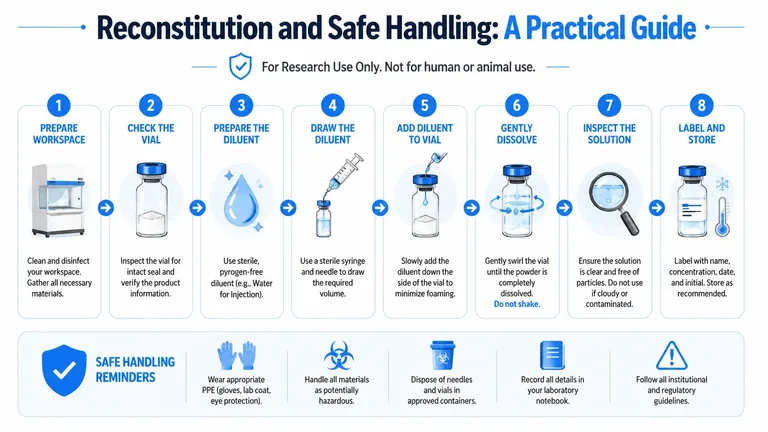
Gentle handling matters. Most people know the math part and ignore the physical handling part. Don’t shake a newly mixed peptide hard if you can avoid it. Swirling slowly is the safer habit.
Step by step handling basics
Researchers usually follow a simple handling flow:
- Check the vial label first. Confirm the peptide amount before you do any math.
- Choose the target concentration. Pick a concentration that makes later syringe measurements practical.
- Use clean supplies. Fresh syringe, clean workspace, careful hand hygiene.
- Add diluent slowly. Aim the stream toward the inside wall of the vial rather than blasting the powder directly.
- Swirl, don’t whip. Let the powder dissolve without rough agitation.
- Label the finished vial. Write the concentration and mixing date so you don’t rely on memory.
- Store appropriately. Keep unmixed material cold as directed by the supplier, and keep mixed solution refrigerated if that matches handling guidance.
- Discard if uncertain. If the solution looks wrong, has questionable handling history, or lacks a clear label, don’t guess.
For a detailed walkthrough of the mixing process itself, this guide on how to mix peptides with bacteriostatic water gives a solid procedural reference.
A short demonstration can also help when the written steps feel too abstract.
Example reconstitution concentrations
| Amount of Bacteriostatic Water Added | Final Concentration (per mL) | Dose per 10 Units on Insulin Syringe |
|---|---|---|
| 5 mL added to a 5 mg vial | 1 mg/mL | 100 mcg |
| 2.5 mL added to a 5 mg vial | 2 mg/mL | 200 mcg |
| 1 mL added to a 5 mg vial | 5 mg/mL | 500 mcg |
The table isn’t a recommendation. It’s just a math aid. The main point is that syringe units only become meaningful after you know the final concentration.
Dosing Calculations and The PepFlow Solution
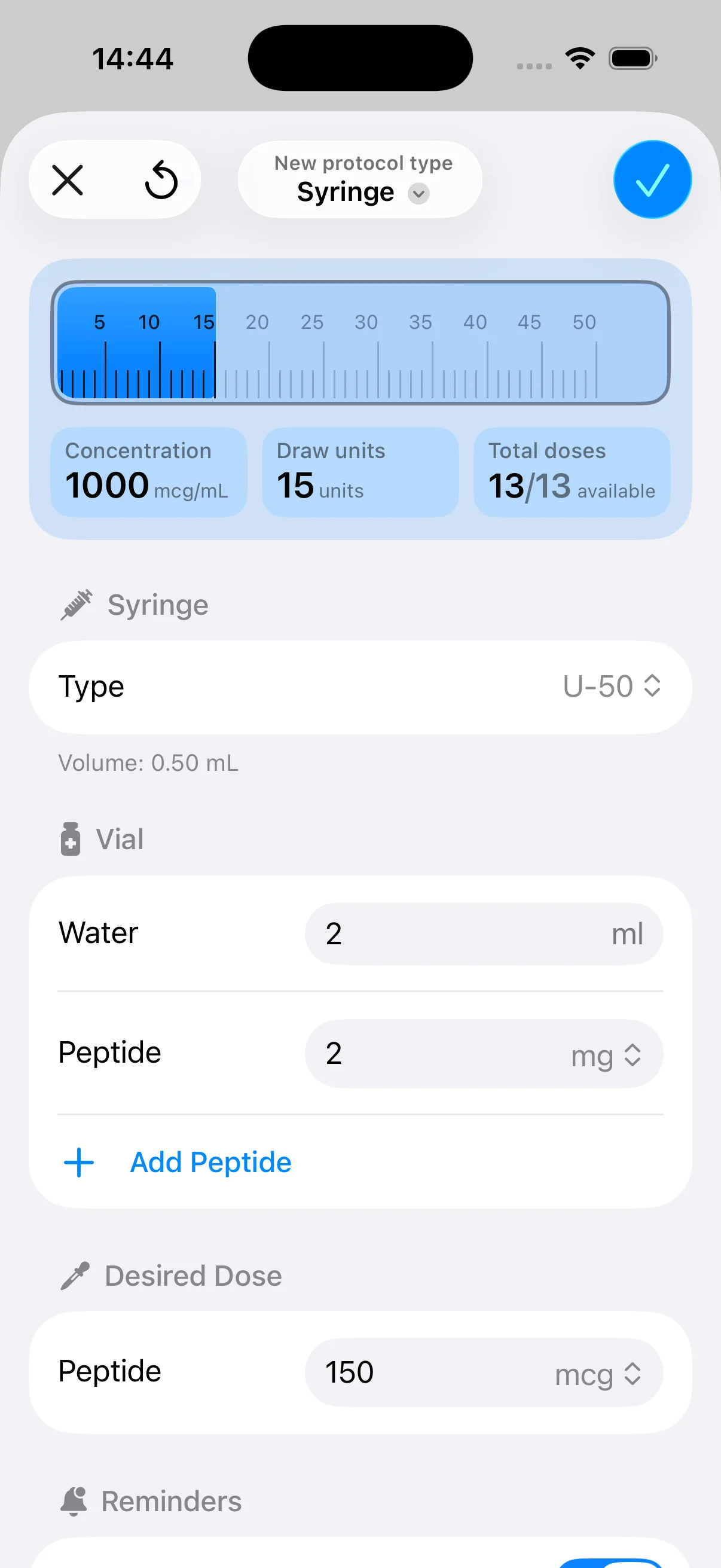
The hardest part of peptide dosing usually isn’t choosing a target amount. It’s converting that amount into a draw volume you can measure.
The core formula
The basic relationship looks like this:
Volume to draw = desired dose ÷ concentration
If your desired dose is in micrograms, make sure your concentration is in a matching unit system before you calculate. Most mixing labels start in mg/mL, while many protocol discussions talk in mcg. Since 1 mg = 1000 mcg, unit conversion comes first.
That’s where people slip. The arithmetic isn’t advanced, but the unit mismatch invites mistakes.
A worked syringe example
Take a simple example.
You want 500 mcg from a solution concentrated at 2 mg/mL.
First convert the concentration:
- 2 mg/mL = 2000 mcg/mL
Now apply the formula:
- 500 mcg ÷ 2000 mcg/mL = 0.25 mL
If you’re using a standard insulin syringe where 1 mL corresponds to 100 units, then:
- 0.25 mL = 25 units
So a 500 mcg target dose from a 2 mg/mL solution would be 25 units on that syringe.
Here’s the same logic in a compact checklist:
- Start with the target dose: 500 mcg
- Convert concentration: 2 mg/mL becomes 2000 mcg/mL
- Divide dose by concentration: 500 ÷ 2000 = 0.25 mL
- Convert mL to syringe units: 0.25 mL becomes 25 units
Why people automate this step
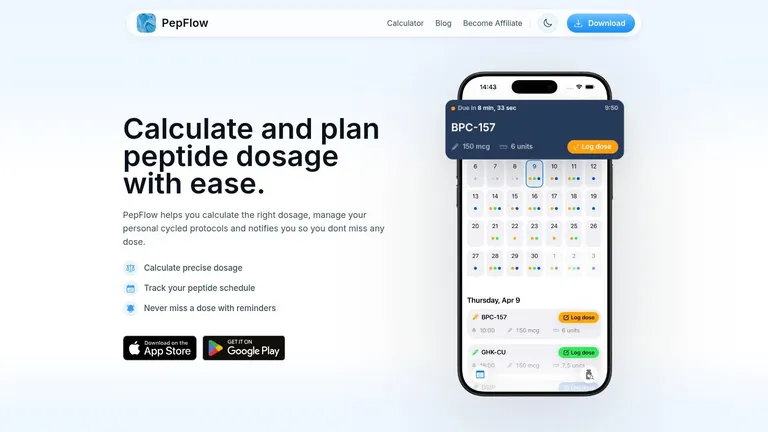
Manual math is manageable when you do it once. It gets riskier when you change vial size, reconstitution volume, or target amount. A small decimal error can turn into the wrong syringe draw very quickly.
That’s one reason peptide users look for tools and references like this peptide dosage guide. The underlying math doesn’t change, but a structured calculator reduces the chance of mixing up milligrams, micrograms, milliliters, and units.
One more caution matters here. Human safety data often cited in this family comes from Tβ4, not from fragment products sold online. In one phase I study, 10 participants received intravenous Tβ4 at doses up to 260 mg per day for 14 days with no reported adverse outcomes, and another study used up to 5 micrograms per kilogram IV daily for 10 days followed by 28 days of follow-up, also with no adverse effects (summary of small human safety studies in Tβ4). Those figures show that formal research has explored a wide range of doses in the parent molecule. They do not create a ready-made dosing template for TB4 Frag 500.
A dosing calculation can be mathematically correct and still rest on weak assumptions if the underlying product identity is unclear.
Scheduling Protocols and Adherence
People often talk about dosing as if the only question is “how much?” In real use, when and how consistently matter just as much.
What scheduling really means
A peptide schedule is a pattern, not a single number. It includes start date, frequency, duration, pause periods, and whether the protocol stands alone or sits beside other compounds in a stack.
Online discussions about TB4-related products often mention loading phases, maintenance phases, or alternating schedules. Those patterns can be useful as organizational concepts, but they aren’t proof that a regimen is evidence-based. For TB4 Frag 500 in particular, a lot of schedule talk comes from community practice rather than strong human trial support.
That means good scheduling isn’t mainly about copying someone else’s template. It’s about keeping records clear enough that you can answer basic questions later: What concentration was used? What was the exact draw amount? Which days were missed? Was the protocol changed halfway through?
Where protocols usually break down
Most adherence failures are boring. People don’t usually abandon a schedule because the biology got too complex. They lose track because the plan was vague from the start.
A workable protocol log should capture:
- Exact product identity: Parent molecule, fragment, or modified formulation
- Mixing details: Vial amount and reconstitution volume
- Per-dose draw amount: In both mcg and syringe units if relevant
- Timing pattern: Daily, alternating, or another fixed cadence
- Change history: Notes on any pause, restart, or adjustment
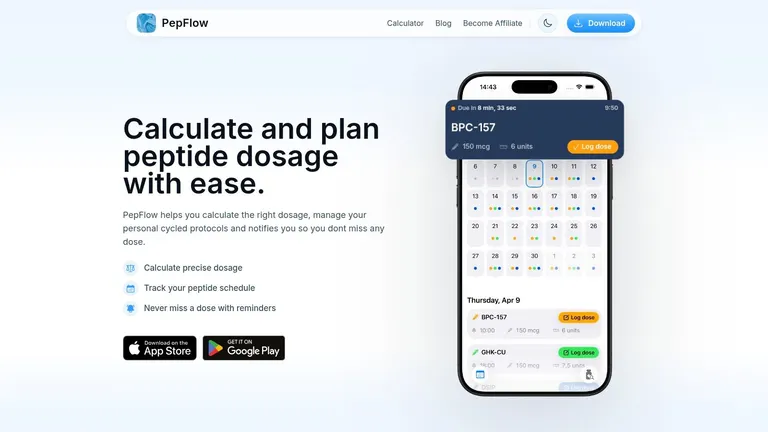
A simple calendar works if you’re disciplined. Few possess that discipline. They rely on memory, then memory turns a structured protocol into guesswork.
Consistency beats complexity. A plain schedule followed accurately is more useful than a clever schedule followed loosely.
If you’re evaluating any TB4 Frag 500 routine, judge the routine by its clarity and traceability, not by how fancy the wording sounds.
Quality Legality and Safety Considerations for 2026
The most overlooked risk with TB4 Frag 500 isn’t a complicated receptor-level detail. It’s the market around it.
Quality and labeling risk
These products are commonly sold as research-use materials, not as approved therapeutic drugs. A peer-reviewed review discussing TB-500 in performance and skeletal-muscle regeneration contexts notes the ongoing anti-doping concern around the compound family, and public commentary around this space also points out that the product sold online is not an FDA-approved therapeutic drug in the US, while human efficacy evidence remains absent for TB-500 itself (peer-reviewed review on TB-500 and anti-doping concern).
That creates a practical problem. In a loosely regulated market, the label may tell you less than you think. A vial can carry a familiar name without giving you high confidence about identity, purity, storage history, or formulation quality.
That issue gets even murkier with variants that add delivery technology. For example, some TB4-Frag products include SNAC to improve oral absorption. That may be an interesting formulation choice, but it doesn’t erase the bigger questions about evidence, regulation, or product verification.
For readers trying to separate marketing from substantiated product thinking more broadly, this guide on science-backed products for your well-being is a useful companion read because it emphasizes evaluating claims through evidence quality rather than hype.
Athletes need to think differently
If you compete in tested sport, the anti-doping angle isn’t a side note. It’s central. The fragment language around TB-500 and TB4-related compounds overlaps with substances that anti-doping systems monitor, and that alone should change how an athlete, coach, or support staff member evaluates risk.
The key point is simple. Even if a product is framed as a wellness or recovery tool, that framing does not protect eligibility. If the naming, identity, or fragment classification sits inside anti-doping concern, a casual approach is a bad approach.
If you want a cleaner way to handle peptide math and scheduling without relying on memory or handwritten notes, PepFlow is built for exactly that. It helps convert doses into practical syringe units, organize protocols, and keep timing consistent, which is especially useful when concentration changes or schedules get more complex.