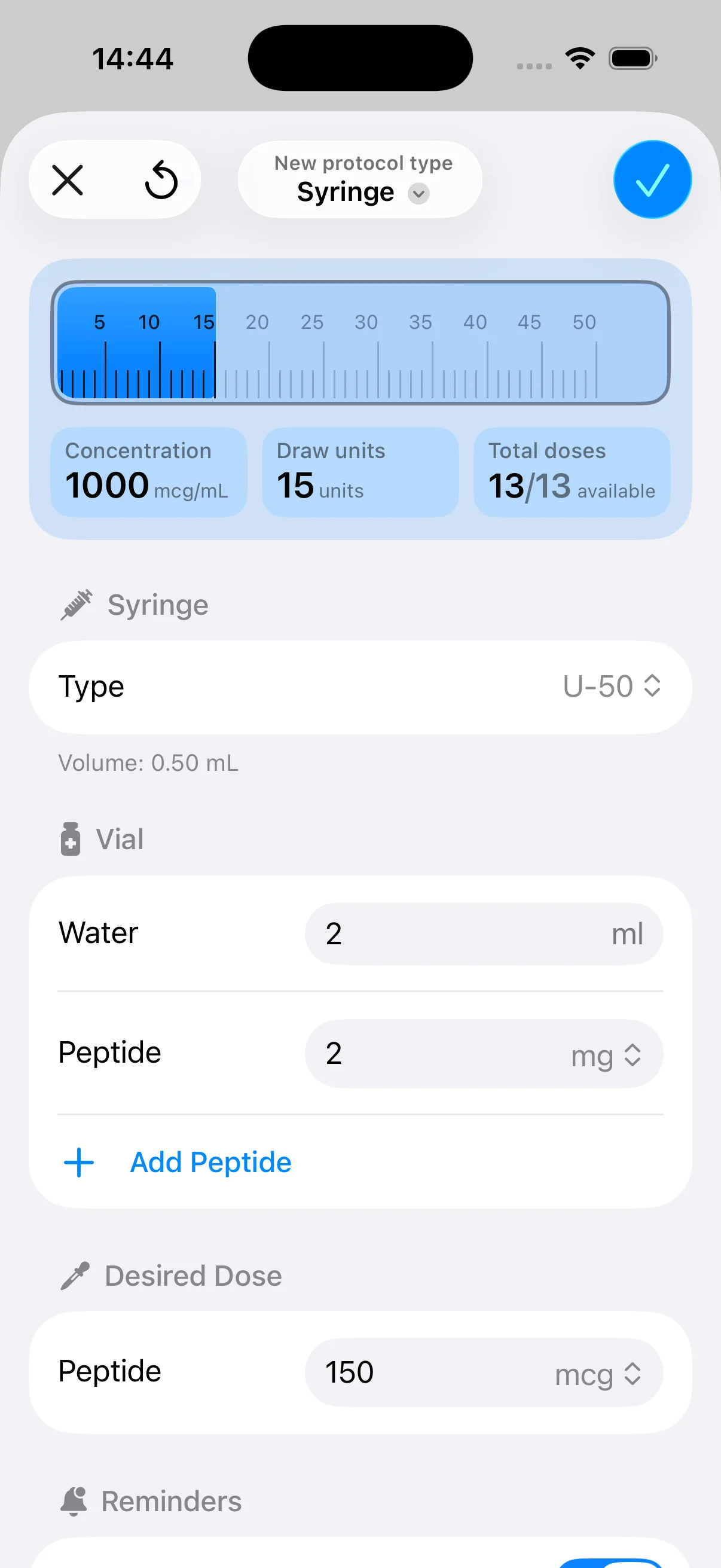
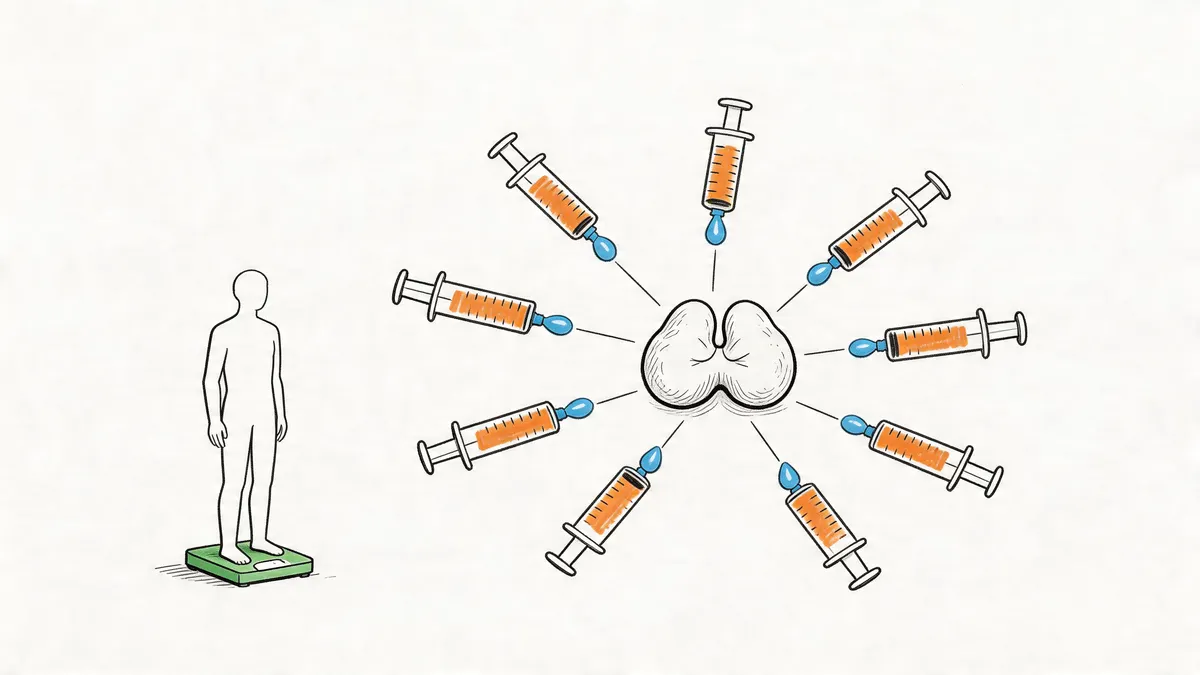
The typical daily sermorelin dosage for weight loss ranges from 200 to 500 mcg, usually given as a subcutaneous injection before bedtime, and initial doses often fall around 200 to 300 mcg. That range still needs to be personalized under medical supervision, because the right dose depends on response, goals, and tolerance.
Most readers looking this up are in the same spot. You’ve been given a dose in micrograms, a vial in milligrams, and a syringe marked in units, and the part that should be straightforward suddenly feels easy to mess up. That’s where people make preventable mistakes. Not usually because the protocol is complicated, but because many guides stop at “take this much nightly” and never show how to translate that into the amount you draw into the syringe.
That practical gap matters. A reasonable sermorelin plan isn’t just about choosing a number inside a standard range. It’s about understanding why bedtime dosing is used, how to convert a prescribed dose into volume, when lower starting doses make more sense, and where one-size-fits-all protocols fall short, especially for women. Used well, sermorelin can fit into a structured body composition plan. Used casually, it becomes another inconsistent protocol that produces confusion more than results.
Table of Contents
- How Sermorelin Actually Works for Weight Loss
- Standard Dosing Ranges and Schedules for Sermorelin
- How to Calculate Your Injection Volume
- Example Sermorelin Protocol Templates
- Understanding the Safety Profile and Side Effects
- Frequently Asked Questions About Sermorelin
- Conclusion The Path to Consistent and Safe Use
How Sermorelin Actually Works for Weight Loss
Sermorelin is a signal, not the hormone itself
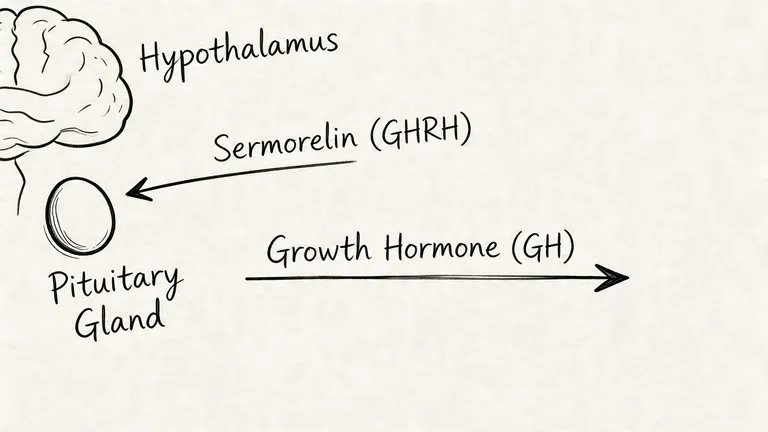
Sermorelin is best understood as a growth hormone-releasing hormone analog. It is not growth hormone. That distinction changes how you should think about the therapy.
A simple way to explain it is this. Growth hormone is the music, while sermorelin is the conductor. The conductor doesn’t play every instrument directly. It cues the orchestra, sets timing, and gets the right players moving together. In the body, sermorelin prompts the pituitary to release its own growth hormone in a more physiologic rhythm.
That’s why sermorelin is often discussed differently from direct HGH use. It works upstream. Instead of replacing the hormone outright, it asks your endocrine system to produce a pulse. Many people exploring broader peptide therapies come across sermorelin for exactly this reason. It fits the category of compounds that influence signaling rather than supplying an end product.
If you want a broader primer on where compounds like sermorelin fit in wellness protocols, PepFlow’s overview of what peptides are used for is a useful starting point.
Why that matters for fat loss
For weight loss, the practical relevance is downstream. Growth hormone signaling influences lipolysis, recovery, and lean-mass preservation. Those aren’t cosmetic details. They affect whether weight loss comes primarily from fat, or whether a person ends up flatter, weaker, and metabolically less resilient.
When clinicians use sermorelin in a body composition context, the goal usually isn’t rapid scale movement. The goal is better fat mobilization, particularly in stubborn areas, while preserving the tissue that helps keep resting energy expenditure from falling too hard during a calorie deficit.
Practical rule: If a protocol is built only around “fat burning” and ignores sleep, protein intake, training, and recovery, sermorelin usually gets blamed for a setup problem it didn’t create.
There’s also a reason bedtime dosing keeps showing up in protocols. Growth hormone follows a natural pulsatile rhythm during sleep. Matching that rhythm is part of the theory behind using sermorelin at night rather than at random times during the day.
A lot of people expect sermorelin to behave like a stimulant or appetite suppressor. It doesn’t. You won’t judge it accurately by asking whether you “feel” it the next morning. It’s a slower tool. It works best when the rest of the plan already supports fat loss and the peptide is used to reinforce physiology, not replace discipline.
Standard Dosing Ranges and Schedules for Sermorelin
A common real-world scenario looks like this. Someone is prescribed sermorelin, sees a dose written in micrograms, hears that bedtime is best, and then starts searching for a “fat-loss dose” as if there is one fixed number that works for everyone. That is usually where dosing errors start.
For body-composition use, many prescribers start with a lower nightly dose and adjust based on response, tolerance, and adherence. In practice, bedtime subcutaneous dosing is common because the protocol is meant to support the body’s normal overnight growth hormone rhythm, not compete with it. Clinical prescribing information for sermorelin also supports individualized dosing rather than one universal target, as reflected in the FDA label for Geref Diagnostic.
The practical range used in adult wellness and body-composition settings often lands somewhere between a conservative starter dose and a moderate nightly dose. What matters more than chasing the top end is whether the person can run the plan consistently for long enough to judge it.
Common scheduling patterns include:
- Low-dose nightly start: used to check tolerance and build consistency before changing the dose
- Steady nightly dosing: the same bedtime dose each day, which makes response easier to track
- Five nights per week: used by some clinicians when simplicity and adherence are bigger concerns than daily perfection
- Defined cycles: sometimes used to give the protocol structure instead of running it indefinitely without reassessment
I usually favor the simplest schedule a patient will follow. A technically sound protocol that gets missed three nights a week is less useful than a modest dose taken consistently, logged correctly, and reviewed after enough time has passed.
Timing matters, but consistency matters more.
Sermorelin itself has a short duration of action, which is why prescribers use repeated dosing schedules instead of occasional injections. The prescribing logic is straightforward. Repeated bedtime administration gives you a repeatable pattern to evaluate. Random timing creates noise. If someone changes the dose every few days, injects earlier on some nights, skips weekends, and then reports “it isn’t working,” there is no clean way to tell whether the issue is the peptide, the dose, or the routine.
That is also why I tell patients to decide on their schedule before the first injection, not after the second missed one. Set the time, set the syringe size, set the reconstitution method, and write it down. If you need help standardizing the math before you choose a schedule, use a peptide reconstitution calculator that converts mg, mcg, mL, and insulin syringe units clearly.
A good sermorelin schedule should be boring. Same window each night. Same preparation method. Same tracking habit.
Dose changes should also be slow enough to judge. If sleep worsens, water retention shows up, or adherence drops because the routine is too complicated, those are signals to simplify or reassess, not reasons to keep increasing the amount. In weight-loss work, the best protocol is usually the one that can be followed accurately for months, alongside diet, training, and sleep that already support fat loss.
How to Calculate Your Injection Volume
You are at the counter with a mixed vial, an insulin syringe, and a prescription written in micrograms. The vial says milligrams. The syringe shows milliliters or units. This is the step where good protocols fail in real use, because the prescription can be correct and the draw can still be wrong.
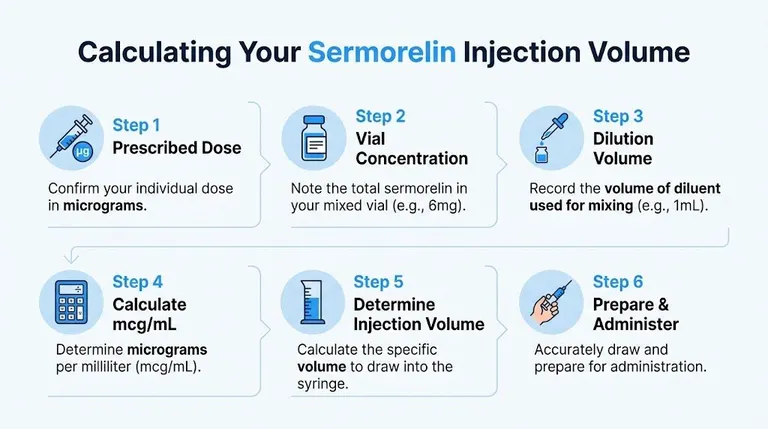
The calculation itself is simple once the units are lined up.
The formula that matters
Volume (mL) = (Desired Dose in mcg × Reconstitution Volume in mL) / (Vial mg × 1000)
Use the formula in the same order every time. Start with the prescribed dose in micrograms. Add the total amount of diluent used to reconstitute the vial. Then divide by the vial strength converted into micrograms. That last part matters because 1 mg equals 1000 mcg.
Worked example using a common vial setup
Say the prescription is 300 mcg, the vial contains 5 mg, and it was reconstituted with 3 mL of bacteriostatic water. Plug those numbers into the formula:
- Desired dose: 300 mcg
- Reconstitution volume: 3 mL
- Vial strength: 5 mg
Now calculate the draw volume:
- (300 × 3) / (5 × 1000) = 0.18 mL
On a standard U-100 insulin syringe, 0.18 mL equals 18 units.
That is the practical conversion many users need. Prescription in mcg. Draw in mL or syringe units.
If you want to check your math before drawing, use a peptide reconstitution calculator that converts mg, mcg, mL, and insulin syringe units clearly.
Where people get it wrong
The errors are usually basic, not technical.
-
Mixing up mg and mcg
Sermorelin vials are labeled in milligrams, while prescriptions are often written in micrograms. Skip that conversion and the rest of the math fails. -
Ignoring the reconstitution volume
A 5 mg vial does not tell you the concentration by itself. The concentration depends on how much diluent was added. -
Treating syringe units like a dose
Units only measure volume. They do not tell you the microgram dose unless you already know the concentration in the vial. -
Copying someone else’s syringe draw
“18 units” is not a universal sermorelin dose. It only matches 300 mcg if the vial strength and reconstitution volume match the example exactly.
Write down four items before the first injection: vial strength, total diluent added, target dose, and exact syringe draw. I recommend keeping that on a printed protocol sheet or in your notes app with a photo of the syringe marking.
That small habit prevents a lot of avoidable mistakes. It also makes dose adjustments safer, because if a prescriber changes the target from 200 mcg to 300 mcg, you can recalculate the draw instead of guessing from memory.
In practice, this is the gap many articles skip. They mention a dose range but stop short of showing how that dose becomes a real syringe measurement. For anyone using sermorelin consistently, that translation step is where safe use becomes repeatable use.
Example Sermorelin Protocol Templates
The biggest weakness in many online guides is that they present one average dose as if everyone should use it. That’s not how this works in practice. The better question is which type of protocol matches the goal, the user’s tolerance, and the context of use.
Sample Sermorelin Protocol Templates
| Protocol Name | Primary Goal | Typical Daily Dose | Schedule | Notes |
|---|---|---|---|---|
| Beginner Fat Loss Start | Conservative entry point | 200 to 300 mcg | Bedtime subcutaneous injection | Best for users who want to start inside the most common range and evaluate tolerance before any change |
| Female-Oriented Low to Moderate Range | Fat loss with lower starting exposure | 100 to 300 mcg | Bedtime subcutaneous injection | Useful because public guidance often misses female-specific starting logic and side effect considerations |
| Male Body Recomposition Range | Fat loss plus lean-mass support | 400 to 500 mcg | Bedtime subcutaneous injection | Often used when the goal leans toward recomposition rather than a purely conservative start |
The categories above are broad examples, not a basis for choosing a personal dose. A template’s label cannot account for an individual’s treatment goals, tolerance, or medical context.
How to choose the right template
A template is not a prescription. It’s a discussion tool.
A few practical rules help:
- If you’re new to the peptide, start with control rather than ambition. The best first protocol is the one you can follow accurately every night.
- If side effects show up early, lower-friction dosing usually wins. A tolerable dose used consistently beats an aggressive dose that gets abandoned.
- If the user is female, don’t default to a generic mid-range dose. That shortcut is common online, and it’s often exactly where unnecessary mismatch begins.
The right protocol also depends on what “weight loss” really means in the case at hand. Some people want scale reduction. Others want waist reduction while preserving training performance. Those aren’t always the same protocol conversation.
A dose can be technically standard and still be wrong for the person using it.
That’s why practitioners should think in terms of starting range, monitoring, and adjustment path, not just a target number. The table above works best when paired with symptom tracking, body composition context, and clear criteria for whether to hold, reduce, or titrate.
Understanding the Safety Profile and Side Effects
A common real-world scenario looks like this. Someone gets the reconstitution right, follows the nightly schedule for a few days, then starts noticing headaches, flushing, or a red irritated spot at the injection site. The immediate question is usually whether the dose is too high, the injection technique is off, or the protocol was a poor fit from the start. Safety depends on answering that question early instead of guessing.

What mild side effects usually look like
The side effects practitioners see first are usually mild and often manageable. Injection site redness, tenderness, headache, flushing, mild nausea, and occasional sleep disruption are the usual starting points. In practice, many of these problems are tied to execution as much as the peptide itself. Poor site rotation, inconsistent timing, incorrect dilution, and sloppy volume measurement can all create symptoms that look like drug intolerance.
That matters because sermorelin safety is not only about the prescribed microgram range. It is also about whether the person using it can mix, measure, and inject the dose accurately night after night. This is one reason tools like PepFlow are useful in day-to-day care. They reduce avoidable dosing mistakes before those mistakes get mistaken for side effects.
A practical way to sort symptoms is to separate them into three buckets:
- Local effects: redness, itching, swelling, or soreness where the injection was placed
- Systemic but milder effects: headache, flushing, stomach discomfort, light sleep changes
- Protocol errors: wrong concentration, wrong injection volume, poor technique, or missed schedule consistency
If someone wants baseline context before starting or while reviewing symptoms with a clinician, at-home hormone testing can help frame better questions. It does not replace formal evaluation, but it can make the conversation more specific.
When not to push through
Persistent or escalating symptoms change the conversation. Repeated headaches, pronounced swelling, symptoms that feel disproportionate to a low starting dose, or anything that suggests an undiagnosed medical issue should trigger a pause and reassessment.
This is especially important in people with hormone-sensitive conditions, a history of malignancy, unexplained fatigue or weight changes, uncontrolled endocrine issues, or symptoms that were never properly worked up before treatment started. In those cases, self-adjusting the dose without supervision is a setup for confusion and risk.
The broader medication context matters too. Sermorelin is often discussed online as if all peptides belong in the same category, which is misleading. PepFlow’s guide to the FDA approved peptide drugs list is a useful reference if you want a clearer view of how peptide therapies differ in regulation and clinical use.
This short overview reinforces the right mindset. Risk assessment belongs in the protocol from day one.
Stop and reassess if the protocol becomes something you’re repeatedly trying to fix on your own. That usually means the original setup needs clinical review, not more experimentation.
Frequently Asked Questions About Sermorelin
How long does sermorelin take for weight loss
Sermorelin usually isn’t judged on a week-to-week basis. Reported timelines for noticeable fat loss commonly fall in the 3 to 6 month range in the clinical wellness guidance cited earlier. That aligns with what practitioners see in real use. It’s a gradual protocol, not a quick visual change intervention.
The quality of the surrounding plan matters just as much. If sleep is poor, diet is inconsistent, and training volume changes every week, the peptide becomes difficult to evaluate.
How is sermorelin different from other peptides
Sermorelin is a GHRH analog, which means it signals the pituitary to release growth hormone. That’s different from using growth hormone directly, and it’s also different from peptides that act through other signaling pathways or are used for different goals entirely.
In practical terms, sermorelin is often chosen by people who want a protocol that works with endogenous hormone signaling rather than replacing the final hormone itself. That doesn’t make it casual or risk-free. It just means the mechanism is different.
Can you take sermorelin with supplements or medications
That depends on the specific medication or supplement. The correct answer is case-by-case, not general reassurance.
Bring your full list to the prescribing clinician, including:
- Prescription drugs: especially anything that may affect endocrine function or metabolic status
- Over-the-counter products: sleep aids, stimulant-based fat loss products, and hormone-related supplements
- Other peptides or injectables: stacking compounds changes how symptoms are interpreted
A common mistake is adding multiple new variables at once. If someone starts sermorelin, changes diet aggressively, adds a sleep supplement, and begins a new training block in the same week, it becomes hard to know what’s helping and what’s causing problems.
Is a higher dose always better for body recomposition
No. A higher dose may be appropriate in some contexts, but “more” isn’t the same as “better.”
The best dose is the one that fits the user’s physiology, is tolerated, and can be followed accurately for long enough to evaluate. Many disappointing results come from either underdosing through bad math or overdosing through impatience.
If you can’t describe your concentration, draw volume, and schedule clearly, the first problem probably isn’t the peptide. It’s protocol management.
What should you track while using sermorelin
Track things that help decision-making, not just scale weight.
Useful observations include:
- Dose accuracy: what you were prescribed and what you injected
- Timing consistency: whether bedtime dosing happened as planned
- Subjective response: sleep quality, recovery, appetite, and any adverse effects
- Body composition context: fit of clothing, waist change, gym performance, and photos if appropriate
Disciplined users separate themselves from frustrated ones. The people who get useful feedback from a protocol are the ones who track enough to know whether the protocol was followed.
Conclusion The Path to Consistent and Safe Use
Sermorelin can be a useful tool for body composition support, but it only works well when the practical details are handled correctly. The dose has to fit the person. The reconstitution and syringe math have to be right. The schedule has to be consistent enough to judge.
That’s the primary difference between clinical theory and real-world use. Most problems don’t come from not knowing the broad dose range. They come from getting lost between the prescription, the vial, and the daily routine. A solid sermorelin dosage for weight loss plan is structured, trackable, and medically supervised from the start.
If you’re discussing sermorelin with a clinician, go in prepared. Know your target dose, your vial concentration, your injection volume, and what you plan to monitor. That alone prevents a surprising number of avoidable mistakes.
If you want help staying accurate and organized with peptide protocols, PepFlow makes the day-to-day process easier. It helps convert prescribed microgram doses into practical syringe units, supports cycled schedules and reminders, and reduces the manual math errors that often derail otherwise good plans. It’s not medical advice, but it is a useful tool for people who want more consistency, better tracking, and less guesswork.