NAD+ injections are experimental treatments given intravenously, intramuscularly or subcutaneously, and no eligible controlled outcome trial yet shows that they improve energy, recovery or longevity. There’s no validated wellness dose or schedule.
The popular advice to replenish NAD+ because cells need it skips the question that matters: does injecting the molecule make people healthier? A biological explanation can justify investigating a treatment, but it can’t establish that the treatment works. To evaluate NAD injections, you need to distinguish the compound administered, what researchers measured, and whether the study could detect a meaningful benefit.
Table of Contents
- What NAD+ Injections Are and How They Differ From Related Compounds
- Routes, Doses and Schedules Used in NAD+ Research
- Proposed Benefits Measured Against the Evidence
- Side Effects and Warning Signs to Recognize
- How to Vet an NAD Injection Source
- Who Should Avoid Unsupervised Use and What to Ask First
What NAD+ Injections Are and How They Differ From Related Compounds
NAD+ is a coenzyme that carries electrons during cellular energy reactions. Injecting it is a separate intervention from the body’s normal use of it, with separate questions about absorption, metabolism, safety and effectiveness.
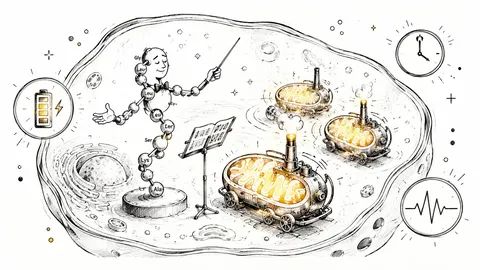
Think of NAD+ as a delivery van that picks up and drops off electrons between reactions. Adding more vans doesn’t establish that deliveries will happen faster. Traffic, loading capacity and the destination still matter.
The chemistry dates to Harden and Young’s 1906 yeast experiments and Warburg’s 1936 nucleotide finding, as described by the American Chemical Society. That history establishes the molecule’s biochemical importance, not the effectiveness of a modern injection service.
NAD+ and related compounds compared
Similar names can conceal different interventions. NAD+ itself, its reduced form NADH, and the precursors nicotinamide riboside and NMN shouldn’t be treated as interchangeable evidence.
| Compound | What it is | Tested by injection? | Evidence status |
|---|---|---|---|
| NAD+ | Coenzyme involved in electron transfer during cellular energy reactions | Yes, in small infusion studies and injectable research protocols | Experimental; wellness benefits aren’t established |
| NADH | Reduced form of NAD+ that carries electrons | Yes, including intravenous and intramuscular administration in Parkinson’s research | Reported symptom improvements weren’t statistically significant or durable |
| Nicotinamide riboside (NR) | Vitamin B3 precursor the body converts to NAD+ | Yes, in an intramuscular and subcutaneous pilot | Preliminary biomarker and tolerability findings, not proof of improved health |
| NMN | Nicotinamide mononucleotide, another NAD+ precursor | Injectable testing isn’t established by the clinical evidence evaluated here | Unproven for injection |
The practical implication is straightforward: a study of NR cannot validate an NAD+ injection, just as an oral precursor study cannot establish an injectable dose. The nicotinamide riboside reference helps distinguish NR from the molecule it helps the body produce.
Biological importance does not prove treatment benefit. A molecule can be essential inside cells without an injection of that molecule improving health.
This distinction also helps when evaluating other cellular-wellness treatments. Yoyime Clinic explains glutathione injections, offering a useful parallel topic for separating a molecule’s normal function from claims about administering it.
NAD+ injections are generally discussed as experimental or compounded interventions. Their value must therefore rest on human clinical outcomes, not on how long scientists have understood the underlying chemistry.
Routes, Doses and Schedules Used in NAD+ Research
The clearest pharmacokinetic evidence concerns slow intravenous infusion. Intramuscular and subcutaneous research is thinner, and some frequently discussed injection findings concern NR rather than NAD+ itself.
A controlled pilot summarized in Frontiers in Aging administered 750 mg of intravenous NAD+ over 6 hours to 8 healthy men, approximately 3 micromol/min, while 3 participants received saline. Plasma NAD+ changed little initially and increased later, alongside changes in related metabolites.
That pattern argues against the assumption that injected NAD+ remains intact in circulation and moves directly into cells. The delayed rise also suggests the administration rate, not the milligram total alone, determined the plasma response.
Separately, a ClinicalTrials.gov record specifies 100 mg of NAD+ in 2 mL of bacteriostatic water for intravenous-push, intramuscular and subcutaneous study arms. A registered intervention describes what investigators intend to test; it supplies no evidence that the intervention improves a wellness outcome.
NAD+ routes, doses and schedules in research
| Route | How it is given | Dose and schedule in research | Key limitation |
|---|---|---|---|
| Slow IV infusion | Drip into a vein over several hours | 750 mg infused over 6 hours in the controlled pilot | Pharmacokinetic findings don’t establish that intact NAD+ enters cells |
| IV push | Short injection into a vein | 100 mg in 2 mL bacteriostatic water in the registered record | Registration isn’t a validated efficacy result |
| Intramuscular (IM) | Injection into muscle | 100 mg in 2 mL bacteriostatic water in the registered record | Published IM outcome data for NAD+ remain scarce |
| Subcutaneous (SC) | Injection beneath the skin | 100 mg in 2 mL bacteriostatic water in the registered record | No demonstrated superior route for a wellness outcome |
Why a milligram amount isn’t a complete protocol
Mass, concentration, route, administration time and preparation volume describe different parts of an intervention. Two preparations can contain the same mass without exposing the body to it in the same way.
The two regimens above illustrate the gap. One spreads 750 mg across 6 hours at roughly 3 micromol/min; the other delivers 100 mg in a short injection of 2 mL. Neither figure transfers cleanly to the other, so quoting a dose without its schedule misrepresents the protocol. A calculator can verify concentration arithmetic. Whether a clinical protocol is justified is a separate question the arithmetic cannot answer.
Sterility adds a further requirement. The FDA’s warning to compounders described food-grade NAD+ being used in IV preparations and adverse reactions consistent with excessive endotoxin exposure. Correct arithmetic cannot detect contaminated starting material.
For readers assessing a clinical setting, Restore Osteopathic Medicine’s overview of IV infusion care in Aurora provides context for discussing supervised administration. A service description doesn’t establish a preferred NAD+ route.
No wellness schedule can be selected confidently from these protocols alone. Research amounts are descriptions of experiments, not instructions for self-treatment.
Proposed Benefits Measured Against the Evidence
Energy, recovery, cognition and longevity are the outcomes people care about. Blood concentrations and metabolite changes answer narrower questions.
A rising NAD+ measurement is like a fuel gauge climbing in a parked car. It shows that something changed, but it doesn’t show that the car travels farther or performs better. The relevant test is whether participants experience a meaningful improvement compared with an appropriate control.
The distinction between personal outcomes and laboratory findings is central to evaluating these claims.

What the study designs can support
A 2024 systematic review in the American Journal of Physiology–Endocrinology and Metabolism identified 10 relevant studies involving 489 participants across different clinical conditions. In the included Parkinson’s study using intravenous and intramuscular NADH, changes on the Unified Parkinson’s Disease Rating Scale weren’t statistically significant and didn’t persist during the following weeks.
The review’s total enrollment must not be mistaken for the size of a single NAD+ wellness trial. Pooling studies of different conditions, compounds and protocols doesn’t create a unified test of energy or longevity.
A 2024 randomized pilot, published as a medRxiv preprint, analyzed 37 participants in its first phase and 16 in its second phase while evaluating intravenous NAD+ and related interventions. Randomization is useful, but a small, non-peer-reviewed pilot still requires cautious interpretation.
Claimed NAD+ benefits and the evidence behind them
| Claimed benefit | What the evidence shows | Study size or gap | Verdict |
|---|---|---|---|
| Higher energy and less fatigue | Short studies examine NAD-related blood measurements, not established durable improvements in energy | No eligible controlled wellness outcome trial of injected NAD+ identified | Unproven |
| Faster recovery | Injection pilots have emphasized biomarkers and tolerability | No controlled demonstration of better recovery from NAD+ itself | Unproven |
| Parkinson’s symptom improvement | NADH symptom-scale changes weren’t statistically significant or sustained | A condition-specific finding within a heterogeneous review, not a wellness trial | Not supported by that study |
| Anti-aging or longevity | No eligible controlled outcome trials of injected NAD+ identified | No demonstrated lifespan or clinically meaningful anti-aging benefit | Unproven |
A biomarker change can show biological activity. It cannot, by itself, show that someone feels better, performs better or lives longer.
Goodlabs’ discussion of blood biomarkers for healthy aging offers context for interpreting measurements. The essential question remains whether a laboratory change corresponds to an outcome that matters to the patient.
The conclusion isn’t that every proposed benefit is impossible. It’s that the available studies don’t carry the claims commonly attached to NAD injections.
Side Effects and Warning Signs to Recognize
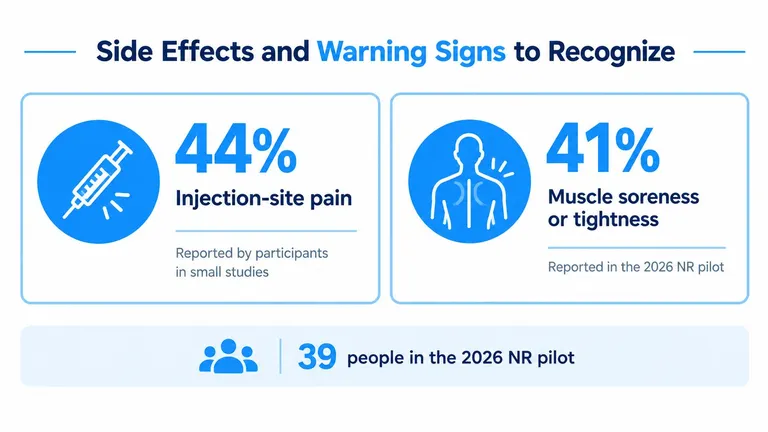
The most-cited reaction figures for injectable NAD-related compounds come from an NR pilot, not an NAD+ trial. Injection-site pain and muscle soreness deserve attention, but treating those percentages as established rates for every NAD+ preparation or route goes beyond what the study measured.
The infographic summarizes that NR pilot’s reported reactions. Its percentages are not universal NAD+ injection risk estimates.
Separate local discomfort from systemic illness
A useful safety assessment considers where symptoms occur, how severe they are and whether they’re worsening. Location and trajectory matter more than the assumption that a reaction is an expected effect of the active ingredient.
-
Injection-site pain. This was reported in the NR pilot and may reflect local irritation or the injection procedure; the study doesn’t establish one cause for every participant. Report it to the clinician and ask whether the site, volume or technique needs review.
-
Muscle soreness or tightness. This was also reported in the NR pilot. Monitor the symptom and contact the treating clinician if it persists, worsens or limits normal activity.
-
Systemic illness, such as chills, shaking, vomiting or marked fatigue after an injection. The FDA’s warning to compounders describes adverse reactions consistent with excessive endotoxin exposure, which can include systemic symptoms. Seek urgent medical assessment rather than treating them as evidence that the treatment is working.
Endotoxins are bacterial components that can provoke an inflammatory response even when no live bacteria remain in the vial. Symptoms alone cannot diagnose contamination. Severe systemic illness needs medical evaluation, not a home adjustment to the dose or infusion rate.
Prepare a response plan before treatment
Agree on who to contact during and after administration, and how you’ll obtain urgent care if necessary. Keep the product label and lot information available so clinicians can identify what was administered.
The injection safety checklist works as an organizational prompt for that conversation. A checklist helps you remember which questions to ask; it cannot certify sterility, confirm a product’s suitability or replace a clinician’s judgment about whether supervised administration is appropriate for you.
The video below adds general context on injection safety. Your clinician’s instructions take priority over any generic guidance.
Small studies cannot reliably characterize uncommon adverse events or long-term risks, especially when follow-up is brief. An absence of reported events does not rule out rare harms.
How to Vet an NAD Injection Source
The most consequential sourcing mistake is assuming that a powder sold as a supplement is suitable for injection. Food-grade and sterile-compounding-suitable are not interchangeable descriptions.
A label tells you what a product is supposed to contain. It doesn’t, by itself, establish how the material was handled, whether the finished preparation meets sterile requirements, or whether its history can be traced.
Checking a source is like inspecting a restaurant kitchen rather than reading only the menu. The listed ingredient matters, but preparation conditions matter too.
Source checks before any NAD injection
| Check | What to confirm | Red flag |
|---|---|---|
| Raw material grade | Material suitable for sterile compounding, not merely food-grade NAD+ | Supplement powder repurposed for injection |
| Sterile production | Documented sterile preparation by a properly authorized source | No meaningful documentation or accountable pharmacy |
| Lot traceability | A lot or batch number linked to the supplier and finished preparation | The provider cannot identify the source |
| Strength and diluent | Written concentration and the identity of the diluent | Missing or contradictory preparation information |
| Beyond-use date and storage | A clear beyond-use date and storage instructions | Undated material or unexplained storage conditions |
| Administration | A licensed professional responsible for administration and monitoring | Self-mixing instructions or unsupervised administration |
What documentation can and cannot prove
Start with material suitability, sterile production and traceability. These establish whether there’s an accountable preparation process to evaluate. If a provider can’t substantiate them, a plausible-looking concentration label doesn’t solve the problem.
Then reconcile the prescription, label and administration plan. The compound name, concentration, diluent and route should agree across the documentation. Ask the clinician or dispensing pharmacy to resolve discrepancies before anything is administered.
A laboratory purity result isn’t a substitute for every other quality check. The guide to peptide purity testing provides context for assessing testing claims, but a claim about chemical purity alone shouldn’t be treated as proof of an injectable product’s sterility or endotoxin control.
Practical rule: If the provider cannot document suitable starting material, sterile preparation and lot traceability, don’t proceed.
Even satisfactory sourcing doesn’t establish effectiveness. It addresses whether a product was prepared appropriately, not whether you need it or whether it will achieve your goal.
Price, branding and a polished consultation cannot answer either question. Keep product quality and clinical justification as separate decisions.
Who Should Avoid Unsupervised Use and What to Ask First
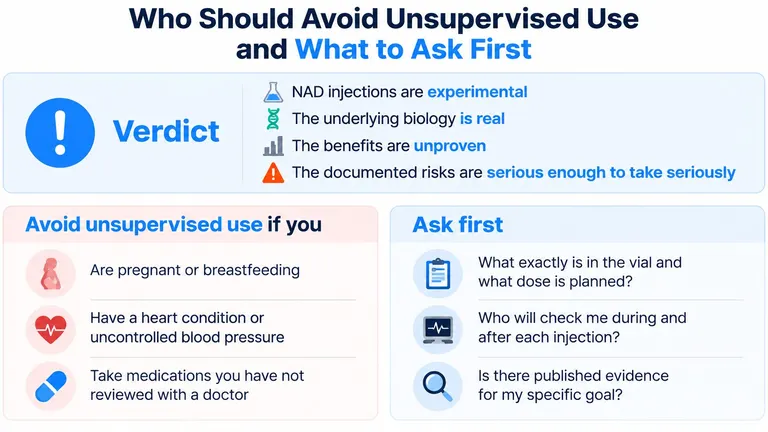
The strongest case for NAD+ injections is biochemical. The wellness case is much thinner. Documented product-quality risks and incomplete safety evidence justify professional review before anyone uses an experimental injectable protocol without supervision.
The GLP Watchdog evidence review described a 2026 open-label pilot involving 39 participants, given 50 mg or 100 mg of NR by intramuscular or subcutaneous injection for three days, with approximately 7.8% to 10.0% average increases in whole-blood NAD+, 44% reporting post-injection pain and 41% reporting muscle soreness or tightness. The same review identified no eligible controlled outcome trials of NAD+ itself administered intravenously, intramuscularly or subcutaneously for anti-aging or wellness.
That pilot matters because it shows how easily a claim can travel beyond its design. The compound was NR, the course lasted three days, the population was small, and the main result was a blood measurement plus short-term tolerability. Those findings establish neither an optimal NAD+ regimen nor a long-term health benefit. They show why the compound, endpoint and study design must remain attached to every result.
Situations that require individual medical review
Treat the items below as practical reasons to pause. The evidence is too limited for a validated NAD+-specific contraindication list, so a particular medical history cannot be declared safe by default.
- Chronic heart, kidney or liver conditions. Ask the clinician managing the condition whether an elective injectable intervention is appropriate and what monitoring would be necessary.
- Pregnancy or breastfeeding. The cited clinical evidence does not establish safety for these groups, so studies in other adults cannot supply reassurance.
- Prescription medicines and supplements. Bring a complete list, including blood-pressure, blood-sugar, blood-thinning and immune medicines. Absence of an identified interaction does not mean the combination has been adequately tested.
- Unexplained fatigue. Seek an assessment before assuming a NAD-related problem. Ask whether anemia, thyroid disease, sleep apnea, depression or another explanation needs investigation.
- A previous reaction to IV therapy or an injection. Describe exactly what happened, including timing and treatment, so the clinician can assess its relevance.
A wellness goal does not remove the need for diagnosis. If fatigue is the problem, identifying its cause may be more useful than choosing an injection schedule.
Questions to bring to the clinician
-
Why do I need this, and what result would show it worked? Define the symptom or functional limitation. A general wish to optimize health gives the treatment no clear target.
-
Which compound, route, dose and schedule are proposed, and why? Ask whether the rationale comes from NAD+ research, precursor research or clinical judgment, and how those uncertainties affect the recommendation.
-
Who is accountable for the specific vial? Ask which pharmacy prepared it, how the lot can be identified and who answers if the preparation is later questioned.
-
What monitoring will be done? Establish who will assess reactions, what should prompt stopping treatment and which symptoms require immediate care.
-
What alternatives have stronger evidence for my situation? Compare the proposed injection with evaluation and treatment aimed at the actual symptom, rather than with doing nothing.
A useful consultation should make uncertainty explicit. A clinician can explain why an intervention seems reasonable without presenting preliminary findings as settled medicine.
Track observations without turning them into proof
If you and a qualified clinician decide to proceed, record the date, route, prescribed dose, product lot, administration details and subsequent symptoms. Include the outcome you agreed to evaluate before treatment began, along with relevant changes in sleep, exercise, medicines or other interventions.
One good day is weak evidence. Personal records can support a clinical discussion, but without a controlled comparison they cannot separate treatment effects from expectations or ordinary variation. Calculations and tracking require cautionary context: a calculator can standardize arithmetic and a reminder can protect timing, while clinical judgment still has to decide whether the plan belongs in the care plan at all.
The decision is yours, made with a professional who can assess your history and goals. Choosing not to use an unproven intervention is a reasonable outcome of an informed consultation.
PepFlow offers dosage calculations, scheduling reminders and history tracking to help organize a clinician-directed plan, not select an NAD+ treatment or establish its safety. Visit PepFlow to explore its planning tools and educational resources, and keep medical decisions with your qualified clinician.