
The most popular advice about longevity supplements is backwards. It starts with a stack, then looks for a reason to take it. No product below has been shown to extend human lifespan. That doesn’t make every bottle useless. It means you need a narrower question.
Ask first whether the product fills a documented need. A nutrient gap, low intake, or a specific training goal is a reason. A vague promise of cellular youth isn’t. Ask second whether the label matches what’s inside. Product identity, active ingredient, amount, and third-party testing matter more than brand language.
Each entry below separates the proven nutrient role from the longevity marketing layered on top. Some products solve a real, ordinary problem well. Others raise a biomarker without proving that you live longer, think better, or function better. If you want broader background before choosing, start with how to evaluate healthy aging supplements, then judge each item here by the problem it solves, not by the category it was sold into.
Table of Contents
- 1. Thorne Creatine, Creatine Monohydrate
- 2. Carlson Maximum Omega 2000, Fish Oil
- 3. Thorne Vitamin D-1,000, Vitamin D3
- 4. Thorne Basic Nutrients 2/Day, Multivitamin/Mineral
- 5. Thorne Magnesium Glycinate
- 6. Life Extension NAD+ Cell Regenerator, Nicotinamide Riboside
- 7. ProHealth Longevity NMNR Pro Synergy, NMN and NR
- How the seven longevity supplements compare on labeled content, evidence, and best-fit use
- Build a Longevity Routine Around Evidence, Not Hype
1. Thorne Creatine, Creatine Monohydrate
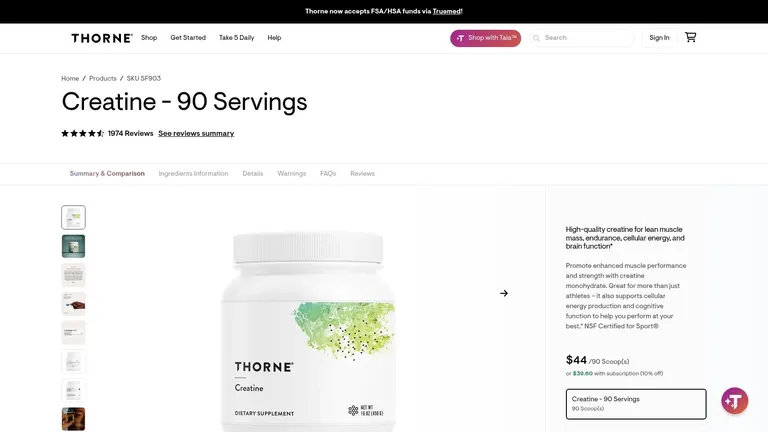
Creatine monohydrate has a defined use: supporting strength and exercise performance. Thorne Creatine provides 5 g per scoop and 90 servings per container. The product is listed as free of gluten, dairy, and soy.
The human evidence supports creatine for strength, lean mass, and performance, particularly alongside resistance training. A clinical evidence summary on longevity supplements describes typical use at 3 to 5 g daily and notes that lifespan extension has not been demonstrated. The distinction matters: a product may support a measurable training goal without being a longevity treatment.
What this product gets right and wrong
- Single ingredient: The label identifies the creatine form and serving size without a proprietary blend.
- Sport screening: Its NSF Certified for Sport status may be relevant to athletes concerned about banned substances.
- Reviews have limits: Product-page satisfaction ratings cannot establish health benefits.
Practical rule: Choose creatine for a specific training goal. Do not treat it as evidence of slower aging.
Powder requires mixing, which may affect whether someone uses it consistently. Water-weight changes and digestive discomfort are possible trade-offs. Preserving strength can support healthy aging, but that does not establish that creatine extends lifespan.
2. Carlson Maximum Omega 2000, Fish Oil
Start with food, not the capsule. If you regularly eat oily fish, you may not need an omega-3 product at all. Carlson Maximum Omega 2000 is a concentrated fish oil softgel for people who have a reason to supplement EPA and DHA, or who don’t get them from seafood.
Carlson says its omega-3 products are tested for freshness, potency, and purity by an FDA-registered laboratory. The range comes in softgel formats and multiple bottle sizes. The 60-softgel listing was about $39.90 when checked, according to the product listing linked above, so it’s not the cheapest way to get omega-3s, and size choice affects the actual cost.
Where the human evidence narrows
Omega-3 evidence isn’t uniform across people or outcomes. The clearer support is for triglyceride reduction and some cardiovascular outcomes in selected low-intake, high-risk, or high-triglyceride populations. Large trials in already well-nourished, low-risk people have produced null results. That pattern should change how you judge this bottle. It’s not a universal longevity supplement. It’s a targeted nutrient for a defined gap or risk profile.
- Concentration helps adherence: Fewer softgels can be easier than a low-strength oil, if a clinician agrees you need it.
- Format choice: Multiple sizes let you test tolerability before committing to a large bottle.
- Stomach issues are common reasons to stop: Aftertaste and stomach upset can undermine consistency.
Check interactions before you start. Fish oil can interact with some medicines, including anticoagulants. If seafood is a realistic route for you, it’s often the preferred first option, because it supplies protein and other nutrients alongside EPA and DHA. The capsule solves an intake problem. It doesn’t prove a longevity benefit for everyone who swallows it.
3. Thorne Vitamin D-1,000, Vitamin D3
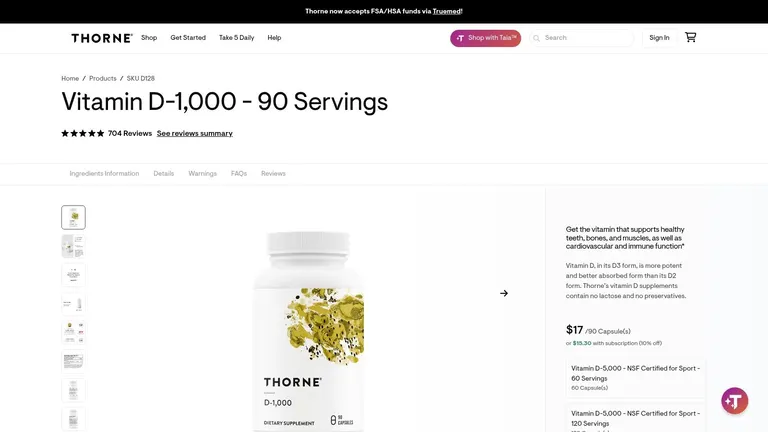
Vitamin D has a documented role in normal bone health. That doesn’t mean more is better, or that everyone needs a supplement. Thorne Vitamin D-1,000 contains 1,000 IU (25 mcg) of vitamin D3 per capsule, with 90 capsules per bottle, listed at about $17 when checked.
The unit itself trips people up. IU and mcg are not interchangeable across nutrients, and confusing them leads to bad records and bad comparisons. If you track doses in different units, read whether IU is the same as mg before you log anything. Accurate units matter when you’re adding up intake from food, a multivitamin, and a single-nutrient capsule.
The case for and against this format
- Single-nutrient clarity: One ingredient makes total intake easier to track than a blend.
- Moderate labeled amount: You can discuss a specific amount with a clinician instead of guessing from a complex formula.
- Lower cost: It’s cheaper than many multi-ingredient longevity products, which reduces the cost of being wrong.
Thorne says it tests ingredients for identity, purity, and potency. That’s useful quality information, but it doesn’t tell you whether you need vitamin D. Only your diet, sun exposure, medical history, and, where appropriate, clinician-monitored status can do that.
Vitamin D is fat soluble. Excessive intake can be harmful, so adequacy is the goal, not the highest number you can reach.
This capsule may be unnecessary if your intake and status are already adequate. It’s not proven to extend lifespan or provide broad disease prevention. Its value is narrow and legitimate. It can help address a documented intake need, provided someone qualified has confirmed that need exists.
4. Thorne Basic Nutrients 2/Day, Multivitamin/Mineral
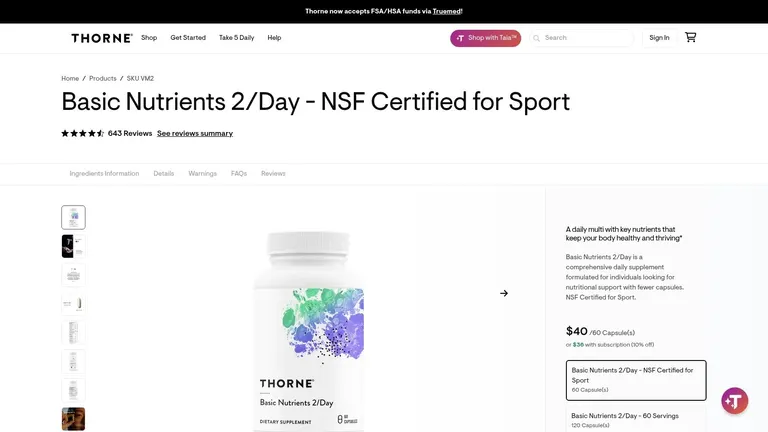
A multivitamin is an insurance-style product, not a longevity formula. Thorne Basic Nutrients 2/Day uses two capsules per daily serving and includes vitamin D3, B vitamins, zinc, and selenium. The 60-capsule version was listed around $40 and the 120-capsule bottle around $68 when checked on the product page.
Use is widespread, but use isn’t proof. In U.S. National Health and Nutrition Examination Survey data, the National Academies summary of supplement use reports use of any dietary supplement among adults aged 20 and older increased from 51.8% to 61.4% between 2011 to 2012 and 2021 to 2023. Among adults aged 60 and older, 75.9% reported using a supplement in the previous 30 days in 2021 to 2023. Popularity at that scale explains the market. It doesn’t validate chronic disease claims.
What to check before you add it
This product lists individual ingredients and amounts, which helps you spot duplication. That’s its main strength. A sport-certified version is also listed, which may suit athletes who want screening against banned substances.
- Duplication risk: Nutrients can stack up across this product, single-nutrient bottles, and fortified foods.
- Vitamin K caution: It contains vitamin K, which can interfere with warfarin.
- Diet still comes first: A capsule can’t substitute for a varied diet or evidence-based preventive care.
Multivitamins haven’t been shown to reliably prevent chronic disease or death. If you use one, treat it as gap coverage with a label you’ve read. Once you add separate vitamin D, magnesium, or fish oil, the multivitamin becomes part of a total intake calculation, not a harmless background habit.
5. Thorne Magnesium Glycinate
Magnesium is essential. That fact is often stretched into claims about sleep, stress, and longevity that the evidence doesn’t support for everyone. Glycinate is marketed as a gentler form of magnesium, which may matter for tolerability, but form alone doesn’t create a benefit where no need exists.
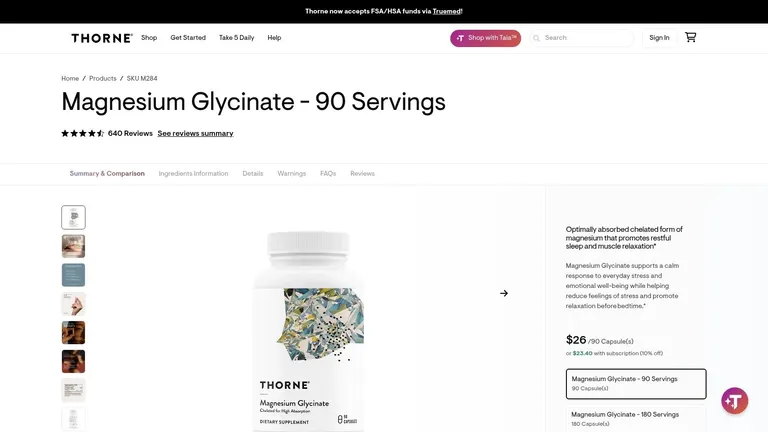
Thorne Magnesium Glycinate provides 120 mg of magnesium per capsule, with 90 capsules per bottle, listed at about $26 when checked. Thorne also sells a powdered bisglycinate option if you prefer drinks to capsules. The capsule’s clear per-unit amount is the useful feature here. You can compare it with your diet and any multivitamin without estimating from a blend.
Where expectations need lowering
User reviews appear on the product page, but reviews aren’t clinical evidence. They can flag taste, capsule size, or stomach tolerance. They can’t tell you whether magnesium improved sleep, because sleep changes for many reasons and reviewers aren’t a controlled comparison group.
- Single-mineral format: Easier to assess alongside food and other supplements.
- Clear amount per capsule: Simpler record-keeping than multi-mineral products with small print.
- Not a universal sleep aid: It isn’t supported as a longevity aid for everyone, regardless of status.
High supplemental intake can cause diarrhea. Magnesium can also affect absorption of some antibiotics and bisphosphonates, and it may interfere with other medicines. Timing separation is sometimes relevant, but that’s a question for your pharmacist or clinician, not a product page. Judge this bottle as a nutrient with a specific intake role. Don’t judge it by whether it feels calming for a week.
6. Life Extension NAD+ Cell Regenerator, Nicotinamide Riboside
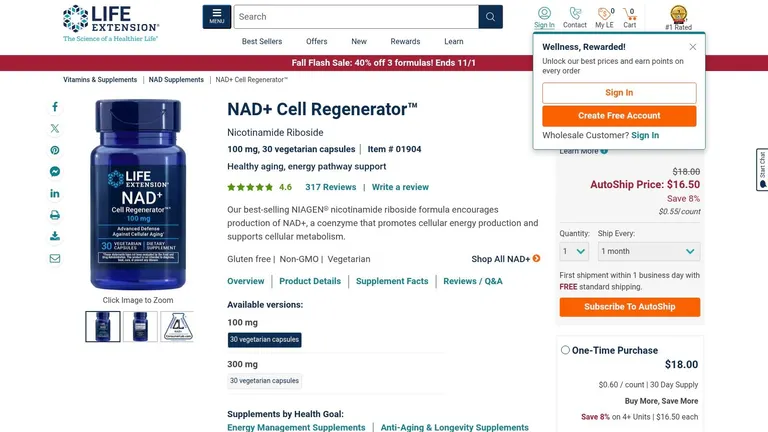
Here’s where the category changes character. The first five products address nutrients or training. This one is sold around a pathway. Life Extension NAD+ Cell Regenerator contains 100 mg of nicotinamide riboside per capsule, identified as NIAGEN, with 30 vegetarian capsules per bottle.
Raising NAD+ is target engagement, not proof of benefit. A review of NAD+ precursors in PMC reports that oral precursors such as nicotinamide riboside and NMN can raise circulating NAD+ levels, while human clinical benefits remain variable and unproven for broad healthspan or lifespan extension. A supplement can change a blood marker without improving strength, cognition, cardiovascular risk, or daily function. If you’re comparing delivery routes, separate oral precursors from NAD injections, because the product, evidence, and oversight questions are different.
What the product discloses well
- Specific ingredient and amount: You know it’s NR and how much is in each capsule.
- Quality reference: The product page showed a ConsumerLab Approved Quality seal when checked.
- Lower entry point: It costs less than many premium NAD-precursor products, though lower cost doesn’t strengthen the evidence.
The page showed about 316 reviews when checked, according to the product listing linked above. Treat those as customer feedback only. They can’t establish effectiveness, and they can’t answer long-term safety questions.
Evidence test: A higher NAD+ number shows the ingredient reached a pathway. It doesn’t show that you gained healthy years.
If you take medication or manage a health condition, review use with a healthcare professional first. The honest classification is experimental. You’re paying to test an unproven hypothesis about aging, not to correct a documented nutrient deficiency.
7. ProHealth Longevity NMNR Pro Synergy, NMN and NR
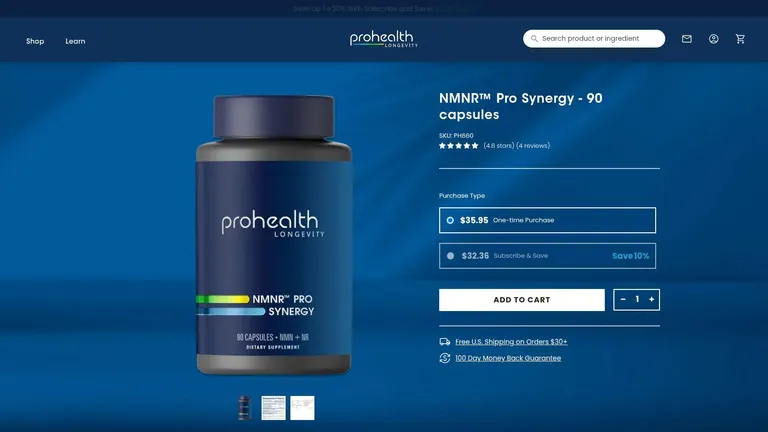
Combining two NAD-related compounds sounds more advanced than taking one. It also makes evaluation harder. ProHealth Longevity NMNR Pro Synergy combines NMN and NR, lists 500 mg of NMN per serving, and was listed at about $35.95 for 90 capsules when checked, with free U.S. shipping on orders over $30 and a 100-day money-back guarantee.
Demand for this positioning is growing, but demand isn’t evidence. The Grand View Research U.S. longevity supplements market report values the U.S. longevity and general-wellness supplements market at approximately USD 6.35 billion in 2025 and projects USD 10.13 billion by 2033. Those are commercial estimates. They size consumer interest, they don’t measure clinical effectiveness.
The testing claim needs inspection
ProHealth offers a certificate of analysis and says third-party test results are published online. That’s better than no documentation, but you still need to read it critically. Check who performed the test, whether it’s independent, and whether it connects to this specific product or batch. A certificate that doesn’t match the bottle in your hand proves little.
- Published testing information: You can inspect product-specific documents before buying.
- Two compounds in one product: Convenient if you’ve decided to use both, but harder to attribute effects or side effects.
- Return policy listed: The guarantee reduces purchase risk, not health uncertainty.
NMN and NR haven’t been proven to extend lifespan in humans. If you’re building a broader routine, a structured longevity protocol still needs stopping rules and clinician review, not just more ingredients. Compared with supplements that address a documented nutrient gap, this is more expensive and less evidence-grounded. Treat it as experimental, and don’t let a guarantee substitute for outcome data.
How the seven longevity supplements compare on labeled content, evidence, and best-fit use
| Item | Labeled Amount | Human Longevity Evidence | Best Suited For | Main Caveat |
|---|---|---|---|---|
| Thorne Creatine, Creatine Monohydrate | 5 g per scoop; 90 servings | Not shown to extend human lifespan | People seeking creatine for sports performance | May cause water-weight changes or digestive discomfort |
| Carlson Maximum Omega 2000, Fish Oil | Concentrated softgel; specific EPA/DHA amount not stated | Evidence varies by health outcome; no established lifespan benefit | People who have a reason to supplement EPA and DHA or rarely eat oily fish | May cause aftertaste or stomach upset and interact with anticoagulants |
| Thorne Vitamin D-1,000, Vitamin D3 | 1,000 IU (25 mcg) per capsule | Not proven to extend lifespan or broadly prevent disease | People with a vitamin D intake or status concern | May be unnecessary if intake and status are adequate; excessive intake can be harmful |
| Thorne Basic Nutrients 2/Day, Multivitamin/Mineral | Two capsules per daily serving | Not shown to reliably prevent chronic disease or death | People seeking to fill dietary gaps | May duplicate nutrients; vitamin K can interfere with warfarin |
| Thorne Magnesium Glycinate | 120 mg per capsule | Not established as a longevity aid | People considering magnesium based on dietary intake or individual needs | High supplemental intake can cause diarrhea and interact with medicines |
| Life Extension NAD+ Cell Regenerator, Nicotinamide Riboside | 100 mg per capsule | Not proven to extend human lifespan | People interested in NAD-related supplements while recognizing evidence limits | Meaningful long-term health benefits remain uncertain |
| ProHealth Longevity NMNR Pro Synergy, NMN and NR | 500 mg NMN per serving; NR amount not stated | NMN and NR are not proven to extend human lifespan | People interested in experimental NAD-related compounds | Experimental; assess whether testing is independent and product- or batch-specific |
Build a Longevity Routine Around Evidence, Not Hype
Start by deleting products that don’t answer a specific question. A documented deficiency, low dietary intake, or a defined training goal gives you a reason to continue. A pathway diagram doesn’t. Expert coverage also stresses personalization, and Prevention’s expert guide to longevity supplements notes that supplement products are not regulated like prescription drugs, label accuracy and dosage can vary, and interactions may occur with medical conditions and prescriptions. That caution applies to every bottle above.
Next, check whether the label identifies the active ingredient, form, amount, and unit. Brand names aren’t enough for a useful record. You need product identity, dose unit, frequency, start date, pauses, and intended outcome. Without those fields, you can’t tell whether a symptom changed because of the supplement, a medication change, sleep, training, or simple passage of time.
Quality claims need the same discipline. Look for testing that matches the exact product and batch, and understand what the seal does and doesn’t cover. For a plain explanation of that distinction, Pro Tec Pep explains independent testing in terms a buyer can apply before trusting a certificate. Testing can support identity and purity. It can’t prove that a product extends life.
A practical checklist before you continue any stack
- Confirm the need: Ask what gap, deficiency, or measurable goal this product addresses, and who confirmed it.
- Review medications: Check anticoagulants, diabetes medication, antibiotics, bisphosphonates, and warfarin where relevant to the ingredient.
- Set a review point: Decide in advance what you’ll track, when you’ll reassess, and what result means you stop.
- Record the details: Log product, amount, unit, timing, pauses, and adverse effects, not just a daily tick box.
Population data show why records matter. The Office of Dietary Supplements summary of population studies reports that in a nationally representative U.S. study of older adults published in 2017, 70% reported using at least one dietary supplement during the preceding 30 days, and 29% of users took four or more. Multi-product routines are normal. Normal doesn’t mean they’re reviewed as a whole.
If a clinician has approved your plan, a tracker such as PepFlow can help you follow timing, cycles, pauses, and dose history without relying on memory. It doesn’t provide medical or dosing advice, and adherence doesn’t prove a supplement works. Use tracking to make your record accurate enough for an honest review. The routine worth keeping is the one you can justify ingredient by ingredient, with labels you’ve checked and interactions you’ve ruled out.
If you’re following a clinician-approved routine with several products, cycles, and pauses, PepFlow helps you organize schedules, set reminders, and keep a clear dose history across iPhone, iPad, and Android. It won’t tell you what to take or how much, but it will help you follow the plan you’ve already agreed on and review exactly what you took and when.