
You’ve probably landed here after bouncing between forum threads, clinic pages, and product listings that all use the same words, but mean slightly different things. One page says HGH peptide, another says secretagogue, another says CJC-1295, and suddenly the simple question becomes, “What am I looking at, and what do I need to know before anyone talks about dosing?” That confusion is normal, because the category mixes real endocrinology, shorthand from the wellness world, and a lot of sloppy marketing.
A clear starting point helps. Some people are comparing options for body composition, some are trying to understand whether a protocol is even legal or medically sensible, and others just want to know how these compounds differ from recombinant HGH and why schedule details matter so much. If you want a practical overview from a clinic-facing perspective, Aspire for Wellness Together is one place people often look for additional context.
Table of Contents
- Navigating the World of HGH Peptides
- What Are HGH Peptides and How Do They Work
- GH Peptides vs Recombinant HGH
- Common Types of Growth Hormone Peptides Explained
- Evidence for Benefits and Potential Risks
- Safety Legality and Regulatory Landscape in 2026
- Practical Dosing and Scheduling Considerations
Navigating the World of HGH Peptides
A person can land in this topic after seeing a protocol posted online and realizing the labels do not explain much by themselves. One post may call a compound a “peptide stack,” another may use GHRP, and a third may promise “sleep, recovery, and lean mass” as if those outcomes happen automatically. The underlying problem is that the category includes compounds with different mechanisms, different evidence, and different regulatory status, so the same label can describe very different biology.
Why the terminology causes so much confusion
HGH is the hormone itself, while HGH peptides usually refer to signaling compounds that encourage the body to release more of its own growth hormone. That distinction matters because endocrine signaling is not constant. Human growth hormone is released in a pulsatile pattern, with levels varying through the day, and the largest spontaneous pulse often occurs soon after sleep onset, so timing is part of the biology, not a cosmetic detail (NCBI Bookshelf).
Practical rule: if a protocol reads like something copied from a comment thread, it usually skips the measurement, timing, and sourcing steps that separate a controlled regimen from a confusing one.
A better way to approach the space is to sort three questions. What does the compound do in the body? What human evidence exists for the intended use? How should it be measured, scheduled, and sourced without guessing? Those questions are basic, but they are the ones most introductory material tends to leave out.
The practical side matters as much as the biology. A signal can still be biologically active, the market can still be under-regulated, and a protocol can still be hard to execute even when the compound is meant to stimulate endogenous release instead of replacing a hormone directly. For readers trying to understand both the science and its practical application, Aspire for Wellness Together is one place where that broader context is discussed.
What Are HGH Peptides and How Do They Work
A human growth hormone peptide works as a signal, not as the hormone itself. It does not deliver HGH directly into the body. Instead, it tells the pituitary gland to release more of its own HGH, which is why these compounds are usually called secretagogues, substances that stimulate secretion.
The pituitary is the production line
The main tissue involved is the anterior pituitary, where somatotroph cells respond to signals from the hypothalamus. In healthy physiology, growth hormone rises and falls across the day instead of staying fixed, so a single random blood draw can miss the overall pattern because it may fall between pulses. That is also why clinicians often rely on IGF-1 or stimulation testing instead of a random HGH value when they assess growth hormone status.
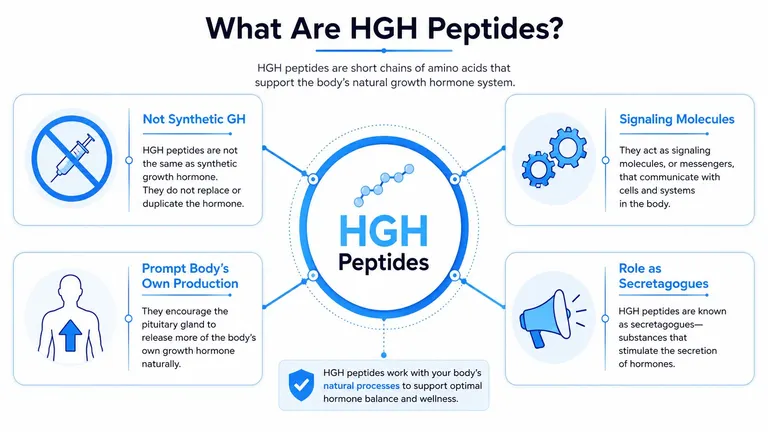
The two broad families people usually discuss are GHRH analogs and GHRPs. GHRH means growth hormone-releasing hormone, the hypothalamic signal that pushes the axis toward release. GHRPs are growth hormone-releasing peptides, which usually act through different receptor pathways and can work alongside GHRH-like signaling. One group functions like a command from headquarters, and the other acts like a separate switch that helps the production line respond.
Why timing and physiology matter
Because HGH secretion is pulsatile, timing can shape the size and usefulness of any protocol. The largest spontaneous pulse often happens after sleep onset, so a protocol that ignores sleep timing ignores one of the body’s main release windows. The schedule should follow physiology, not convenience.
Useful mental model: peptides are closer to “press the release button” than “inject the final hormone.”
This is also why a random lab value can mislead. If the body is between pulses, a low reading does not necessarily prove a deficiency, and a normal-looking reading does not show the full picture. That distinction becomes important later when people compare laboratory numbers, timing, and practical protocol design.
GH Peptides vs Recombinant HGH
A person comparing treatment paths can get tripped up by the wording. Recombinant human growth hormone, also called somatropin, is the hormone itself. HGH peptides sit earlier in the chain, as upstream signals that tell the body to make more of its own hormone. Recombinant HGH is a 191-amino-acid polypeptide with the structural and manufacturing demands that come with replacing a hormone directly, which helps explain why it is handled as a different kind of medical product.
Stimulation versus replacement
That difference changes how each approach works in practice. A secretagogue tries to preserve the body’s own release pattern. Recombinant HGH skips that step and delivers the hormone directly.
For readers who want a clearer picture of the hormone form itself, this internal overview gives a useful companion explanation.
A simple way to frame it is this. The peptide is part of the signaling chain, while the hormone injection is the end product. If someone talks about “keeping the pulse natural,” they are usually referring to that upstream signaling idea, not direct hormone replacement.
Practical differences that matter
The clearest differences usually show up in three places.
- Mechanism: peptides stimulate release, recombinant HGH replaces the hormone directly.
- Feedback: peptide protocols aim to work within the body’s own signaling rhythm, while direct HGH use overrides that step.
- Classification: recombinant HGH is a tightly regulated drug product, while many peptide discussions happen in a more ambiguous research or compounding context.
Recombinant HGH also carries the manufacturing and regulatory weight that comes with a large polypeptide. That is part of why the market, the legal environment, and the sourcing conversation often feel different from the discussion around smaller signaling compounds. The practical gap is not just scientific, it shows up in access, oversight, and the way protocols are discussed.
Bottom line: if the goal is to understand protocol design, do not treat “HGH peptide” and “HGH” as interchangeable labels. They lead to different expectations, different monitoring, and different risk conversations.
The distinction also explains why some users prefer peptides. They want an indirect approach that feels more physiologic, closer to asking the body to do the work than replacing the hormone outright. Whether that tradeoff makes sense depends on the compound, the goal, and the quality of the evidence, which is where the next layer becomes more specific.
Common Types of Growth Hormone Peptides Explained
The names people hear most often usually fall into two buckets. GHRH analogs try to mimic the hypothalamic signal that tells the pituitary to release growth hormone. GHRPs work through different signaling routes and can be used in ways that are sometimes discussed as complementary. That’s the high-level map, but the individual compounds matter because their behavior in practice isn’t identical.
A quick comparison of the familiar names
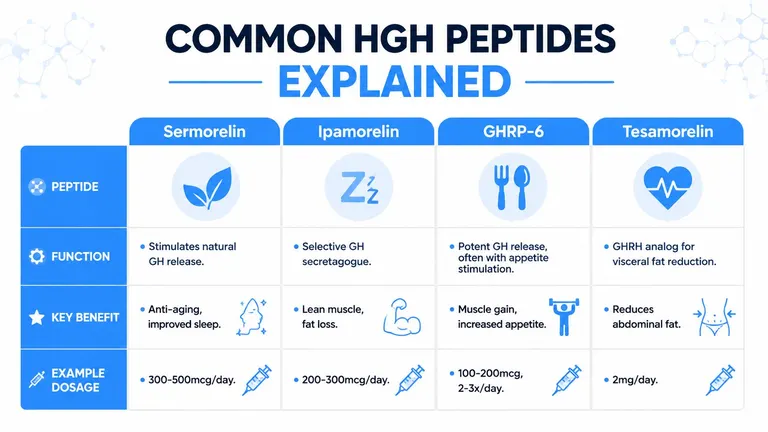
| Peptide | Class | Primary Mechanism | Common Dosing Frequency |
|---|---|---|---|
| Sermorelin | GHRH analog | Stimulates natural GH release | Often scheduled repeatedly in practice |
| Ipamorelin | GHRP | Selective GH secretagogue | Often scheduled repeatedly in practice |
| GHRP-6 | GHRP | Potent GH release, often with appetite stimulation | Often scheduled repeatedly in practice |
| Tesamorelin | GHRH analog | Used for a narrow visceral fat-related indication | Typically a daily schedule in its approved context |
Sermorelin, Ipamorelin, GHRP-6, and Tesamorelin
Sermorelin is often discussed as a classic GHRH analog. Its appeal comes from its relationship to natural signaling, not from being synthetic HGH. Ipamorelin is usually framed as a selective secretagogue, which is why it’s frequently grouped with recovery or body-composition conversations. GHRP-6 is known for strong GH release discussions and appetite-related chatter, which separates it from the more selective compounds. Tesamorelin stands apart because it has a specific approved use, unlike the broader wellness-oriented discussion around other names.
For a deeper look at the CJC-1295 and ipamorelin combination conversation, this internal guide covers the pairing in more detail.
Why half-life and dosing frequency come up so often
A short half-life means the body clears a compound quickly, which is one reason many secretagogues are discussed in multi-dose schedules. Longer-acting compounds change that rhythm, but they also change the monitoring conversation. The key point isn’t memorizing every molecule, it’s understanding that receptor target, duration, and use case all affect how a protocol gets built.
Read the label carefully: a peptide can sound familiar, but its class, intended context, and schedule logic may be completely different from the next one on the list.
That’s why broad “which peptide is best?” questions usually miss the core issue. The more useful question is, “Which compound best matches this goal, and what kind of evidence and scheduling burden comes with it?” The answer isn’t the same for every user, and it isn’t supposed to be.
Evidence for Benefits and Potential Risks
A person may hear the benefits first, better recovery, more lean mass, less fat, better sleep, or a general sense of youthfulness. The evidence is narrower than the marketing. In one placebo-controlled crossover study of healthy fasted volunteers, a single oral amino-acid supplement produced a 682% increase in mean HGH at 120 minutes after dosing, while placebo stayed near baseline, and the supplement produced a mean AUC of 20.4 ng/mL versus 19.7 ng/mL for placebo, with p=0.04 (PMC). Those numbers show that hormone levels can move. They do not show that every biochemical rise becomes a real-world change a person can feel or measure.

What the human data actually supports
A broader clinical review cited by Harvard reported that daily HGH injections over an average of 20 days increased lean body mass by 4.6 pounds and boosted IGF-1 by 88%, but did not improve measurable strength or exercise capacity, and caused more fluid retention and fatigue than placebo (PMC). That pattern matters because it separates a lab change from a functional change. A marker can rise while performance stays the same, which is why protocol design should be tied to the outcome someone actually wants.
For readers focused on physique goals, the conversation can drift toward a quick fix. A more grounded reference for general physique planning is achieve your body composition goals, but the growth hormone literature itself remains mixed and cautious.
Where the risk conversation starts
The most common concerns include fluid retention, fatigue, and other hormone-related side effects, especially when levels are pushed outside normal physiology. The growth hormone system connects to other metabolic pathways, so raising it is not a free exchange. Even when the biochemical signal increases, the tradeoffs can show up in how a person feels and functions.
Clinical caution: if a protocol promises a dramatic physique shift but never mentions side effects, monitoring, or the limits of the evidence, that’s a red flag.
The evidence gap matters even more for popular peptides that attract a lot of online discussion but have limited human data. A useful overview of the adverse effects people commonly discuss is available in this side effects guide, and it helps frame the benefit conversation more clearly. The practical question is whether a compound makes sense for a specific goal once cost, monitoring, legal status, and risk are all part of the same decision.
Safety Legality and Regulatory Landscape in 2026
The legal picture around HGH peptides is complicated because the market isn’t one thing. Some compounds have a narrow medical role, some live in compounding gray zones, and some circulate online as “research use only” products that don’t map cleanly onto ordinary patient care. That’s why the safest mental model is not “peptides are legal” or “peptides are illegal,” but “each compound sits in its own regulatory category.”
Approved use is narrow, and that matters
Tesamorelin is the clearest example of a peptide with an FDA-approved role, but its approval is narrow rather than broad. Outside that kind of defined indication, major consumer-facing summaries are cautious. Mayo Clinic’s position, as summarized in WebMD’s overview, is that there’s little evidence HGH helps otherwise healthy adults and that it shouldn’t be used for anti-aging, with risks including diabetes noted in the same discussion (WebMD).
That distinction matters because a lot of marketing blurs medical use with wellness use. A product can be discussed constantly online and still have limited support in the setting people are buying it for. The marketing language often skips the part where indication, evidence, and oversight all have to line up.
What an unregulated market changes
When source quality isn’t controlled, the risks aren’t limited to the molecule itself. Purity, contamination, and dosage accuracy become part of the safety equation. In a market where products are sold for “research” rather than regulated treatment, the label may not tell you enough about what’s in the vial, how it was handled, or whether the concentration matches what the user assumes.
The practical concern is simple. If a compound is meant to affect an endocrine axis, a mislabeled or poorly handled product can turn a planning issue into a safety issue quickly. That’s why third-party testing, source transparency, and clinician oversight matter so much more than polished branding or influencer screenshots.
Regulatory takeaway: the more a product relies on online hype, the more careful you need to be about evidence, source quality, and the actual legal pathway behind it.
The 2026 snapshot is still one of fragmentation. Some compounds remain attached to specific medical uses, while others sit outside a clean approval pathway. For readers trying to sort legitimate care from gray-market experimentation, the main task is not chasing the trendiest name. It’s checking whether the product has a real indication, a real source, and a realistic monitoring plan.
Practical Dosing and Scheduling Considerations
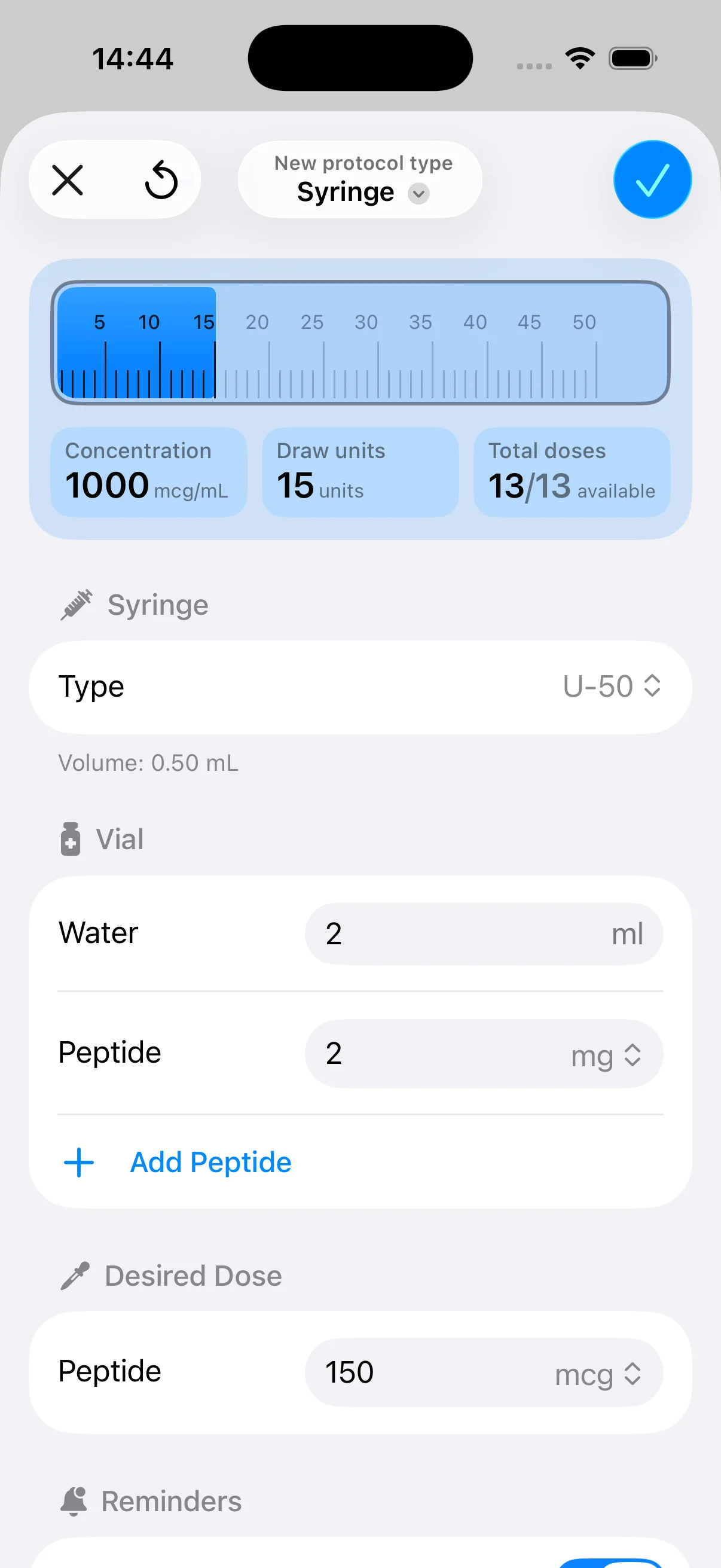
The hardest part of a peptide protocol often isn’t the biology, it’s the math. A prescribed dose in micrograms has to be converted into a vial-specific injection volume, and that calculation has to be redone whenever the vial concentration or reconstitution volume changes (PMC). That’s where most user error starts, because the numbers look small until they’re tied to an actual syringe.

The three places mistakes happen most often
First, people forget that changing the amount of diluent changes the final concentration. Second, they assume every vial of the same peptide behaves the same way, even though reconstitution changes the math. Third, they try to carry old calculations forward after the protocol changes, which is how inconsistency creeps in.
If you’re looking for a practical walkthrough on reconstituting peptides for research, that kind of reference is useful for understanding the handling side, but it doesn’t replace checking the math every time the vial setup changes.
Why scheduling discipline matters
HGH-related protocols are often discussed in cycles, with start dates, pause periods, and frequency rules that need to stay consistent. That consistency matters because the body’s hormone release is pulsatile and timing-sensitive, not flat and mechanical. If someone wants predictable tracking, they need a system for dose logs, reminders, and re-checking the plan when anything changes.
PepFlow is one example of a tool built around that problem, it provides a dosage calculator, protocol scheduling, and reminder tracking for peptide routines. That kind of organization doesn’t change the science, but it does reduce the chance that a user makes avoidable math or timing mistakes.
Simple rule: if you change the vial, re-check the vial math. If you change the schedule, re-check the schedule. If you’re guessing, you’re not really tracking.
The safest practical mindset is consistency over improvisation. Good protocols are usually boring in the best way, because the same calculations, logs, and reminders repeat cleanly enough to reduce mistakes. That’s the part people overlook when they focus only on the peptide name.
If you’re trying to make sense of an HGH peptide protocol, PepFlow helps with a common initial point of confusion, the dosage math and the schedule. Visit PepFlow to see how calculation, cycle planning, and reminders fit together when you want a routine that stays accurate from vial to vial.