
You’re reviewing a peptide plan, and one word keeps showing up in the notes from your clinic, coach, or online research: secretagogue. It sounds technical enough to be important, but vague enough to be risky. Is it a hormone? A peptide? A drug that forces your body to do something? And why would someone use a secretagogue instead of taking the hormone directly?
That confusion is common, especially in wellness, recovery, and body-composition conversations where people mix up growth hormone secretagogues, ghrelin mimetics, and plain hormone replacement. The distinction matters. A secretagogue doesn’t merely replace what your body makes. It signals your body to release something it already stores or is prepared to produce.
That hidden difference shapes protocol design, monitoring, and safety. It also affects expectations. If you understand what a secretagogue is, you can ask better questions about receptor targets, downstream hormones, and whether an indirect approach fits your goals better than direct hormone injections.
Table of Contents
- Introduction to Secretagogues
- Understanding Key Concepts
- How Secretagogues Work
- Main Classes and Representative Examples
- Physiological Effects and Clinical Applications
- Safety Risks and Monitoring Considerations
- Practical Guidance for Users
- Conclusion and Further Resources
Introduction to Secretagogues
Someone starts a recovery or physique protocol and hears two options. One is a direct hormone injection. The other is a secretagogue. At first glance, they sound like different roads to the same place.
They aren’t.
A secretagogue works indirectly. Instead of supplying the final hormone from outside the body, it stimulates a tissue or gland to release its own output. In peptide conversations, that usually means prompting the pituitary and related pathways to release endogenous growth hormone rather than injecting growth hormone itself.
That difference is easy to miss because the language around peptides often gets compressed into shortcuts. People say they’re “taking GH” when they are using a compound that signals GH release. Others assume indirect always means safer, gentler, or weaker. None of those assumptions hold in every case.
Secretagogues make the body answer a signal. Direct injections deliver the end product.
That’s why protocol design matters so much. If a compound works through receptors, pulsatile release, and upstream signaling, then timing, monitoring, and side effects won’t look exactly like a replacement model. The details become more important, not less.
Understanding Key Concepts
The simplest definition
A secretagogue is a substance that causes a cell, gland, or tissue to secrete something. Think of it as a doorbell rather than a delivery truck. It doesn’t bring the package. It tells the house to send something out.
That “something” depends on the system involved. In one context, a secretagogue may trigger growth hormone release. In another, it may stimulate insulin release from pancreatic beta cells. In the stomach, a secretagogue can promote gastric acid secretion.
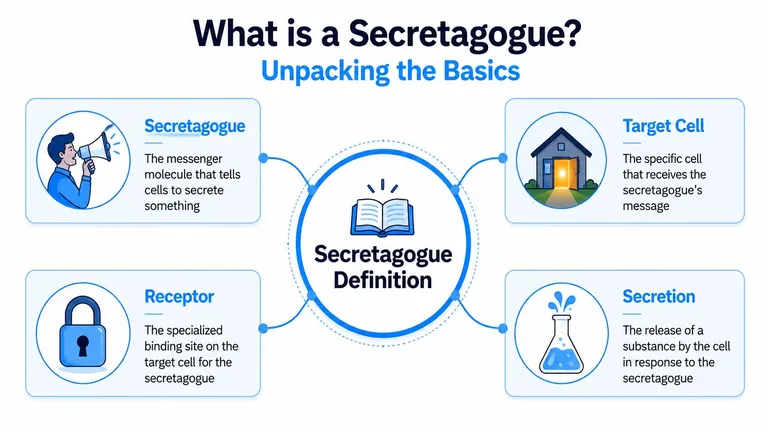
The common pattern is simple:
- A signaling molecule appears.
- It binds to a receptor or acts on a specific cellular target.
- The target cell responds.
- The cell releases a stored or newly mobilized substance.
Broad term versus peptide-specific use
Many readers get tripped up here. “What is a secretagogue” can be answered broadly or narrowly.
Broadly, it’s a physiology term. Natural examples include ghrelin, which has strong growth hormone-releasing activity mediated by hypothalamic-pituitary growth hormone secretagogue receptors, and gastrin, which acts as a gastric secretagogue that stimulates acid production through gastric mechanisms described in the medical literature on secretagogues and endocrine signaling (PubMed overview on ghrelin, gastrin, and related secretagogue functions).
In peptide and wellness discussions, the word often refers more specifically to growth hormone secretagogues. These are compounds used to stimulate the body’s own GH release rather than supplying GH directly.
Mental model: A hormone replacement acts like pouring water into a tank. A secretagogue acts like turning the valve that lets the tank release water on its own.
That broad-versus-specific split explains why the term can sound inconsistent online. It isn’t one exact substance. It’s a functional category.
How Secretagogues Work
The process starts at the cell surface or another molecular target. A secretagogue doesn’t work by wishful thinking. It works because it interacts with a receptor, channel, enzyme system, or cellular transport mechanism that can convert an outside signal into an internal response.
From signal to secretion
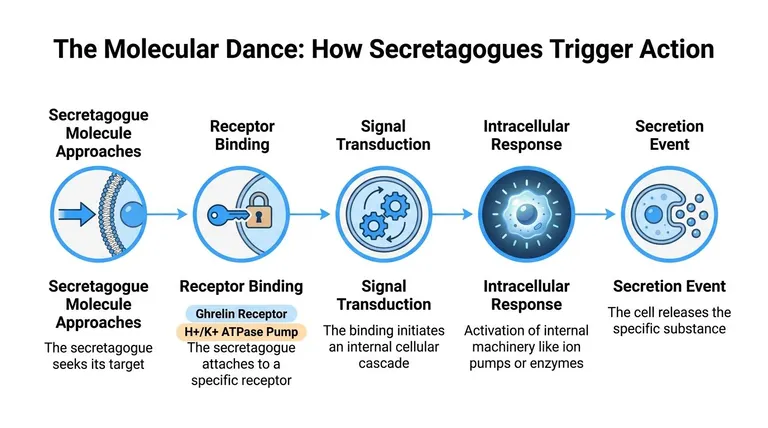
Here’s the basic sequence in plain language:
- Recognition: The secretagogue reaches the target tissue.
- Binding: It attaches to a receptor or affects a defined target on the cell.
- Signaling: The cell activates internal pathways.
- Mobilization: Vesicles, enzymes, ion channels, or pumps respond.
- Release: The cell secretes its product.
That internal signaling can involve calcium movement, membrane depolarization, second messengers, or vesicle trafficking. The exact route changes by tissue, but the logic stays the same. The signal at the surface gets translated into action inside the cell.
A useful peptide-specific example is ghrelin, which is described as a 28 amino acid-acylated peptide produced predominantly by the stomach, with strong GH-releasing activity mediated by hypothalamic-pituitary GH secretagogue receptors. The same literature notes that secretagogin in pancreatic cells helps regulate insulin granule trafficking through de-SUMOylation-related events (PubMed on ghrelin and secretagogin).
Comparing common GH-support stacks such as CJC-1295 and Ipamorelin can help connect receptor-level ideas to the protocol choices people discuss.
Examples across different systems
The stomach offers a clean example. Gastric secretagogues stimulate cells that increase acid output. The pancreas provides another. Some compounds increase insulin secretion by changing electrical activity in beta cells, which then triggers exocytosis.
Later in a protocol discussion, this matters because “secretagogue” doesn’t tell you enough by itself. You need to know:
- Which tissue is being targeted
- What is being secreted
- How selective the signal is
- Whether the pathway affects other hormones too
A short visual can make that chain easier to follow.
Main Classes and Representative Examples
Secretagogues aren’t one family with one mechanism. The cleaner way to understand them is by grouping them according to what they stimulate and how they do it.
How to think about the categories
In everyday peptide discussion, people often focus only on GH-related compounds. That’s useful, but incomplete. Medicine uses the same functional idea in metabolic and digestive settings too.
One group stimulates the growth hormone axis. Another stimulates insulin release. Others act in the digestive tract by promoting secretion such as gastric acid release.
If you’re evaluating protocol options, this broader view helps you avoid a common mistake. Two substances can both be called secretagogues while having very different targets, outcomes, and risk profiles.
Secretagogue classes and examples
| Class | Mechanism | Examples |
|---|---|---|
| Growth hormone secretagogues | Stimulate endogenous GH release through GH secretagogue receptor or related GH-releasing pathways | Ghrelin, MK-0677 |
| Gastric secretagogues | Stimulate gastric secretion mechanisms in the stomach | Gastrin, pentagastrin, histamine, acetylcholine |
| Insulin secretagogues | Increase pancreatic insulin release by altering beta-cell signaling and secretion | Glyburide, glipizide, repaglinide, nateglinide |
A clinically important class is the insulin secretagogue group. Sulfonylureas such as glyburide and glipizide, and meglitinide analogues such as repaglinide and nateglinide, increase pancreatic insulin release by closing ATP-sensitive K+ channels in beta cells, which triggers membrane depolarization and exocytotic discharge of stored insulin (NIH review on insulin secretagogues).
That mechanism is very different from the GH secretagogue world, even though the umbrella term is the same. If you’re comparing peptide discussions with dose-planning conversations, practical context around compounds like sermorelin can help. This guide on sermorelin dosage for weight loss is one example of how users translate class-level knowledge into protocol questions.
Classification first, brand names second. That order prevents a lot of confusion.
Physiological Effects and Clinical Applications
The effects of a secretagogue depend on the system being stimulated. Some increase digestive output. Some alter metabolic signaling. The most discussed in peptide circles are the compounds that act on the growth hormone and IGF-1 axis.
Growth hormone applications
Growth hormone secretagogues have attracted attention because they don’t replace hormone from outside the body. They act on signaling pathways that influence pulsatile GH release. In older adults, that distinction has been studied with MK-0677.
According to a review of growth hormone secretagogues, chronic administration of the long-acting GHS MK-0677 reversed the age-related decline in pulse-amplitude of GH secretion and restored IGF-1 levels to profiles typical of young adults, with measurable improvements in body composition in frail elderly subjects (PubMed review on MK-0677 and the GH/IGF-1 axis).
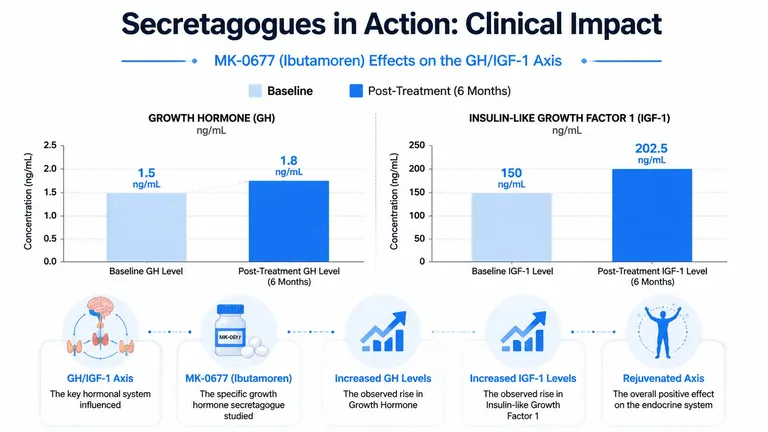
That finding matters because it supports a real physiological concept, not just a marketing phrase. The goal isn’t merely “more hormone.” The goal is influencing the axis, meaning the signaling relationship between GH release and downstream IGF-1 activity.
Digestive and metabolic applications
Outside GH protocols, secretagogues have well-established roles elsewhere in physiology and medicine.
Consider these examples:
- Gastric secretion: Gastrin and related agents stimulate acid-related processes in the stomach.
- Insulin release: Diabetes medications in the insulin secretagogue class increase pancreatic insulin output.
- Pituitary signaling: Some secretagogues act centrally, influencing pituitary hormone release through receptor-mediated pathways.
A secretagogue’s value comes from the pathway it recruits, not just the label on the bottle.
That’s also why clinical application is never one-size-fits-all. An athlete looking at recovery, an older adult discussing endocrine support, and a patient using an insulin secretagogue for glucose control are all dealing with the same general principle, but not the same practical decision.
Safety Risks and Monitoring Considerations
The biggest safety misconception is simple. People hear “indirect” and assume “mild.”
That’s not a safe assumption.
Why indirect does not mean risk-free
Growth hormone secretagogues don’t act with perfect exclusivity. Their signaling can extend beyond GH alone. In a review of GHS biology, researchers noted that growth hormone secretagogues not only stimulate GH release but also trigger ACTH and prolactin via somatostatin antagonism, showing that their activity is not fully specific to GH (PubMed review on GHS specificity and off-target pituitary effects).
That matters because users often compare a secretagogue to direct GH as if the only issue is “natural versus synthetic.” The pertinent question is broader. Which receptors and downstream hormones are being influenced, and how will that show up clinically?
A related concern in broader hormone planning is fertility. Anyone thinking across testosterone, GH-related compounds, or layered endocrine protocols should understand how different hormone strategies can affect reproductive function. This explainer on Cost Plus TRT on infertility is useful context when a protocol discussion starts drifting into multiple hormone systems.
What to monitor in practice
Monitoring should match the pathway, not just the product name.
Useful discussion points with a clinician include:
- Symptom tracking: New headaches, fluid-related symptoms, sleep changes, appetite changes, or mood shifts deserve attention.
- Hormone context: If a compound can influence ACTH or prolactin, your review shouldn’t stop at GH-related expectations.
- Protocol review: Timing, stacking, and dose frequency can change how strongly a pathway is pushed.
If you’re sorting through common peptide concerns in practical language, this guide to peptide side effects is a helpful companion.
Clinical habit: Don’t monitor only for the effect you want. Monitor for the hormones and symptoms the pathway can also influence.
Practical Guidance for Users
People usually ask the wrong first question. They ask, “What dose works?” A better opening question is, “What is this compound asking my body to release, and through which receptor system?”
Questions to ask before starting
Bring these questions to your prescriber or clinician:
- What exactly is being stimulated? Endogenous GH, insulin release, gastric secretion, or something else.
- How selective is the compound? If the pathway isn’t fully specific, what spillover effects should you watch for?
- What markers matter most? The answer depends on the protocol, but the point is to agree on markers before starting.
- What does success look like? Better recovery, body-composition change, sleep support, glucose control, or symptom relief are not interchangeable goals.
One distinction that many resources skip is the difference between indirect stimulation and direct replacement. A growth hormone secretagogue stimulates endogenous GH release, which may help avoid receptor downregulation associated with direct injections and support a more sustainable enhancement of the GH-IGF-I axis, as described in ScienceDirect’s overview of growth hormone secretagogues.
Daily protocol habits that matter
The boring details usually matter most.
- Keep timing consistent: Secretagogue protocols often depend on repeatable signaling patterns, so random use makes interpretation harder.
- Check your stack: Combining multiple compounds without understanding overlap can muddy both results and side effects.
- Support the basics: Recovery, sleep, and food quality still shape outcomes. If energy, training, or meal structure is part of your plan, PlateBird’s guide to energy foods is a useful practical resource.
- Store and prepare carefully: Poor handling can create user error that looks like a compound problem.
A secretagogue isn’t a shortcut around physiology. It is physiology. The better you respect timing, context, and monitoring, the more intelligently you can use it.
Conclusion and Further Resources
A secretagogue is best understood as a signal that causes secretion, not as a direct replacement for the substance being released. That single idea clears up a lot of confusion around peptides, hormones, and protocol design.
In practice, the most overlooked distinction is the one between indirect stimulation and direct hormone delivery. That difference shapes receptor behavior, downstream hormones, expected effects, and the kind of monitoring you need. It also explains why two protocols aimed at similar goals can feel very different in real use.
If you want to go deeper, stick with peer-reviewed literature, clinical guidance, and practical planning tools that help you stay consistent without turning dosing into guesswork.
If you’re managing a peptide schedule and want less manual math, PepFlow helps you calculate doses, organize cycles, set reminders, and keep your protocol consistent. It’s built for people who want a cleaner way to plan and track peptide routines, while keeping medical decision-making where it belongs, with a qualified clinician.