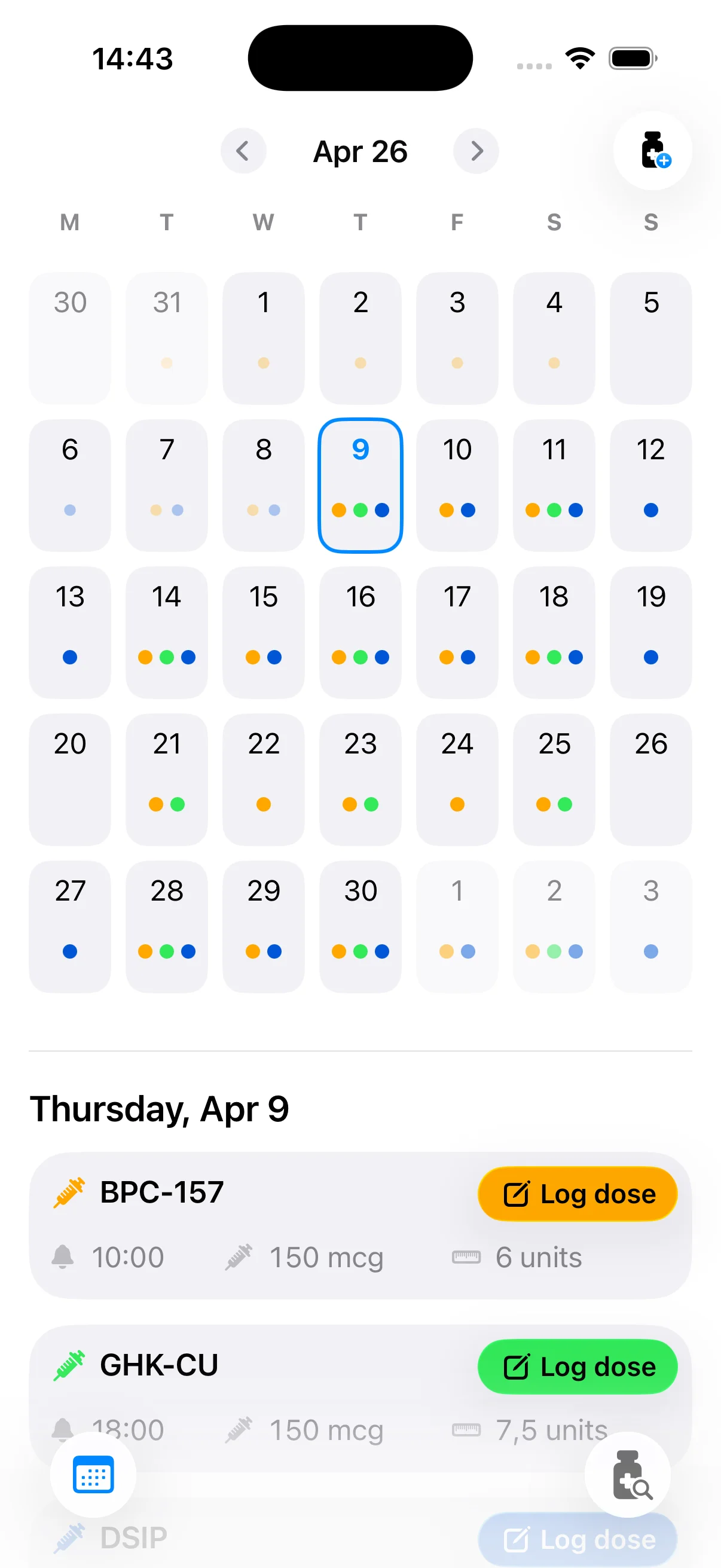
KLOW Stack dosage chart
This summary compares component doses by route. These are separate component amounts, not a combined blend dose.
| Component / route | Dose | Frequency & duration |
|---|---|---|
| BPC-157 · Injectable | 250–500 mcg | 1–2x daily · 4–8 wk |
| BPC-157 · Oral | 3 mg | 3 times daily · 14 days |
| BPC-157 · Topical | 1 mcg/g cream (mouse experiment) | Once daily · Observations through 21 days |
| TB-500 · Injectable | 2–4 mg | 2-3 times weekly · 4-8 weeks |
| GHK-Cu · Topical | 1–3% | 1–2x daily · 8–12 wk |
| GHK-Cu · Injectable | 1–2 mg | 1-2 times daily · 4-12 weeks |
| GHK-Cu · Transdermal | 2 mL of 5.8 mM (GHK)₂Cu donor solution | Single laboratory exposure · 9-hour human-skin experiment |
| KPV · Oral | 1–2 mg | 1-2 times daily · 4–8 wk |
| KPV · Topical | 10 mg per 30 mL serum (about 0.33 mg/mL) | Not established |
| KPV · Injectable | 1–2 mg | 1-2 times daily · 4–8 wk |
| KPV · Transdermal | 0.5 mL of 10 mg/mL donor solution (5 mg loaded) | Single laboratory exposure · 6-hour current application; 26-hour observation |
KLOW Stack dosage by administration route
BPC-157 · Injectable
Commonly reported injection protocols use 250–500 mcg per dose, 1–2x daily, for 4–8 wk. Once-daily schedules use one administration; twice-daily schedules separate morning and evening administrations. An alternative reported subcutaneous schedule uses 200 mcg daily in weeks 1–2, 400 mcg daily in weeks 3–4, and 600 mcg daily from week 5. An alternative schedule uses an 8–16-week course; this is separate from the fixed-dose pattern above.[12][58][15][16][53]
Subcutaneous BPC-157 is given beneath the skin. BPC-157 may support tendon, muscle and ligament repair.[12][58][15][16]
BPC-157 · Oral tablets
For the oral tablet formulation, the documented schedule is 3 mg every eight hours (3 times daily) for 14 days, totaling 9 mg per day.[20][21]
Oral BPC-157 may support protection and repair of the stomach and intestinal lining.[20][21]
BPC-157 · Topical — experimental mouse cream
The experimental burn-wound cream contains 1 mcg of BPC-157 per gram and is applied once daily, with observations through 21 days. This mouse preparation specifies a concentration, not a quantified amount of cream per application or a human topical regimen.[23][1]
Topical BPC-157 may support local skin and wound repair.[23][1]
TB-500 · Injectable
Reported injectable protocols use 2–4 mg per administration, 2-3 times weekly for 4-8 weeks. A separate reported daily subcutaneous pattern uses 500 mcg in weeks 1–2, 600 mcg in weeks 3–4, 750 mcg in weeks 5–8, then 1 mg in weeks 9–12. Its daily microgram amounts are distinct from a milligram amount given two or three times weekly.[12][13][54]
TB-500 is the N-acetylated LKKTETQ fragment associated with thymosin beta-4 biology. Its proposed role concerns cell movement and soft-tissue remodeling; benefits from the fragment are not interchangeable with those of full-length thymosin beta-4.[26][12][13][27][4]
GHK-Cu · Topical
Reported topical GHK-Cu routines use 1–3% formulations applied once or twice daily for 8–12 weeks.[51]
GHK-Cu is a copper-binding signal peptide involved in collagen and extracellular-matrix turnover. Topical formulations may support skin texture and appearance.[25][33][34][9][6][8][35][36][51]
GHK-Cu · Injectable
Reported injectable protocols use 1–2 mg per administration, 1-2 times daily for 4-12 weeks. An alternative reported subcutaneous schedule steps from 1 mg in weeks 1–4 to 1.5 mg in weeks 5–8 and 2 mg from week 9, on three or five days per week, over 8–12 weeks.[33][13][7][52]
Injectable GHK-Cu produces systemic exposure to a copper-binding peptide. The skin-appearance findings for topical cosmetics do not establish the effects of systemic administration.[13][6][8][35][33][36]
GHK-Cu · Transdermal — ex vivo microneedles
The microneedle experiment places 2 mL of 5.8 mM (GHK)₂Cu solution over a 1 cm² excised-skin sample, with human-skin permeation measured over 9 hours. The starting complex has a 2:1 GHK-to-copper molar ratio. This is the donor solution placed above the skin, not the amount absorbed or a patient patch dose.[37]
Transdermal GHK-Cu depends on its carrier and delivery system. A consistent absorbed amount or systemic treatment effect has not been established for these preparations.[37][6][8][35][33][36]
KPV · Oral
Reported oral protocols use 1–2 mg per administration, 1-2 times daily. The listed course is 4–8 wk. Another reported pattern lists 300–500 mcg once daily for 4–8 weeks for oral or subcutaneous administration. It differs from the milligram range above; a change of route does not justify substituting one amount for another.[41][42][51][55]
KPV is the three-amino-acid C-terminal fragment of alpha-MSH. Its proposed role concerns inflammatory signaling at gut and skin barriers.[41][42][43][44]
KPV · Topical
A ready-to-use KPV cosmetic serum contains 10 mg per 30 mL, approximately 0.33 mg/mL. This concentration describes the specific external-use serum; the public directions do not quantify an amount per application, daily frequency or course length.[50]
KPV is the three-amino-acid C-terminal fragment of alpha-MSH. Its proposed role concerns inflammatory signaling at gut and skin barriers.[45][43][44][41]
KPV · Injectable
Reported injectable protocols use 1–2 mg per administration, 1-2 times daily. The listed course is 4–8 wk. An alternative schedule uses 300–500 mcg once daily over 4–8 weeks for subcutaneous use. This is an alternative reported microgram pattern, separate from the 1–2 mg pattern above.[46][47][51][55]
KPV is the three-amino-acid C-terminal fragment of alpha-MSH. Its proposed role concerns inflammatory signaling at gut and skin barriers.[46][47][43][44][41]
KPV · Transdermal — ex vivo iontophoresis / microneedles
An excised-human-skin experiment uses 0.5 mL of 10 mg/mL KPV in the donor chamber, totaling 5 mg loaded over 0.64 cm². The iontophoresis comparison applies current for 6 hours and measures permeation over 26 hours. These figures describe the laboratory reservoir and observation period, not an absorbed amount or a daily patch course.[48][56]
The microneedle and iontophoresis comparisons measure transport across excised skin. A reservoir concentration and skin-permeation rate are separate measurements, and neither supplies a human patch course.[48][43][44][41]
Frequency and timing
BPC-157: Once-daily schedules use a morning or evening administration; twice-daily schedules separate morning and evening administrations. The oral tablet schedule uses an eight-hour interval.[12][58][15][16][20][21][23][1]
TB-500: Injections are commonly timed after a workout or in the evening.[12]
GHK-Cu: Topical products are applied in the morning or evening; injection timing follows a consistent morning or evening schedule. Experimental transdermal preparations follow their own application and observation periods.[7][13][51][33][37]
KPV: Morning or evening timing is common.[41]
Cycle length and breaks
BPC-157: Injectable courses run 4–8 weeks. Reported clinic protocols include a 2–4-week break between injectable courses; long-term safety remains unknown, including with cycling. The oral tablet schedule spans 14 days.[59][57][12][20][21]
TB-500: Injectable: 4-8 weeks. A standard break interval between courses is not established.[12][13]
GHK-Cu: Topical: 8–12 wk. Injectable: 4-12 weeks. Transdermal — ex vivo microneedles: 9-hour human-skin experiment. A standard break interval between courses is not established.[51][33][13][7][37]
KPV: Oral: 4–8 wk. Injectable: 4–8 wk. Transdermal — ex vivo iontophoresis / microneedles: 6-hour current application; 26-hour observation. A standard break interval between courses is not established.[41][42][51][46][47][48][56]
KLOW Stack dosage calculator
Calculate each separately prepared component using its own vial strength and final volume. A fixed-ratio blend requires the amount of every component; the total blend weight alone is insufficient.
See the reconstitution guidelines for preparation terms. For the distinction between separate preparations and mixed vials, read the mixing versus co-scheduling explainer.
KLOW Stack safety and side effects
Combination and product quality
KLOW has no validated four-component treatment regimen. Fixed-ratio products restrict independent adjustment of BPC-157, TB-500, GHK-Cu and KPV. Copper exposure, gastrointestinal symptoms and overlapping injection-site reactions can make adverse effects difficult to attribute.[12][13][2][14]
Side effects and long-term safety
BPC-157: Route-specific pharmacokinetics, dose-ranging, long-term safety, interactions, safety in special populations, product purity and human recovery outcomes remain unresolved. Small human reports have not shown a clear adverse-event pattern. FDA identifies compounding concerns involving immunogenicity for certain routes, peptide-related impurities and active-ingredient characterization; sports-medicine reviews also warn about unapproved peptide-market risks.[20][17][12][13][18][2]
TB-500: Local injection-site irritation is a practical concern, while fragment-specific systemic adverse-event rates remain unresolved. Pharmacokinetics, long-term safety, human recovery outcomes and whether commercial products match the material described remain uncertain. FDA has not identified human exposure data for drug products containing TB-500.[13][12][26][28][29]
GHK-Cu: For topical GHK-Cu, local irritation, stinging, redness, itching and sensitivity are the main tolerability concerns. Vehicle, pH, delivery method, copper loading and peptide content can change tolerability and performance. Injectable or systemic exposure adds concerns about aggregation, impurities, immunogenicity and product quality. Long-term injectable safety, human dose-ranging and route-specific interactions remain uncertain.[7][37][13][34][25][9][38]
KPV: Oral use raises gastrointestinal-tolerance and disease-context questions; topical use raises local irritation and formulation questions. Route-specific absorption, degradation, tissue exposure and dose-response remain unresolved.[46][45][41][49][43]
Route-specific dosing limits
Separate products and fixed-ratio blends have different preparation requirements. Keep the exact formulation, component amount and route with each recorded dose.
Peptides in KLOW Stack
Open each full dosage guide for its routes, schedules and references.
Common KLOW Stack dosage questions
Does KLOW Stack have one combined dose?
Each component has its own amount and schedule. A stack name does not define a blend ratio or combined dose.
Can the component doses be calculated separately?
Yes, for separately prepared components. Use each vial's peptide amount and final volume in the calculator. A combined vial requires its exact component composition.