GHK-Cu dosage chart
This summary table compares available dose amounts and schedules by administration route.
| Route | Dose | Frequency & duration |
|---|---|---|
| Topical | 1–3% | 1–2x daily · 8–12 wk |
| Injectable | 1–2 mg | 1-2 times daily · 4-12 weeks |
| Transdermal | 2 mL of 5.8 mM (GHK)₂Cu donor solution | Single laboratory exposure · 9-hour human-skin experiment |
GHK-Cu dosage by administration route
GHK-Cu topical dosage
Reported topical GHK-Cu routines use 1–3% formulations applied once or twice daily for 8–12 weeks.[18]
GHK-Cu is a copper-binding signal peptide involved in collagen and extracellular-matrix turnover. Topical formulations may support skin texture and appearance.[1][2][3][4][5][6][7][8][18]
GHK-Cu injectable dosage
Reported injectable protocols use 1–2 mg per administration, 1-2 times daily for 4-12 weeks. An alternative reported subcutaneous schedule steps from 1 mg in weeks 1–4 to 1.5 mg in weeks 5–8 and 2 mg from week 9, on three or five days per week, over 8–12 weeks.[2][11][9][19]
Injectable GHK-Cu produces systemic exposure to a copper-binding peptide. The skin-appearance findings for topical cosmetics do not establish the effects of systemic administration.[11][5][6][7][2][8]
GHK-Cu transdermal — ex vivo microneedles dosage
The microneedle experiment places 2 mL of 5.8 mM (GHK)₂Cu solution over a 1 cm² excised-skin sample, with human-skin permeation measured over 9 hours. The starting complex has a 2:1 GHK-to-copper molar ratio. This is the donor solution placed above the skin, not the amount absorbed or a patient patch dose.[10]
Transdermal GHK-Cu depends on its carrier and delivery system. A consistent absorbed amount or systemic treatment effect has not been established for these preparations.[10][5][6][7][2][8]
GHK-Cu dosage calculator
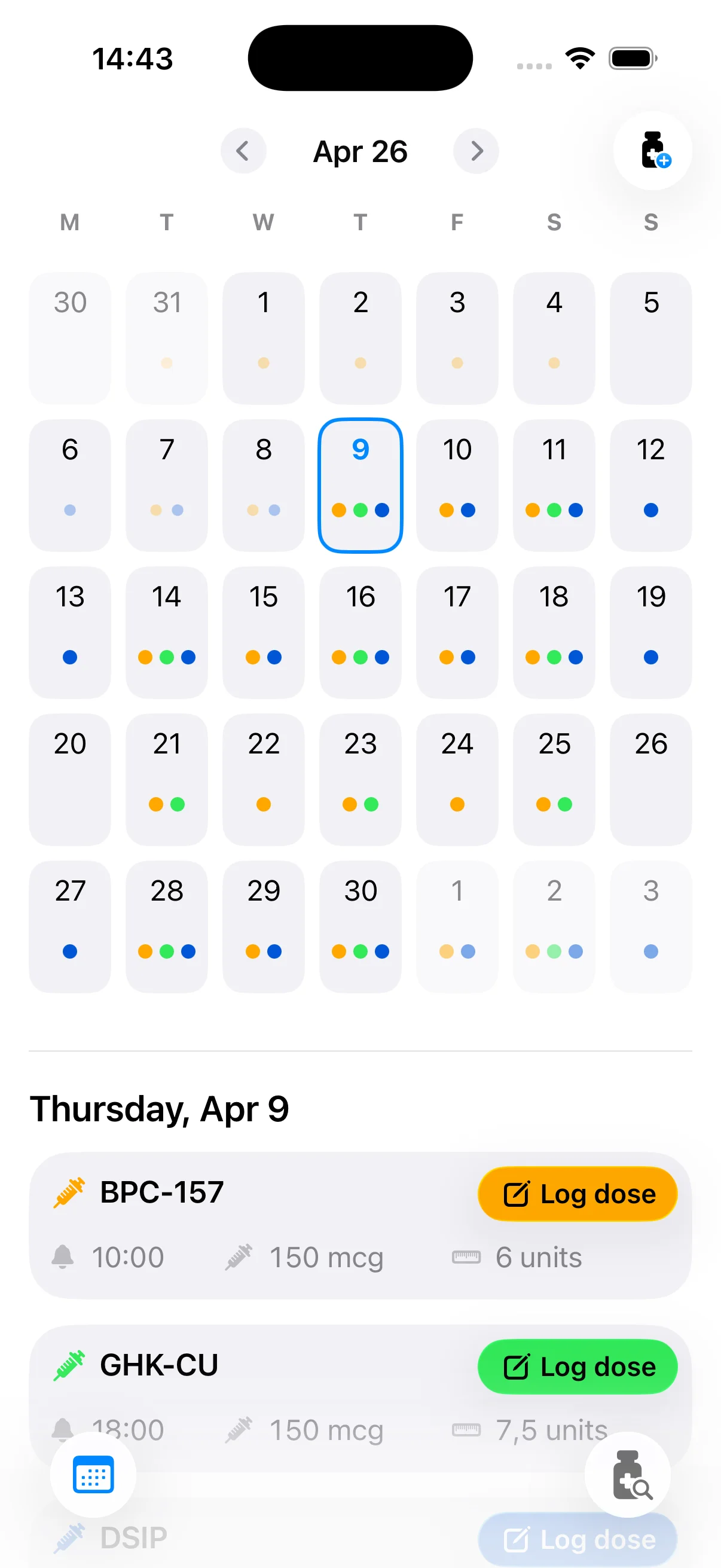
Convert your chosen GHK-Cu amount into volume and U-100 syringe units. Adjust the inputs to match your vial and preparation.
GHK-Cu safety and side effects
Side effects and long-term safety
For topical GHK-Cu, local irritation, stinging, redness, itching and sensitivity are the main tolerability concerns. Vehicle, pH, delivery method, copper loading and peptide content can change tolerability and performance. Injectable or systemic exposure adds concerns about aggregation, impurities, immunogenicity and product quality. Long-term injectable safety, human dose-ranging and route-specific interactions remain uncertain.[9][10][11][3][1][4][12]
Route-specific dosing limits
Systemic exposure deserves extra caution in copper-handling disorders such as Wilson disease, where copper accumulates in the body. Additional schedules attributed to Everything Peptide are reported patterns; citing research does not make these schedules clinically established or approved product instructions.[12][11][19]
Stacks that include GHK-Cu
Open a stack dosage guide for its component amounts, schedules and supporting information.
For a blend calculation, each component's amount and the final volume must be known. A total blend weight alone cannot tell you the dose of each component.