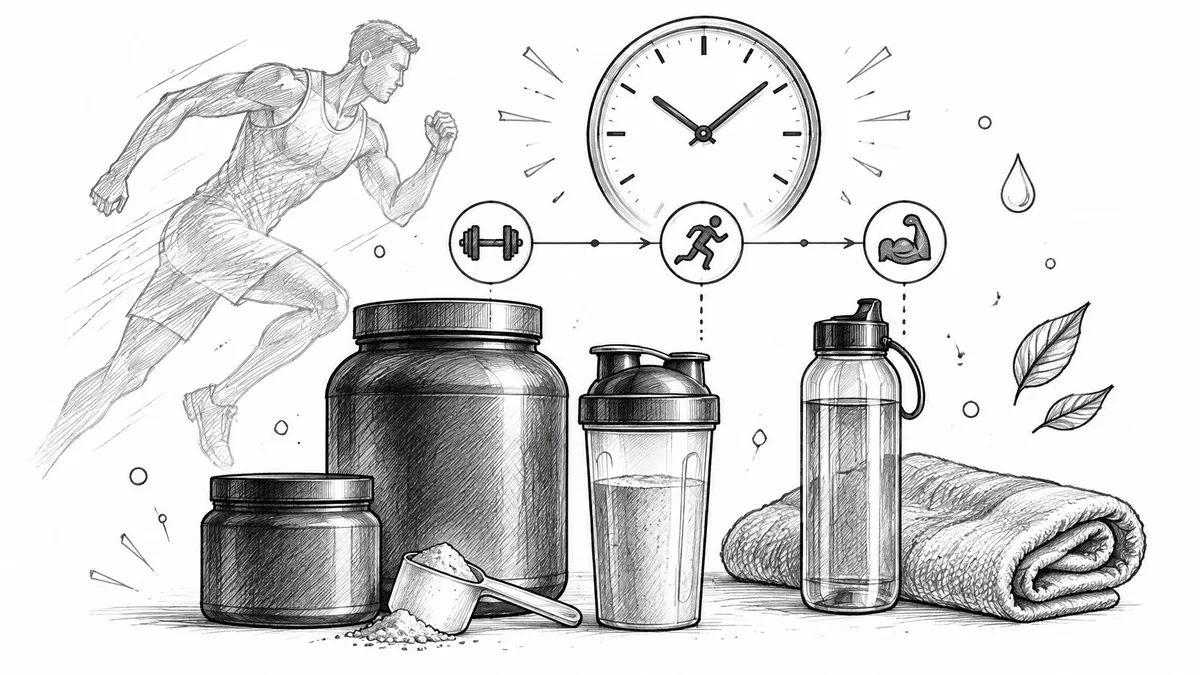
The most popular workout advice puts every bottle in a pre, intra, or post slot. That clock is useful for a few products and clutter for the rest. A workout supplement schedule that people can keep starts by sorting the shelf. Daily-adherence products earn their place when the serving happens on a steady rhythm, including rest days. A smaller set can change the session or the sleep that follows, so the hour is the point.
Protein, creatine monohydrate, and a basic vitamin mostly require a habit. Caffeine, and carbohydrate with protein after hard work, are the rows where the clock can matter. Labels and a clinician still set the dose. The schedule only decides where a chosen serving sits on the day you train.
Table of Contents
- Workout Supplement Timing You Can Scan
- How to Place Supplements Around One Session
- Scale the Schedule to Your Day
- Fix Missed Doses and Rough Timing
- Log One Week and Act on It
Workout Supplement Timing You Can Scan
Most cards treat a shake, a scoop, and a stimulant as if they share one timeline. They don’t. Daily products fail when you skip them, not when you miss a magic minute. Session-linked products fail when the hour fights the workout or the night.
An eight-week study in collegiate athletes found that creatine timing produced no additional effect on measured training adaptations or body composition. A Frontiers in Sports and Active Living review also reports recovery benefits from immediate post-exercise protein and carbohydrate, and that finding doesn’t carry over to creatine, vitamins, or stimulants.
How to read the card
Match the product you already use to one row. The pattern is placement, not a new prescription.
| Product | Where it sits | Practical pattern | What to prioritize |
|---|---|---|---|
| Protein | One 20–40 g serving in the pre- or post-training window; other servings every 3–4 hours | About 1.4–2.0 g per kg per day; each serving about 10–12 g essential amino acids for roughly 3–4 hours of elevated synthesis | Daily total over an immediate post-workout deadline; response can stay elevated at least 24 hours |
| Creatine monohydrate | Any consistent time of day; not required immediately before training | 3–5 g daily, or about 20 g per day for 5 days as four 5 g doses about 4 hours apart, then 3–5 g daily | Taking it every day and watching gut tolerance |
| Caffeine | Before exercise, during exercise, or as fatigue develops | Trial in training, not first in competition; half-life about 5 hours | Clock time versus bedtime, residual caffeine, and sleep |
| Carbohydrate with protein | Immediately after demanding sessions when recovery is the goal | Pair carbohydrate with a protein serving after hard training | Recovery from that session, not a rule for every other product |
| Ordinary daily products such as a basic vitamin | With a meal already in the day | Whatever the label and a clinician specify | A repeatable meal anchor, not a workout clock |
| Intra-session fluid or electrolytes | Sipped during long or hot sessions | Only for the sessions that actually run long or sweaty | Session length and conditions, not a fixed minute mark |
Protein is the daily-total row, with one serving beside training and the rest on meals. Creatine is the any-time row. A short load is optional and often harder on the gut. Caffeine is the bedtime row, so you trial it on an ordinary training day. Carbohydrate with protein is for recovery after demanding work. A vitamin rides a meal. Electrolytes show up only when the session is long or hot.
Practical rule: Match the row to the product, then follow the label and a qualified professional for the actual dose.
How to Place Supplements Around One Session
Tuesday is a normal training day, not a race. Write the day before you touch a scoop. Training starts at 17:30, runs about 60 minutes, and bedtime is 22:30. The card below is that evening, not a blank template.
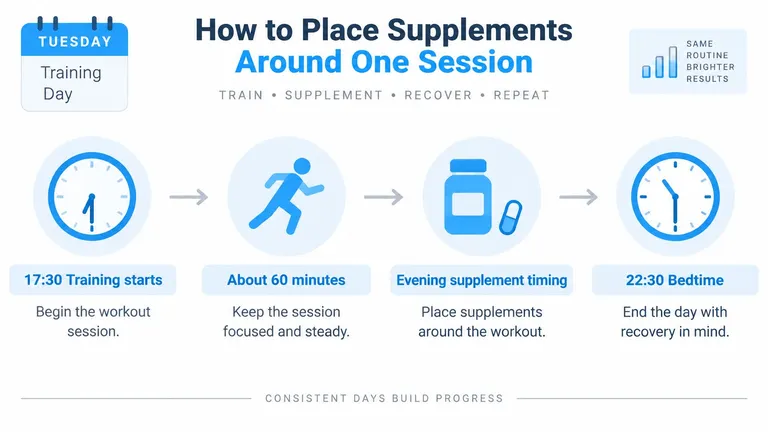
- Write the frame first. Put 17:30, about 60 minutes, and 22:30 on the card so every later choice has a bedtime to protect.
- Anchor daily items to meals you already eat. Creatine goes with breakfast at the same clock time every day, including the rest days you’ll copy later, because the point is the daily serving, not the gym door.
- Place caffeine against bedtime. A dose around 16:30 can still be in your system near 22:30, so move it earlier, use a smaller amount only as fatigue builds inside the session, or skip it if last night was short. Trial that choice on this Tuesday, not on a test day.
- Put one protein serving in the pre- or post-training window. Leave the other servings on the meals you already space through the day. Don’t invent a second shake to hit a magic minute. If you want a plain companion on amino-acid timing, NexiHerb’s note on the best time to take aminos is worth a read, and it still leaves the serving size to your label.
- Add fluid during the session only if this workout is long or hot. A standard hour in a cool gym doesn’t need a special drink.
- Close the day with two lines. Mark taken or skipped, then note gut upset, jitters, or sleep. A separate recovery protocol, including anything you track alongside peptides for recovery, stays on its own line.
- Copy the day onto a rest-day card. Keep the breakfast creatine and the meal anchors. Delete the acute caffeine.
A short walk-through of the same evening makes the order easier to see before you fill the lines.
You now have a one-day card you can repeat. You don’t have a new dose.
Scale the Schedule to Your Day
Set protein before you move anything else. For most exercising adults seeking muscle gain or retention, a Journal of the International Society of Sports Nutrition review puts the benchmark at about 1.4–2.0 g of protein per kg of body weight per day, divided every 3–4 hours. Each serving in the 20–40 g band typically supplies about 10–12 g of essential amino acids. Missing an immediate shake doesn’t erase the session, because heightened responsiveness can last at least 24 hours.
One body weight, then the edits
Say you’re 70 kg and you aim at the middle of that range, about 1.6 g per kg. That lands near 112 g for the day. The full band is about 98–140 g. Four feedings near 28 g, or five nearer 22 g, stay inside 20–40 g and respect the 3–4 hour gap. Put one feeding beside the workout. Breakfast, lunch, dinner, and a snack hold the rest.
A 90 kg lifter at 1.6 g per kg needs about 144 g. Five or six feedings stay inside 20–40 g more easily than three huge ones. The change is the number of meals, not a new post-workout rule.
| Body weight | Daily target | Feedings |
|---|---|---|
| 70 kg | About 98–140 g per day; the middle near 112 g | Four feedings near 28 g, or five nearer 22 g |
| 90 kg at 1.6 g per kg | About 144 g | Five or six feedings kept inside 20–40 g |
Shift the workout, not the creatine. Morning training moves the protein serving to breakfast or the meal after. Creatine stays on its usual dose time. Twice-a-day training gets one protein serving near each session only if those servings were already inside the daily total. Don’t stack extra protein past the 2.0 g per kg top of the range without professional advice. A training schedule app can show when those sessions land so the protein feeding moves with them.
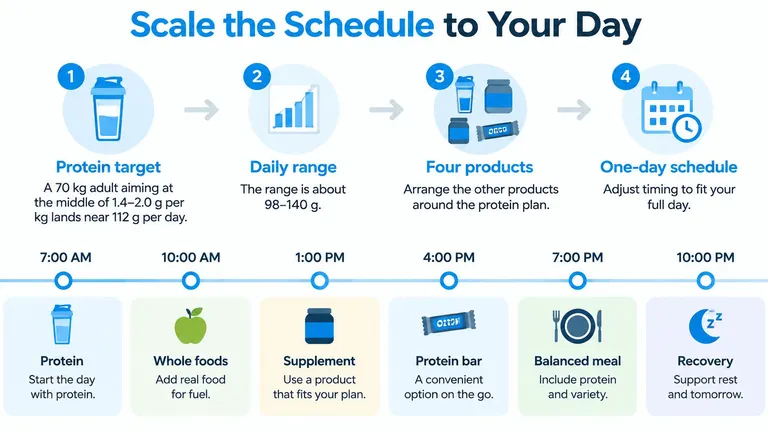
Long or hot endurance work is what earns an intra-session fluid plan. A 45-minute lift usually doesn’t. People with kidney disease, pregnancy, medication interactions, or a prescribed diet shouldn’t use these ranges as their plan.
Set the daily protein total first, then hang timing on meals and the session you actually have.
Fix Missed Doses and Rough Timing
A missed shake after lifting feels like a ruined workout. It isn’t. Take the next planned 20–40 g serving and keep a running daily total. Don’t double the serving to punish the miss.
Creatine and caffeine need different edits, which is why a review on creatine and caffeine scheduling doesn’t treat them as interchangeable. Creatine monohydrate can be a load of about 20 g a day for 5 days, commonly four 5 g doses about 4 hours apart, then 3–5 g a day, or a steady lower daily dose with no load. Taking it immediately before training isn’t established as essential. The Australian Institute of Sport notes that caffeine may be used before exercise, during it, or as fatigue develops, while an approximately 5-hour half-life means late-day use can interfere with sleep. Log dose, clock time, workout start, how it felt, sleep length, and symptoms, and trial the plan in training rather than in competition.
Three slips from a normal week
The load that upsets your stomach. Four 5 g creatine doses can be too much right now. Stop the load and use a single 3–5 g at a consistent time. The pre-workout minute was never the point.
The evening session that wrecks sleep. Residual caffeine from that half-life, plus a second serving, is the usual cause. Move the dose earlier, drop the repeat, and write down sleep length the next morning.
The cancelled workout. Daily creatine and meal-anchored products stay. The pre-workout stimulant doesn’t. If you started two new products the same week, separate them by what the labels already say and log the symptom against each one so you can tell which misbehaved.
| What happened | Why the schedule slipped | Change to make |
|---|---|---|
| Post-workout protein missed | Deadline treated as more important than the day | Take the next planned 20–40 g serving and keep the daily total; responsiveness can last at least 24 hours |
| Creatine loading causes gut trouble | About 20 g per day split into four 5 g doses is too much right now | Stop the load and use 3–5 g once daily at a consistent time |
| Sleep worse after an evening session | Caffeine half-life about 5 hours plus a repeat dose | Move caffeine earlier, skip the second serving, and log sleep length |
| Workout cancelled or rest day | Acute pre-workout item left on the card | Keep daily creatine and meal-anchored products; drop the session stimulant |
| Two products started together | No way to tell which caused a symptom | Separate by label directions and log the symptom against each product |
| Dose taken with no note of source | Later review cannot check quality or advice | Record product, amount, time, and whether it was third-party tested |
Repair the day you had. Don’t invent a tighter window.
None of these edits is a medical dose change.
Log One Week and Act on It
A perfect minute you can’t review is weaker than a week you can show a clinician. The source line matters because a 2025 study of student-athletes found that 80.5% reported using third-party-tested supplements, but only 17.8% used such products consistently, as described with related findings in this athlete supplement study. Separate research in that same discussion found supplement use among 91.1% of 659 Polish athletes, while knowledge of anti-doping and certification programs stayed a central concern.
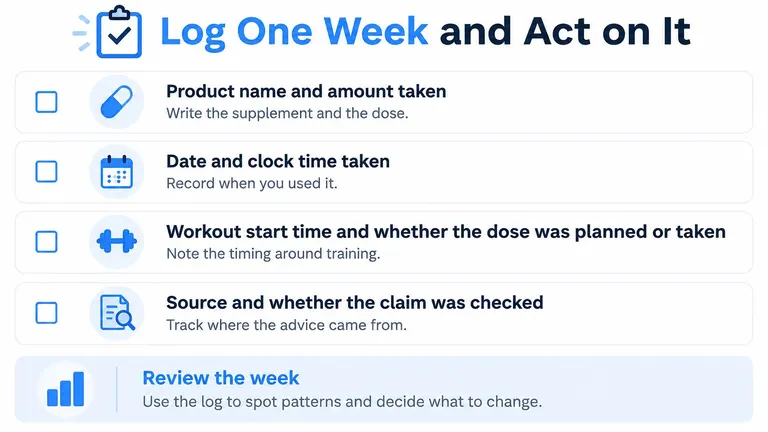
Fields to write before the week starts
- Product name and amount taken. Use the serving you swallowed, not the one on a teammate’s plan.
- Date and clock time taken. A blank time makes the bedtime problem invisible.
- Workout start, and whether the dose was planned or taken. A skip is data, not a failed week.
- Source, and whether the product is third-party tested. Awareness without a consistent product is the gap those student-athlete figures describe.
- Symptoms, sleep length, and any professional instruction. Gut, jitters, and a short night tell you which row to edit.
The seven-day card
Before you buy anything new, write this week’s card. Note training time, the daily anchors, one protein serving near training, a caffeine cutoff, and a rest-day version with the stimulant removed. Record planned versus taken for all seven days, including one missed or shortened session, and use the problem table instead of restarting Monday. Don’t start two new products in one week, and don’t copy a teammate’s dose.
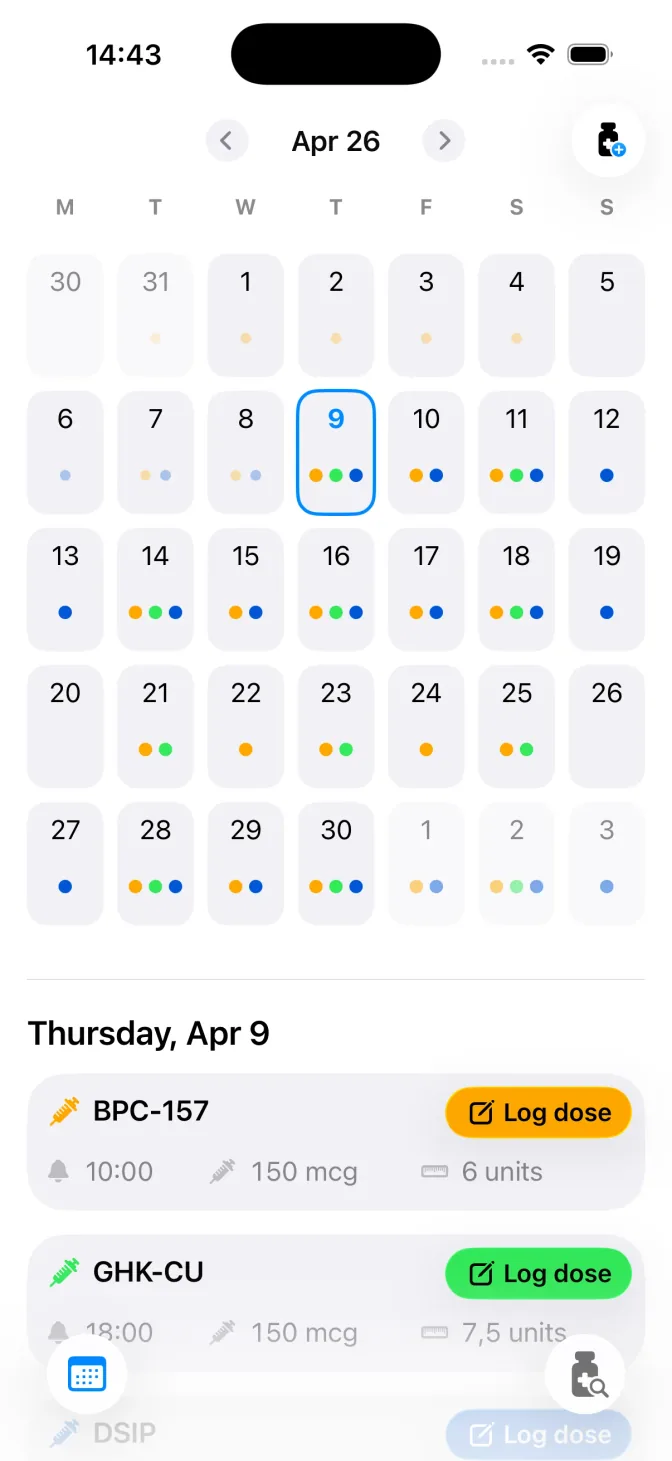
Keep any peptide or other protocol in the same history, with product, amount, date, cycle or pause, and symptoms. Change only the row that sleep, your stomach, or a professional told you to change. A supplement reminder app can hold that week so the card isn’t a scrap of paper. PepFlow records and organizes the instructions you chose. It doesn’t choose treatments or determine medically appropriate doses, it doesn’t replace medical advice, and reminders and logs support organization without guaranteeing adherence, safety, or results.
PepFlow keeps a workout supplement schedule in one history, with the times, amounts, cycles, and pauses you already decided, plus reminders so a rest day doesn’t erase the daily anchors. It organizes that record. It doesn’t pick your dose. If you want the week on your phone instead of a loose note, visit PepFlow.