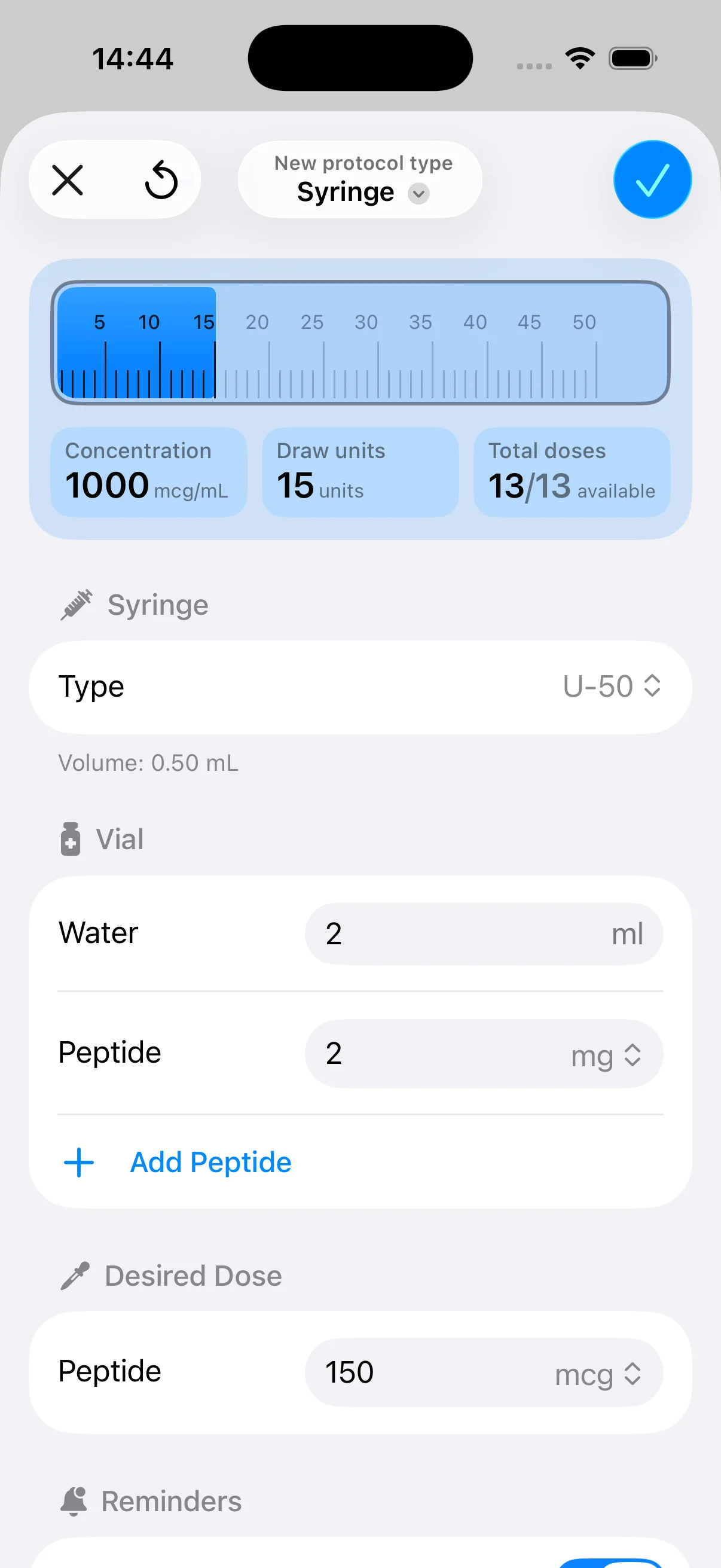
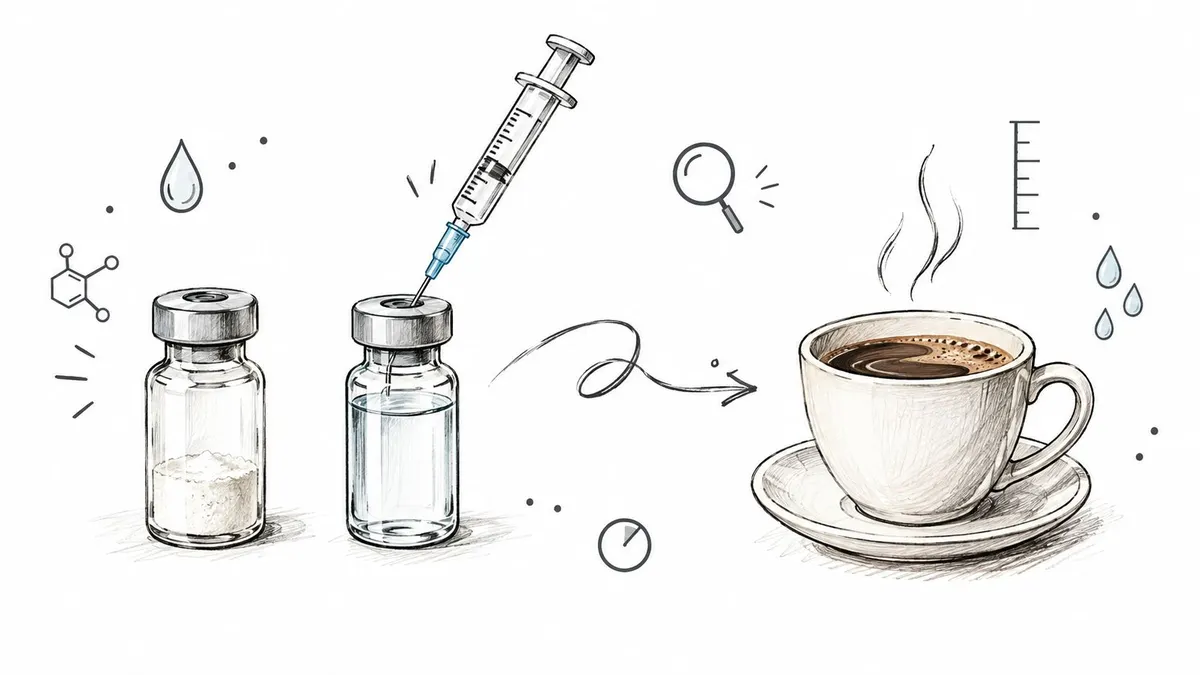
Reconstitution solution is a sterile diluent added to a lyophilized powder to create a measurable liquid dose, and the choice of diluent changes stability and storage. In one label example, 250 mg mixed with 1.9 mL yields about 125 mg/mL, while 500 mg mixed with 1.8 mL yields about 250 mg/mL, so the clear liquid isn’t just “water.” It helps determine the final concentration you’ll draw.
You’re probably here because you’re holding a small vial of powder and a separate vial of clear liquid, and the obvious question is simple: what is reconstitution solution, and why can’t any clean-looking liquid do the job?
That moment trips up a lot of people. The powder looks inactive. The liquid looks interchangeable. The instructions often feel shorter than the decision is. But reconstitution is less mysterious once you treat it as two linked jobs. First, you have to create the right concentration. Second, you have to use the right solvent for the product’s needs.
Table of Contents
- Introduction to Reconstitution Solutions
- What Reconstitution Solution Really Means
- Common Types of Reconstitution Solutions Compared
- How to Read Vial Labels and Understand Concentration
- Safe Handling Storage and Preparation Essentials
- Common Mistakes to Avoid During Reconstitution
- Putting It All Together for Accurate Dosing
Introduction to Reconstitution Solutions
You open a medication kit and see two simple parts. One vial holds powder. The other holds a clear liquid. At a glance, the liquid can seem generic, like any clean fluid would do. That assumption causes a lot of confusion.
A better starting point is dose math.
The powder contains a fixed amount of drug. The liquid sets the volume that fixed amount will be spread through. Once those two meet, you do not just have a dissolved product. You have a concentration, and concentration is what lets you measure a repeatable dose from the vial.
That is why reconstitution should be understood as two connected decisions. First, how much liquid creates the concentration the label expects. Second, which sterile liquid is compatible with that product’s chemistry, storage limits, and intended use. A single-use sterile diluent, a bacteriostatic multi-dose diluent, and an isotonic solution may all look alike in the vial, but they do different jobs.
Why the powder arrives dry
Many medications are supplied as powder because dry form often holds up better before use. Once liquid is added, stability, storage time, and handling rules can change quickly. The vial has crossed from long-term storage into a prepared product with a shorter use window.
That change is easy to underestimate.
The phrase reconstitution solution also causes trouble because it sounds like one specific product name. In practice, it means a category of sterile liquids used to prepare a dry medication according to its instructions. The right choice depends on the label, because the liquid does more than wet the powder. It can affect how well the drug dissolves, how long it stays usable, whether the solution is suitable for the intended route, and whether the final concentration matches the dose plan.
Safe reconstitution depends on matching three things: the powder, the exact diluent named in the instructions, and the target concentration.
What people are usually trying to figure out
When someone asks, “what is reconstitution solution,” question usually has three parts:
- What is it? A sterile liquid used to prepare a dry medication for measurement and dosing.
- Why does it matter? It affects the final concentration, compatibility, and how the product can be handled after mixing.
- How do I choose it? You use the specific diluent and volume listed by the manufacturer or product label.
As noted earlier, official reconstitution guidance also stresses practical details that matter in the world, such as using the named diluent, following the stated expiration and storage instructions after mixing, and mixing gently when the product directions call for it. If the wrong liquid goes in, or the right liquid goes in at the wrong volume, the result is not just a cosmetic mistake. It can change the concentration you draw, how the product behaves in solution, and how long it remains suitable for use.
What Reconstitution Solution Really Means
A vial contains 5 mg of powder. One person adds 1 mL of liquid. Another adds 2 mL. They started with the same drug amount, but they did not end up with the same liquid strength.
That is the core idea.
Reconstitution starts as a concentration problem
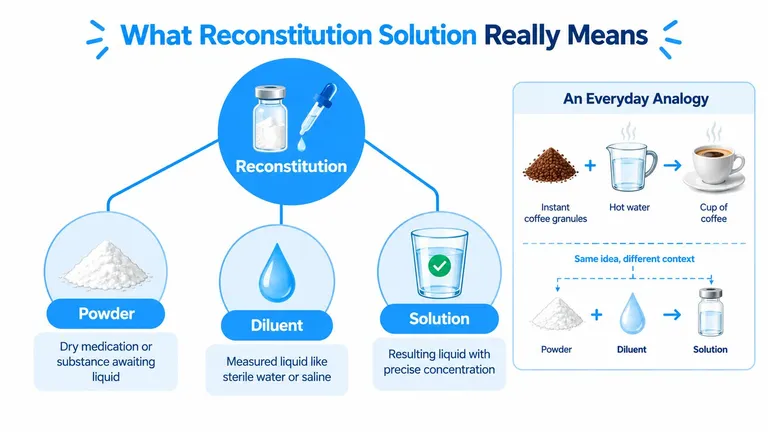
A lyophilized product is a medication that has been freeze-dried into a powder for stability. Reconstitution means adding a specified sterile liquid so that the powder becomes a measurable solution.
The useful question is not just “what liquid goes in the vial?” The better first question is, “what concentration should the final liquid have?”
Drug amount + exact diluent volume = final concentration you will measure from.
That equation clears up a lot of confusion. The powder provides the total amount of drug. The liquid sets how spread out that drug becomes in each milliliter.
Instant drink mix works as a rough everyday parallel. One packet in a small glass tastes stronger than the same packet in a large bottle. The packet did not change. The concentration did.
If you want a practical walk-through for a common peptide example, this guide on how to reconstitute semaglutide at home shows the step-by-step logic from dry vial to measured liquid.
The “solution” is not just filler liquid
People often treat all clear liquids as interchangeable because they look the same. In practice, each one has a job tied to use, handling, and route of administration.
Some diluents are meant for single use. Some contain a preservative and are chosen for multi-dose handling when the product instructions allow it. Some are selected because the final preparation needs to be isotonic, meaning it matches the salt balance the body tolerates better for certain uses.
So “reconstitution solution” is not one standard product name. It is a category. The exact liquid is chosen to help produce the intended concentration and the intended finished preparation.
That is why two vials of powder can require different liquids even if both powders look similar.
What the diluent is really doing
The diluent usually has more than one role at the same time:
- Dissolving the powder so the drug is evenly distributed
- Setting the final concentration so each drawn volume matches the dose plan
- Supporting the intended use pattern, such as single-use or multi-dose directions
- Matching formulation needs, such as preservative content or isotonicity when specified by the product
This is the part many quick explanations skip. The liquid is part of the formulation, not just a vehicle.
Proper mixing means complete dissolution, not aggressive shaking
In a kitchen, stronger stirring often helps. In a medication vial, that habit can be the wrong reflex. Product directions commonly call for gentle swirling or rolling so the powder dissolves without rough handling.
A quick visual check helps confirm whether the vial is ready:
- Appearance fits the product directions
- No visible particles remain
- No unexpected color change
- No powder clinging in clumps to the glass
A practical definition, then, is more precise than “the liquid you mix with the powder.” A reconstitution solution is the specified sterile liquid that turns a fixed amount of dry medication into a liquid with a known concentration, while also matching the product’s handling and use requirements.
Common Types of Reconstitution Solutions Compared
A common error starts with a simple visual shortcut. Three clear liquids sit on a counter, and someone treats them as if they differ only by name. In practice, each one changes the final preparation in a different way.
A better way to sort them is to start with the math, then assign the liquid its job. First, the powder and added volume create a target concentration. After that, the chosen diluent has to match how the product is meant to be used, whether that means single-use handling, multi-dose handling, or an isotonic final mixture.
The three solution types people mix up
The names that cause the most confusion are Sterile Water for Injection, bacteriostatic water, and 0.9% sodium chloride (saline).
Sterile Water for Injection is plain sterile water without preservatives. The product labeling describes it as sterile and nonpyrogenic, with no bacteriostat, antimicrobial agent, or added buffer, and it is commonly supplied in single-dose containers (DailyMed Sterile Water for Injection labeling). In everyday terms, it works like a fresh single-serving ingredient. Once used, any leftover portion is generally not kept for repeated entries.
Bacteriostatic water contains a preservative. Its role is not “stronger water.” Its practical purpose is to support situations where a vial may be entered more than once, if that matches the product directions. The preservative affects handling expectations, which is why it gets discussed so often in multi-dose contexts.
0.9% saline brings something different to the table. It is isotonic and contains sodium chloride, so it may be chosen when the finished preparation needs that salt balance or when the product specifically calls for it. That makes saline a formulation choice, not a universal substitute.
Compare them by job, not by appearance
| Solution Type | What it contributes | Typical role | Handling idea |
|---|---|---|---|
| Sterile Water for Injection | No preservative | Reconstitution for products that call for plain sterile water | Usually aligned with single-use handling |
| Bacteriostatic Water | Preservative present | Reconstitution where repeated vial entry may be part of the intended use | Often associated with multi-dose handling, if allowed by the label |
| 0.9% Saline | Isotonic salt solution | Products that require saline rather than plain water | Used when isotonicity or formulation compatibility matters |
That “job description” mindset prevents a lot of confusion.
Why saline is not a close substitute for water
Powdered drugs do not respond to every liquid the same way. One product may dissolve well in the specified water but behave differently in saline because dissolved salt changes the environment around the powder. Another may be designed specifically for saline because the final mixture needs to better match body fluids.
A kitchen analogy helps here. Flour, sugar, and gelatin all look like simple powders, but they behave differently in plain water, salty broth, or syrup. Medication powders are the same kind of problem, just with far less room for improvisation.
The practical point is simple. Clear does not mean interchangeable.
For readers who want a closer side-by-side of the two options that get confused most often, this guide on bacteriostatic water vs sterile water helps clarify how preservative content changes use.
For a parallel from another lab workflow, this spore vs liquid culture comparison shows the same broader principle. Starting materials that look similar can lead to different handling, storage, and contamination risks, so matching the medium to the task matters.
How to Read Vial Labels and Understand Concentration
A vial label can look simple until you realize it is answering two different questions at once. One part tells you how much drug is in the container. The other tells you what concentration you create after you add the specified liquid. If you skip the second part, the number on the syringe can mislead you.
That is why reconstitution starts as a concentration math problem.
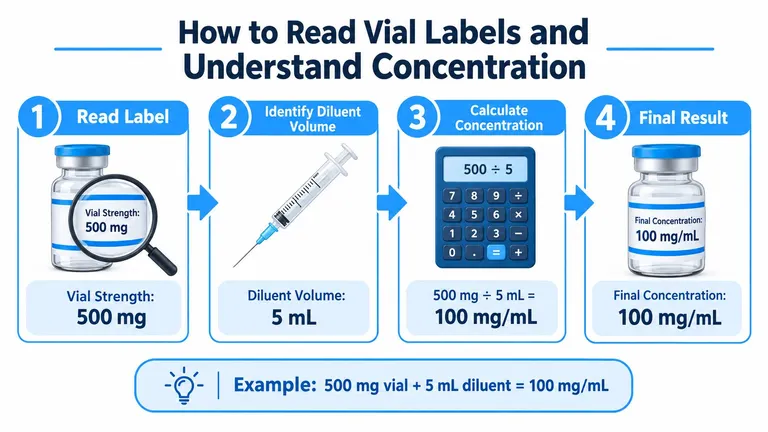
A good way to read the label is to move from total amount to final mixture, in the same order you would read a recipe.
- Find the vial strength. This is the total drug in the dry powder vial, such as 250 mg or 1000 mg.
- Find the exact reconstitution volume. This tells you how much of the specified diluent to add.
- Calculate or confirm the final concentration. This is the number that matters for dosing, usually written as mg/mL.
- Check the withdrawable volume if listed. The final usable amount in the vial may not match the amount of diluent you injected.
That last point causes confusion. Powder takes up space, and manufacturers may label the vial based on the final volume after mixing rather than the starting liquid volume alone. So “add 1.9 mL” and “final volume is 2 mL” are not interchangeable statements.
A prescribing information example shows how this works in practice. 250 mg reconstituted with 1.9 mL yields about 125 mg/mL, 500 mg with 1.8 mL yields about 250 mg/mL, and 1000 mg with 3.5 mL yields about 250 mg/mL (prescribing information example PDF).
Notice the pattern. The vial size changes. The added volume changes too. The concentration only makes sense once you combine both numbers.
A kitchen comparison helps here. Hot chocolate mix in a mug works the same way. One packet in a small cup tastes strong. The same packet in a large mug tastes weaker. The powder amount did not change. The concentration did.
That is the habit this section is trying to build. Do not ask only, “What liquid goes in?” Ask, “What concentration will that volume create?”
A few label-reading habits prevent many dosing mistakes:
- Separate mg from mL in your notes. Milligrams tell you drug amount. Milliliters tell you liquid volume.
- Write the final mg/mL clearly after mixing. That gives you the number you dose from.
- Recalculate for every new vial strength or dilution instruction. A familiar product can still produce a different concentration.
- Do not copy a past syringe volume without checking the new label. The same drug name does not guarantee the same mg/mL.
This also connects back to the earlier question about solvents. Sterile water, bacteriostatic water, and saline do different jobs, but once the correct liquid is chosen, the next safety step is mathematical: what concentration did that liquid create in this specific vial?
Clear liquid is not the whole story. The final mg per mL is.
Safe Handling Storage and Preparation Essentials
A common lab mistake looks harmless at first. The powder is correct, the liquid is clear, and the syringe shows roughly the right amount. Then one small handling error changes everything. The stopper was touched after cleaning, the wrong storage assumption was made, or the vial was shaken hard enough to create foam and uneven mixing.
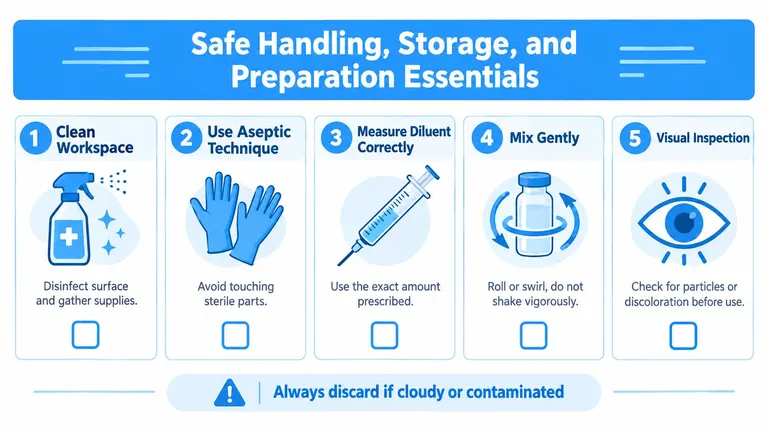
Safe preparation has two jobs. It protects sterility, and it protects the concentration you just calculated. Reconstitution is not only a clean-technique task. It is also a measuring task.
The preparation habits that matter most
Set up before you uncap anything. A quiet, clean workspace helps for the same reason a clear kitchen counter helps when you measure baking ingredients. Fewer distractions usually means fewer mix-ups between milligrams, milliliters, and vial types.
Once you begin, the highest-risk points are simple:
- Measure the exact diluent volume. A small volume error changes the final mg/mL.
- Clean vial stoppers and let them dry before puncturing.
- Avoid touching needle hubs, syringe tips, or vial openings after they are exposed.
- Mix gently unless the product instructions say otherwise. Swirling or slow rolling usually protects the solution better than forceful shaking.
- Inspect the final liquid. Cloudiness, particles, or unexpected color changes are reasons to stop and verify before use.
- Label the vial right away if storage is allowed. Include the concentration, date, and time.
The solvent choice still matters here, but for a different reason than in the comparison section. Sterile water, bacteriostatic water, and saline are not interchangeable clear liquids. Each one affects how the product is used after mixing. Single-use handling, multi-dose use, and tonicity are different jobs. If you want a closer look at preserved diluents and sterile workflow, this guide to BAC water reconstitution gives a practical example.
Why storage rules change after mixing
A dry powder is usually more stable than that same drug in liquid form. Once you add diluent, you create a ready-to-use solution with a shorter and more fragile life. That is why storage instructions often change immediately after reconstitution.
Preservative-free diluents need extra caution. Without an antimicrobial preservative, the solution has less built-in protection after the vial is entered and mixed. In plain terms, a single-use diluent should be treated like fresh food without preservatives. Safe for its intended use, but less forgiving once opened.
This is also where label discipline prevents quiet errors. A vial in the refrigerator can still be the wrong vial to use if no one wrote the concentration, preparation date, or beyond-use timing. Clean handling is only part of the job. Good records finish it.
A useful rule is simple. If you cannot confirm what was added, when it was mixed, and what concentration it now contains, do not guess. Recheck the product instructions or prepare a new vial.
Common Mistakes to Avoid During Reconstitution
A common failure pattern looks simple at first. Someone sees a vial of powder, reaches for a clear liquid, mixes quickly, and assumes the old syringe volume from last time still applies. That sequence can create the wrong concentration even before the first dose is drawn.
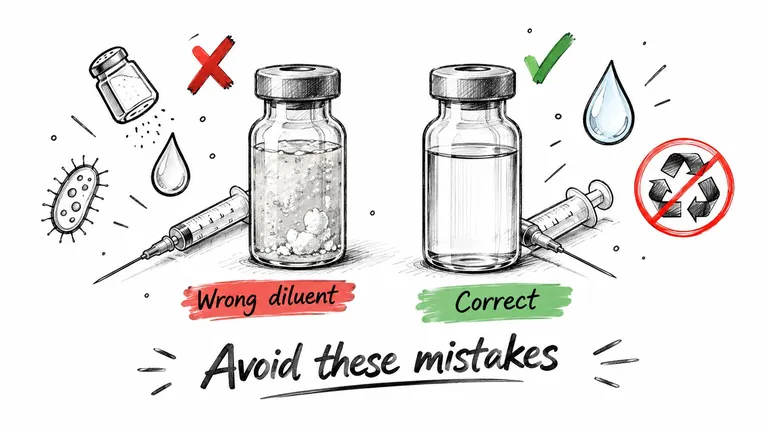
The safest way to catch mistakes is to sort them in the same order the task happens. First comes concentration math. Then comes solvent choice. Then comes handling.
Mistakes that start before the needle touches the vial
The first error is often mathematical, not mechanical. A vial contains a fixed amount of drug. The volume you add determines the concentration you create. Add the wrong amount, and every later step can look tidy while the dose is still wrong.
That is why “I always use 1 mL” is not a reliable rule. One powder strength, one diluent instruction, or one target dose can change the setup completely.
The next mistake is treating all clear liquids as interchangeable. They are not. Sterile water, bacteriostatic water, and saline each serve different jobs. One may be intended for single-use handling, another for multi-dose use because it contains a preservative, and another may be chosen because isotonicity matters for the finished preparation. The label decides which job matters for that product.
Mistakes that affect mixing quality and sterility
Technique matters after the math is set.
Forceful shaking can damage delicate products or create foam that makes inspection harder. Gentle swirling usually works better unless the product instructions say otherwise. A good comparison is dissolving a fragile ingredient into a drink. Stirring helps it disappear. Violent shaking can leave bubbles and make it harder to tell whether it dissolved.
Another mistake is partial mixing. A solution can look clear near the top while undissolved material remains against the glass or in the corners of the vial. If the powder is not fully dissolved, the concentration in the liquid you draw may not match the concentration you calculated.
Contamination errors are often quieter. Touching the stopper after cleaning it, reusing supplies that were meant for one-time use, or leaving an opened vial unlabeled can all turn a correct setup into an unreliable one.
The hidden dosing error people miss
Even with the right solvent and the right math, the delivered amount may differ from the amount prepared.
A nursing study on residual medication volume found that leftover liquid often remained in ampoule-vials after withdrawal, which means some prepared solution may stay behind instead of reaching the final dose (study PDF on residual medication volume).
This matters more when volumes are small. Losing a small visible drop from a large mixture may not change much. Losing that same amount from a tiny-volume preparation can shift the practical dose more than people expect.
A visual demonstration can help if you want to see common setup errors and handling habits in action.
Habits that prevent these errors
- Calculate the concentration first: Start with the vial strength and the exact volume to be added.
- Use the labeled diluent: Choose by product instructions, not by appearance.
- Mix gently and completely: Swirl until the solution is fully dissolved and visually uniform.
- Inspect before drawing: Stop if you see particles, cloudiness, or discoloration.
- Draw carefully: Smooth technique reduces avoidable leftover volume and dose drift.
- Label the prepared vial clearly: Write the concentration and preparation details so the next dose is based on facts, not memory.
Reconstitution works like recipe math under sterile conditions. The powder provides the fixed ingredient amount. The liquid sets the concentration. The handling determines whether that calculated dose is the one that reaches the syringe.
Putting It All Together for Accurate Dosing
You have a vial of powder, a syringe, and two clear liquids on the table. One is the correct diluent. The other may look interchangeable, but it changes the result. Accurate dosing starts by treating reconstitution as a concentration math problem first, because the liquid is not just there to “mix it up.” It sets the final strength of every amount you draw.
That is the point many readers miss when asking what is reconstitution solution. It is the sterile liquid used to create a known concentration from a fixed amount of dry medication. After that, each solvent has its own job. Some are meant for single-use preparation. Some contain preservatives for multi-dose handling. Some are chosen because the final solution needs to be closer to body fluid conditions. Clear does not mean equivalent.
A simple way to anchor the process is to read the vial like a recipe label. The powder gives you the fixed amount. The added liquid determines how concentrated the final mixture becomes. If 10 mg of powder is reconstituted with 1 mL, the concentration is 10 mg/mL. If that same 10 mg is reconstituted with 2 mL, the concentration becomes 5 mg/mL. The drug amount did not change. The draw volume for a given dose did.
That is why memory causes trouble. A remembered syringe mark from a previous vial only makes sense if the vial strength, added volume, and diluent instructions are all the same.
For repeated protocols, it helps to write the setup in one line: vial strength plus added volume equals final concentration. If you need help with that calculation, this guide on how much reconstitution solution to use walks through the math that determines the concentration you will draw from.
PepFlow can also help with the recordkeeping side of that process. It converts target amounts into draw measurements, logs vial setups, and tracks dosing schedules. That can reduce handwritten conversion errors, but it does not replace product labeling, sterile technique, or advice from a licensed clinician.
Use one final pause point before mixing. Confirm three things agree with each other: the label instructions, the concentration math, and the specific solvent selected for that vial. When those line up, the number on the syringe has a clear meaning.