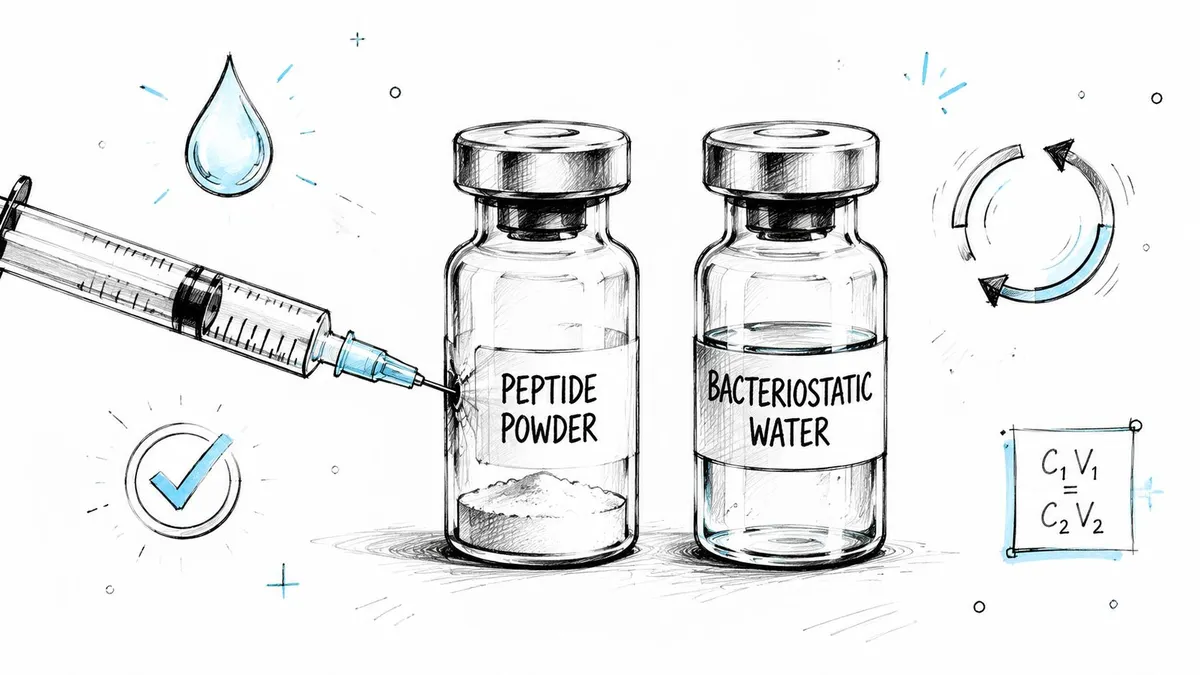
You’ve got a lyophilized peptide vial in one hand, bac water in the other, and one immediate concern. If this step goes wrong, everything after it gets less reliable. Bad math gives you the wrong concentration. Poor sterile technique invites contamination. Rough handling can leave you with foam, clumps, or a peptide that never fully dissolves.
That’s why bac water reconstitution deserves more respect than most guides give it. This isn’t just mixing liquid into powder. It’s a controlled preparation step that determines whether the peptide stays usable, whether repeated withdrawals remain reasonably safe under proper handling, and whether your dosing math means anything at all.
Most writeups stop at the basics and assume the supplies are legitimate. That assumption is getting riskier. A lot of people now buy “bac water” from online sellers they’ve never vetted. Some of those products may not be legitimate bacteriostatic water. That changes the safety profile completely, especially if you plan to use the same vial more than once.
Table of Contents
- The Foundation of Peptide Safety and Efficacy
- Gathering Your Tools and Ensuring Sterility
- The Math Demystified Calculating Your Reconstitution Volume
- The Reconstitution Process A Gentle Approach
- Proper Storage and Understanding Shelf-Life
- Common Mistakes and the Bac Water Quality Problem
The Foundation of Peptide Safety and Efficacy
A peptide vial doesn’t become “ready” when powder hits liquid. It becomes ready only when the right diluent, the right concentration, and the right technique all line up.
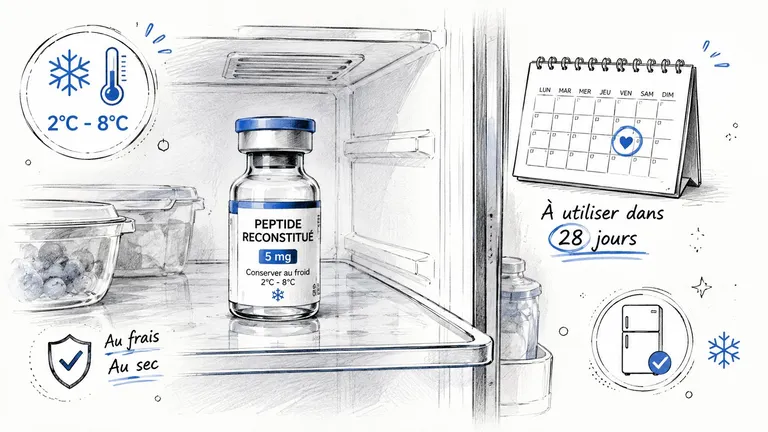
Bacteriostatic water for injection is not just sterile water with a different label. It contains exactly 0.9% benzyl alcohol (9 mg/mL), and that concentration is what allows it to inhibit bacterial growth and support multiple withdrawals from the same vial for up to 28 days when sterility is maintained, as described in this overview of what bacteriostatic water is used for and supported by the USP-based product reference.
That single detail changes the entire workflow. If you’re reconstituting for repeated use, true bac water fits the job. If the vial labeled “bac water” doesn’t contain that preservative system, you’re working under a false assumption from the start.
Why the diluent matters
Lyophilized peptides are sensitive to avoidable handling errors. The powder may look inert, but once reconstituted it becomes part of a live handling process. Every puncture, every withdrawal, every storage decision matters more after that point.
A lot of frustration people blame on “bad peptide quality” starts earlier. It starts with the wrong liquid, sloppy prep, or concentration math that was guessed instead of calculated.
Practical rule: Treat reconstitution as part of dosing accuracy, not as a separate chore.
Safety and efficacy are tied together
People often separate safety from effectiveness as if they’re different topics. In peptide prep, they overlap. A contaminated vial is unsafe. A foamed, partially dissolved vial is unreliable. A mislabeled or fake bac water product can undermine both.
The best mindset is simple. Don’t aim to “mix it carefully enough.” Aim to create a repeatable, sterile, measured process you can trust every time.
Gathering Your Tools and Ensuring Sterility
Reconstitution gets easier when the bench is prepared before the needle ever touches a stopper. Scrambling for alcohol pads or trying to calculate volume mid-process is how people make preventable mistakes.
Use the right kit
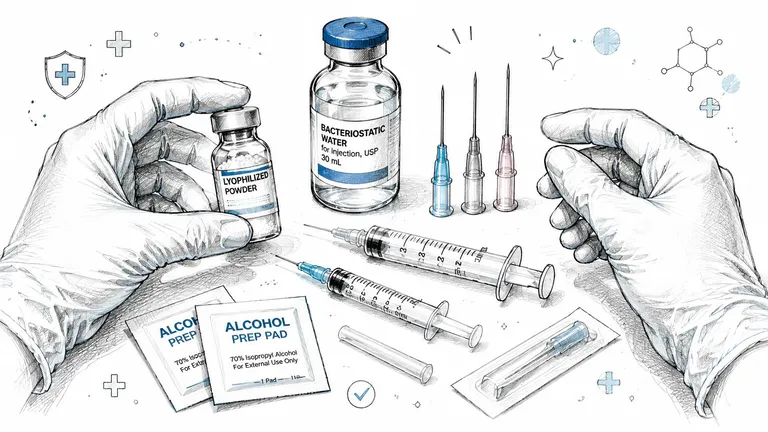
For a clean bac water reconstitution workflow, lay out everything first:
- Lyophilized peptide vial: Check the label, strength, and vial integrity before opening anything.
- Bacteriostatic water vial: Use a source you trust, with intact packaging and clear labeling.
- Reconstitution syringe and needle: Use a fresh sterile syringe and needle for the transfer.
- Alcohol prep pads or sterile swabs: You need these for both vial stoppers.
- Sharps container: Don’t leave used needles on the bench.
- Clean disposable gloves: Helpful if you’re trying to keep handling disciplined.
Some advanced users also keep spare sterile syringes nearby in case a needle touches a non-sterile surface. That’s good practice. Once sterility is questionable, swap the tool instead of rationalizing it.
Build a clean workspace
The minimum standard is straightforward. The reconstitution guidance from Polaris Peptides states that the work area should be aseptic, with a clean surface disinfected with 70% isopropanol, and that reconstitution should be avoided in high-foot-traffic areas or near open windows and HVAC airflow.
That means no kitchen counter with people passing through. No desk under a vent. No “it’s probably clean enough” corner.
Use a dedicated area and let the disinfected surface dry before placing supplies on it.
If you like understanding sterile process at a broader level, the principles behind sterilization for mushroom cultivation are a useful parallel. Different application, same underlying lesson: contamination control starts with environment, not with wishful thinking after exposure.
The small prep steps that matter
Before puncturing either vial stopper:
- Bring materials to room temperature if they’ve been stored cold.
- Swab both rubber stoppers thoroughly.
- Let the alcohol dry completely before inserting the needle.
That drying step matters. Wet alcohol on the stopper isn’t extra sterile. It’s just incomplete prep.
A careful setup saves more peptides than people think. Most mixing problems start before the liquid enters the vial.
The Math Demystified Calculating Your Reconstitution Volume
A dosing error usually starts on paper, not at the injection step. If the vial concentration is wrong, every insulin-syringe unit pulled from that vial is wrong too.
There is also a quality problem people miss here. The math can be perfect and the setup can still fail if the “bac water” was sourced from a gray-market seller and does not contain benzyl alcohol at the labeled strength. Concentration math only helps if the product in both vials is what the label says it is. Use reputable pharmacy or medical suppliers whenever possible, and document the lot and source along with your mix.
The only formula that matters
Use this equation first:
Concentration (mg/mL) = Peptide Mass (mg) ÷ Reconstitution Volume (mL)
Then convert to micrograms if needed:
- 1 mg = 1000 mcg
Examples:
- 2 mg/mL = 2000 mcg/mL
- 5 mg/mL = 5000 mcg/mL
That conversion step matters because peptide doses are often discussed in mcg, while vial labels are usually in mg. Mixing those units is one of the fastest ways to misdose.
Worked examples
Start with a 5 mg vial.
If you add 1 mL of bac water:
- 5 mg ÷ 1 mL = 5 mg/mL
- That equals 5000 mcg/mL
If you add 2 mL:
- 5 mg ÷ 2 mL = 2.5 mg/mL
- That equals 2500 mcg/mL
If you add 2.5 mL:
- 5 mg ÷ 2.5 mL = 2 mg/mL
- That equals 2000 mcg/mL
Now a 10 mg vial.
If you add 1 mL:
- 10 mg ÷ 1 mL = 10 mg/mL
- That equals 10000 mcg/mL
If you add 2 mL:
- 10 mg ÷ 2 mL = 5 mg/mL
- That equals 5000 mcg/mL
If you add 3 mL:
- 10 mg ÷ 3 mL = 3.33 mg/mL
- That equals 3333.33 mcg/mL
Write the exact concentration in your notes. If the number is awkward, keep it anyway. Casual rounding creates avoidable dosing drift, especially when someone later calculates a small mcg dose from memory instead of from the original mix record.
Good notes are part of safe reconstitution. Record the peptide mass, the exact volume added, the final concentration, the date mixed, and the source of the bac water.
Example Reconstitution Concentrations
| Peptide Mass | BAC Water Volume | Resulting Concentration (mg/mL) | Resulting Concentration (mcg/mL) |
|---|---|---|---|
| 5 mg | 1 mL | 5 mg/mL | 5000 mcg/mL |
| 5 mg | 2 mL | 2.5 mg/mL | 2500 mcg/mL |
| 5 mg | 2.5 mL | 2 mg/mL | 2000 mcg/mL |
| 5 mg | 3 mL | 1.67 mg/mL | 1666.67 mcg/mL |
| 10 mg | 1 mL | 10 mg/mL | 10000 mcg/mL |
| 10 mg | 2 mL | 5 mg/mL | 5000 mcg/mL |
| 10 mg | 3 mL | 3.33 mg/mL | 3333.33 mcg/mL |
Choosing a practical volume
The smallest volume is not always the best choice. Highly concentrated mixes reduce injection volume, but they also make fine dose adjustments harder and magnify small syringe-reading errors.
More dilution gives better measuring resolution. That is usually the safer choice for low-dose work, especially if you are measuring from a U-100 insulin syringe in small unit increments. The trade-off is simple. More bac water means a larger draw volume per dose and, in some cases, slower full dissolution.
Consistency matters more than chasing a “best” number. Pick a concentration that makes your intended dose easy to read on the syringe, then keep that approach consistent across vials so you do not apply old assumptions to a new mix. If you want a planning reference before you reconstitute, this guide on how much bacteriostatic water to mix with peptides lays out the volume decision clearly.
The Reconstitution Process A Gentle Approach
A common failure point happens after the math is done correctly. The volume is right, the vial is labeled correctly, and the peptide still gets mishandled during mixing. On the bench, rushed technique shows up.
Start with the exact amount of bac water you already calculated and a fresh sterile syringe. Before you puncture anything, inspect the bac water vial itself. In the gray market, labels are easy to copy and quality is not. If the source is questionable, do not assume the vial contains properly preserved bacteriostatic water just because the cap and label say it does.
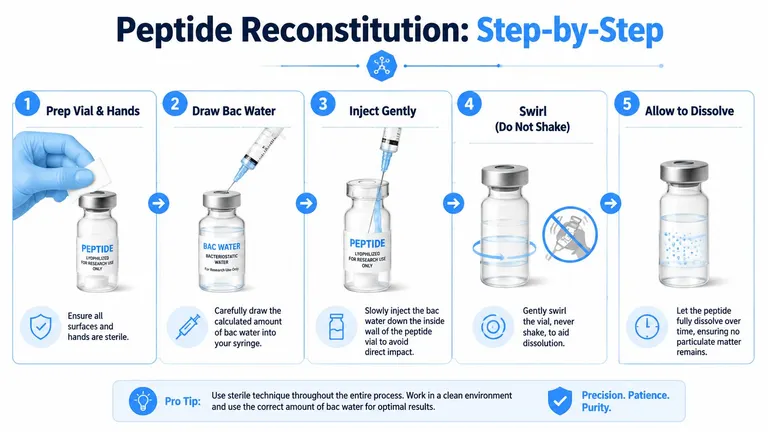
A visual walkthrough helps if you want to compare your bench routine to a clean process:
Add the liquid with control
Insert the needle into the peptide vial and direct the stream against the inner glass wall. Do not drive the liquid straight into the powder cake. Fast impact creates bubbles, can leave part of the cake stuck to the glass, and often makes people over-handle the vial afterward because they think it is not dissolving correctly.
Slow addition works better. Let the bac water run down the wall and spread across the lyophilized material on its own.
A bench sequence that works
- Verify the vial label and target volume again before drawing the diluent.
- Withdraw the bac water slowly and clear any large air bubbles while the needle is still in the source vial.
- Puncture the peptide vial once, cleanly, with the vial upright on a stable surface.
- Inject against the glass wall over several seconds, not all at once.
- Pause and let the powder wet out before deciding it needs more movement.
- Swirl or roll gently only if needed to finish dissolution.
Do not shake aggressively. Do not vortex. Do not keep jabbing the stopper because the first pass looked slow.
What successful dissolution looks like
A properly reconstituted vial should settle into a clear solution without visible particles, stringy material, or persistent foam. Some peptides dissolve quickly. Others need a little patience, especially at higher concentrations or after cold storage. Waiting a minute is usually safer than forcing the process.
If you plan to keep the vial for repeated use, label it before it leaves the bench and move it into the refrigerator promptly. This short guide on storing reconstituted peptides correctly is a useful reference for that part of the workflow.
Later in the process, if you want a quick visual demonstration to compare against your own handling, this embedded walkthrough can help:
The goal is a fully dissolved solution with no haze, no floating debris, and no need for repeated agitation.
When to stop and question the vial
Do not assume every problem is technique. Sometimes the issue is the peptide. Sometimes it is the diluent. In gray market sourcing, both can be unreliable.
Pause and reassess if you see any of these:
- Persistent cloudiness: give it reasonable time first, then question peptide quality, concentration, or solvent choice.
- Visible particles: undissolved material that does not clear with gentle swirling should not be ignored.
- Heavy foam: this usually points to injecting too forcefully.
- Repeated poor dissolution across different vials: look at your supplier, especially if the “bac water” may not contain a real preservative system.
Clean reconstitution usually looks uneventful. That is the result to aim for.
Proper Storage and Understanding Shelf-Life
Reconstitution isn’t finished when the powder dissolves. The clock starts then.
How to store a reconstituted vial
Keep the vial refrigerated, protected from unnecessary light exposure, and handled as little as possible outside actual use. Each time you access it, use clean technique again. A contaminated stopper can defeat otherwise careful storage.
Label the vial clearly with:
- Peptide name
- Final concentration
- Date of reconstitution
- Any dose note you rely on repeatedly
That label prevents the classic mistake of remembering the peptide correctly but forgetting whether you mixed it at a stronger or weaker concentration than last time.
For a practical companion reference, this guide on how to store reconstituted peptides is worth reviewing before you build a longer routine around multi-dose use.
Why sterile water is a different workflow
People often treat sterile water as if it’s “basically the same thing.” It isn’t. The UAE Peptides reconstitution guide notes a common problem here: people try to stretch a sterile-water-mixed vial to a full week, even though the strict protocol is to discard sterile-water reconstituted vials after 24 to 48 hours to reduce bacterial contamination risk.
That’s the practical divide. Bac water supports a multi-dose workflow because of its preservative system. Sterile water does not. If you substitute one for the other but keep the same handling timeline, you’re no longer following the same safety assumptions.
Storage discipline matters more than people expect
A few habits keep reconstituted vials usable for their intended handling window:
- Minimize repeat exposure: Take the vial out, withdraw what you need, and return it promptly.
- Use fresh needles and syringes: Don’t reuse hardware because the vial “still looks fine.”
- Inspect before every withdrawal: If appearance changes, stop and reassess.
- Respect the timeline: Don’t improvise a longer window because the vial seems okay.
A reconstituted vial can look normal and still be a bad bet if the handling discipline has slipped.
Common Mistakes and the Bac Water Quality Problem
Most peptide prep mistakes are ordinary. People rush. They forget to let alcohol dry. They use the wrong concentration note from a previous vial. They shake because the powder didn’t dissolve instantly. Those errors are common, but they’re fixable.
The harder problem is supply fraud or sloppiness. A lot of online buyers still assume any bottle labeled “bac water” is suitable for multi-dose use. That assumption can fail badly.
Errors that ruin otherwise good technique
The most common issues tend to cluster around a few points:
- Bad calculation carryover: You changed vial size or volume but kept using old syringe assumptions.
- Rough injection technique: Direct spray into the powder cake causes unnecessary stress during dissolution.
- Weak sterile discipline: Touching needle hubs, working near airflow, or puncturing unswabbed stoppers creates avoidable risk.
- Ignoring visual warning signs: Cloudiness and particulates shouldn’t be rationalized away.
- Poor logging: If you can’t reconstruct what you mixed, you can’t trust the dose.
Any one of those can ruin a careful protocol.
Why gray market bac water is a real problem
The more overlooked issue is product legitimacy. According to the gray-market warning discussed in this independent testing summary on YouTube, a significant portion of online “bac water” products may contain zero benzyl alcohol, may have pH outside the 4.5 to 7.0 range, or may contain dangerous endotoxins. That means some products sold as bacteriostatic water may function more like plain sterile water, while others may present a different safety problem entirely.
That changes sourcing from a convenience issue into a protocol issue.
What to do instead:
- Buy from reputable medical or laboratory suppliers: Don’t choose only by marketplace ranking or price.
- Look for complete labeling: You want clear product identity, lot information, and intact packaging.
- Avoid vague “research liquid” listings: If the seller can’t clearly state what the vial contains, move on.
- Be skeptical of bargain listings: The cheapest bottle can become the most expensive mistake.
- Use screening tools carefully: A basic product for water purity can help you think more critically about contamination screening in general, but it is not a substitute for proper pharmaceutical sourcing or lab verification.
If the bac water isn’t real bac water, the rest of your technique can still fail.
Treat the diluent as part of the compound workflow, not as an interchangeable accessory. That one decision affects storage assumptions, contamination risk, and whether your multi-dose plan is grounded in reality.
This article is for informational and research-oriented use only. It isn’t medical advice, and it doesn’t replace product-specific instructions or professional guidance.
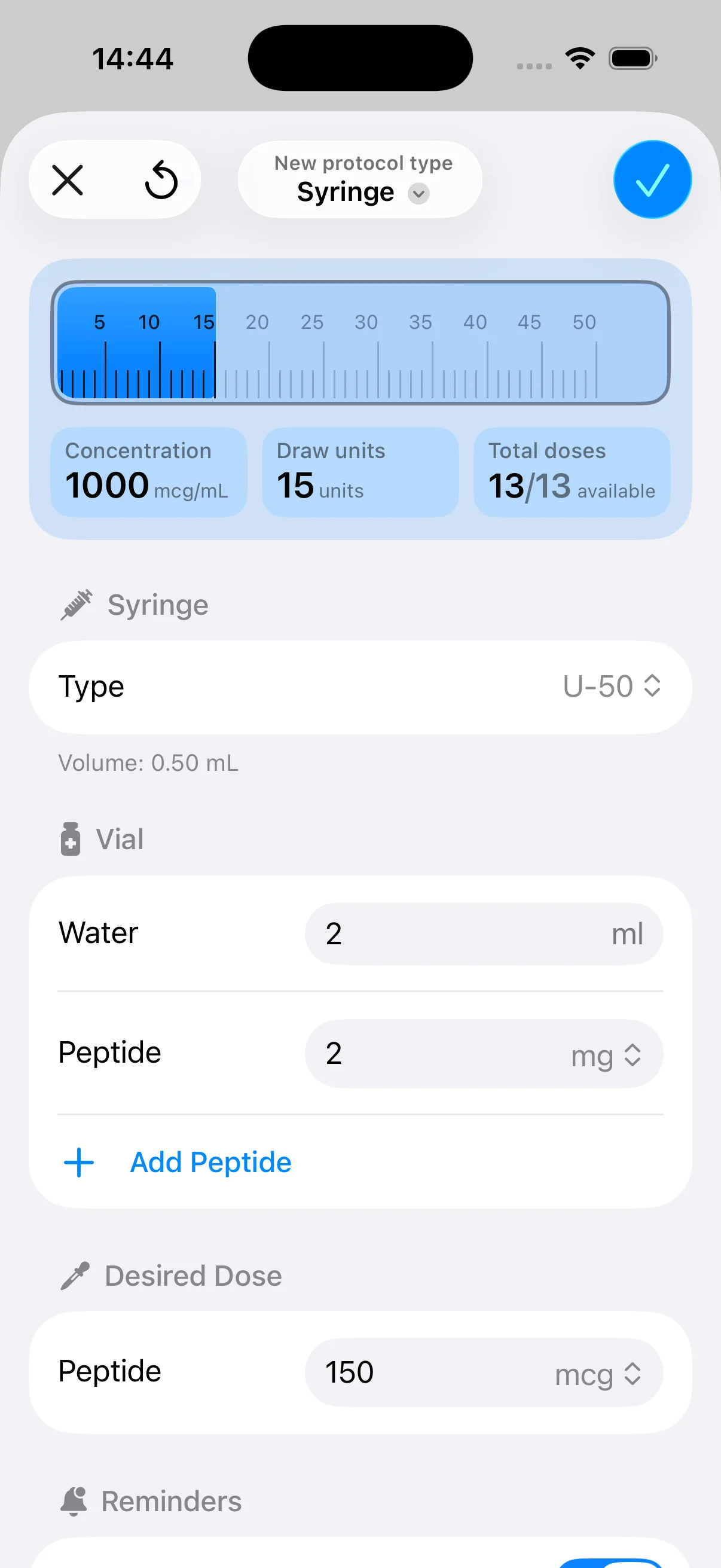
If you want to remove the routine calculation mistakes from peptide prep, PepFlow helps you turn vial strength, reconstitution volume, and target microgram dose into practical measurements you can use. It also makes it easier to track protocols, timing, and dose history so you’re not relying on memory or old notes when accuracy matters.