
You’re probably here because PEG MGF keeps popping up in peptide chats, gym conversations, or late-night forum threads. Someone calls it a “longer-lasting MGF,” someone else treats it like a recovery shortcut, and before long you’re staring at a pile of jargon that mixes muscle biology, chemistry, and bro-science.
That confusion is normal. PEG MGF sits in an awkward category: it sounds simple at first, but the meaning changes a lot depending on whether someone is talking about natural muscle signaling, lab research, athletic misuse, or practical protocol management. It is common to hear the name long before understanding what the “PEG” part specifically changes.
If you already know the basics of peptides, great. If not, this primer on what peptides are and how they’re commonly discussed helps frame the broader context. For now, the important question is narrower: what is PEG MGF, and why did researchers modify MGF in the first place?
Table of Contents
- An Introduction to PEG MGF
- The Foundation Mechano Growth Factor
- The Pegylation Process Explained
- PEG MGF vs Regular MGF A Direct Comparison
- Potential Applications in Research and Fitness
- Safety Legal Status and Important Considerations
- Managing Complex Protocols The Role of Organization
An Introduction to PEG MGF
A typical starting point looks like this: a biohacker reads that MGF is involved in muscle repair, then runs into PEG MGF and assumes it is only the longer-lasting version. That shorthand creates confusion fast, because a longer-lasting peptide is not just the same signal stretched out over more time. Its behavior in the body changes, and that changes how researchers think about timing, observation windows, and protocol design.
PEG MGF is a chemically modified form of Mechano Growth Factor. The key modification is pegylation, which means attaching a polyethylene glycol, or PEG, component to the peptide. This single modification is the defining characteristic of PEG MGF.
If you are new to the category, this helps: peptides are short chains of amino acids, and this overview of what peptides are gives the broader context for how compounds like MGF are classified.
The practical reason researchers became interested in PEG MGF is simple. Native MGF tends to clear quickly. Pegylation works like putting a small, fast-moving note inside a more protective envelope. The message is still related to MGF, but the way it travels and how long it remains available are different. That does not automatically mean better. It means different pharmacokinetics.
That distinction matters.
Without pegylation, MGF is generally discussed as a short-lived signaling peptide. With pegylation, PEG MGF is discussed as a longer-acting research compound, which creates different logistical questions around dosing intervals, scheduling, and record-keeping. For anyone trying to understand why tools like PepFlow exist, this is the first practical clue. Once timing gets more complicated, staying organized becomes part of the challenge.
One more point keeps this topic grounded: PEG MGF is best understood as a research peptide, not an approved treatment for self-directed performance goals. People often hear the shared name and assume the compounds are interchangeable. They are related, but they should not be treated as identical in how they persist, how they are studied, or how their effects are interpreted.
The Foundation Mechano Growth Factor
A lot of the confusion around PEG MGF starts here. If the base molecule is unclear, the modified version will sound more mysterious than it is.
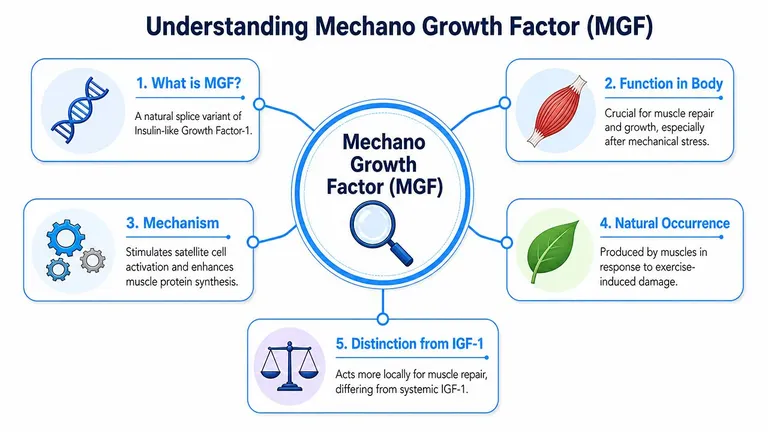
Mechano Growth Factor, usually shortened to MGF, refers to a splice variant within the IGF-1 system that is discussed in the context of muscle stress and repair signaling, as described in this overview from ScienceDirect. In plain language, it is part of the body’s response to mechanical strain. Researchers became interested in it because it appears in the same biological setting where muscle tissue is trying to recover and adapt.
Why MGF matters in muscle repair
After training or other mechanical strain, muscle tissue does not rebuild itself just by having raw materials available. It also relies on signals that help coordinate the repair response. MGF is usually discussed as one of those local signals.
That point matters because “growth factor” can sound bigger and broader than the research usually suggests. Native MGF is generally described less like a body-wide switch and more like a short-range message sent in a specific repair environment.
Research discussions of MGF tend to return to three ideas:
- It appears in response to muscle stress: Its expression is linked to mechanical loading or tissue damage.
- It is associated with repair-related activity: Researchers study it in connection with muscle adaptation and recovery processes.
- It is often discussed alongside satellite cells: These cells are involved in muscle regeneration and are frequently mentioned in MGF research.
A simple analogy helps here. If muscle recovery were a construction project, amino acids and nutrients would be the bricks and lumber. MGF would be closer to a signal flare or work order. It does not “build” the tissue by itself. It helps organize the conditions in which rebuilding starts.
Why researchers paid attention to it
MGF drew attention for another reason. It seems to act on a short timetable.
That makes it scientifically interesting and logistically awkward.
A brief-lived signal can still matter a great deal biologically. But from a research perspective, short persistence creates practical problems. Timing becomes harder to study. Exposure windows become narrower. Comparing protocols gets messier. Those same organizational headaches are part of why modified versions later attracted attention, and why readers who track peptide schedules often end up looking for systems that help record timing clearly.
One way to picture native MGF is as a text message, not a billboard. It can deliver a meaningful instruction, but only for a limited window and usually in a more local context. That is very different from a compound discussed as circulating for longer periods.
This is also a good place to separate research language from approved use. MGF is commonly discussed in experimental and theoretical terms related to muscle repair biology. That does not make it an approved treatment for performance goals, recovery routines, or self-directed bodybuilding use.
Readers who have seen other peptide modifications may recognize the same general problem. Researchers often try to change how long a molecule stays available, which is also the reason compounds with DAC peptide modifications come up in similar conversations about duration and scheduling.
The Pegylation Process Explained
Pegylation answers a very practical question. If a peptide disappears quickly, how do researchers keep it around long enough to study in a more controlled way?
What pegylation does
PEG MGF is created by attaching polyethylene glycol, usually shortened to PEG, to the MGF molecule. The goal is not to turn MGF into a different signal in name only. The goal is to change how the body handles that signal over time.
A useful comparison is a tiny house key on its own versus that same key attached to a large floating keychain. The key still fits the same lock. But it becomes harder to lose, easier to spot, and slower to vanish into the background. Pegylation follows that same basic logic. The peptide is still related to MGF, but the added PEG changes its pharmacokinetic behavior, especially how quickly it is cleared.
That matters because peptides do not exist in a vacuum. A molecule can look interesting on paper and still be frustrating to work with if its window of availability is very short. Researchers often modify peptides for this reason. Readers who have seen other persistence-focused designs may recognize a similar theme in DAC peptide modifications, even though the chemistry is different.
Why the half-life discussion matters
Half-life sounds abstract until you translate it into a schedule.
In plain terms, half-life describes how long a substance tends to remain available before the body breaks it down or clears it away. With unmodified MGF, that window is often described as short. With PEG MGF, the expected window is discussed as much longer because the PEG portion can reduce how quickly the peptide is removed from circulation.
That shift changes more than duration. It changes planning.
A short-lived signal demands tight timing if someone is trying to study exposure windows, sequence effects, or repeat administration patterns. A longer-circulating version creates a different organizational problem. The timing may be less compressed, but tracking overlap, spacing, and total exposure can become harder. That is one reason PEG MGF comes up not just in biochemical discussions, but also in conversations about logs, calendars, and protocol tracking tools such as PepFlow.
Here is the practical takeaway:
-
Clearance may slow down
The peptide is designed to remain available longer than the unmodified form. -
Timing logic changes
A longer-acting research compound is not scheduled the same way as a short local signal. -
Study design changes
Longer persistence can affect how researchers think about spacing, observation periods, and interpretation. -
Trade-offs change too
More time in circulation may make certain experiments easier to organize, while also making errors in protocol timing harder to ignore.
PEG MGF, then, is best understood as MGF that has been chemically modified to alter its stay in the body. That is the core reason pegylation exists here. It is a pharmacokinetic adjustment, not proof of approved medical use or a recommendation for self-experimentation.
PEG MGF vs Regular MGF A Direct Comparison
Here, many readers finally get the distinction.
The easiest mistake is to treat PEG MGF as if it were just regular MGF with a branding twist. It isn’t. The pegylated form changes the practical behavior of the molecule enough that people discussing one often shouldn’t assume they’re talking about the other.
The practical difference
Regular MGF is usually framed as a short-acting, locally relevant repair signal. PEG MGF is framed as a longer-acting version that can circulate for much longer before clearance. That difference affects how people think about timing, persistence, and what kind of research design even makes sense.
A short-lived signal is like a text message sent to one nearby coworker. A longer-circulating signal is more like an email that stays in everyone’s inbox all day. Both communicate something. But they differ in reach, timing, and how much follow-up management they require.
One way readers get tripped up is stability. If a compound is known for lasting only a short time, protocol planning becomes very sensitive to timing. If a modified version lasts much longer, the scheduling logic changes. That doesn’t say anything about approved use. It just shows why researchers bothered creating a modified version at all.
Comparison of MGF and PEG MGF Properties
| Property | Standard MGF | PEG MGF |
|---|---|---|
| Base identity | Naturally occurring MGF, also called IGF-1Ec | Chemically modified variant of MGF |
| Peptide length reference | Discussed as a 24-amino acid peptide in the referenced overview | Built from MGF, with PEG attached |
| Half-life | A few minutes in circulation | Several days in circulation |
| Typical behavior | More local and short-acting | More prolonged and systemically circulating |
| Research appeal | Useful for studying rapid repair signaling | Useful for studying longer-duration exposure |
| Scheduling implications | Narrower timing window | Less tied to a brief window, but more persistence to manage |
| Regulatory context | Associated with banned athletic misuse | Research-focused status, not approved as a human pharmaceutical in most countries |
A few practical takeaways matter more than the chemistry details:
- Native MGF is brief: it behaves like a fast biological note.
- PEG MGF is extended: it behaves more like a delayed-release version of that note.
- They shouldn’t be discussed as interchangeable: the pharmacokinetic logic differs.
If you’re asking what PEG MGF is, the shortest accurate answer is this: it’s MGF redesigned for duration.
That duration is the reason the compound gets attention. It’s also the reason it creates more complexity.
Potential Applications in Research and Fitness
PEG MGF attracts attention because the modified form appears to support several processes researchers care about. The reference material describes PEG MGF as a long-acting candidate associated in research contexts with satellite cell activation, nitrogen retention, protein synthesis, and muscle regeneration, particularly in animal research rather than approved human treatment settings.
Why it attracted research interest
Those mechanisms matter because muscle recovery isn’t one single event. It’s a coordinated process involving repair signaling, cellular activation, and rebuilding. A compound that may prolong those signals becomes scientifically interesting even before anyone talks about real-world use.
In broad terms, PEG MGF is discussed in research for its possible role in:
- Muscle regeneration: especially where sustained signaling may matter.
- Protein synthesis support: a central concept in tissue rebuilding.
- Satellite cell activity: often highlighted because these cells are tied to regeneration.
- Recovery-related models: especially where short-lived native signals are hard to study.
This is also why adjacent fields care about handling and preservation. If you’re interested in the broader research ecosystem around sensitive biological materials, this guide to cryogenic cell storage techniques gives useful context on how labs think about viability, preservation, and material integrity.
Why fitness communities talk about it
Fitness communities don’t usually talk in the language of “mechanistic signaling persistence.” They talk about recovery, growth, and convenience. PEG MGF gets discussed because it sounds like a way to extend a muscle-repair signal that would otherwise fade quickly.
That said, there’s an important boundary here.
The interest comes from research potential, not from established, approved human use. The source material explicitly places PEG MGF in research settings and notes that it isn’t approved as a human pharmaceutical in most countries. So the scientific basis for the hype and the practical legitimacy of personal use are not the same thing.
That gap is where many online conversations go wrong. They jump from “interesting mechanism” to “useful personal protocol” without passing through the missing step of regulatory approval and human evidence.
Safety Legal Status and Important Considerations

A longer-lasting peptide can sound convenient until you ask the harder question. What happens if the effect you wanted lasts longer than expected, or an unwanted effect does too?
That question matters with PEG MGF because pegylation changes time in the body. A simple way to frame it is this: regular MGF is discussed as a short signal, while PEG MGF is engineered to remain in circulation longer. In research terms, that can make a signal easier to observe. In risk terms, it can also make mistakes, uncertainty, and adverse reactions harder to contain.
PEG MGF is generally discussed as a research compound rather than an approved medicine for routine human use. It is also relevant to sports rules. WADA prohibits growth factors and related substances in competition, which is why any athlete looking at this topic needs to separate curiosity from eligibility very carefully.
Safety concerns discussed around peptides in this category can include blood sugar changes, fluid retention, cardiovascular strain, and other systemic effects. Those are not minor details. They are the kind of variables that make researchers use controlled protocols, documentation, and oversight instead of guesswork. If you want a broader frame for the kinds of problems people watch for across this category, this guide to common peptide side effects and monitoring concerns is a useful reference.
A practical point often gets missed. Pegylation does not just change theory. It changes scheduling pressure. If a compound persists longer, timing decisions matter more, record-keeping matters more, and confusion about sequencing can matter more too. That does not turn PEG MGF into an approved tool or a safe self-experiment. It explains why longer-acting compounds create more organizational burden alongside more research interest.
Keep these distinctions clear:
- Legal and regulatory status: PEG MGF is commonly sold into research channels, not as an approved consumer wellness product.
- Sport compliance: WADA rules matter for tested athletes, even if online communities discuss the compound casually.
- Pharmacokinetic implications: extended persistence can increase observational value in research, but it can also prolong problems.
- Practical reality: interest on forums is not the same as validated human evidence.
Curiosity is fine. Informal confidence is where people get into trouble.
That is also why adjacent technical fields rely on formal review, intellectual property filings, and structured claims rather than community hype. For a very different example of how emerging technical work gets presented, you can learn about their MLR patent and compare that format with how peptide claims are often circulated online.
Managing Complex Protocols The Role of Organization
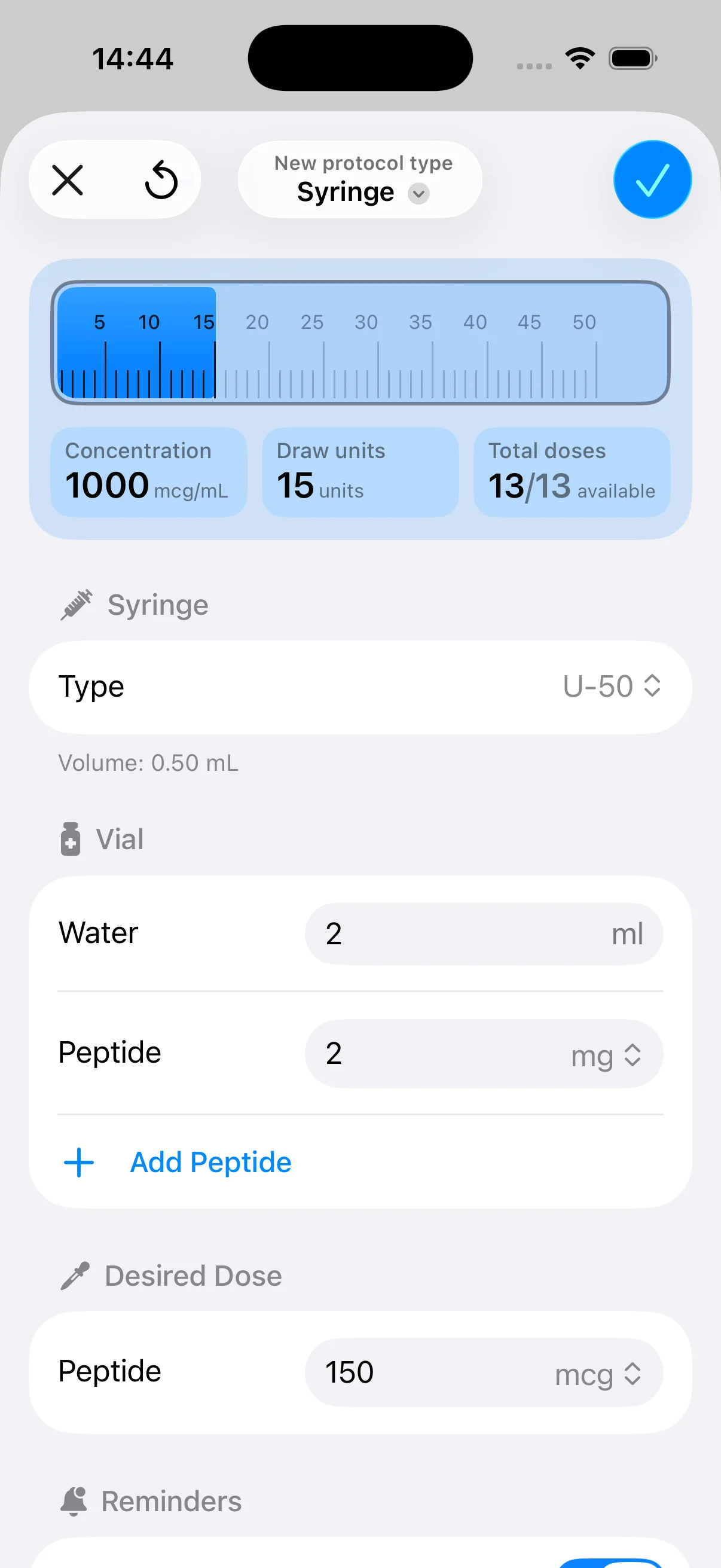
Even in legitimate research contexts, compounds like PEG MGF create a logistics problem. The challenge isn’t only understanding the molecule. It’s managing concentrations, timing, records, and repeated protocol steps without turning every dosing day into mental arithmetic.
Where research logistics get messy
A lot of protocol errors are boring errors. Wrong reconstitution notes. Forgotten schedule changes. Confusion about whether a planned administration day is today or tomorrow. Misreading a vial setup and drawing the wrong volume.
Those aren’t chemistry failures. They’re organization failures.
That’s a familiar issue across life-science work more broadly. If you’re interested in how structured systems support complex experimentation, this piece on accelerating life-science R&D with models offers a useful lens on why researchers rely on formal frameworks instead of memory.

Why planning tools matter
For people tracking structured peptide regimens, organization tools help with the unglamorous but necessary parts:
- Calculation clarity: converting a planned microgram amount into usable draw measurements
- Schedule visibility: knowing whether today is an active day, pause day, or restart point
- Consistency: logging what occurred instead of trusting memory
- Reminder support: reducing skipped steps in longer protocols
That’s not medical advice. It doesn’t tell anyone what to take, when to take it, or whether they should use a compound at all. It reduces spreadsheet mistakes and calendar confusion once a protocol has already been defined elsewhere.
The more persistent and timing-sensitive a compound is, the more that kind of organization matters.
If you’re managing peptide schedules and want less manual math, PepFlow helps organize dosing calculations, protocol timing, reminders, and logs in one place. It’s built for planning and adherence, not diagnosis or medical guidance.