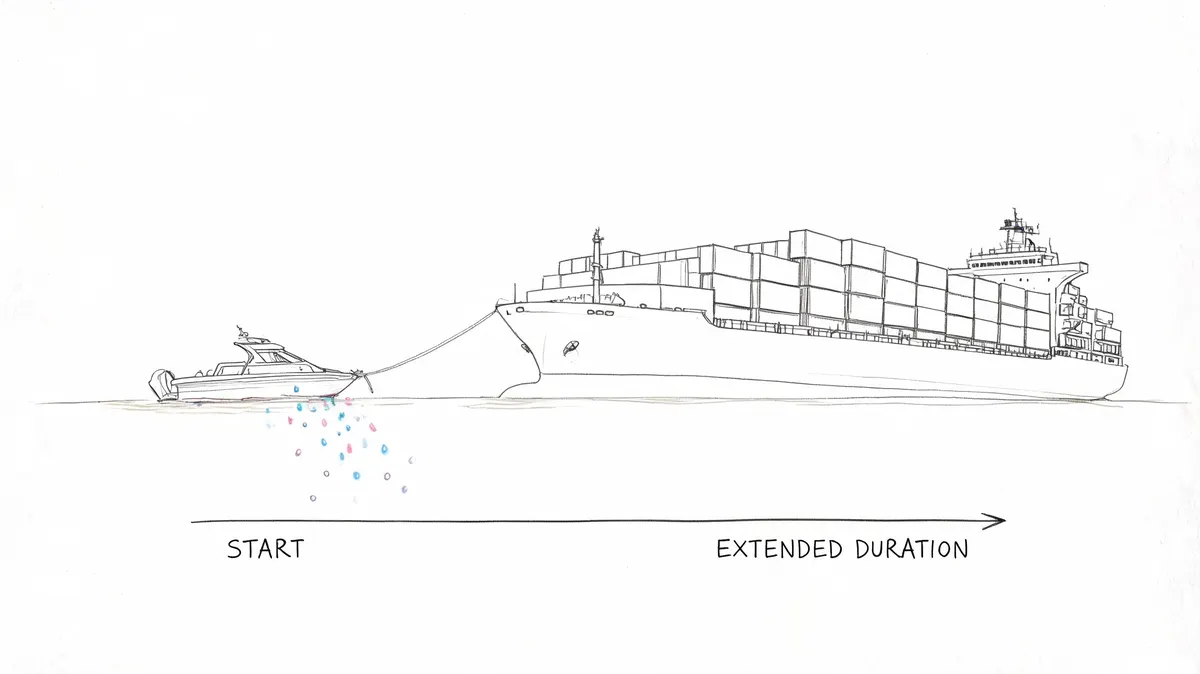
You’re probably here because you saw two versions of the same peptide on a label. One says CJC-1295. The other says CJC-1295 with DAC. The names are nearly identical, but the protocols around them aren’t even close.
That tiny add-on, DAC, changes how long the peptide stays active, how often someone would schedule it, and how careful they need to be with spacing doses. Most peptide guides stop at “DAC makes it last longer.” That’s true, but it’s not enough. If you want to understand what is DAC in peptides, you need to connect the chemistry to the practical implications: fewer injections, more sustained exposure, and a higher need for precise timing.
Table of Contents
- The DAC Difference You Can’t Ignore
- What is DAC The Science of Extended Half-Life
- DAC vs No-DAC Peptides A Practical Comparison
- How DAC Impacts Dosing Calculations and Safety
- Managing DAC Protocols with PepFlow
- Conclusion Key Takeaways for Your Protocol
The DAC Difference You Can’t Ignore
If you’ve ever compared peptide listings and wondered why the “with DAC” vial often gets treated like a different product, the reason is simple. DAC changes the behavior of the peptide, not just the label.
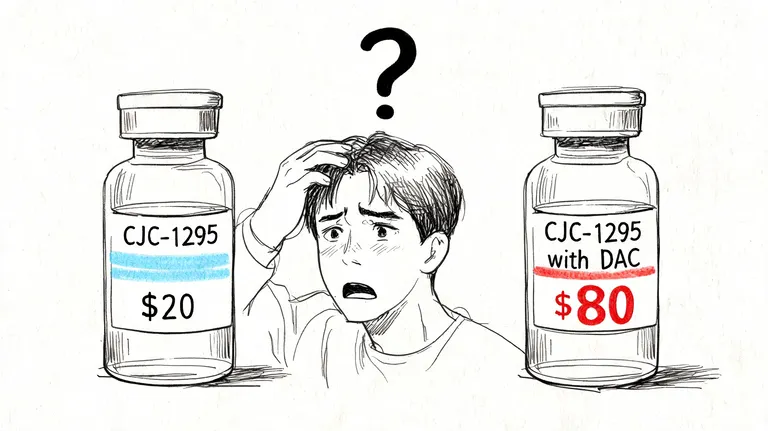
In peptide discussions, DAC stands for Drug Affinity Complex. Think of it as a built-in slow-release strategy. Instead of letting a peptide move through the body quickly and disappear fast, DAC helps it stay around much longer.
That matters because some peptides start with very short active lives. According to Core Peptides’ summary of CJC-1295 DAC and hormonal regulation, DAC technology transformed peptides with native half-lives of minutes into agents with half-lives of 6 to 10 days, and this shift changed dosing from multiple daily injections to once-weekly schedules in research settings.
Why this matters: When a peptide lasts for days instead of minutes, every decision around timing becomes more important.
A beginner often assumes longer-lasting automatically means better. Sometimes it means more convenient. But it also means less room for sloppy scheduling. A short-acting peptide gives you more frequent chances to adjust. A long-acting one keeps exerting influence after the injection is over.
That’s why DAC isn’t just a chemistry term. It’s a protocol term. It affects:
- Injection frequency: The schedule can shift from repeated daily use to a far less frequent rhythm.
- Exposure pattern: The body doesn’t get a quick spike and clear-out. It gets a more sustained signal.
- Planning mistakes: If the spacing is wrong, the overlap can matter more.
If you’ve been asking what is DAC in peptides, the short answer is this. It’s a half-life extension system with scheduling consequences. The chemistry is the reason. The protocol impact is the tangible effect experienced.
What is DAC The Science of Extended Half-Life
DAC sounds abstract until you picture what the body is doing with a peptide after injection. A small peptide on its own is easy to clear. The kidneys filter small molecules quickly, and enzymes in the bloodstream can break them down before they do much for long.
DAC changes that.
A simple way to picture DAC
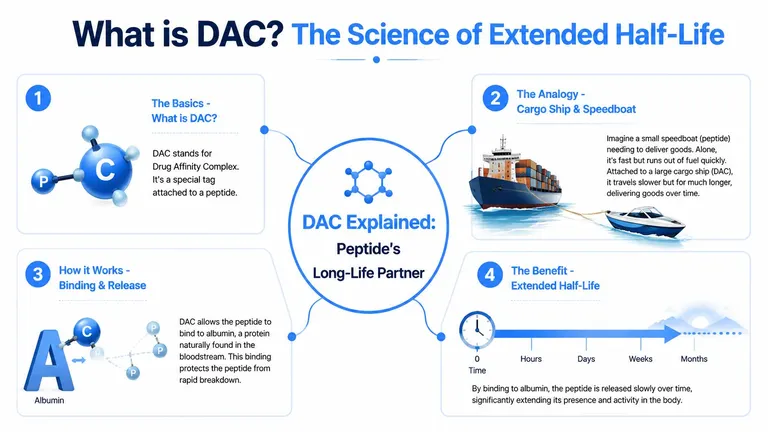
A useful analogy is a small boat tied to a cargo ship. The peptide is the small boat. By itself, it moves fast but doesn’t last. Albumin, a major protein in the bloodstream, is the cargo ship. DAC is the tether that links them.
Once attached, the peptide is harder to wash out quickly. It’s less exposed to fast clearance and less vulnerable to breakdown. That’s the practical meaning of albumin binding.
Later, if you want a broader comparison of pulse-style versus longer-release growth hormone peptide setups, PepFlow has a related explainer on CJC-1295 and Ipamorelin protocols.
What DAC is doing chemically
The chemistry is more specific than most articles make it sound. According to ConjuChem’s DAC technology overview, DAC works through covalent attachment to serum albumin via its cysteine-34 residue. That attachment extends peptide half-life from hours to 6 to 8 days by blocking peptidase cleavage and reducing kidney excretion. The same overview notes that this shift is what allows weekly injections rather than daily injections for non-DAC formulations.
Here’s the plain-language version:
-
The peptide gets a chemical tag.
That tag is built to connect with albumin in the bloodstream. -
Albumin acts like a protective carrier.
Because albumin is large and abundant, the peptide becomes harder to clear rapidly. -
The peptide stays available longer.
It isn’t just floating around as an exposed, easy-to-remove molecule.
A peptide without DAC is more like a text message. A peptide with DAC is more like a calendar invite that stays on the schedule.
Many readers often get confused. They assume DAC means the peptide is “released” in the same way as a time-release capsule. That’s not the best mental model. The key idea is protection through albumin attachment, not a simple delayed opening. The peptide remains active in a way that is shaped by that binding.
The result is a very different experience in protocol design. You’re no longer thinking, “When do I take the next shot today?” You’re thinking, “How long is this still active, and when does the next dose start stacking onto the last one?”
The chemistry creates the convenience. It also creates the need for restraint.
DAC vs No-DAC Peptides A Practical Comparison
Once you understand the binding mechanism, the next question becomes practical. How does a peptide with DAC feel different on paper when you build a protocol?
The clearest comparison is CJC-1295 with DAC versus a short-acting GHRH-style option without DAC. They aren’t just the same compound on different calendars. They create different signaling patterns.
Two different signal styles
In controlled human trials, Particle Peptides’ review of the CJC-1295 DAC science reports that single 10 to 60 µg/kg doses of CJC-1295 with DAC increased mean serum GH by 200% to 1,000% above baseline, while increased IGF-1 persisted for 9 to 11 days. The same source contrasts that with the 30 to 60 minute effect of unmodified GHRH.
That one sentence explains most of the practical difference.
A no-DAC peptide behaves more like a quick prompt. It produces a brief signal, then gets out of the way. That makes it easier to line up with specific times of day when someone wants a pulse-style approach.
A DAC peptide creates more of a slow bleed. The signal hangs around. You don’t need to inject as often, but you also don’t get the same clear separation between one exposure window and the next.
Some people choose no-DAC because they want more control over timing. Others choose DAC because they want fewer injections. Neither choice makes sense unless it matches the signaling pattern they actually want.
DAC vs. No-DAC Peptides Key Differences at a Glance
| Characteristic | Peptide with DAC (e.g., CJC-1295 w/ DAC) | Peptide without DAC (e.g., Mod GRF 1-29) |
|---|---|---|
| Primary behavior | Sustained exposure over days | Short pulse with fast clearance |
| Scheduling style | Less frequent, often weekly-style planning | More frequent, often daily-style planning |
| Signal feel | Steadier “bleed” | Briefer “pulse” |
| Adjustment speed | Slower to evaluate because the compound lingers | Faster feedback because each dose clears sooner |
| Protocol risk | Overlap and accumulation matter more | Missed timing matters more |
| Best fit for | People prioritizing convenience and fewer injections | People prioritizing timing control and pulse-based scheduling |
A good way to choose is to stop asking which is stronger and start asking which is easier to manage correctly.
- If you want fewer injection events, DAC often fits that preference.
- If you care about tightly timed pulses, no-DAC may align better.
- If you tend to improvise your dosing, long-acting compounds punish that habit more.
That last point gets overlooked. A shorter-acting peptide can still be misused, but a long-acting one gives your mistakes more time to matter.
How DAC Impacts Dosing Calculations and Safety
The biggest mistake people make with DAC peptides is using a short-acting mindset on a long-acting compound. They see the same vial size, the same syringe, and the same peptide family name, then assume the dosing logic is similar. It isn’t.
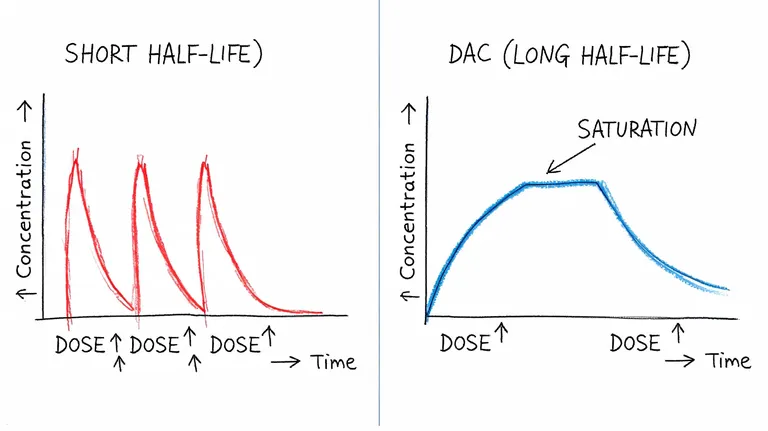
Why long half-life changes the dosing mindset
The issue isn’t only that DAC lasts longer. The issue is that longer exposure changes the biological pattern.
According to Revolution Health’s discussion of CJC-1295 with DAC versus without DAC, prolonged exposure from DAC peptides risks GH and IGF-1 desensitization because continuous stimulation disrupts natural pulsatile GH release, which normally occurs every 3 to 5 hours. That’s why precise, less-frequent dosing matters.
This is the practical translation:
- More isn’t automatically better: If the signal is already sustained, adding doses too close together may increase exposure without improving the intended rhythm.
- Timing errors can stack: With a short-acting compound, the body clears the mistake faster. With DAC, yesterday’s choice may still be affecting today’s baseline.
- Saturation risk is a scheduling issue: The chemistry creates the possibility. The calendar determines whether it becomes a problem.
Practical rule: A long half-life doesn’t give you permission to be casual. It demands a more disciplined schedule.
A practical way to think about label math
When someone reads a vial label like “CJC-1295 w/ DAC 2 mg,” there are two separate tasks. First, figure out concentration after reconstitution. Second, map that concentration to the actual schedule. The math and the calendar are equally important.
A careful workflow looks like this:
-
Read the vial name fully
“CJC-1295” and “CJC-1295 w/ DAC” should never be treated as interchangeable entries in a logbook. -
Confirm the concentration after reconstitution
The same mass in the vial can produce very different per-unit amounts depending on how much bacteriostatic water was added. -
Tie the dose to the interval
A number only means something when paired with frequency. Weekly planning and daily planning are not substitutes for each other. -
Record each injection date clearly
With DAC compounds, forgetting whether the last dose was several days ago or very recent can change the whole interpretation of what’s happening.
If you want help converting vial strength, diluent volume, and unit markings into usable measurements, a dedicated peptide reconstitution calculator guide can simplify the arithmetic side.
The larger safety lesson is straightforward. DAC peptides ask for fewer injections, but more intention. The lower injection frequency doesn’t reduce the importance of precision. It raises it.
Managing DAC Protocols with PepFlow
Most scheduling problems with DAC aren’t caused by misunderstanding chemistry. They’re caused by normal life. People forget dates. They mix up vial strengths. They remember the dose but not the interval. Long-acting compounds make those small organizational errors harder to ignore.
Why organization matters more with DAC
A short-acting peptide often forces routine because it shows up on the calendar more often. DAC can create the opposite problem. The schedule is less frequent, so it’s easier to lose track of the exact day, the intended spacing, or whether the next dose is due.
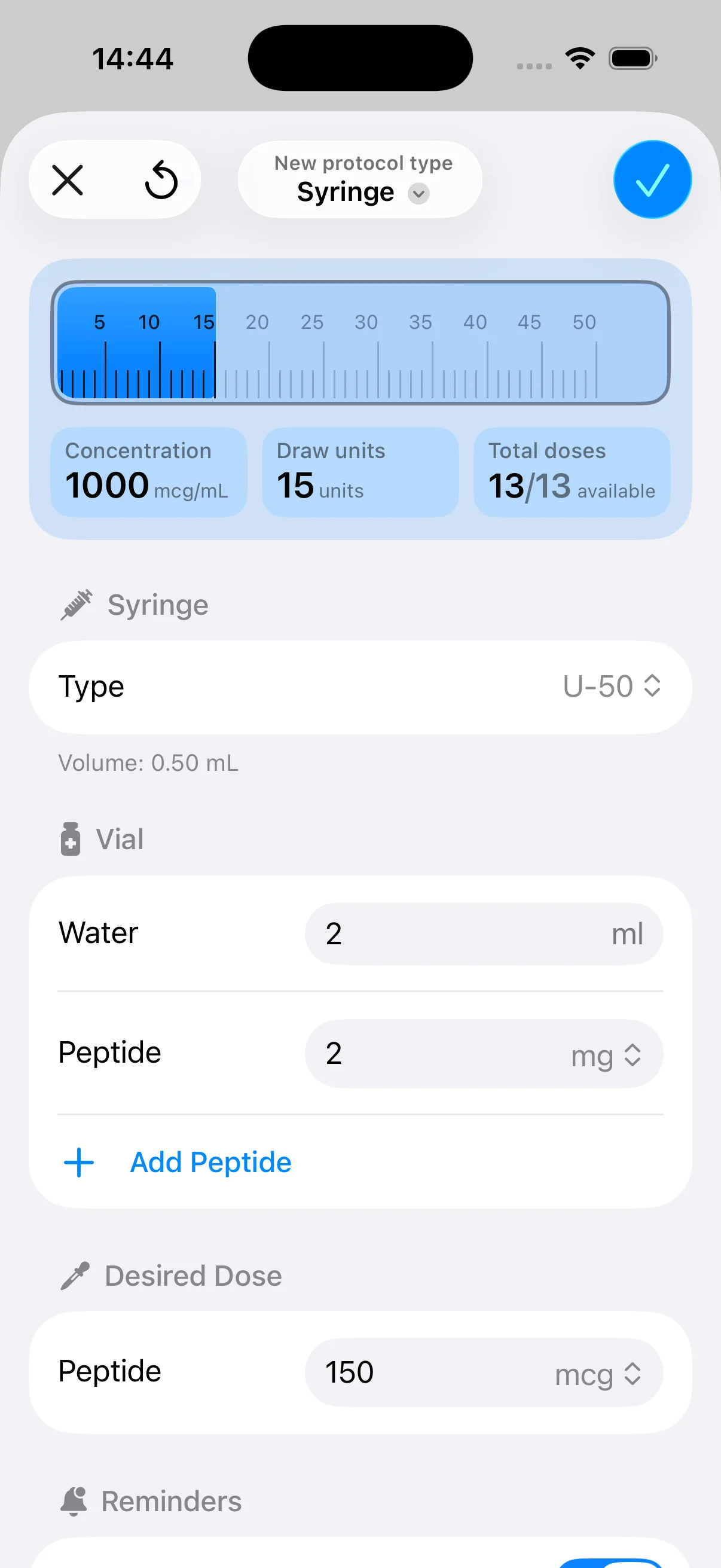
That’s where a structured tracker helps. One option is PepFlow’s peptide calculator app, which is built for vial configuration, dosage calculation, protocol scheduling, reminders, and dose logging. For a DAC-based setup, the useful part isn’t hype. It’s the ability to define a recurring interval like every 7 days, keep concentration details attached to the protocol, and avoid redoing syringe math from memory.
A clean system should help you do a few things well:
- Separate protocols clearly: If someone is tracking a daily peptide and a weekly DAC peptide at the same time, each one needs its own schedule.
- Store vial assumptions: Reconstitution details shouldn’t live on scraps of paper or in phone notes.
- Log actual injection dates: Planned dates and real dates often drift. The record needs to show what happened, not only what was intended.
Long-acting compounds reward consistency, not guesswork.
Whether you use an app, a spreadsheet, or a paper logbook, the standard is the same. You need a system that treats dosing math and scheduling as one task, not two unrelated ones.
Conclusion Key Takeaways for Your Protocol
If you’ve been trying to answer what is DAC in peptides, the clearest answer is this. DAC is a chemical modification that lets a peptide bind to albumin, stay in circulation longer, and behave like a long-acting version of the same basic signal.
That sounds technical, but its practical meaning is simple:
- DAC changes half-life in a major way
- DAC changes dosing frequency
- DAC changes the risk of overlap
- DAC increases the need for precise scheduling
The practical split is easy to remember. A no-DAC peptide tends to act more like a short pulse. A DAC peptide acts more like a sustained bleed. One gives more timing control. The other gives more convenience. Neither should be chosen just because the name sounds more advanced.
The most overlooked point is the one that matters most. Longer action can also mean greater saturation risk if the schedule is careless. Continuous exposure can work against the body’s natural pulsatile rhythm, which is why less-frequent dosing has to be deliberate, not casual.
If you understand the mechanism, the label stops being confusing. It becomes a planning signal. You know that “with DAC” doesn’t just mean “lasts longer.” It means the whole protocol should be built differently.
If you want a simple way to keep vial math, recurring schedules, and dose reminders organized in one place, PepFlow is a practical tool for planning peptide protocols without relying on memory or handwritten notes.