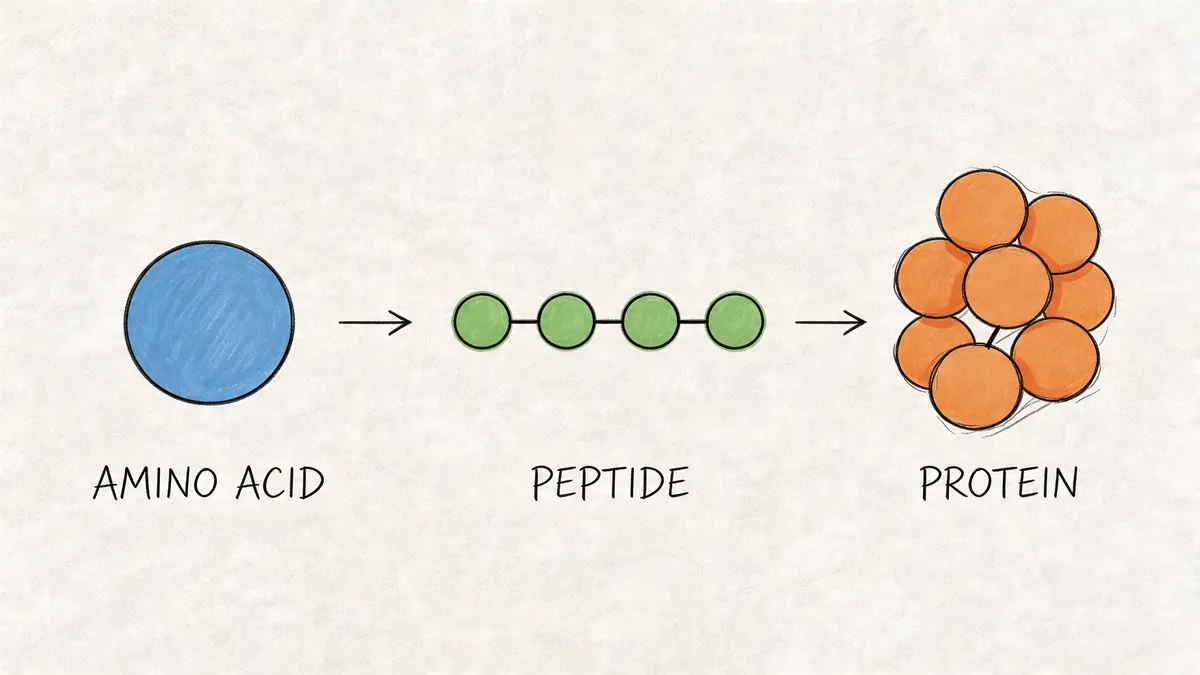
TL;DR: A peptide is a short chain of amino acids that acts as a precise signaling molecule in the body, telling specific cells what to do. In chemistry terms, peptides are short chains of 2 to 50 amino acids linked by peptide bonds, sitting between single amino acids and larger proteins in size and function.
You’re probably here because you’ve seen peptides mentioned in fitness, recovery, skin care, or weight loss conversations, and the explanations felt either too technical or too vague. One person says they’re “healing compounds.” Another says they’re “just amino acids.” Both are incomplete.
The useful answer sits in the middle. Peptides are real biological molecules with well-established roles in the body, but the practical side gets messy fast once people move from reading about them to trying to understand dosing, timing, and safety.
Table of Contents
- From Amino Acids to Proteins The Peptide Place in Between
- How Peptides Act as Cellular Messengers
- A Brief History of Peptide Discovery and Use
- Common Peptides in Wellness Performance and Weight Loss
- Understanding the Benefits Limitations and Safety
- The Practical Side Dosing Legality and Tools
- Frequently Asked Questions About Peptides
From Amino Acids to Proteins The Peptide Place in Between
Start with one building block
A lot of confusion starts here. Someone hears “peptide,” then “amino acid,” then “protein,” and it all begins to sound like three words for the same thing. They are related, but they are not interchangeable.
To build a clean mental model, start with amino acids. These are the small chemical units the body links together in a precise order. Once joined by peptide bonds, they form a chain. A short chain is called a peptide. A much longer, more complex chain is generally called a protein.
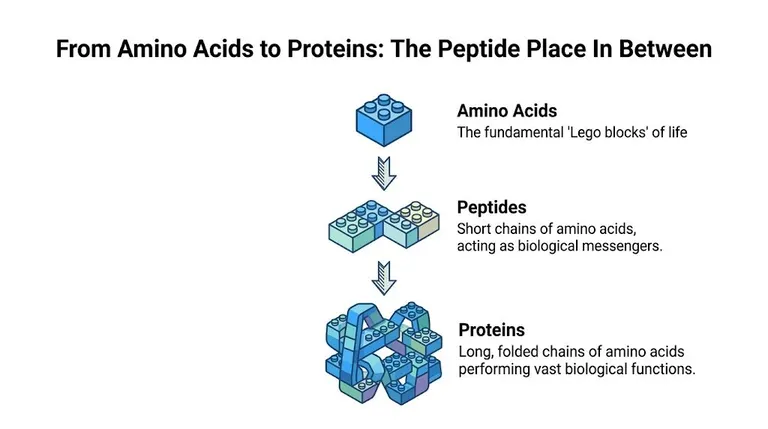
A useful comparison is letters, words, and full instructions. Amino acids are the letters. Peptides are short phrases with a specific job. Proteins are longer instruction manuals or larger working parts built from the same alphabet. The sequence matters because changing the order can change the final shape and function.
People often describe peptides as short chains of amino acids, while proteins are larger and usually fold into more elaborate structures. That size difference matters in practice. A peptide may act more like a targeted signal than a large structural component, which helps explain why peptides come up so often in conversations about recovery, appetite, body composition, and performance.
Why peptides behave differently from proteins
Size changes behavior.
Large proteins often serve as enzymes, scaffolds, transporters, or structural materials. Peptides more often act in narrower roles, especially as signals the body can recognize and respond to. That does not make peptides “better” than proteins. It means they tend to be used for different jobs.
For anyone reading peptide protocols online, this distinction has a practical payoff. If you understand that peptides sit in the middle, smaller and often more task-specific than proteins, claims about dosing frequency and timing start to make more sense. A compound that acts like a brief signal may need a different schedule than something designed to provide a broad nutritional effect. That is one reason wellness and fitness users get tripped up. They treat all peptides like one category, when the real question is what biological message a given peptide is trying to send, and for how long.
Here’s the simplest framework to keep in mind:
- Amino acids are the raw chemical units.
- Peptides are short chains that often carry focused biological instructions.
- Proteins are larger molecules that usually take on bigger structural or functional roles.
Practical rule: If a guide jumps straight to brand names, cycle lengths, or dose talk without explaining where peptides fit between amino acids and proteins, it becomes much harder to judge whether the advice is biologically sensible.
If you want a plain-language reference for names people commonly mention, this peptide cheat sheet for common compounds and terminology can help you keep the vocabulary straight while you learn.
How Peptides Act as Cellular Messengers
The lock and key idea
The easiest way to understand peptide function is the lock-and-key analogy. A peptide has a particular shape and chemical pattern. A cell has receptors on its surface. If the peptide fits the receptor, binding happens. That binding tells the cell to do something.
That “something” depends on the peptide and the receptor involved. The signal might influence tissue repair, appetite, hormone release, inflammation, or metabolism. The key point is specificity. Cells don’t respond to random molecules equally.
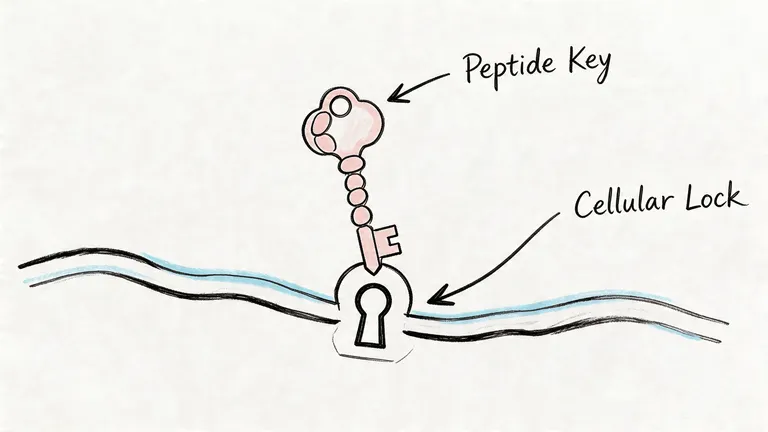
This is why two peptides can sound similar but act very differently. They aren’t interchangeable just because both are short amino-acid chains. Their sequence affects their shape, and their shape affects which receptor they can bind.
Why shape matters so much
A useful way to think about this is texting versus shouting across a room. A broad-acting compound can feel like a loud announcement. A peptide often acts more like a targeted text message sent to one person. The message still matters, but it reaches a narrower destination.
That precision is one reason peptides attract so much interest. In the body, they can act as specific signaling molecules, not just passive nutrients floating around. Their structure lets them fold or orient in ways that matter for receptor binding and effect.
A peptide only works biologically if its shape lets the right cell “recognize” it.
That’s also where confusion starts in practical use. People hear “targeted” and assume “simple.” It isn’t simple. A peptide’s effects depend on the compound, the context, the dose, the schedule, and the quality of what’s in the vial.
If you want a visual walk-through of peptide basics before getting into protocols, this short explainer is a useful companion:
A Brief History of Peptide Discovery and Use
From chemistry bench to medicine
Peptides aren’t a social media invention. Their story reaches back to the early 19th century, when chemists began isolating amino acids and slowly realizing they were the building blocks of larger biological substances. One key early milestone came in 1820, when Henri Braconnot isolated glycine, helping lay the foundation for peptide and protein chemistry, as outlined in this history of peptides.
Later, Emil Fischer pushed the field forward and coined the term peptide in the early 1900s. That mattered because naming a class of molecules often helps a field mature. Researchers could move from “interesting fragments” to a clearer chemical category with real biological relevance.
A turning point came in 1921, when insulin, a 51-amino-acid peptide, was isolated. That changed diabetes from a fatal disease to a manageable condition. Then in 1953, Vincent du Vigneaud achieved the first chemical synthesis of oxytocin, a nine-amino-acid peptide hormone, work that earned him the Nobel Prize and showed peptides could become serious therapeutic tools.
Why that history matters now
This history matters because it cuts through hype. Peptides are not new, even if today’s marketing is. Scientists have studied them for a very long time, and medicine has used certain peptide-based treatments for decades.
When you hear peptides discussed only as a trend, you’re missing a century-long scientific backstory.
That doesn’t mean every peptide sold online deserves trust. It means the category is scientifically real and historically important. The challenge today isn’t whether peptides exist or matter. The challenge is telling the difference between established biology, legitimate medical use, and loosely regulated wellness markets.
Common Peptides in Wellness Performance and Weight Loss
A person starts reading about peptides because their goals seem ordinary enough. Recover from hard training. Get leaner without feeling hungry all day. Keep performance steady while life, work, and sleep are less than perfect. Then they hit a wall of names that get tossed around as if they all belong in one bucket.
They do not.
A better way to understand this section is to sort peptides by the job people expect them to do. That sounds simple, but it clears up a lot of confusion. A peptide discussed for appetite control belongs in a very different conversation from one discussed for tissue support or growth hormone signaling. If you miss that distinction, dosing schedules, expectations, and risk assessment get muddy fast.
A simple comparison by goal
| Peptide | Primary Goal | Simplified Mechanism |
|---|---|---|
| BPC-157 | Recovery and tissue support | Often discussed in recovery-focused protocols because people associate it with repair-related signaling |
| TB-500 | Mobility and recovery | Commonly framed as supporting movement and tissue recovery pathways |
| CJC-1295 | Performance and body composition | Generally described as influencing growth hormone signaling patterns |
| Ipamorelin | Performance and recovery | Often grouped with compounds aimed at stimulating growth hormone release |
| Semaglutide | Weight management | Acts as a GLP-1 receptor agonist involved in appetite and metabolic regulation |
| Tirzepatide | Weight management | Commonly discussed as a metabolic signaling peptide used in weight-focused protocols |
That table is a map, not a verdict.
Peptides work a bit like different text messages sent inside the body. One message may relate to appetite. Another may relate to hormone release. Another may be discussed in the context of recovery. The names may sit side by side on a forum, but the biological intent is not the same, and the practical use is not the same either.
Where people usually place these peptides
Recovery peptides are the ones fitness enthusiasts often ask about after injuries, persistent soreness, or overuse problems. This category creates the most confusion because the discussion online is usually built from anecdotes, coach recommendations, and product pages rather than one clean, standardized playbook. For a reader trying to make sense of scheduling, that matters. A compound associated with tissue support may be used very differently from one associated with metabolic control.
Performance peptides show up in conversations about training adaptation, body composition, and recovery capacity. People usually pair them with bigger variables such as sleep, calorie intake, resistance training, and stress load. That practical context matters more than it gets credit for. A peptide protocol discussed in a bodybuilding forum is rarely a stand-alone idea. It is usually one moving part inside a larger routine.
Weight-management peptides are easier to place conceptually because the mechanism is easier to explain in plain English. Semaglutide and tirzepatide are discussed mainly through appetite, food intake, blood sugar handling, and pacing of weight loss. In practical terms, that often leads to a different set of questions from the ones asked about recovery or performance. People want to know how often they are taken, how appetite changes over time, what happens if doses rise too quickly, and how to plan training and meals when hunger drops. A consumer-oriented overview like Peptides for Weight Loss can help frame those real-world questions before someone gets lost in brand names.
Many beginners often get tripped up, comparing peptides by category label instead of by mechanism and use pattern. That is like comparing a sleep aid, a pre-workout, and a protein shake because they all sit in the same gym bag.
The practical difference between “same goal” and “same tool”
Two peptides can be discussed for similar goals and still behave very differently in real life. One may be talked about as a daily protocol. Another may be set up around a longer dosing interval. One may mainly affect appetite. Another may mainly affect hormone signaling. Those differences shape the day-to-day experience more than the marketing headline does.
That is especially relevant for wellness and fitness readers, because scheduling is often the hidden problem. It is one thing to read that a peptide supports a goal. It is another to ask whether the timing fits your training split, your meal structure, your travel schedule, your tolerance for injections, and your ability to follow a protocol consistently. The biology matters. The calendar matters too.
Even in longevity and physique conversations, similar labels can hide very different pathways. If you want a cleaner terminology guide for that side of the topic, this overview of best peptides for anti-aging is useful for sorting names and categories without treating them as interchangeable.
- Use categories as a starting point. Recovery, performance, and weight management are helpful buckets, but they do not tell you everything you need to know.
- Match the mechanism to the outcome you care about. Appetite regulation, tissue support, and hormone signaling are separate conversations.
- Pay attention to scheduling. The practical burden of a protocol often shapes adherence more than the theory behind it.
- Treat online summaries with caution. A short claim like “good for healing” or “good for fat loss” leaves out the details that actually affect decision-making.
Understanding the Benefits Limitations and Safety
Where peptides can be appealing
Peptides appeal to people for a straightforward reason. They can act with a high degree of specificity. Because they often work as signaling molecules, they may influence a narrower biological pathway than a more blunt tool would.
That precision is the attractive part. If a molecule can bind a particular receptor and trigger a particular response, it feels cleaner and more purposeful than taking something broad and hoping for the best.
People also like that peptides fit into a familiar biological story. They’re built from amino acids, and the body already uses peptide signals naturally. That doesn’t make every peptide protocol safe or smart, but it does explain why the category feels intuitive to many readers.
Where things get risky fast
The limitations start where internet enthusiasm usually gets quiet. Many peptides aren’t convenient to use. Some protocols rely on injection rather than a simple oral routine. Some compounds are also discussed in ways that outrun the quality control behind them.
The biggest practical risk sits in the research peptide market. Products may be sold with language that shifts responsibility to the buyer, while the buyer still has to decide whether the label is accurate, whether the concentration is right, and whether sterile handling is being taken seriously.
Reality check: A peptide can be biologically plausible and still be a poor choice in the real world if the sourcing, preparation, or self-administration is sloppy.
This is also where confusion between medical treatment and self-experimentation causes trouble. A prescribed peptide medication under clinical supervision is one thing. A vial bought online “for research purposes only” is another.
A related issue is comparison shopping by headline instead of by mechanism. For example, many people looking into growth-hormone-related compounds don’t realize there are meaningful differences in how schedules and use cases are discussed. This breakdown of CJC-1295 DAC vs no DAC is useful because it shows how a small naming difference can change the practical conversation.
A simple safety filter helps:
- Ask what the peptide is supposed to do: If the answer is fuzzy, stop there.
- Ask how it’s being sourced: If you can’t clearly describe that, risk goes up.
- Ask whether you can prepare and measure it accurately: If not, the protocol isn’t ready for use.
The Practical Side Dosing Legality and Tools
Why dosing trips people up
This is the part most articles skip. Learning what are peptides is the easy part. Converting that knowledge into a real protocol is harder, because dosing requires math, concentration awareness, and consistency.
A person may know the intended amount in micrograms, but still not know how that translates into the volume drawn into a syringe after reconstitution. That’s not a minor issue. Practical challenges in reconstituting and dosing research peptides lead to substantial user error, with some biohacking-community surveys suggesting error rates as high as 30 to 50%, and many basic guides omit the math needed to convert dosages into injection volumes, as summarized in WebMD’s peptide overview.

That gap matters because a protocol can go wrong even when the peptide choice was thoughtful. Errors can come from using the wrong reconstitution volume, misunderstanding the vial concentration, or forgetting where you are in a cycle.
Tools can reduce math mistakes
The legal side is also murky for many compounds. Some peptide products are prescribed medicines. Others are sold in a gray area labeled for research rather than personal use. That means the burden of caution lands heavily on the buyer.
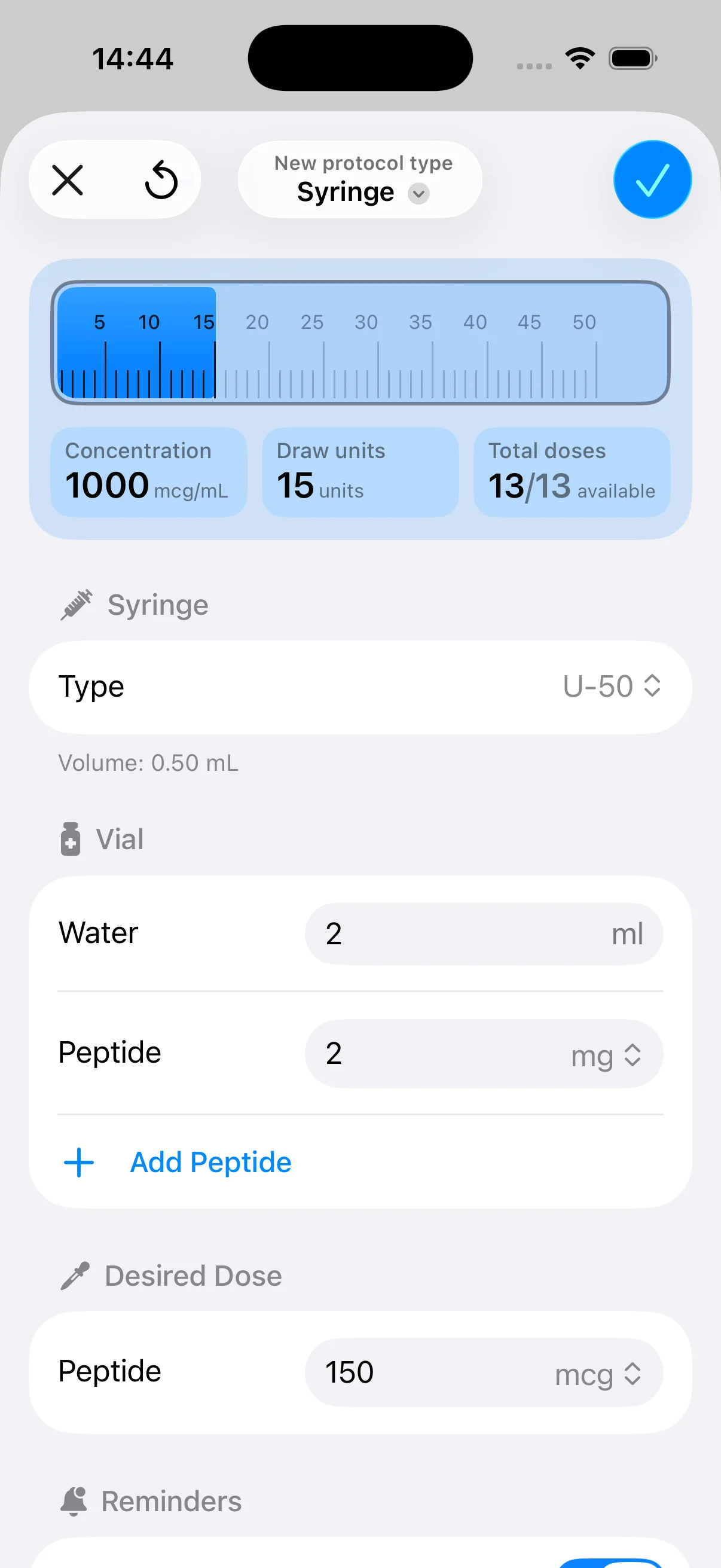
For people trying to stay organized, tools can help with the logistics even though they don’t replace medical advice. PepFlow is one example. It calculates dose conversions from micrograms into practical unit measurements and helps users map schedules, reminders, pauses, and logs for structured protocols.
If you’re comparing physician-guided care with self-managed use, it also helps to read a clinic-style overview of Peptide Therapy so you can see how supervised treatment is framed differently from informal online peptide use.
- Precision matters: A small math mistake can change what gets administered.
- Scheduling matters too: Even the right dose can become inconsistent if timing drifts.
- Organization is not treatment: A calculator or reminder system can reduce manual error, but it doesn’t validate the compound or the protocol.
Frequently Asked Questions About Peptides
How should peptides be stored
Storage depends on the specific compound and form, so the most important rule is to follow the handling instructions that come with the product from a legitimate source. In general, peptides are discussed as substances that should be protected from unnecessary heat, moisture, and light.
Once a product has been mixed or reconstituted, people should be even more careful about cleanliness, labeling, and following the product-specific guidance. Don’t improvise storage rules from forum comments.
Are peptides legal to buy and use
There isn’t one universal answer. Some peptides exist as regulated prescription medications used in standard medical care. Others are sold online with “research use” language that creates a gray area for buyers.
That distinction matters. Legal availability doesn’t guarantee quality, and online availability doesn’t mean personal use is clearly lawful or medically appropriate. If you can’t tell which category a product falls into, pause before ordering.
Buying a vial online is not the same thing as using an approved medication under medical supervision.
How long does it take to notice anything
That depends on the peptide, the goal, the person, and whether the product is authentic and used correctly. There’s no honest single timeline that fits every peptide protocol.
A better approach is to set expectations around consistency and observation. Know what you’re monitoring, track timing carefully, and separate subjective impressions from actual trends. If you don’t know what result you’re looking for or how you’d measure it, you’re not ready to evaluate the protocol.
One last practical note
Most peptide mistakes don’t come from not knowing the buzzwords. They come from confusing a basic biological idea with a ready-to-run plan. Understanding what peptides are gives you the map. It doesn’t hand you safe sourcing, accurate dosing, or a sensible schedule.
If you’re trying to keep peptide dosing and protocol timing organized, PepFlow is a simple tool for calculating practical dose units, planning cycles, and keeping reminders in one place. It’s built for accuracy and routine, not as a substitute for medical advice.