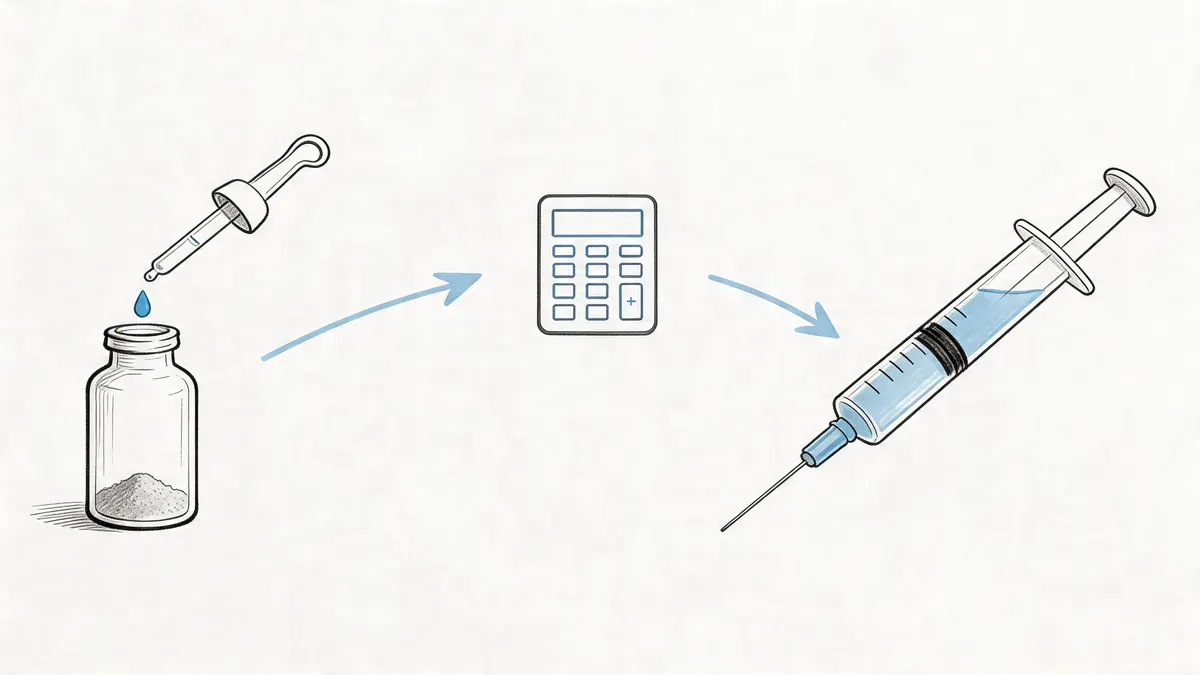
You’re probably here because you have a vial in front of you, a syringe nearby, and a small window to get the math right before you mix anything. That moment is where most dosing mistakes start. The powder looks simple. The arithmetic doesn’t.
A lot of people think the best peptide reconstitution calculator is just the one that gives a quick mL answer. In practice, that’s only half the job. The primary failure point usually comes later, when someone forgets what concentration they mixed, misses a scheduled draw, or tries to manage multiple vials from memory. During the 2020 to 2022 biohacking surge, calculator use spiked 400%, and mobile tools became the turning point, with Google Play apps reaching 5,000+ reviews and a 4.8/5 rating. That shift makes sense. People didn’t just want math help. They wanted protocol control.
That matters even more if you’re comparing different peptide stacks or rotating compounds for recovery, body composition, or general wellness planning. Once more than one vial enters the picture, a plain browser calculator starts feeling incomplete.
Table of Contents
The Challenge of Perfect Peptide Dosing
The hard part isn’t opening a calculator. The hard part is trusting that every number you entered matches the vial, the solvent volume, the syringe markings, and the actual dose you intend to pull.
Users often encounter friction at the same points. They know the vial mass, but they’re less certain about the concentration they want. They know the dose in micrograms, but the syringe is marked in units. Then they try to convert everything mentally while handling supplies that don’t leave much room for distraction.
The pressure comes from tiny margins
A peptide vial is small, but the consequences of a sloppy setup aren’t. Reconstitution is one of those tasks that looks basic until someone confuses mg and mcg, assumes syringe units are the same as mass, or forgets what volume they used last time.
Practical rule: If you have to do unit conversion in your head while holding a syringe, you’re already increasing the chance of an avoidable mistake.
The best peptide reconstitution calculator removes that pressure in two ways. First, it standardizes the math. Second, and more important for real-world use, it preserves the setup so you don’t have to reconstruct your own protocol later from memory.
Why phone-based tools changed the workflow
A desktop browser form is useful for a one-off answer. It’s less useful on day six of a cycle when you’re trying to remember whether the vial was mixed for a higher or lower concentration.
That’s why mobile-first protocol tools took off. They fit the actual workflow. You can configure a vial once, check draw volume quickly, and keep the schedule attached to the same entry instead of scattering notes across screenshots, paper labels, and message threads.
The calculator matters. The surrounding system matters more.
Understanding Peptide Reconstitution Fundamentals
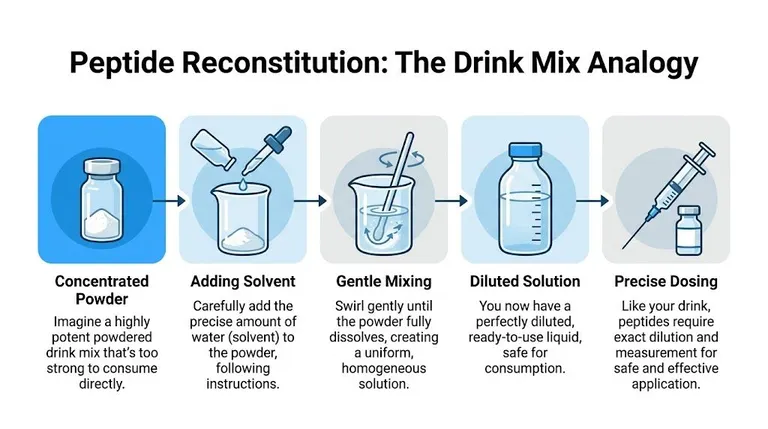
Reconstitution is just controlled dilution. The powder in the vial contains a fixed amount of peptide. You add a measured amount of solvent to dissolve it, creating a liquid with a known concentration. From there, every dose is just a volume draw based on that concentration.
A simple analogy helps. Think of a strong powdered drink mix. The powder amount is fixed. If you add a small amount of water, the drink is concentrated. If you add more water, the drink is weaker. Peptides work the same way, except the measurement needs to be exact.
What reconstitution actually means
The core formula is straightforward. Volume (mL) = Mass (mg) / Desired Concentration (mg/mL). The same reference gives a simple example. To make a 1 mg/mL solution from a 5 mg vial, you add 5 mL of solvent. It also notes that calculator automation reduces manual math errors by over 90%.
That’s the logic every serious calculator is running in the background.
If you want a deeper primer on how lyophilized material behaves before mixing, PepFlow has a useful article on freeze-dried peptides.
The three variables that control every calculation
Every accurate setup comes down to three inputs:
| Variable | What it means | Why it matters |
|---|---|---|
| Peptide mass | The total amount in the vial | This is your fixed starting quantity |
| Solvent volume | How much liquid you add | This determines concentration |
| Target dose | The amount you want per injection or draw | This determines how much volume you pull |
Here’s the practical sequence:
-
Read the vial correctly
Confirm the mass in the vial first. If that number is wrong, every later number is wrong. -
Choose a concentration that’s easy to work with
People often pick a solvent volume that makes the final dose easy to measure on a U-100 syringe. -
Convert the desired dose into draw volume
Once concentration is set, the dose becomes a simple volume calculation.
A good calculator doesn’t replace understanding. It prevents transcription mistakes while making the underlying math repeatable.
When someone says they want the best peptide reconstitution calculator, this is what they should mean. A tool that makes the logic visible, not a black box that spits out a number with no context.
Why Manual Dosing Math Is a High-Risk Gamble
You reconstitute a vial late at night, write the concentration on a note, and tell yourself you will remember the draw volume tomorrow. A week later, you are staring at the same peptide name with no confidence that the mix, syringe units, or target dose in your head still match what’s in the vial.
That is how dosing errors happen in real use. They rarely come from ignorance. They come from rushed setup, reused notes, and small assumptions that slip past review.
Manual reconstitution math creates too many places to be slightly wrong. Slightly wrong is enough to change what reaches the syringe. I have seen the same pattern repeatedly. The vial label is read correctly, but the solvent amount is remembered incorrectly. The target dose is right, but the syringe conversion is copied from a different setup. Everything looks clean on paper, yet the actual draw is off.
Where manual dosing breaks down
The repeated failure points are practical, not theoretical:
-
Unit mix-ups
Milligrams and micrograms get swapped, or a person calculates in one unit and measures in another. -
Syringe conversion mistakes
A target peptide dose does not automatically translate cleanly to insulin syringe markings unless the concentration was chosen with that syringe in mind. -
Reused vial assumptions
Two vials with the same peptide name can be mixed to different concentrations. If the old draw volume gets reused, the dose changes. -
Memory-based protocol management
A loose note, screenshot, or text message is not a dosing system. It does not tell you what was mixed, when it was mixed, what was drawn, or what is due next.
That last point matters more than many users expect. The best peptide reconstitution calculator should not stop at a one-time answer. It should store the vial setup, convert the dose into a real draw amount, schedule the protocol, and keep a log you can verify before the next injection. That is where adherence usually fails.
Small arithmetic errors become real protocol errors
Peptide work happens in tight measurement ranges. A small concentration mistake changes every draw that follows. A small scheduling mistake leads to double-dosing, skipped doses, or guessing whether the last injection happened at all.
That is why a web form alone is not enough. Good tools reduce the number of decisions you need to remake, then preserve the exact setup so you are not rebuilding the protocol from memory every time.
The same principle shows up in other tracking-heavy health routines. People comparing devices for cycle data often focus on the hardware first, but finding the best health tracking options usually comes down to whether the system records, reminds, and keeps the context intact over time.
The expensive mistake is not a hard equation. It is trusting yourself to remember a chain of small numbers days later.
A reliable calculator reduces math errors. A protocol management app reduces repeat errors, missed doses, and bad records. For peptide use, that difference matters more than interface design.
Key Features of the Best Reconstitution Tools
A calculator earns trust when it handles more than a single equation. The best peptide reconstitution calculator has to support the whole chain of use, from setup to repeat dosing.
A lot of online tools still behave like disposable utilities. You enter numbers, get an answer, close the tab, and then lose the context that is important later.
What a serious tool needs to handle
The strongest tools do five things well.
| Feature | Why it matters in practice |
|---|---|
| Accurate unit handling | It must cleanly handle mg, mcg, mL, and syringe-unit conversions without ambiguity |
| Clear vial setup | You should be able to see mass, solvent volume, and resulting concentration at a glance |
| Saved configurations | Reused compounds shouldn’t require rebuilding the same setup each time |
| Dose translation | The tool should convert a target amount into a practical draw volume |
| Protocol support | Scheduling, reminders, and logs matter once the initial mix is done |
The last point is where basic calculators usually fail.
Most calculators don’t address multi-peptide blends, even though that practice has surged by 35% in wellness communities. That gap matters because mixing protocols add compatibility and tracking questions that one-field web forms don’t solve.
Why protocol management matters more than people expect
People don’t usually abandon a protocol because they forgot how division works. They fall off because the routine becomes messy.
A reliable setup should answer questions like these without friction:
-
What concentration did I mix
-
How many units do I draw for today’s dose
-
When is the next administration due
-
How many doses remain in the vial
-
Which vial am I currently using
That’s the same reason people spend time finding the best health tracking options in other wellness contexts. Precision is useful. Consistency is what makes precision stick.
Field observation: A technically correct protocol still fails if the person following it has to reconstruct it from old notes every time.
So when comparing tools, don’t stop at “does it calculate volume.” Ask whether it helps you repeat the same protocol accurately a week later.
A Practical Walkthrough with the PepFlow App
You reconstitute a vial correctly on Monday, then by Thursday you are checking old notes, recalculating units, and trying to remember whether the last dose was 200 mcg or 250 mcg. That is the failure point a basic calculator does not solve.
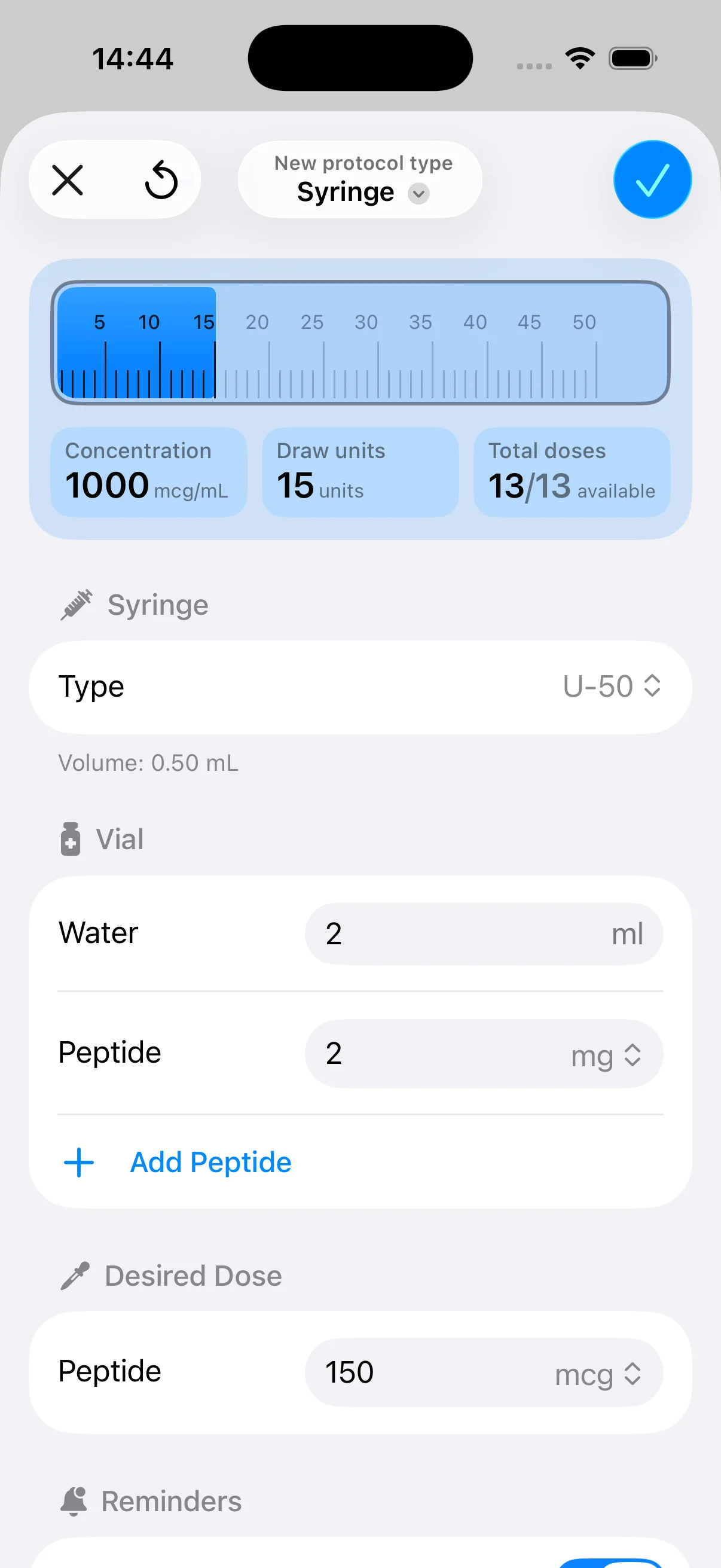
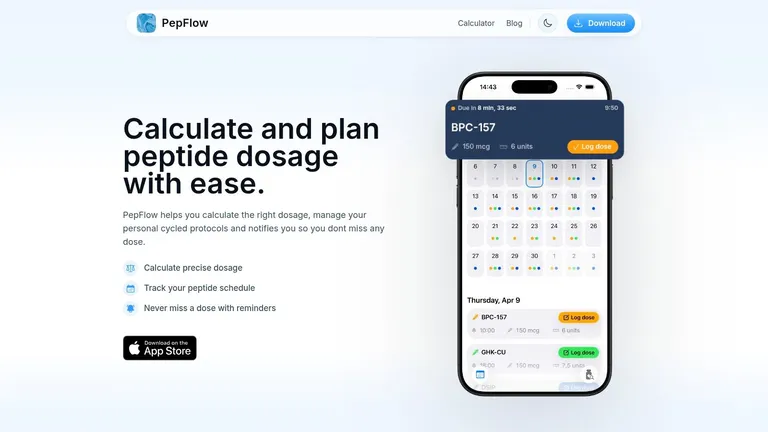
PepFlow is useful because the math stays tied to the protocol after the vial is mixed. The PepFlow peptide protocol tracker keeps the concentration, dose conversion, schedule, and log in one place, which reduces the chance of making a fresh syringe math error every time you draw.
Setting up a vial correctly
The setup step decides whether the rest of the protocol is clear or sloppy. I always want the vial entry to answer three questions without any guesswork later. How much peptide is in the vial, how much solvent went in, and what dose will be pulled each time.
A clean setup usually looks like this:
-
Enter the peptide amount in the vial
Record the vial strength exactly as labeled so you are not relying on memory or a photo in your camera roll. -
Add the solvent volume used for reconstitution
This determines the final concentration. A small change here affects every dose that follows. -
Set the target dose
The app should convert that target into the draw volume you use with the syringe on hand.
That persistence matters. A browser calculator gives you an answer once. A phone-based protocol tool stores the answer with the vial, so the same concentration and dose mapping are still there next time.
Use a real example. A 5 mg vial reconstituted with 3 mL gives a concentration of about 1,667 mcg/mL, as noted earlier from the Cellgenic example used in this article. At that concentration, a 250 mcg dose comes to 0.15 mL, or roughly 15 units on a U-100 insulin syringe. That is exactly the kind of conversion that should be automatic, because the common mistake is not the initial formula. It is misreading mL, mcg, and syringe units when you are in a hurry.
Turning one calculation into an actual routine
This is the part that separates a calculator from a protocol system.
After the first mix, the essential task is repetition without drift. The tool should show the active vial, the dose due, the time of the next administration, and what has already been logged. If those details live in three different places, written note, calendar alert, and calculator tab, errors start creeping in.
A solid phone workflow usually includes:
-
Recurring schedule setup
Enter the start date and frequency once, then keep the timing consistent. -
Dose reminders tied to the protocol
A reminder should point back to the actual vial and dose, not a generic alarm with no context. -
Quick logging after administration
Fast logging matters because long input screens usually get skipped. -
Visible status between doses
Countdown timers or widgets help keep the protocol in view instead of buried in notes.
One practical trade-off is speed versus documentation. A stripped-down web calculator is faster for a one-off check. An app takes a little longer at the start, but it saves time and prevents confusion over the next several doses. For anyone running a multi-week protocol, that trade is usually worth it.
The best peptide reconstitution calculator category is larger than concentration math. The stronger option is the one that carries the protocol from initial mix to daily execution, because that is where dosing plans usually break down.
Common Pitfalls and Safe Use Principles
A dosing plan usually fails after the math is done.
The common miss is not the calculator. It is the moment a mixed vial sits in the fridge with no label, no reconstitution date, and no clear record of what was drawn yesterday. That is why the best peptide reconstitution calculator needs to function like a protocol system on your phone, not a one-time web form. Good concentration math prevents one error. Good handling and tracking prevent a week of them.
Handling rules that calculators can’t enforce
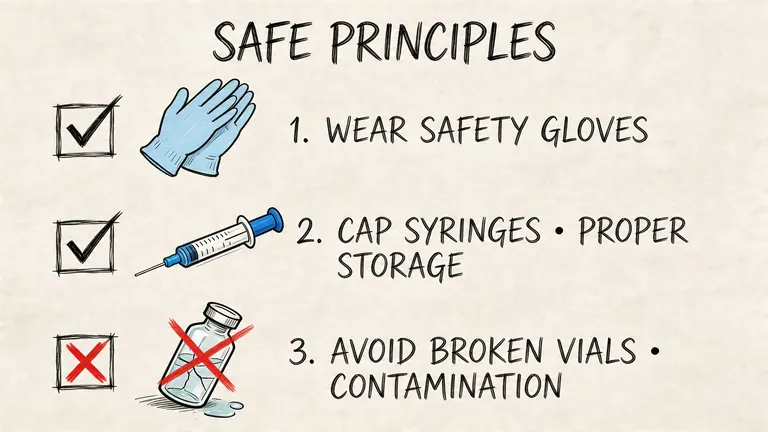
Sterile technique comes first. Wipe the stopper before every puncture, use fresh supplies, and keep the work area clean. A correct dilution does nothing for a vial that was handled carelessly.
Mixing technique is the next failure point. Add solvent slowly down the vial wall, then swirl gently until the powder dissolves. Do not blast liquid straight onto the cake and do not shake the vial hard. If you need a plain-language refresher on solvent choice before mixing, this guide on what bacteriostatic water is used for covers the practical distinction.
Temperature and storage matter too. Let refrigerated components come closer to room temperature before reconstitution if your protocol calls for it, and avoid repeated warming and cooling once the vial is mixed. In real use, storage inconsistency causes more confusion than the initial calculation.
A short safety checklist
Use this before and after reconstitution:
-
Clean vial tops every time
Swab before each puncture, not just the first one. -
Add solvent slowly
Let it run down the inside wall to reduce stress on the powder. -
Swirl instead of shaking
Dissolve gently and give it time. -
Label immediately
Write the compound, final concentration, reconstitution date, and any protocol note you will need later. -
Track each use
Log what was drawn and when. Memory is unreliable after a few days. -
Store consistently
Follow the storage conditions for that compound and stop treating a reconstituted vial like it will be fine indefinitely.
The expensive mistakes are usually boring ones. Wrong vial. Wrong concentration. Missed date. An app that ties the calculation to reminders, vial status, and dose logs helps catch those routine failures before they turn into bad dosing decisions.
These tools support planning, organization, and research workflow. They do not replace medical advice, individualized treatment decisions, or sterile compounding standards.
Frequently Asked Questions
What’s the difference between bacteriostatic water and sterile water
The practical difference is use case. Bacteriostatic water is generally chosen when a vial will be accessed more than once over time. Sterile water is typically treated more cautiously for single-use situations. If you want a plain-language overview of the topic, PepFlow’s guide on bacteriostatic water use is a solid starting point.
For routine peptide reconstitution workflows, people usually prefer bacteriostatic water because repeat vial access is common.
Should different peptides be mixed in the same vial or syringe
A common point of overconfidence emerges. Many calculators can handle a single-vial concentration but don’t solve compatibility, stability, or mixing-order concerns for blends. In practice, unless you have a clear protocol and a justified reason, keeping compounds separate is the safer organizational approach.
That’s especially true if you can’t verify stability, pH compatibility, or how the mixed solution will be stored over time.
How long does a reconstituted peptide stay usable
That depends on the compound, the solvent, storage conditions, and how the vial is handled after reconstitution. There isn’t one universal answer that safely applies across every peptide. Treat the shelf life as protocol-specific, not generic.
The safer habit is to label the vial clearly, track reconstitution dates, and avoid guessing once a vial has been sitting for a while.
If you want one place to handle both the math and the routine, PepFlow is built for that workflow. It helps convert vial and solvent inputs into practical draw amounts, then keeps the protocol organized with scheduling, reminders, widgets, and dose history so you’re not recalculating or second-guessing the same setup every day.