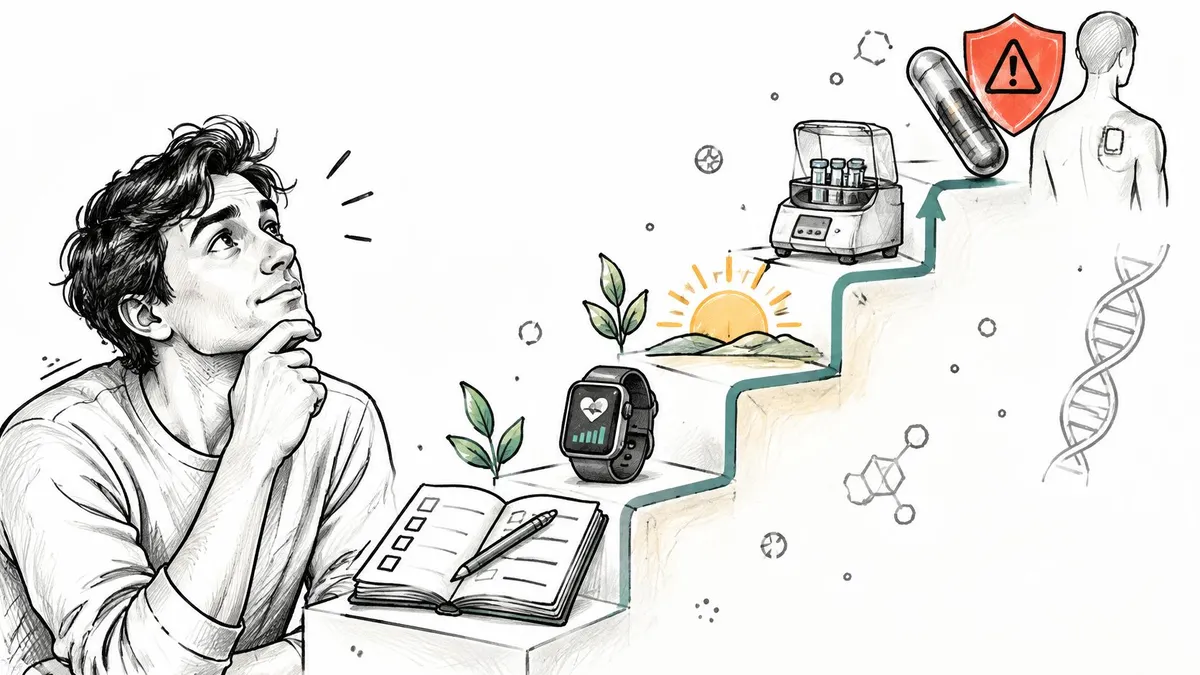
Biohacking applies a hacker mindset to human biology, learning how a system works and then trying to change it, and it is not a regulated treatment or proof of benefit.
If a sleep diary and an experimental injection both count as biohacking, what does the label tell you about safety? Less than you might think. The useful question isn’t whether something qualifies as a biohack, but what you’re changing, what evidence supports it, and how easily you can undo it.
Table of Contents
- What Biohacking Actually Means
- Where Common Biohacks Sit on Risk
- From Quantified Self to Community Labs
- Running One Change at a Time
- When a Biohack Needs a Clinician
- Choose a Modest First Experiment
What Biohacking Actually Means
Biohacking is an approach to changing biology, not a medical specialty. People use the word for activities that differ enormously in purpose, equipment, and consequences. That’s why answering “what is biohacking?” requires more than a list of fashionable routines.
The overview of do-it-yourself biology describes a broad field of biological experimentation outside conventional institutional settings. Within the wider biohacking label, newcomers commonly encounter personal measurement, community science, and experimental interventions. Those activities share curiosity and a do-it-yourself attitude, but they don’t share a standard of medical evidence.
A kitchen analogy helps: using a food scale and undergoing surgery can both affect a body, but they aren’t the same craft. Calling both “optimization” doesn’t make their hazards comparable.
The practices people mix together
The broad label contains several distinct activities:
- Personal self-tracking. Recording sleep, food, exercise, or physiological signals to understand routines and notice patterns.
- Community biology. Learning and conducting biological experiments with shared equipment, training, and laboratory rules.
- Experimental body modification. Using supplements, implanted devices, or biological techniques in pursuit of changes to health or performance.
Even within these categories, the purpose matters. Someone learning laboratory technique may be pursuing science education, not treating an illness. Someone recording bedtime may want a routine they can maintain.
The label also says little about rigor. A notebook with consistent entries can be more useful for a narrow question than an expensive dashboard full of measurements collected without a plan. More data isn’t automatically better information.
Everyday scenes reveal the difference
Consider a new parent trying to understand broken sleep. They record bedtime, caffeine timing, morning light exposure, and hours asleep. The things they’re changing are schedule and attention, not a biological product.
That parent may discover that the intended bedtime rarely survives the evening routine. The useful result is practical: identifying what prevents the routine from happening. They haven’t demonstrated that any particular sleep intervention treats a medical condition.
A runner has a different question. They place training volume beside resting heart rate and notes about fatigue to examine whether an easier training period coincides with feeling recovered. Their focus is the relationship between workload and recovery, not achieving the lowest possible number on a watch.
- The community-lab learner joins a space such as Genspace or BioCurious to study a basic technique with shared equipment and house rules. What changes is access to scientific education and supervised practice.
- The longevity-forum reader combines unnamed peptides and high-dose supplements because each has an appealing explanation involving cells or signaling pathways. What changes is pharmacology and medical risk, even if the person calls the routine self-improvement.
These scenes show why “natural,” “technical,” and “data-driven” aren’t reliable safety categories. A simple-looking product can have biological effects, while advanced software may only organize observations.
Practical rule: Identify the action beneath the label. Recording a behavior, changing a behavior, and introducing a substance are different decisions.
A useful definition therefore ends with a sorting question: How invasive is the practice, how strong is the evidence, and how reversible is the change? Those criteria make biohacking a decision tool rather than a slogan. They also set a clear boundary for this guide: no recommended peptide, dose, or implanted device.
Where Common Biohacks Sit on Risk
| Practice | Invasiveness | Typical evidence | Reversibility | Sensible boundary |
|---|---|---|---|---|
| Sleep, food, and training logs | Low | Everyday physiology is well studied; a personal log is not a trial | Fully reversible as a tracking activity | Self-directed, with moderation |
| Fitness wearables and stress checks | Low | Devices measure signals; they don’t prove a protocol | Stop tracking anytime | Ease off if tracking raises anxiety |
| Diet and exercise changes | Low to moderate | Strong evidence for basic versions; extreme protocols need separate evaluation | Usually reversible | Consult a clinician if you have a medical condition |
| High-dose or stacked supplements | Moderate | Often mechanistic or small studies; not regulated as drugs | You can stop the product, but effects may persist | Check interactions before combining |
| Unapproved peptides or hormone-like compounds | High | Human research on many popular peptides is very limited | Effects may outlast the dose | Medical supervision, not forum-led experimentation |
| Implants and body devices | High | Require device-specific evidence, not general biohacking claims | Removal may be surgical | Licensed clinician |
| DIY lab or genetic techniques | Highest for personal biological modification | Community science is not evidence for personal medical care | Some changes are hard to undo | Not a home health experiment |
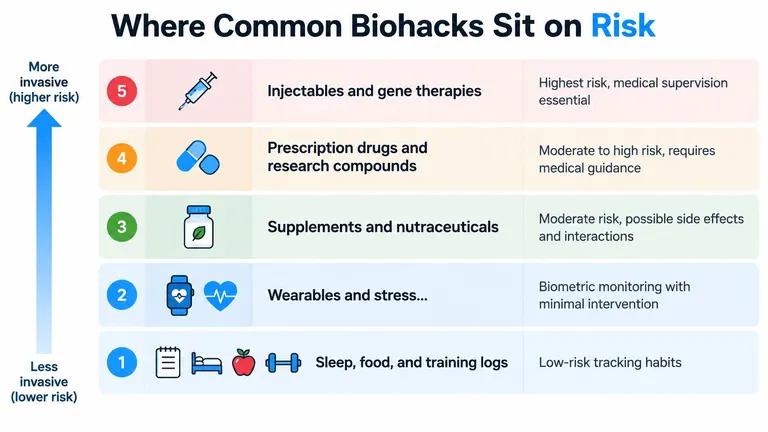
Use this ladder as an initial sorting aid, not a declaration that everything on a lower rung is safe.
The visual version highlights the progression from observation toward intervention.
Evidence and reversibility are separate questions
Cleveland Clinic’s guide to biohacking includes exercise, diet, sleep, stress monitoring, and fitness tracking, while warning that supplements aren’t regulated like drugs and that optimization can become excessive. That combination matters: an ordinary activity can become unhealthy when someone pursues it rigidly.
Being able to stop an activity doesn’t prove that it’s harmless. You can stop swallowing a supplement immediately, but that doesn’t guarantee its biological effects disappear immediately. Similarly, removing a wearable is easy; undoing anxiety built around its daily scores may take more effort.
For supplement-related ideas, use a guide to longevity supplements to identify the category and questions involved, rather than treating the category name as evidence. For a specific peptide example, Celonyx Labs’ discussion of BPC-157 human evidence gaps is a prompt to examine what’s missing between a biological explanation and a demonstrated human benefit. Neither reading replaces an independent clinical assessment.
Where fasting and cold exposure fit
Time-restricted eating belongs with diet changes, not with passive tracking. Its physical invasiveness is low, and the eating schedule can usually be reversed, but evidence for ordinary healthy eating shouldn’t be transferred automatically to a particular fasting schedule. Medical conditions and existing treatment can change whether the experiment is appropriate.
Short cold-water exposure sits closer to the lower rungs because it doesn’t require a product or implant, and you can end the exposure. Nevertheless, claims about broad health or longevity benefits require specific evidence; an activity being brief doesn’t establish that it’s suitable for you. Don’t confuse a controllable setting with a guarantee of safety.
For another explanation of the broad label, watch with the same evidence questions in mind.
The most useful starting point for many people is disciplined attention to ordinary behaviors, not escalation toward exotic interventions. Name the practice you’re considering and match it to a row. The rung describes what you would do, not whether your motives are sensible or sincere.
From Quantified Self to Community Labs
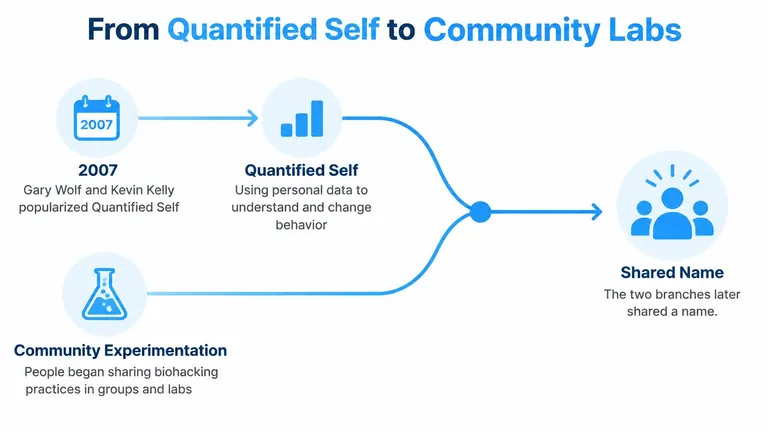
Biohacking’s broad meaning makes more sense when you separate its personal-data branch from its community-science branch. One centers on understanding yourself through measurements. The other centers on making scientific tools and education accessible outside conventional institutions.
The personal-data tradition is associated with Gary Wolf and Kevin Kelly’s popularization of Quantified Self, the practice of using personal information to understand and change behavior. Its everyday descendants include sleep diaries, training dashboards, and wearable trend reviews.
These branches help explain why people use the same label for very different activities.
Shared tools, different purposes
A scholarly history of DIY biology records that Jason Bobe and Mackenzie Cowell founded DIYbio.org in 2008, followed by community spaces including Genspace in New York in 2010, BioCurious in Santa Clara later that year, and La Paillasse in Paris in 2011. These milestones describe the development of networks and shared laboratories, not the establishment of a medical treatment pathway.
Today, a person exploring that personal-data tradition might need help making sense of Apple Watch readings, as discussed by Cardiogram. Another might compare biohacking apps to find a manageable way to record routines. Neither task is equivalent to learning wet-lab technique.
The history explains the uneven definition without resolving the safety question. A lab membership and a bedtime routine share a do-it-yourself attitude, not a risk level. Neither curiosity nor community participation establishes that an intervention will extend life.
Running One Change at a Time
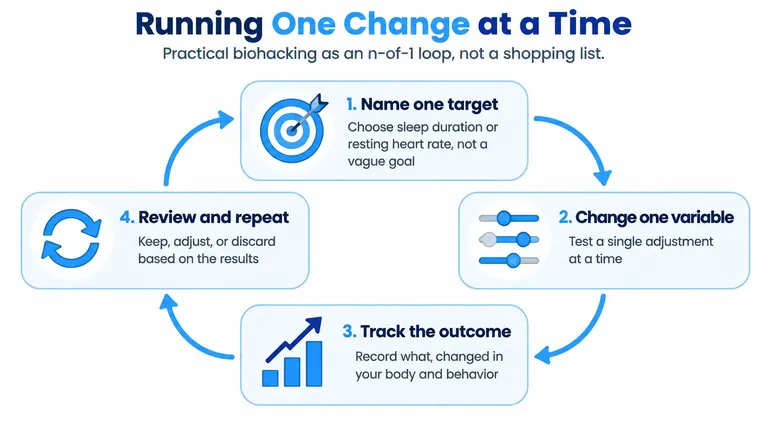
Practical self-tracking works best as a focused question, not a shopping list. An n-of-1 approach means examining changes within an individual, with enough structure to distinguish an observation from an impression.
A peer-reviewed analysis in Body & Society places biohacking at the intersection of data-driven self-tracking and complementary or alternative medicine. The important practical distinction is between collecting personal observations and establishing a causal medical effect.
Build a usable observation loop
-
Name a specific target. Choose sleep duration, resting heart rate, or another clearly defined outcome. “Optimize my biology” doesn’t tell you what to measure or what would count as improvement.
-
Record a baseline. Observe your usual routine before changing it. Include ordinary working days and the disruptions that normally affect you, rather than selecting only unusually good or bad days.
-
Change a single variable. For a low-risk routine, that might mean adopting a consistent bedtime or setting a training-volume cap. Keep the other relevant habits as stable as reasonably possible.
-
Log exposure and outcomes. Write down what you did and when, not just what you intended. Pair objective measurements with notes about fatigue, mood, discomfort, or other relevant experiences.
-
Review the pattern. Ask whether the change looks meaningfully different from your baseline variation. A memorable good day isn’t the same as a consistent shift.
Without randomization or a suitable comparison, this loop doesn’t establish causality. A better week could reflect expectation, a lighter workload, repaid sleep debt, or simple fluctuation. Regression to the mean means that an unusually bad stretch may be followed by a more ordinary stretch even when the new routine contributed nothing.
The simplified cycle below is useful as a reminder, with baseline recording included before you make the adjustment.
Record enough context to interpret the result
Useful measurements include sleep duration, resting heart rate, blood pressure, training volume, and laboratory markers a clinician has already ordered. Use comparable measurement conditions where practical. A resting reading and a post-workout reading answer different questions.
Say you move your coffee earlier, add a supplement, and reduce your training at the same time. If you sleep better, you won’t know which adjustment mattered. Even a perfectly maintained spreadsheet can’t separate changes you introduced together.
Specificity also matters when discussing products. GutRx’s guide to matching probiotic strains to digestive symptoms illustrates the kind of concrete question to bring to a professional: which product characteristic relates to which defined symptom? A broad category such as “gut health” is too vague to evaluate meaningfully.
A useful log preserves inconvenient observations, including missed entries, side effects, and days when nothing improved.
Record changes accurately rather than adjusting the story to fit your expectations. Missing entries should remain missing, not become guessed values.
This loop is appropriate for organizing low-risk behavioral observations. If your idea involves a high-rung intervention, the missing ingredient isn’t a better spreadsheet. It’s appropriate clinical evaluation before you proceed.
When a Biohack Needs a Clinician
An intervention can affect a pathway in cells or animals without producing a meaningful benefit in humans. Mechanistic plausibility is a starting question, not a treatment result. It doesn’t establish an appropriate human dose, a useful outcome, or long-term safety.
Channel NewsAsia’s examination of biohacking and longevity highlights the lack of large randomized human trials and strong long-term safety evidence for many popular interventions. The concern becomes especially important with high-dose supplements, compounded products, and unapproved peptide or hormone-like compounds.
Manufacturing quality adds another uncertainty. A label may not reliably resolve questions about concentration, impurities, or contamination, while combinations can create interactions that a user can’t identify by how they feel.
Establish boundaries before exposure
Before considering a medical intervention, have a clinician assess its regulatory status, product provenance, relevance to your health, and monitoring needs. Ask what outcome would justify continuing and what evidence would count against it. Medical supervision is a safeguard, not a way to make an unapproved product automatically appropriate.
Agree on stop rules before starting. Those rules should address severe symptoms, unexpected reactions, and abnormal vital signs, with a clear plan for contacting the clinician or seeking urgent care. Don’t wait until you feel unwell to decide whether an alarming change is acceptable.
Record the exact product, dose, and clock time when a professional plan requires that information. Avoid introducing additional products or schedule changes without discussing them, because those additions can obscure the cause of an adverse reaction. Don’t invent your own abnormal-reading thresholds from someone else’s online routine.
A guide to peptide therapy can help you prepare vocabulary and questions for that conversation. It shouldn’t function as permission to begin an intervention or choose a dose.
Look beyond the hoped-for benefit
The medical commentary on biohacking and self-experimentation also identifies concerns including side effects, infection, delayed treatment, anxiety from excessive tracking, and misuse of health data. These risks aren’t captured by asking only whether a product might help.
An injection introduces procedural concerns that don’t exist with a sleep diary. Pursuing an optimization explanation for persistent symptoms can also delay appropriate assessment. Constant measurement can become a source of distress rather than reassurance.
Health records deserve similar care. Before exporting logs or sharing dashboard screenshots, check what personal information they contain, who will receive it, and whether sharing is necessary. A detailed routine can reveal more about your health than you intend.
Plausibility is a reason to ask a better question, not a reason to inject.
A careful record can support clinical communication by preserving what happened between appointments. It can’t identify the contents of a vial, verify product quality, or replace laboratory monitoring. The professional’s task is to assess the intervention; the record’s task is to make the history accurate.
Choose a Modest First Experiment
Leave with a decision, not a stack of ideas. If your goal is better energy, sleep, or fitness, choose the least invasive change that addresses a concrete problem in your routine.
That could mean protecting a consistent sleep window, describing your usual food pattern clearly, or placing a sensible limit on training workload. Choose something you can carry out without turning daily life into a test you’re constantly failing. You don’t need to buy equipment before you can observe a habit.
Write the decision before buying anything
On paper, name the outcome you care about, the baseline period you’ll observe, and the condition that would make you stop. Make the plan specific enough that someone else could understand what changed. “Be healthier” isn’t a recordable action; “keep bedtime consistent” is.
Keep the question narrow enough to answer usefully. If your main discovery is that the routine doesn’t fit your responsibilities, that’s valuable information, not a failed experiment. The aim is a sustainable decision, not an impressive protocol.
Before starting, ask yourself:
- Can I name the variable? You should be able to explain the adjustment without listing a bundle of new habits and products.
- Can I undo it this week? If reversal requires a procedure or leaves uncertain biological effects, don’t treat it as a casual home experiment.
- Would I show the unedited log to a clinician? If you’d hide doses, omit symptoms, or remove inconvenient days, pause and reconsider.
If any answer is no, don’t start. If the idea involves an injection, an implant, a hormone-like compound, or a product of unknown origin, arrange a clinical discussion instead of refining the schedule.
For readers who already have a professional plan, a tracker such as PepFlow can organize the routine, dose history, and pauses, but it doesn’t choose treatments, set doses, or establish benefit.
Choose the modest action you can describe and review calmly. Better organization is useful when it serves a sound decision, not when it helps you pursue an unjustified one more consistently.
PepFlow offers dose logging, scheduling, and reminders to help you follow an established peptide plan and retain a clear history of doses and pauses. If you already have a professionally guided routine, visit PepFlow to organize it, while keeping treatment decisions and medical monitoring with your clinician.