If a compound has never been shown to build muscle in a healthy adult, can it still end your season? For a growing list of peptides sold to lifters, both answers are yes at the same time, and that contradiction is the part most explainers skip.
Anyone asking what peptides are used for in bodybuilding gets a confident list back: growth-hormone release, faster recovery, fat loss, more muscle. What’s missing is a grade next to each claim, plus a note that a compound can be unproven for muscle gain and prohibited in tested sport in the same breath. Those are separate questions and they don’t resolve in the same direction.
So this guide treats every claim as a claim. It sorts peptide groups by what human evidence shows and by what anti-doping rules say, so you can place a marketing line on both scales at once. Nothing here is a dosing guide, and nothing here recommends a compound.
Table of Contents
- Claimed Uses of Peptides in Bodybuilding at a Glance
- How Growth-Hormone Peptides Are Supposed to Work
- Where the Muscle-Building Evidence Stops
- Recovery Claims and Anti-Doping Rules
- Safety and Product Quality Risks Lifters Miss
- Pre-Use Checklist and Clinician Next Steps
Claimed Uses of Peptides in Bodybuilding at a Glance
In bodybuilding, peptides are promoted as performance-enhancing substances meant to influence growth-hormone signaling, recovery, body composition, and, for some compounds, muscle growth. Treat that as a statement of intent, not a result. A critical review of the peptide market sorts the marketed compounds into four families: growth-hormone-releasing peptides, growth-hormone-releasing hormone analogues, insulin-like growth factor-related compounds, and experimental agents acting on myostatin or other growth pathways. The same review notes that peptide hormones, growth factors and their mimetics sit on the World Anti-Doping Agency prohibited list, naming growth-hormone secretagogues, GHRH analogues, IGF-1 and growth hormone among them.
Claimed bodybuilding uses of peptide groups, with evidence and sport status
| Peptide group | Examples | Claimed bodybuilding use | Human evidence and sport status |
|---|---|---|---|
| Growth-hormone secretagogues and GHRH analogues | CJC-1295, ipamorelin, sermorelin | Body composition, recovery, muscle growth | Limited human data, no approved muscle-building use, prohibited for athletes under WADA S2 |
| Recovery and repair peptides | BPC-157, TB-500 | Injury repair, faster training recovery | Mostly preclinical, human evidence rated very low certainty, BPC-157 listed as S0 non-approved |
| IGF-1-related compounds | IGF-1 and related analogues | Muscle growth, recovery | No established benefit in healthy adults, prohibited for athletes under WADA S2 |
| Experimental myostatin or growth-pathway agents | Follistatin, myostatin-inhibiting research compounds | Muscle growth | Experimental with no approved human use, prohibited in tested sport under WADA’s growth-factor category (S2) |
Popularity is not the same thing as proof. The review found that reliable prevalence studies of peptide use among recreational gym-goers are still lacking, despite heavy promotion on social media, and that many compounds sold to bodybuilders have never had adequate human clinical trials. Claims for those products often rest on animal studies or anecdotes rather than controlled trials in trained people.
That gap puts peptides in a different evidentiary position from approved medicines, which arrive with defined indications, manufacturing controls and safety monitoring. It also makes the table above a sorting tool rather than a shopping list. Pick any compound you’ve heard about, find the row it belongs to, and ask what the strongest human study behind its claim measured.
The sorting rule: if you can’t name the row, you can’t name the evidence.
How Growth-Hormone Peptides Are Supposed to Work
Think of the pituitary gland as a thermostat. Growth hormone is the heat it releases, and IGF-1 is what the rooms feel like once that heat spreads. Compounds like CJC-1295, sermorelin and ipamorelin are proposed to nudge the thermostat, not to pump heat into the room directly the way a heavy set of squats or an anabolic steroid does.
The chain runs in four steps. The pituitary releases growth hormone into the bloodstream. That hormone travels to the liver and other tissues, which convert the signal into IGF-1. IGF-1 then carries many of the downstream growth and repair messages. The intended effects of turning up this chain include higher IGF-1 signaling, shifts in how the body handles fuel, and changes in extracellular water retention, which is one reason a user can look fuller within days without adding any muscle tissue.

Where the chain breaks down
Raising growth-hormone concentrations has not established meaningful improvements in strength or functional performance in healthy adults, and no peptide in this group is FDA-approved to build muscle or enhance athletic performance, as Drugs.com’s review of the peptide evidence sets out. A hormone marker moving on a lab report is not the same as a bigger squat.
Human studies also don’t match how these compounds get used. Published trials run controlled therapeutic protocols, while recreational users may stack several peptides or run doses far above anything studied, which makes any extrapolation from the trial to the gym unreliable. If you want the broader clinical background on this hormone axis, this guide to human growth hormone peptides covers the same pathway from the medical side.
Practical rule: track the protocol you intended and the outcomes you can measure separately, such as body mass, waist measurement, training performance, glucose-related symptoms and edema.
A dose log records what you took. It can’t tell you whether the compound works, and it can’t stand in for medical monitoring.
Where the Muscle-Building Evidence Stops
Could a peptide raise growth hormone and still fail to build muscle? Yes. The claim that peptides prompt the pituitary to release growth hormone is a proposed mechanism, not proof of an anabolic benefit. The distinction is like the difference between turning on a signal and showing that it produces a useful result in trained people.
Evidence sits on a ladder. Lab studies show what a compound does to cells; animal studies show effects in animals; observational reports describe what individuals say they experienced. Controlled human trials measuring training outcomes provide more direct evidence, and that is the rung with the least support for many peptides promoted to lifters.
The ladder, and what sits on each rung
BPC-157 illustrates the gap. An evidence review of peptide research found that 35 of 36 included studies were preclinical. The limited human evidence was rated very low certainty and methodologically weak. In other words, a compound promoted for injury repair has little human evidence at the standard used to assess clinical treatments.
Human data for many injectable peptides is sparse. That makes appropriate dosing, long-term safety and adverse-event rates difficult to establish. Without reliable measurements in people, a plausible mechanism or an online account cannot fill the evidence gap.
Ask the boring question: did the study measure muscle or performance in healthy trained people, or did it measure a marker in cells?
A three-question evidence test
Use these questions to assess a peptide claim:
- What level of evidence supports it? Findings from cells or animals, or reports on forums, leave the claim as a hypothesis.
- Did research include healthy athletes? Trials involving patients with a diagnosed deficiency do not establish what a lifter with normal hormone levels can expect.
- Is the claim about injury recovery or hypertrophy? These are different outcomes. A plausible repair mechanism does not demonstrate muscle growth.
Anecdotes travel faster than controlled trials. Social posts show physiques, not study methods, and the promise of a shortcut around years of training can be compelling. None of that changes what research has measured.
For muscle gain, keep the evidence standard focused on outcomes, not just mechanisms or stories. Training and nutrition remain the practical foundations to assess, including hitting protein goals without junk.
Recovery Claims and Anti-Doping Rules
BPC-157 and TB-500 are often discussed as tissue-repair peptides, but a plausible biological pathway is not proof of faster recovery. Proposed mechanisms include angiogenesis, inflammatory signaling, cell migration and tissue-repair pathways. The overview of peptide compounds from Drugs.com describes much of the supporting literature as preclinical. It does not establish reliable benefits for muscle growth, injury recovery or performance in healthy athletes. That distinction matters: a compound can lack convincing evidence for muscle gain and still be prohibited in sport.
A mechanism is only the beginning of the evidence chain. Results can depend on the substance, its purity, how it is administered and how the body responds. Evidence from a research product cannot automatically establish what a particular product will do in a person.
For athletes subject to anti-doping rules, the practical question is whether a substance is prohibited, not whether its proposed effects sound plausible. Growth-hormone-related peptides, growth factors and IGF-I fall under WADA’s S2 category and are prohibited in and out of competition. BPC-157 is listed as a non-approved substance under S0. Check the current prohibited list for TB-500 rather than assuming its category. The rules and distinctions are explained further in this guide to whether research peptides are legal.
Eligibility rule: Unsupervised peptide use in tested sport can put eligibility at risk. A personal experiment may still violate the rules.
Recovery support does not have to mean peptide use. For training and recovery wear, you can compare sleeves by joint and activity. This is a separate option, not evidence that sleeves or peptides treat an injury.
If a clinician has prescribed a plan, keep clear records rather than relying on memory:
- Product identity. Record the exact name, concentration and batch number when the vial arrives.
- Every administration. Log the dose, timing and route as they happen.
- Clinician paperwork. Keep notes and documentation for the medical plan.
- A current rules check. Review the governing body’s current prohibited list before making a decision, not afterward.
Safety and Product Quality Risks Lifters Miss
What does a label tell you about what is in a vial? Peptides used for bodybuilding are not standardized supplements, and compounded products can carry uncertainties that a label cannot resolve. The FDA has flagged safety concerns for several compounded peptides, including immune reactions and peptide-related impurities, while noting limited safety information for some substances, as Men’s Fitness reported on the shifting peptide policy landscape. Manufacturing oversight and product quality can vary, leaving sterility, potency and concentration uncertain. Learn how peptide purity testing works.

A product can be mislabeled, contain a different concentration than stated, or carry impurities. Anti-doping test results offer one limited window into these problems, not a complete count of all products or users. The cited figures in the original section are not supported by a relevant source, so they cannot establish how often these failures occur. For a closer look at the gap between a product label and its contents, see this guide to peptide purity testing.
What each failure means in practice
- Mislabeled: the name on the package does not match the compound inside. Assumptions based on the label may therefore be wrong.
- Underdosed: the vial contains less than the label claims, making the recorded amount unreliable.
- Overdosed: the vial contains more than stated, increasing exposure beyond what the user expected.
- Contaminated: impurities are present alongside the active compound. Careful injection technique cannot remove them.
- Sterile technique lapses: infection can result from the injection process itself, independently of the peptide’s effects.
This video covers peptides and the safety questions surrounding them.
A symptom after use may be difficult to distinguish from training fatigue, but that does not make it safe to dismiss. Review information on peptide side effects at ProMD Health Columbia and seek professional guidance about symptoms.
The risks are separate but can overlap: uncertain product identity, inaccurate concentration, impurities and infection from injection. A compound can also remain unproven for muscle gain while being prohibited in sport. Product-quality concerns are distinct from evidence of benefit, and neither a label nor a claimed use establishes that a product is safe or effective.
Pre-Use Checklist and Clinician Next Steps
Six checks stand between a question about peptides and a decision you can defend later. Each one exists because of a specific failure mode, not because caution sounds nice.

-
Competition status. If you compete in a tested sport, the prohibition applies in and out of competition, which means an out-of-season experiment carries the same eligibility exposure as an in-competition one. Confirm whether your federation tests at all before you treat this as someone else’s problem.
-
The governing body’s current prohibited list. Categories change by year, and a compound you checked two seasons ago may sit differently now. Read the list published for the current year rather than a summary, and note the section a compound falls under.
-
Clinician oversight. Only a qualified clinician can judge whether any use fits a medical need, and only with your health history in front of them. Blood markers, medications and existing conditions change the answer completely.
-
Source verification. Product identity and batch number are the two facts you’ll need if anything goes wrong, and the reason is practical: mislabeling and contamination are common enough that the label alone proves little. Buy nothing you can’t document.
-
Storage and sterile technique. Storage temperature and injection hygiene limit contamination and infection risk, and they’re the parts of the process fully within your control. Get the technique taught properly rather than copied from a video.
-
Adverse-event documentation. Write down symptoms, dates and what you were taking, so a clinician can review a real timeline instead of a memory. This is also what makes any report to a manufacturer or regulator possible.
The single recommendation that follows from all six is a consultation. Book time with a qualified clinician who can review your health history, your competition status and any specific product you’re considering, and bring written questions rather than a product page. Ask which peptide is involved, what evidence supports the claim you were sold, what your sport’s rules say about it this year, and how the product’s identity and source were verified.
What a log can do: it documents. It doesn’t advise, and it doesn’t validate a compound.
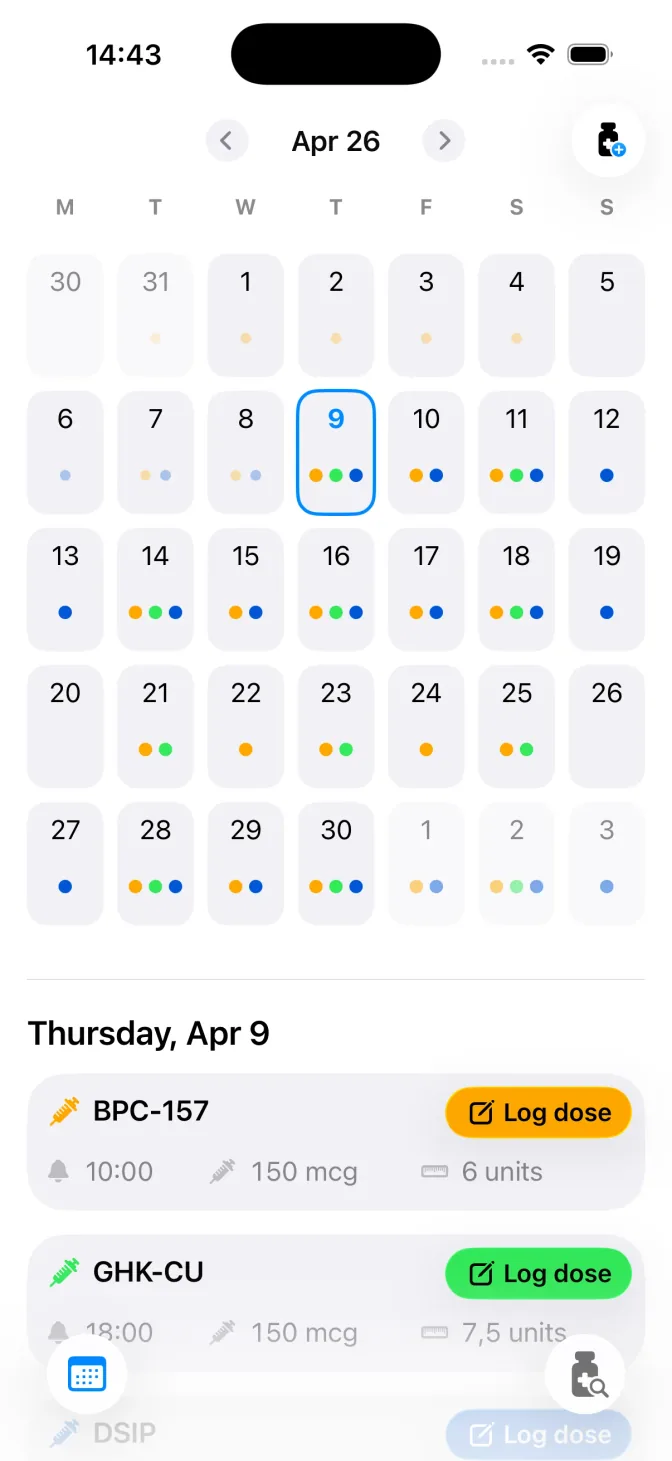
Personal records help you and your clinician see clearly, which is why a tracker such as PepFlow, which stores the protocols, dose logs, schedules and saved preparation details you enter, keeps that history in one place. It’s a tracking and planning tool and does not replace medical advice. The checklist above contains no dosing instructions, and none belong in an article like this one.
PepFlow makes the organizational side of a peptide routine manageable: you enter your own protocols, doses and schedules, and the app keeps a clear dose history with reminders so the record stays complete. That history is what you bring to a clinician’s appointment, alongside a knowledge base and cheat sheet for checking terms. Visit PepFlow to see how the tracker and reference guides fit together.