Research peptides aren’t legal or illegal: in the US, genuine laboratory supply can be lawful, while consumer sale of unapproved peptides for self-injection generally isn’t. A research-use-only label doesn’t change that distinction, and rules outside the US require country-specific verification.
The popular advice to check the vial for a disclaimer gets the analysis backward. The more useful questions concern who is selling, who is buying, what the product is intended for, and which legal pathway permits the transaction. Those facts can put the same compound in different legal positions without changing its chemistry.
Table of Contents
- Legal Status of Research Peptides at a Glance
- Labels Do Not Settle It and Intent Signals Do
- Recent FDA Enforcement Against Online Sellers
- Compounded Peptides Under US 503A and 503B Rules
- Approval, Compounding and Enforcement Discretion Compared
- Competitive Sport Bans Apply Even When Lab Use Is Legal
- Verify the Source Before You Buy or Use
Legal Status of Research Peptides at a Glance
Start with the activity, not the molecule. Buying a reagent for a documented laboratory protocol, obtaining a compounded prescription, and ordering something to inject at home aren’t interchangeable transactions.
The FDA’s Summit Research Peptides warning letter illustrates the central distinction: research-only language didn’t prevent the agency from treating products as drugs when surrounding claims indicated human use. That finding concerns intended use and marketing, not a blanket rule that every research peptide transaction is unlawful.
Legal status of research peptides by context
| Context | Generally lawful? | What makes it unlawful |
|---|---|---|
| Laboratory research supply to qualified buyers in the US | Generally yes, when genuinely supplied for non-human research | Marketing or instructions establishing an unapproved human-drug purpose |
| Consumer sale for self-injection in the US | Generally no for unapproved products outside an applicable lawful pathway | Human-use marketing, including disease claims, injection guidance, dosing guides, or associated reconstitution supplies |
| Pharmacy compounding in the US | Only when applicable bulk-substance and pharmacy requirements are met; patient-specific prescribing applies under the relevant pathway | No qualifying pathway under the federal compounding framework, or failure to meet its conditions |
| Human use in the UK or EU | Not established by the authorities discussed here | Verify local medicines law, authorization requirements, and the specific transaction |
| Human use in Australia | Not established by the authorities discussed here | Verify local therapeutic-goods, prescribing, importation, and possession rules |
| Athletes subject to the WADA Code | Prohibited at all times for covered non-approved pharmacological substances | Lack of current governmental approval for human therapeutic use can trigger a sport prohibition, not necessarily a criminal offense |
Match the transaction before drawing a conclusion
The country entries are deliberately limited. US enforcement documents don’t establish the rules for the UK, individual EU jurisdictions, or Australia, and replacing those gaps with a confident worldwide answer would be misleading.
Practical rule: A lawful laboratory transaction doesn’t establish a lawful consumer treatment pathway.
Find the row that matches your actual situation, including whether you’re a researcher, patient, seller, or athlete. This table summarizes general US and sport patterns, not the exact law governing every substance, person, or jurisdiction.
Labels Do Not Settle It and Intent Signals Do
The label myth is straightforward: put “research use only” on a vial and human-use restrictions disappear. Under the US intended-use framework described in Buzko Legal’s peptide startup guide, regulators examine labeling, website claims, accompanying materials, and seller conduct rather than treating that wording as decisive.
That distinction matters because a product intended to affect the human body may qualify as a drug. An unapproved new drug generally can’t be marketed to consumers for injection, ingestion, treatment, or performance enhancement merely by adding “not for human consumption.”
Think of a cleaning product advertised for cleaning versus the same bottle promoted as a cure. The analogy isn’t a statement that the products have identical regulations. It shows why claims about a product’s purpose can matter more than a narrow description printed on its container.
Read the entire commercial presentation
The FDA’s Gram Peptides warning letter identifies human-use evidence extending beyond a vial label, including therapeutic claims, injection-related materials, reconstitution supplies, dosing information, and peptide calculators. These details matter as a combined commercial presentation, not as a universal rule that any individual accessory automatically makes a sale unlawful.
Review materials for:
- Body-outcome claims: References to healing, fat loss, recovery, or other effects on human structure or function.
- Administration guidance: Injection instructions, dose schedules, or advice explaining how a consumer should use the product.
- Bundled preparation supplies: Bacteriostatic water and reconstitution materials presented alongside human-use guidance.
- Calculation tools in context: Calculators used to turn a research-vial purchase into a self-administration plan.
A calculator isn’t itself regulatory authorization. Neither is a discussion of a peptide’s possible clinical role.
For comparison, a patient-facing resource such as the ProMD Health Washington, DC peptide guide can help readers recognize the distinction between treatment-oriented information and a laboratory reagent listing. A clinic guide, however, doesn’t establish another seller’s compliance or prove that an identically named product has an authorized pathway.
Compare purpose, not packaging
Say a seller offers a vial with a weekly injection recommendation and a mixing guide. Compare that with a laboratory catalogue offering a reagent with analytical documentation, institutional procurement controls, and no human-use representations. The name on the vial could be the same, but the evidence of intended use is materially different.
A certificate of analysis answers questions about the tested material. It doesn’t erase the first seller’s human-use marketing or independently authorize administration.
Would a reasonable buyer understand the seller’s materials as an invitation to put the product into their body?
That’s a useful screening question, not a substitute for the legal test. Possession is also separate from sale: a warning letter about a seller doesn’t establish that every purchaser has committed a possession offense. A buyer’s purpose and actual use may be relevant evidence, but local counsel must assess the substance, transaction, and applicable possession rules.
Recent FDA Enforcement Against Online Sellers
Enforcement records answer two questions that peptide coverage often conflates: whether a substance qualifies for compounding, and whether a seller may market a finished product to buyers. Regulators can act on either track, and action on one settles nothing about the other.
Enforcement and classification events for research peptides
| Date | Event | What it targeted |
|---|---|---|
| 2023 | Category 2 review removed a group of popular peptides from routine compounding eligibility | Possible significant safety risks for compounding |
| 2023, month unspecified | Approximately 20 unapproved peptide medicines removed from the bulk-substances compounding framework, as described by The Scientist | Production under that compounding pathway |
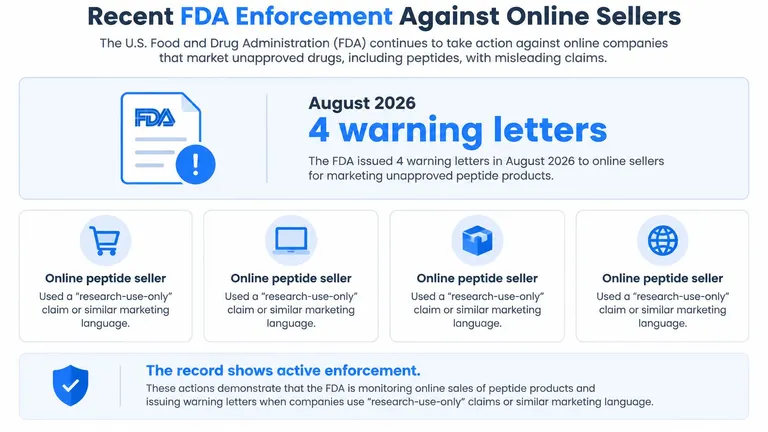
| Recent enforcement | Warning letters to online peptide sellers whose listings carried research-use-only or not-for-human-consumption disclaimers | Online sales and marketing of unapproved peptide products |
The enforcement summary is illustrated below.
What these actions establish
The two compounding rows shouldn’t be added together. They describe regulatory treatment of peptide substances through different summaries, which may cover overlapping groups rather than distinct ones.
The warning-letter track answers a different question: whether a disclaimer insulates an online seller from enforcement. It does not. A label that says “research use only” carries little weight when the surrounding marketing, dosing language, or buyer funnel points at human use, because regulators read intended use from the total evidence around a sale. Warning letters themselves state the agency’s allegations and compliance concerns. They are not court judgments establishing every disputed fact.
The conclusion is narrower than “all peptides were banned.” The same compound can lose a compounding route while remaining lawful for genuine laboratory research, and a seller can lawfully offer a reagent while a competitor selling the identical molecule for self-injection draws enforcement. Position follows pathway and purpose, not the label.
For buyers, availability isn’t evidence of regulatory review. A functioning checkout, a polished label, and an analytical report don’t explain which legal pathway supports the sale. Because classification turns on the facts of a specific transaction, local counsel should confirm how a given product and intended use are treated.
Compounded Peptides Under US 503A and 503B Rules
A vendor can identify a peptide chemically and offer it for sale without establishing a lawful route for a pharmacy to compound it. The missing element may be bulk-substance eligibility, not uncertainty about what the molecule is.
The FDA’s bulk drug substances guidance describes separate requirements under 503A and 503B. These are conditional compounding frameworks, not a general research-peptide exception.
US compounding pathways and what to verify
| Pathway | Core requirement | What to verify |
|---|---|---|
| 503A, applicable USP/NF monograph exists | Bulk substance meets the applicable monograph | Pharmacy license, applicable prescribing requirements, and monograph compliance |
| 503A, no monograph | Substance is a component of an FDA-approved drug or appears on FDA’s applicable bulk-substances list | Exact substance identity, eligibility basis, and state rules |
| 503B outsourcing facility | Substance generally appears on the clinical-need list, or the compounded drug qualifies through the shortage-list route | Facility registration and applicable list or shortage basis |
| 503B material documentation | Valid certificate of analysis and manufacture by an FDA-registered establishment | Supplier and manufacturer documentation |
| Any compounded peptide | All applicable federal pathway conditions must be satisfied | State pharmacy rules and relevant import restrictions |
Verify the pathway behind the prescription
A prescription is important, but it doesn’t by itself make an ineligible bulk substance eligible. Equally, don’t assume that the prescribing and distribution requirements for a traditional pharmacy are identical to those for an outsourcing facility.
- Confirm the entity’s status. Establish whether you’re dealing with a state-licensed pharmacy, a physician compounding under applicable rules, or a registered outsourcing facility. A research-chemical storefront isn’t interchangeable with any of these.
- Establish the prescribing basis. For patient-specific pharmacy treatment, confirm the valid prescription and prescriber relationship. Ask which framework applies rather than accepting a generic claim that the product is pharmacy-grade.
- Check the precise eligibility route. Match the substance to the applicable monograph, approved-drug component status, FDA list, or shortage basis. A similar name isn’t enough.
- Request material documentation. Obtain the certificate of analysis and relevant supplier records. Confirm what the document identifies and which batch it covers.
- Check state-specific requirements. Federal eligibility doesn’t settle every pharmacy, prescribing, or distribution restriction.
The cause-and-effect distinction is important: better analytical documentation can address material identification, but it can’t create a missing statutory pathway. Likewise, an eligible substance doesn’t excuse a facility from meeting the other conditions.
Read the federal framework alongside any applicable customs, importation, controlled-substance, professional-licensing, and advertising rules. Those questions become especially important when the prescriber, pharmacy, manufacturer, and buyer are in different jurisdictions.
Approval, Compounding and Enforcement Discretion Compared
When a clinic says a peptide is allowed, ask what that means. FDA approval, lawful compounding, and enforcement discretion describe different statuses, and a seller shouldn’t use them interchangeably.
The distinction is useful when discussing a product with a pharmacist.
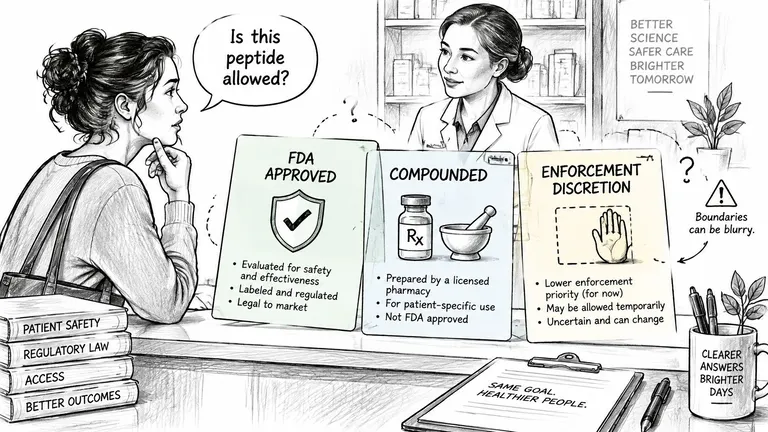
Approval, lawful compounding and enforcement discretion
| Status | What it means | What it does not prove |
|---|---|---|
| FDA approval | Safety, quality, and effectiveness were demonstrated for the approved product and stated use | Approval of a different product, dose, or route |
| Lawful compounding | The compounder satisfies applicable statutory and pharmacy-specific conditions | FDA approval of the compounded preparation or proof of effectiveness |
| Enforcement discretion | The government may choose not to pursue action while specified conditions hold | A change in the substance’s underlying legal status |
Permission and enforcement priorities aren’t equivalent
A Fox Rothschild analysis of HHS peptide policy describes limited enforcement discretion for certain 503A compounders using six peptide bulk substances, while emphasizing that the policy doesn’t itself change their legal status. Its scope may not extend to research-chemical or supplement sales.
That qualification is decisive. A policy directed at qualifying compounders isn’t a general permission slip for unrelated online vendors, and a decision not to prioritize enforcement isn’t an approval finding.
Use our FDA-approved peptide drugs list as a starting point for identifying the approval question. Then match the exact product and intended use to the relevant regulatory documentation rather than assuming approval follows the molecule’s name.
The accompanying video provides additional context for the discussion.
Ask for the basis: Which approval, compounding provision, or written enforcement policy supports this particular product and transaction?
The answer should identify a document and explain its scope. State pharmacy rules and foreign importation or possession requirements may still produce a different result, even where a seller accurately describes the federal position.
Competitive Sport Bans Apply Even When Lab Use Is Legal
The WADA 2026 Prohibited List places peptide hormones, growth factors, related substances, and mimetics in section S2; its separate non-approved-substances category prohibits covered pharmacological substances lacking current governmental approval for human therapeutic use at all times.
Consider an athlete who also works in a laboratory. Their institution obtains an investigational peptide for a legitimate experiment, and the athlete assumes that lawful access makes personal use acceptable. It doesn’t establish sport eligibility, because procurement law and anti-doping rules answer different questions.
Follow the athlete’s decision, not the supplier’s label
The relevant distinction isn’t whether the supplier completed a lawful laboratory sale. It’s whether the athlete’s proposed use involves a substance prohibited under the applicable sport rules.
WADA’s non-approved category encompasses drugs in preclinical or clinical development, discontinued drugs, designer drugs, and veterinary-only substances without current human therapeutic approval. An investigational status therefore isn’t a sporting exemption.
- Laboratory access: Establishes neither permission to self-administer nor permission to compete after use.
- Out-of-competition timing: Doesn’t avoid an at-all-times prohibition.
- Human therapeutic approval: Doesn’t, by itself, establish that a substance is permitted in sport, because other prohibited categories may apply.
International federations and national anti-doping organizations apply the list through the World Anti-Doping Code, giving these distinctions practical reach beyond a single country’s medicines system.
Our guide to peptides for athletes can help frame questions for a sport-qualified clinician, but a resource organized around athletic use isn’t an eligibility determination. Product descriptions focused on recovery or performance shouldn’t replace a check against the applicable rules.
Before any use, ask your anti-doping organization or federation contact to confirm the substance’s status and any applicable authorization requirements. Treat the buyer’s role as an athlete as a separate compliance question, even when the laboratory procurement itself is legitimate.
Verify the Source Before You Buy or Use
Legality attaches to the transaction, not the molecule. A seller’s “research use only” label, a clean certificate of analysis, or a buyer’s genuine research purpose each answer only part of the question, so verification has to cover the seller’s status, the buyer’s purpose, and the legal pathway between them. If the seller can’t identify a legal basis for the sale, pause the transaction rather than treating uncertainty as permission.
Work through these checks before ordering, importing, or administering a product.
- Save the full sales presentation. Keep the product page, label, bundled accessories, checkout representations, and any advice sent with the order, and record when you obtained them. Intended-use evidence is assembled from exactly this material, so the marketing around a product can carry as much regulatory weight as the compound inside it.
- Verify the dispensing entity. For a compounded product, confirm the pharmacy license or facility status, the applicable prescription requirements, and the exact bulk-substance eligibility basis the dispenser relies on.
- Examine the documentation. Request a certificate of analysis and supplier records, including relevant manufacturer registration details. Our peptide purity testing guide can frame the right quality questions, though analytical purity alone establishes nothing about lawful human use.
- Resolve sport eligibility independently. If you compete, check the current prohibited list and your federation’s requirements before use, because lawful purchase and lawful participation are separate questions.
- Identify every relevant jurisdiction. Include your location, the dispensing location, and any border crossing. Ask specifically about state pharmacy, importation, and possession rules.
- Have local counsel confirm specifics. Give a licensed lawyer or appropriately qualified regulatory professional the actual documents, the product identity, the seller type, the intended purpose, and the proposed route of administration.
Keep organization separate from authorization
This is general information, not legal advice. Laws, agency policies, and list status can change, and the authorities discussed here don’t establish the rules for every country. A documented answer should identify both its jurisdiction and the date it was checked.
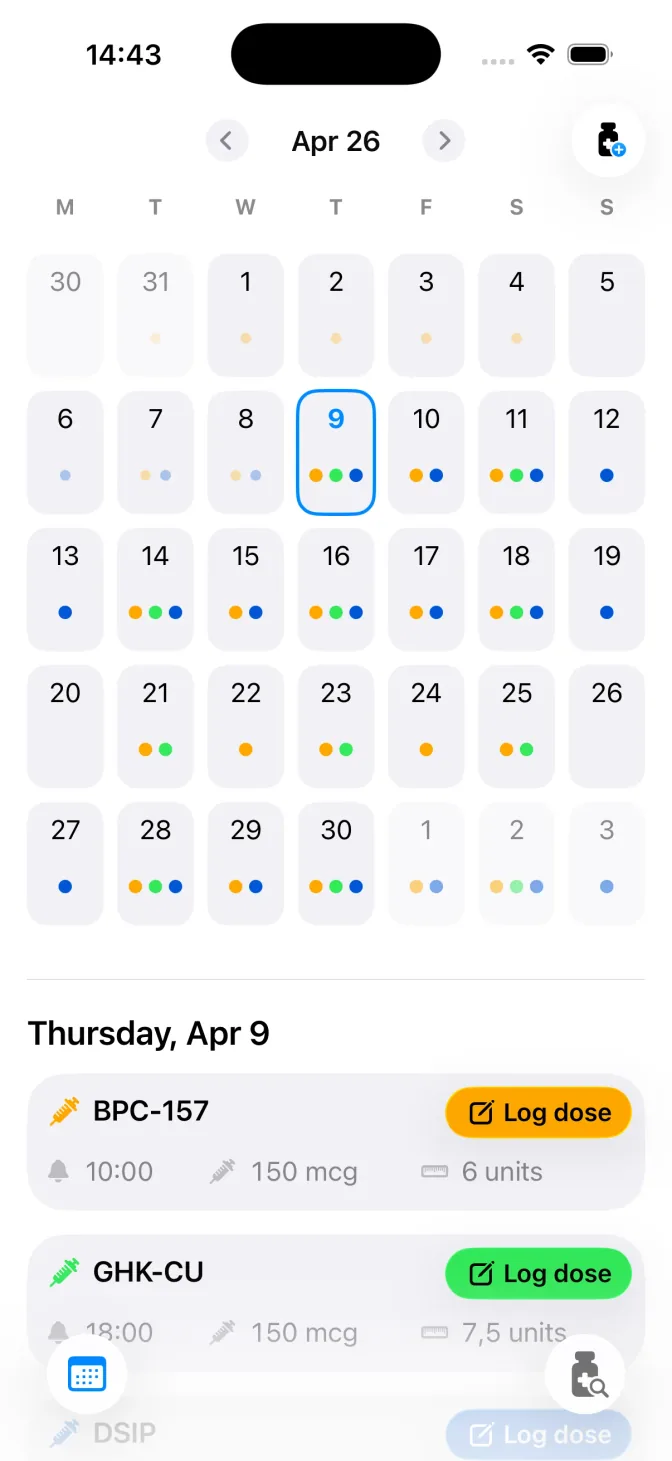
PepFlow helps users organize an established routine with schedules, reminders, and a clear dose history. Its Peptide Calculator, Peptide Knowledge Base, Peptide Cheat Sheet, and Reconstitution Guidelines are reference and organizational resources. They don’t verify a product’s legal status, authorize use, recommend treatment, or replace professional advice.
A well-organized record can support an explanation of what you checked. It can’t make an otherwise unlawful transaction lawful.
Keep dated copies of the sources and documentation behind your decision, not just screenshots of a seller’s disclaimer. Those records let counsel assess compliance and explain the basis for your actions if questions arise later.
Visit PepFlow to organize an established routine with schedules, reminders, and a clear dose history. Use its calculator and reference resources as organizational aids, while leaving legal authorization, treatment decisions, and dosing to qualified professionals.