You open a vial of peptide powder, add your diluent, swirl gently, and put it back in the fridge. It feels simple. But the thing you’re handling isn’t just “powder.” It’s a population of carefully built molecules whose behavior depends on one tiny chemical feature repeated over and over: the peptide bond.
That’s where a lot of confusion starts. Most explanations of what are peptides bonds stop at a textbook line like “a bond between amino acids.” That’s true, but it doesn’t help much when you’re trying to understand why one peptide tolerates handling well, why another seems to lose performance after poor storage, or why reconstitution technique matters at all. A practical example shows the gap. Questions in user communities often center on why a peptide seemed to “stop working,” and one reason can be bond instability after reconstitution under poor conditions, with 20-50% potency loss in 24-48 hours reported under suboptimal storage and reconstitution conditions in the background material tied to Wikipedia’s peptide bond overview.
If you want the broader foundation first, PepFlow’s primer on what peptides are is a helpful companion. Here, the focus is narrower and more useful for handling: what peptide bonds are, why they behave the way they do, and why that chemistry changes what you do with a vial in your hand.
Table of Contents
- The Invisible Links That Build Everything
- Forging the Link Between Amino Acids
- Why Peptide Bonds Are Uniquely Rigid and Planar
- From Simple Chains to Complex Protein Architectures
- Understanding Peptide Bond Stability and Cleavage
- Putting It All Together for Better Dosing and Handling
The Invisible Links That Build Everything
You open a vial, add diluent, and draw up a dose. On the label, the peptide looks like one neat name. At the molecular level, it is a chain, and that chain only exists because tiny chemical links hold each amino acid in the right order.
Those links are peptide bonds.
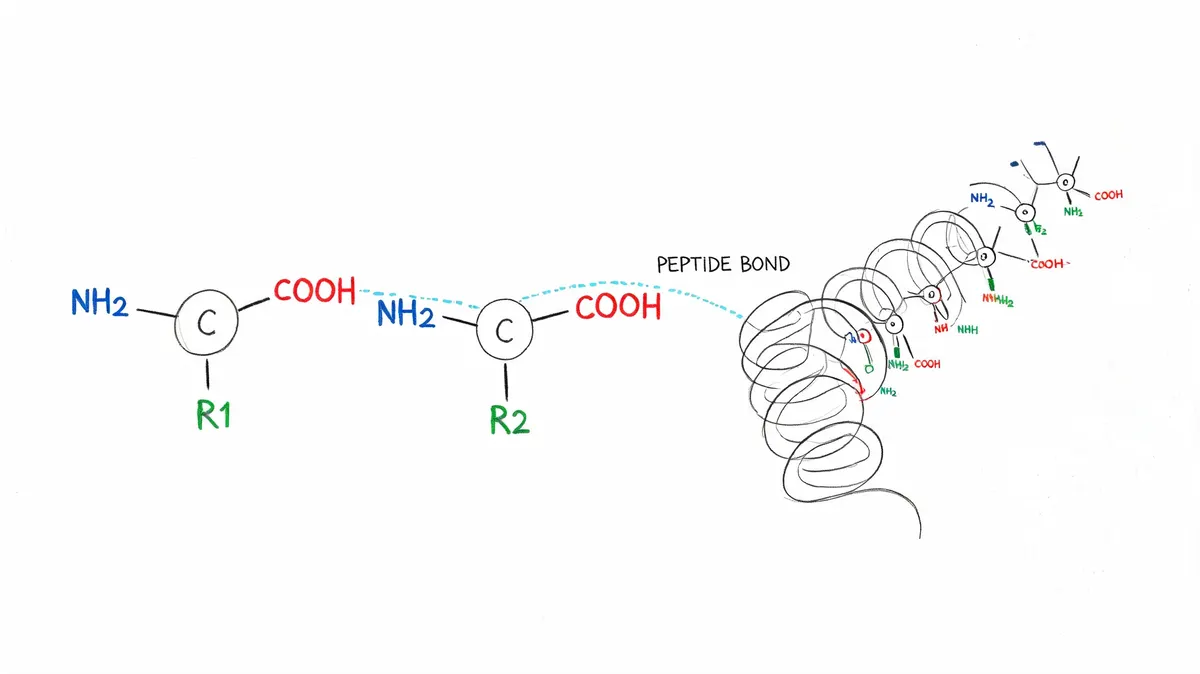
A peptide bond is the covalent connection between one amino acid and the next. It is the thread in the necklace. Remove the thread, and you no longer have a necklace. You have loose beads. In the same way, if those bonds break, a peptide stops being the defined sequence you intended to store, reconstitute, and dose.
If you want a quick refresher on the bigger picture, our guide to what peptides are and how they differ from proteins helps place peptide bonds in context.
A bond you never see but always depend on
Peptide bonds make up the backbone of every peptide and protein. They are easy to ignore because you never see them directly in a vial, but every practical step depends on them staying intact. Sequence, shape, and function all start with this repeating connection.
That matters outside the textbook.
A lyophilized peptide can look unchanged while its chemistry tells the full story. In dry form, the chain is often easier to preserve. After reconstitution, the environment shifts. Water, pH, temperature, and time can all affect how well those links hold up. The bond itself is microscopic, but the consequences are not. If the chain changes, your dosing accuracy and your expectations change with it.
Why biohackers should care
You do not need to memorize every detail of organic chemistry to handle peptides well. You do need to understand one simple point. The product in the vial is not just a pile of amino acids. It is a specific sequence held together by specific bonds.
That is why storage advice is really chemistry advice.
Cold storage slows unwanted reactions. Careful reconstitution reduces stress on the chain. Limited time in solution lowers the chance that bond cleavage and related degradation will turn a known peptide into a mixture of fragments. The peptide bond is the quiet chemical reason those handling rules exist.
Forging the Link Between Amino Acids
Open a peptide vial and you see powder or liquid. The actual product, though, is a specific chain built by repeating one small chemical connection over and over. If that connection never forms correctly, you do not get the peptide you think you are handling.
What joins to what
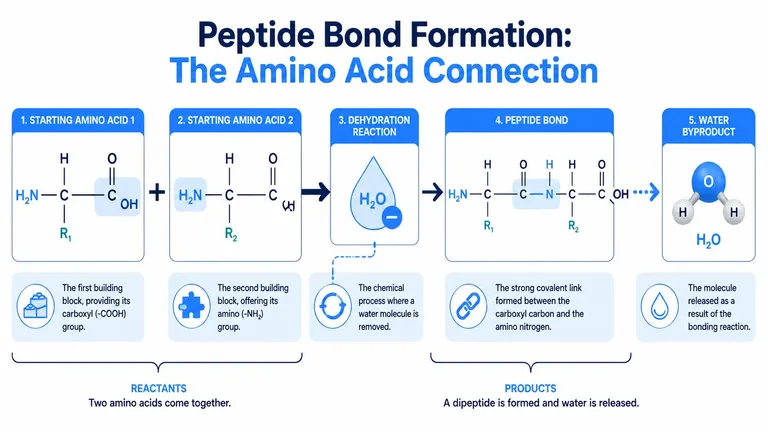
A peptide bond forms when the carboxyl group of one amino acid reacts with the amino group of another. During that reaction, the pieces combine in a way that releases water and leaves behind a new covalent C-N bond. That C-N bond is the peptide bond.
A simple comparison helps. It works like snapping two custom links together to make a chain, except one tiny piece is discarded during assembly. In this case, that discarded piece is water.
You can follow it in four steps:
- One amino acid provides the carboxyl end.
- A second amino acid provides the amino end.
- The reaction releases water.
- The remaining atoms form a new C-N linkage.
That sounds abstract until you map it onto a peptide label. If a vial says a peptide contains a defined amino acid sequence, every letter in that sequence is connected by this same kind of bond. The sequence is not just a list of ingredients. It is a chemical order held together link by link.
How the bond gets made
In living cells, amino acids do not spontaneously drift together and stick. Bond formation requires organized machinery and energy input. Cells use ribosomes and enzyme-guided chemistry to build the chain in the right order.
Chemists have to solve the same assembly problem in the lab. One common method is solid-phase peptide synthesis, or SPPS. The basic idea is straightforward. The growing peptide is attached to a solid support, one amino acid is added at a time, and each new step is controlled so the next bond forms in the intended position.
That matters for a practical reason. Research and wellness peptides are made as deliberate sequences, not as random amino acid mixtures. If the order changes, the identity changes. A peptide with one missing bond, one extra residue, or one sequence error can behave very differently during testing, storage, or dosing.
| Part of the reaction | What it does |
|---|---|
| Carboxyl group | Supplies the carbon side of the new linkage |
| Amino group | Supplies the nitrogen side of the new linkage |
| Water release | Shows that a condensation reaction occurred |
| Peptide bond | Connects amino acids into the chain backbone |
The chain only does its intended job when the amino acids are connected in the intended order.
This is why handling advice is more than routine lab caution. When you reconstitute a peptide, aliquot it, or store it for later use, you are protecting a carefully assembled sequence of peptide bonds. Understanding how that chain is built makes it easier to understand why preserving it matters.
Why Peptide Bonds Are Uniquely Rigid and Planar
You reconstitute a peptide, swirl the vial, and it is tempting to picture the chain inside as a loose strand that twists any way it wants. The backbone is more disciplined than that. Each peptide bond behaves less like a free hinge and more like a flat link in a small metal chain.
Why this bond doesn’t spin freely
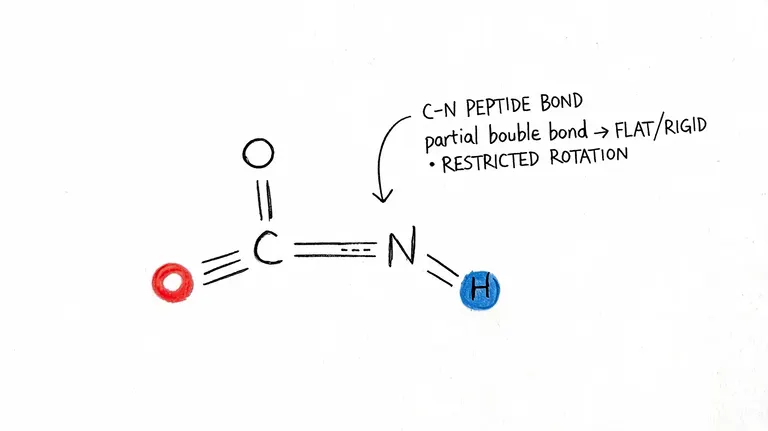
The reason is resonance. Electrons are shared across the peptide linkage in a way that gives the carbon-nitrogen bond some double-bond character. In practice, that means the bond is harder to rotate than a typical single bond.
A door hinge swings easily because it has one clear axis of rotation. A peptide bond works more like a thin, flat board bolted into place. The atoms around it tend to stay in the same plane, so the backbone is forced to follow geometric rules instead of flopping around at random.
That flatness can feel abstract until you connect it to real peptides. A chain made of many planar links has fewer shapes available to it, and those limits affect how the peptide folds, how stable it stays in solution, and how predictably it behaves after reconstitution. The same backbone chemistry also helps explain why products like collagen peptide supplements and collagen-derived chains have characteristic structural behavior rather than acting like random amino acid soup.
Why trans wins almost every time
Once rotation is restricted, orientation matters. Most peptide bonds prefer the trans arrangement, where neighboring side groups sit on opposite sides of the bond. That geometry usually reduces steric crowding, which is a chemistry way of saying the atoms are less likely to bump into each other in awkward, unstable positions.
There is an exception students often hear about. Bonds next to proline are more likely than others to show up in the cis form, because proline’s ring structure changes the tradeoff between the two arrangements. But the big picture stays the same. Peptide bonds are shape-setting features of the backbone.
Key idea: A peptide bond is a connection with built-in geometric rules.
If you want a quick visual explanation before going further, this walkthrough is useful:
One point often causes confusion. Rigid does not mean unbreakable. It means the bond restricts rotation. That distinction matters for handling peptides. Storage, pH, temperature, and repeated freeze-thaw cycles do not usually make the backbone spin into a new random shape. They can, however, increase the chance of chemical damage elsewhere or, under harsh conditions, contribute to bond cleavage. Understanding that difference helps you separate normal conformational limits from actual degradation.
From Simple Chains to Complex Protein Architectures
A useful way to see the jump from chemistry to biology is to stop looking at one bond in isolation and start looking at a whole chain. Once amino acids are linked together, the backbone behaves less like a loose thread and more like a strip of connected panels. The chain can still bend, but only at specific places and within specific angle ranges.
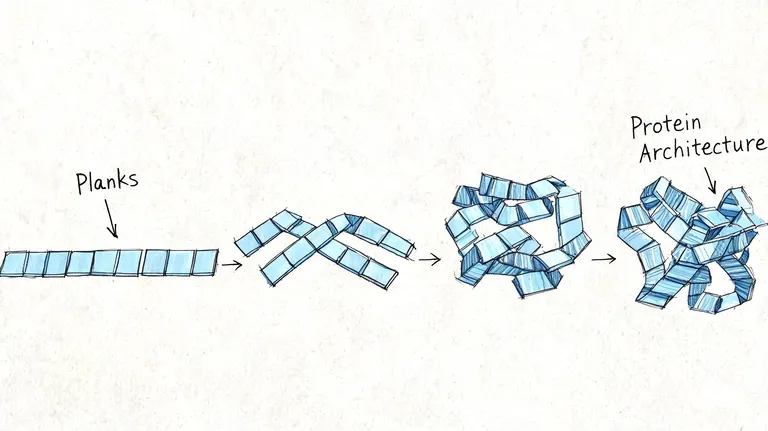
Rigid links create repeated folding patterns
That limited flexibility is why peptide and protein chains form recognizable shapes instead of random tangles. The flat peptide bond acts like a hinge with rules. Rotation happens mainly around the bonds on either side of it, so the backbone explores a restricted set of positions rather than every position that seems possible on paper.
Biochemists map those allowed positions with a Ramachandran plot. If that term sounds intimidating, the idea is simple. It is a map of which backbone angles are comfortable for the chain and which ones force atoms too close together. Some regions on that map are favorable enough that the same shapes show up again and again.
Two classic examples are:
- Alpha-helices, where the backbone coils into a regular spiral
- Beta-sheets, where stretched segments line up side by side
A paper model works well here. A chain made from string can collapse into almost any shape. A chain made from short cardstock pieces joined at limited angles keeps falling into a smaller set of stable arrangements. Peptides and proteins behave more like the second model.
Sequence still decides a lot. The amino acids in the chain determine where bends are easier, where charges attract or repel, and where hydrogen bonds can form. But sequence is not acting on a blank canvas. The peptide bond sets the physical rules of the canvas itself.
Why this matters for peptide users
For someone handling a research or wellness peptide, this helps answer a practical question. Why can a tiny molecule be so sensitive to storage and reconstitution choices if its backbone is chemically well organized? The answer is that function depends on more than having the right ingredients. It depends on keeping the chain in the right overall arrangement, or at least avoiding conditions that push it toward aggregation, chemical modification, or other structural problems.
That matters even more with short peptides because they have fewer interactions holding them in a preferred shape. A small change in solvent, concentration, pH, or temperature can shift how the chain behaves in solution. You may not see that shift with your eyes, but it can affect solubility, consistency, and how reliably you dose from one preparation to the next.
This is one reason familiar products such as collagen peptides behave differently from a single, highly specific signaling peptide. Both are built from the same kind of backbone link, but chain length, sequence, and higher-order structure change what the material does in the world.
The big takeaway is simple. Peptide bonds do more than connect amino acids. They constrain the backbone, guide recurring shapes, and help determine whether a peptide stays well behaved once you add water and start handling it.
Understanding Peptide Bond Stability and Cleavage
You reconstitute a peptide, put the vial back in the fridge, and assume the hard part is over. The chemistry is calmer than many people fear, but it is not frozen in place. Once water enters the picture, the peptide bond sits in an environment that can slowly work against it.
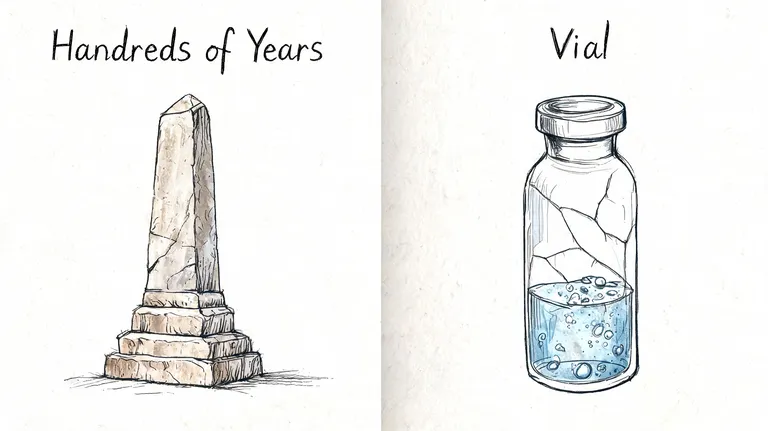
Hydrolysis is the reverse reaction
A peptide bond forms when one amino acid joins another and water is released. Hydrolysis runs that chemistry in reverse. Water helps split the link back apart.
In plain language, the bond itself is fairly stubborn under mild conditions. That is why peptide backbones can exist long enough to do useful biological work. But a peptide in a vial is not living inside the controlled machinery of a cell. It is exposed to storage temperature, pH, dissolved oxygen, surfaces, and possible contamination. Those factors do not usually snap every bond at once. They slowly increase the chance that the material you dose today is not identical to what was in the vial at the start.
That distinction matters. Bond stability explains why peptides can exist. Handling explains whether your specific preparation stays consistent enough to use predictably.
What actually makes cleavage more likely
Hydrolysis usually speeds up when conditions become harsher. Heat gives molecules more kinetic energy, which raises the odds of bond-breaking reactions. Strong acid or strong base can also accelerate cleavage. Enzymes called proteases are even more efficient because they are built to cut peptide bonds on purpose.
For peptide users, the biggest practical shift is simple. Dry powder and dissolved peptide behave differently. In the lyophilized state, the molecules are far less mobile and many degradation pathways slow down. After reconstitution, the peptide is in a reactive medium where time, temperature, and cleanliness matter more. If you want a clearer picture of why the dry form is easier to preserve, this guide to how freeze-dried peptides behave before and after reconstitution is a useful companion.
A good analogy is a paper document versus that same document left out in the rain. The words do not change because the paper became bad paper. The environment changed, and now the material is easier to damage.
Practical handling follows from the chemistry
Use the bond chemistry to set your routine.
- Reconstitute with care. Use an appropriate diluent, add it gently, and avoid aggressive shaking that can stress the peptide in solution.
- Keep the vial cold after mixing. Lower temperature slows many unwanted reactions, including hydrolysis and other side reactions that reduce quality.
- Minimize time in solution. A dissolved peptide is easier to degrade than a dry one, so avoid leaving it warm or repeatedly exposing it to room temperature.
- Keep the preparation clean. Microbial contamination can introduce enzymes and byproducts that make degradation more likely.
- Dose from a consistent protocol. If storage and handling vary from one use to the next, your concentration and performance can vary too.
The point is not to treat peptide bonds as fragile glass. They are more like strong links that still wear faster in the wrong environment.
That is also why broad clinical discussions, such as Easton anti-aging peptide treatments, can sound simpler than real vial handling. In practice, the chemistry between reconstitution and dosing often determines whether a peptide remains usable in the way you expect.
Many users focus on dose calculations first. The smarter order is chemistry first, math second. If the material changes in the vial, even perfect math cannot recover consistency.
Putting It All Together for Better Dosing and Handling
A peptide bond is the small chemical link that turns single amino acids into a usable chain. It forms by condensation, holds a precise sequence together, stays unusually rigid because of resonance, and limits how that chain can fold. Those details aren’t trivia. They explain why peptides behave the way they do in storage, in solution, and in use.
For a biohacker or wellness user, the practical lesson is straightforward. Handling isn’t separate from structure. If you reconstitute carelessly, let a vial sit warm, or treat dissolved peptides like they’re as forgiving as dry powder, you’re taking chances with the same bond chemistry that gives the molecule its function in the first place.
If you’re comparing broader treatment contexts, a clinic resource such as Easton anti-aging peptide treatments can help you see how different peptide categories are discussed in practice. And if your immediate concern is the powder in your hand, PepFlow’s guide to freeze-dried peptides is a useful next read for understanding why the dry form behaves differently from a reconstituted vial.
The big win is consistency. Protect the molecule physically, then manage the protocol carefully. Good technique preserves what’s in the vial. Good planning helps you use it the way you intended.
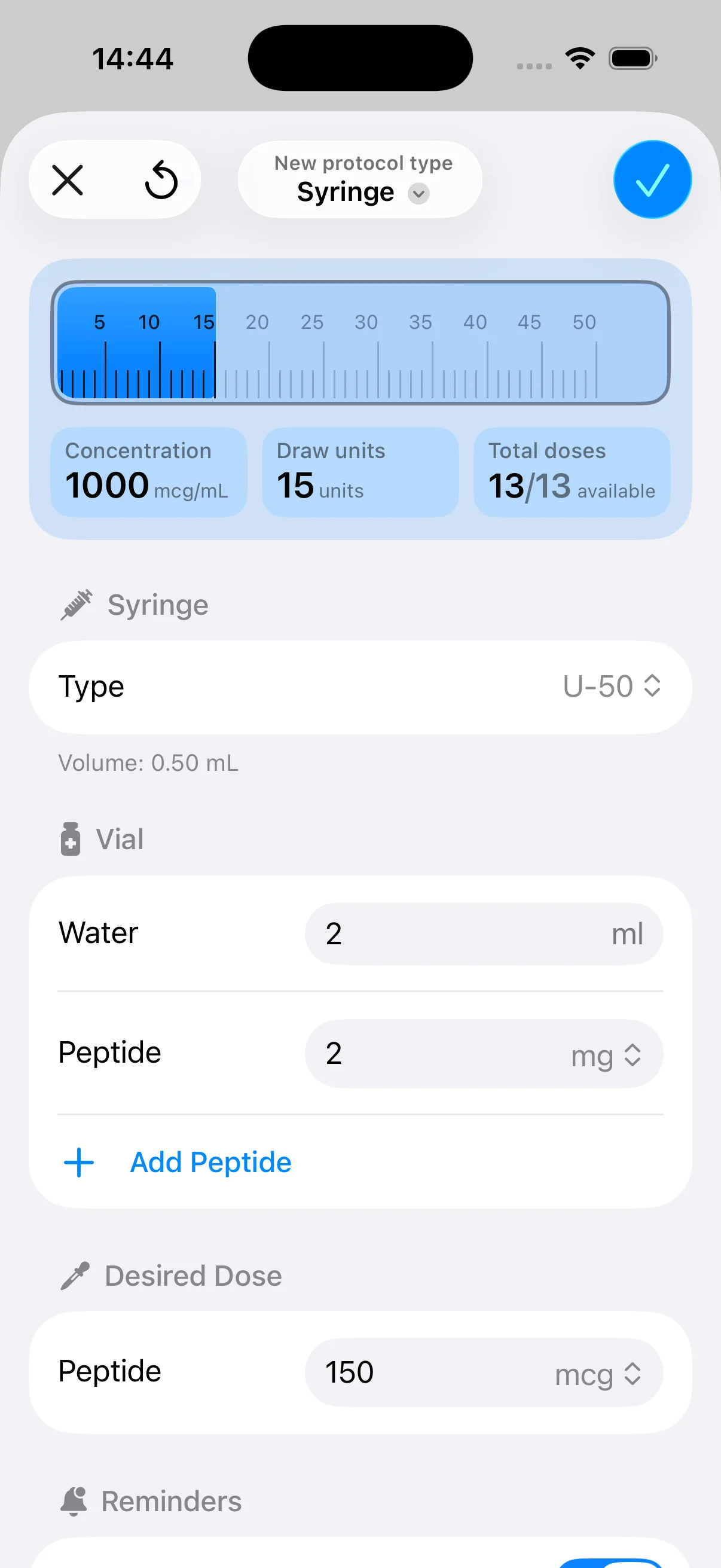
If you want help with the math and timing side, PepFlow makes peptide protocols easier to run accurately. It converts desired microgram amounts into practical unit measurements, helps you set vial concentrations and injection volumes, and keeps cycles organized with reminders, countdowns, and dose logging. It won’t replace professional medical guidance, but it can remove the routine calculation errors and scheduling friction that make consistency harder than it needs to be.