
Collagen peptides are small, easily absorbed pieces of collagen protein created through hydrolysis, and they’re commonly used as a supplement in daily doses between 2.5 and 15 grams. They’re different from regular, non-hydrolyzed collagen because hydrolysis makes them far more absorbable, with about 80% digestion and absorption compared with less than 1% for native collagen.
If you’ve been in any wellness corner of the internet lately, you’ve probably seen collagen peptides in coffee, smoothies, tubs at the gym, and “skin support” powders lined up next to creatine and electrolytes. That visibility makes people ask a reasonable question: what are collagen peptides, really, and are they just a nutrition supplement with good branding?
The short answer is yes, they are a nutritional protein supplement, not a drug and not the same thing as injectable therapeutic peptides. But the longer answer matters, especially if you track training, recovery, skin changes, or joint comfort and want to know what a supplement is doing.
A useful way to think about collagen is this. Native collagen is like a thick braided rope that gives structure to skin, tendons, cartilage, and bone. Hydrolysis is the step where manufacturers cut that rope into short, usable strands. Those strands are the peptides. Smaller size changes what happens after you swallow them. They dissolve easily, digest more efficiently, and behave more like a practical food ingredient than a chunk of structural tissue.
Table of Contents
- Introduction What This Guide Covers
- From Structural Protein to Bioactive Peptide
- Exploring the Common Sources of Collagen
- The Real Evidence Behind the Health Claims
- A Practical Guide to Using Collagen Peptides
- Understanding Safety and Potential Side Effects
- Clearing Up Common Collagen Misconceptions
Introduction What This Guide Covers
Collagen peptides sit at the intersection of nutrition, beauty marketing, sports recovery, and supplement culture. That’s one reason they confuse people. Another is sheer market scale. The global collagen peptides market is projected to grow from USD 2.86 billion in 2025 to USD 7.77 billion by 2034 according to Fortune Business Insights market projections. When a category grows that fast, claims multiply faster than understanding.
Here’s the plain-language version. Collagen is one of the body’s structural proteins. In its natural form, it’s tough, bundled, and built for strength. Think tendon, skin framework, cartilage, and connective tissue. As a supplement, though, manufacturers don’t usually sell that full rope-like structure. They break it into smaller fragments.
Those fragments are collagen peptides, also called hydrolyzed collagen in many product labels. “Hydrolyzed” just means water and processing were used to split a large protein into shorter chains. If native collagen is a climbing rope, hydrolysis is the cutting step that turns it into short lengths your digestive system can handle more efficiently.
Practical rule: When a product label says “collagen peptides” or “hydrolyzed collagen,” it’s usually signaling that the collagen has already been broken down into supplement-friendly form.
A lot of confusion comes from mixing three separate questions together:
- What it is: A processed protein supplement made from animal collagen.
- What it does: Provides collagen-derived amino acid fragments that are more absorbable than native collagen.
- What it isn’t: It isn’t an injectable therapeutic peptide, and it isn’t a guaranteed fix for every joint, skin, gut, or recovery problem.
That distinction matters if you’re comparing collagen peptides with things people in biohacking circles call “peptides.” Those are often researched or prescribed compounds with very different functions, dosing logic, and regulatory status.
From Structural Protein to Bioactive Peptide
The biggest shift in understanding happens when you stop thinking of collagen peptides as “just collagen” and start thinking of them as processed fragments designed for absorption.
Why size changes everything
Native collagen is structurally impressive. It forms a complex, tightly wound framework in tissue. That’s useful inside the body, but awkward as a supplement. Large structural proteins aren’t automatically easy to digest in their original form.
Hydrolysis changes that. Manufacturers use enzymatic or acid processing to break the triple-helix collagen structure into shorter peptide chains rich in amino acids such as glycine, proline, and hydroxyproline. This is what turns a structural material into a more bioavailable supplement ingredient.
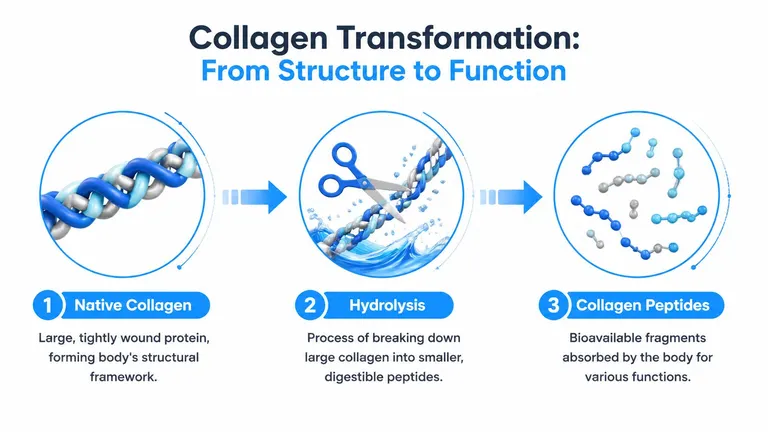
That processing step matters because hydrolyzed collagen peptides reach about 80% digestion and absorption, compared with less than 1% for native, non-hydrolyzed collagen, as described in this technical overview of collagen peptide absorption. That’s the core reason people buy peptides instead of trying to eat “regular collagen” in supplement form.
Some readers mix up “small peptides” in supplements with “peptides” in skincare. They overlap conceptually because both involve short chains, but they aren’t the same product category. If you want a cosmetic-side comparison, this guide to understanding skincare peptides helps clarify how topical peptide claims differ from oral supplement use.
How collagen peptides differ from other peptides
The word peptide causes a lot of noise. In nutrition, collagen peptides are food-derived protein fragments taken by mouth. In the broader peptide world, some compounds are discussed as research or therapeutic agents with targeted signaling roles. Those are different conversations.
If you want a broad primer on that bigger category, PepFlow has a useful explainer on what peptides are. The important distinction for this article is simpler:
- Collagen peptides are nutritional. You stir them into coffee or water.
- Injectable therapeutic peptides are not collagen supplements.
- Function matters more than the shared word “peptide.”
Source also matters. Consumer content often treats all collagen peptides as interchangeable, but that’s too simplistic. Bovine, marine, and chicken sources can differ in amino acid profile and absorption behavior, and those differences may affect whether a product is marketed more toward skin, hair, or joint support.
A smart way to read a collagen label is to ask two questions first: what animal source did this come from, and was it clearly sold as hydrolyzed collagen peptides?
Exploring the Common Sources of Collagen
The source animal affects how a product is framed, how people use it, and sometimes which outcomes they expect from it. That doesn’t mean one source is always best. It means “collagen” is not one uniform raw material.
The key point from available background research is that bovine, marine, and chicken collagen sources have different amino acid profiles and absorption efficacy, and most consumer content doesn’t explain how that may affect use cases like skin versus joint support, as outlined in this discussion of what collagen peptides are made of and how source matters.
Collagen peptide sources at a glance
| Source | Primary Collagen Type(s) | Commonly Associated With |
|---|---|---|
| Bovine | Type I and Type III | Skin, connective tissue, general wellness support |
| Marine | Type I | Skin-focused products and beauty positioning |
| Chicken | Type II | Joint and cartilage-oriented products |
| Porcine | Type I and Type III | General collagen supplementation |
Bovine collagen is the most common format on the market. It’s widely used in powders and “one scoop daily” products. Marine collagen is often marketed with a skin-health angle, partly because it’s associated with Type I collagen. Chicken collagen is usually positioned toward joint support because of its association with Type II collagen.
That said, labels often oversimplify. A source can suggest a likely use case, but it doesn’t guarantee a specific outcome in any one person.
Where marketing gets ahead of the science
A lot of collagen branding turns source into a certainty. “Marine for beauty” and “chicken for joints” sound clean and decisive. Biology is messier than that.
A better way to think about source is as one decision factor among several:
- Goal fit: Skin-focused buyers often look toward marine or mixed Type I products.
- Dietary preference: Some people avoid bovine or porcine sources for personal or religious reasons.
- Allergy awareness: Fish-derived products require extra care if seafood allergy is a concern.
- Label clarity: Products that clearly state source and hydrolyzed form are easier to evaluate.
If you want to see how some brands frame collagen as part of broader nutrient-dense wellness support, it’s useful to compare that marketing language with the actual source, form, and intended use listed on the label.
The Real Evidence Behind the Health Claims
A common biohacker mistake is to treat all “peptides” as if they belong in one bucket. Collagen peptides do not work like injectable therapeutic peptides. They are digested protein fragments used as a nutrition supplement, not precision drug compounds designed to trigger a specific receptor. That distinction matters before you judge any claim.
Marketing often blurs those categories. A tub of hydrolyzed collagen gets discussed next to research peptides, anti-aging stacks, and clinic treatments, which can make a basic supplement sound far more targeted than it is. The evidence for collagen’s health claims is uneven, so the useful question is simple: where is the signal strongest?
One useful reality check comes from WebMD’s summary of the category. It notes that the better-supported findings for joint pain and strength are tied to collagen peptides being used alongside exercise, not as a stand-alone fix, in this WebMD review of collagen peptides.

Better-supported claims
The strongest practical case is joint comfort and connective tissue support, especially in people who already train. A useful analogy is protein timing in strength programs. The supplement is not replacing the stimulus. It may support adaptation around that stimulus.
Bone support also has some support, but the context is narrower than many labels suggest. Research summaries describe benefits when collagen peptides are combined with nutrients such as calcium and vitamin D. For someone who tracks health data, that means collagen is better viewed as one input in a broader bone-health plan, not a single-variable solution.
Claims with promising but mixed evidence
Skin health gets the most attention because it is easy to market and easy to visualize. The biology is plausible. Some technical reports describe peptide fragments with properties related to skin hydration and structure, including differences linked to molecular size, as reviewed in this collagen peptide source and properties report.
That still leaves a measurement problem. Skin changes are influenced by sun exposure, sleep, protein intake, age, skincare, and baseline health. If someone starts collagen while also changing those variables, it becomes hard to know what caused the improvement.
You’ll also see oral collagen bundled into clinic-based skin programs. That can be a reasonable supportive add-on. It is not proof that the powder alone created the visible result. Some aesthetic practices frame collagen this way within broader treatment plans, such as the Beverly Wilshire Aesthetics Morpheus8 program, where procedures, recovery, and overall skin strategy all matter.
Claims that deserve more skepticism
Claims around gut healing, full-body repair, dramatic anti-aging effects, and major muscle gain run ahead of the evidence. Some of these ideas come from plausible mechanisms. Plausible is not the same as proven.
This is also the point where peptide terminology confuses people. Collagen peptides are small pieces of dietary protein. Injectable peptide drugs are regulated medical products with defined targets, doses, and clinical use cases. If you want a clean comparison, PepFlow’s guide to FDA approved peptide drugs helps show why supplements and peptide medications should not be judged by the same standard.
A practical way to rank collagen claims is to use three tiers:
- Most supported: joint comfort, connective tissue support, especially with exercise
- Possibly helpful in the right context: skin hydration or appearance, bone support as part of a broader nutrition plan
- Weak or overstated: gut repair, sweeping anti-aging promises, stand-alone muscle building
If you track outcomes, use the same standard you would use for any supplement. Ask what changed, what else changed at the same time, and whether the expected effect matches the kind of evidence behind the claim.
A Practical Guide to Using Collagen Peptides
A common real-world question goes like this: you see collagen peptides in coffee creamers, recovery stacks, and skin supplements, then you hear people in biohacking forums talk about “peptides” as if they mean the same thing. They do not. Collagen peptides are a powdered food-style protein supplement. They are used more like protein powder than like a prescription or injectable peptide.

For practical use, the first job is simpler than marketing makes it sound. Choose a plain product, use a realistic daily amount, and track one outcome you actually care about. Studied intakes commonly fall in the low-grams to mid-grams range, which is a useful reality check if a brand pushes oversized scoops or stacks collagen into a long ingredient blend.
How to choose a product
The label should answer three basic questions without forcing you to guess.
- What form is it? Look for collagen peptides or hydrolyzed collagen. Hydrolyzed means the long collagen protein has been cut into smaller pieces, a bit like chopping a rope into short lengths so it dissolves and mixes more easily.
- What is the source? Bovine, marine, chicken, or a blend should be listed clearly.
- What else is in it? A short ingredient list makes it easier to judge tolerance and compare products.
Quality language also matters. Third-party testing, lot testing, or certification does not prove a supplement will work, but it does give you more confidence that the tub contains what the label says.
A vague front label such as “beauty support” tells you very little. “Hydrolyzed collagen peptides from bovine hide” tells you what you are buying.
How to use it in real life
Collagen peptides fit routines because they are easy to mix into existing foods and drinks. Coffee, yogurt, oatmeal, smoothies, and plain water all work. The best choice is the one you already use consistently.
Consistency usually matters more than timing tricks.
A simple routine works well:
- Attach it to an existing habit. Morning coffee or breakfast is common because it removes the need to remember a separate supplement window.
- Keep the serving steady for a while. If you change the dose every few days, it becomes hard to judge whether anything improved.
- Track one or two signals. Joint comfort after training, skin dryness, or recovery notes are easier to evaluate than a long checklist.
This matters if you log your health data. If you start collagen the same week you also change your training volume, sleep schedule, and total protein intake, you will not know what caused the result. Treat it like a small self-experiment. Pick a baseline, keep the rest of your routine as stable as you can, and reassess after a reasonable stretch of regular use.
People who spend time in peptide forums should be extra careful with terminology. Collagen peptides are digested dietary protein fragments. They are not used in the same way as peptide therapies discussed in performance and longevity circles. If you want a broader category view, PepFlow’s guide to what peptides are used for in supplements and therapeutic contexts helps separate those use cases.
A quick visual walk-through can also help if you prefer seeing how people mix and use collagen in routine settings:
Understanding Safety and Potential Side Effects
For most healthy adults, collagen peptides have a reassuring safety profile when used within studied ranges. Cleveland Clinic and other clinical summaries describe them as generally well tolerated, with safe use reported at common daily doses and only minimal side effects generally.
What most people tolerate well
The most common issues are mild and practical, not dramatic. Some users notice fullness, a heavy feeling after mixing a large scoop into a drink, or minor digestive discomfort. Those effects are usually manageable by splitting the dose, changing the product, or taking it with food.
Collagen peptides are still a protein supplement. That means tolerance can depend on serving size, what else is in the product, and how sensitive your digestion is to powders or sweeteners.
Start with a modest serving and pay attention to how your stomach responds before assuming more is better.
Who should look more closely at the label
Allergy risk depends on source. Fish-derived collagen deserves extra scrutiny if you have seafood allergies. Eggshell membrane products also require care if egg allergy is relevant. Chicken and bovine products may matter for dietary, ethical, or religious reasons even when allergy isn’t the issue.
The most useful safety habit is simple: check the source animal first, then scan the rest of the ingredient list for flavorings, additives, or blended ingredients that may matter more to your body than the collagen itself.
Clearing Up Common Collagen Misconceptions
A few recurring myths cause most of the confusion around what are collagen peptides.
Are collagen peptides the same as injectable peptides
No. This is the biggest misunderstanding in biohacking spaces.
Collagen peptides are oral nutrition supplements. They come as powders, capsules, or drinks. They’re made from animal collagen that has been hydrolyzed into smaller fragments for digestion.
Injectable therapeutic peptides are a different category. They’re discussed for signaling effects, dosing schedules, compounding concerns, medical oversight, and in some cases research-only use. They aren’t just “stronger collagen.” They don’t do the same job, and they aren’t regulated the same way.
If two products share the word peptide, that tells you something about molecular size. It does not tell you they belong to the same use case.
Is a collagen supplement better than food
Not automatically. Food gives you total protein plus vitamins and minerals that help tissue maintenance. A collagen supplement is a convenient, concentrated form of collagen-derived peptides.
That convenience is the point. If you want a measured amount in a repeatable daily routine, a scoop is easier to track than trying to estimate intake from broth, skin, cartilage-rich cuts, or mixed meals.
Do collagen creams rebuild deep skin collagen
Usually not in the way people imagine. Topical products can help with feel, hydration, or surface conditioning, but that’s different from rebuilding deeper structural collagen.
This is one reason oral collagen and topical collagen get mixed up so often. People hear “collagen” and assume every format reaches the same tissue depth. It doesn’t. Delivery route changes the question completely.
Does every collagen source work the same way
No. Source, processing method, and intended use all matter. A marine powder marketed for skin and a chicken-derived joint product may both be collagen, but they’re not identical inputs.
That doesn’t mean one is universally superior. It means your goal should drive the choice more than the trendiest branding.
If you already track protocols, timing, and consistency in your wellness routine, PepFlow can help you organize the peptide side of that process with less manual math and fewer scheduling mistakes. It’s built for people who want precise dosing calculations, structured cycles, reminders, and a cleaner way to stay consistent.