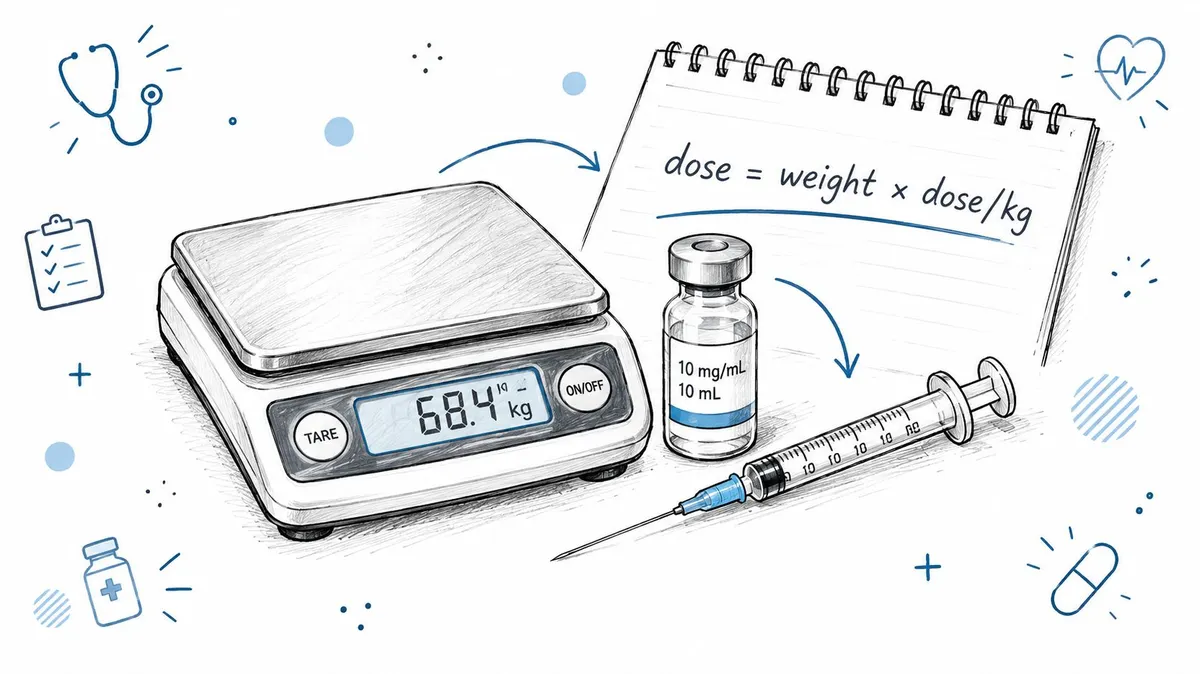
You’re holding a peptide vial, a prescription written in mcg/kg, and a syringe marked in units. The arithmetic may look simple, but the result depends on a chain of conversions. A small mistake at the beginning can change the volume you draw at the end.
The weight dosage calculation formula is the starting point, not the entire process. You also need to identify the correct type of body weight, keep kilograms and micrograms consistent, account for the vial concentration after reconstitution, and convert the final volume into the markings on your syringe. This guide walks through that chain carefully, with worked examples and practical checks you can use alongside a calculator or dosing app.
Table of Contents
- Why Weight Based Dosing Matters for Accurate Results
- Understanding the Core Weight Dosage Calculation Formula
- How to Convert Weight Based Doses Into Vial Concentration and Injection Volume
- Worked Examples That Show the Math in Action
- Common Mistakes to Avoid and How to Catch Them
- Putting It All Together With PepFlow for Consistent Dosing
Why Weight Based Dosing Matters for Accurate Results
A fixed dose gives every patient the same amount. A weight-based dose scales the medication to body mass, using a formula such as dose in mg = weight in kg × prescribed dose in mg/kg. Many drugs are prescribed this way, particularly in pediatric care, critical care, antimicrobial treatment, anticoagulation protocols, and peptide regimens. Historical pediatric systems also used weight scaling before modern pharmacokinetic research, including Clark’s rule, which divides a child’s weight in pounds by 150 and multiplies by the adult dose. The 150-pound reference became a widely recognized benchmark in pediatric medicine, as described in the NCBI Bookshelf overview of medication dosage calculations.
Consider two people following the same protocol. If one weighs less than the other, multiplying each person’s weight by the same prescribed amount per kilogram produces different total doses. That’s the purpose of the method. The calculation responds to the patient’s recorded weight instead of treating a fixed adult amount as appropriate for everyone.
The practical challenge appears when the calculated dose must become an injection. A prescription might state a dose in micrograms per kilogram, the vial label might show total milligrams, the reconstituted solution might be expressed in milligrams per milliliter, and the syringe might use units. Each value can be correct while still being easy to misread if the units aren’t tracked.
Practical rule: Treat every conversion as a separate checkpoint. Don’t jump directly from body weight to syringe units without showing the intermediate dose and concentration.
Weight estimation adds another layer of risk in settings where a patient can’t be placed on a scale immediately. Emergency medicine literature uses a benchmark in which at least 70% of estimated weights should fall within 10% of actual weight, and 95% should fall within 20% for an estimation system to be considered acceptable, according to this emergency weight-estimation review. A 10% weight error can translate directly into a 10% dosing error when the prescribed equation is weight multiplied by mg/kg.
A safe workflow therefore includes more than multiplication. It asks which weight belongs in the equation, whether the prescription is per dose or per day, whether the vial strength is stated before or after reconstitution, and whether the syringe scale matches the final volume. For additional clinical calculation context, learners may also find the ProMed Certifications NICU guide useful when reviewing weight-based medication decisions in neonatal settings.
Understanding the Core Weight Dosage Calculation Formula
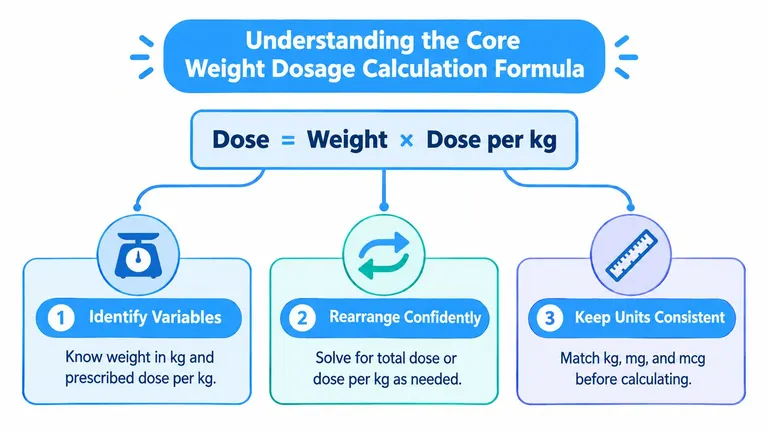
The basic equation is:
Total dose = weight in kg × prescribed dose per kg
If the prescription uses milligrams, the result is milligrams. If it uses micrograms, the result is micrograms. The units should cancel visibly:
kg × mg/kg = mg
That small unit check catches many mistakes. If your weight is still in pounds, or if the prescribed amount is written per kilogram but you multiply by pounds, the units don’t cancel and the result isn’t ready to use.
Separate a single dose from a daily dose
A prescription may instead state:
Daily dose = weight in kg × dosage in mg/kg/day
That result represents the total amount for the entire day. It isn’t automatically the amount to inject at each interval. If the daily amount is divided into multiple administrations, divide the daily total according to the prescribed schedule. Never assume the number of administrations from the formula alone.
The same logic applies to micrograms:
Weight in kg × dose in mcg/kg = total mcg per dose
To convert micrograms to milligrams, divide by 1,000. To convert milligrams to micrograms, multiply by 1,000. Write the conversion explicitly rather than relying on mental movement of the decimal.
Choose the correct weight value
Total body weight, often abbreviated TBW, is the measured body mass. It may be the correct value, but not always. In obesity dosing, clinical guidance may instead specify ideal body weight, adjusted body weight, or lean body weight. One commonly used adjusted-body-weight expression is AdjBW = IBW + 0.4(TBW − IBW), described in this antimicrobial weight-based dosing and rounding guideline.
Don’t choose among these values based on convenience. Use the weight type named by the prescriber, protocol, or pharmacist. A calculator can perform the multiplication accurately while still producing the wrong clinical answer if the wrong weight category is entered.
For a practical discussion of medication protocols and individualized considerations, the Vials + Vitals guide to medication after bariatric surgery offers useful context. You can also review how to calculate final concentration before converting a dose into an injection volume.
How to Convert Weight Based Doses Into Vial Concentration and Injection Volume
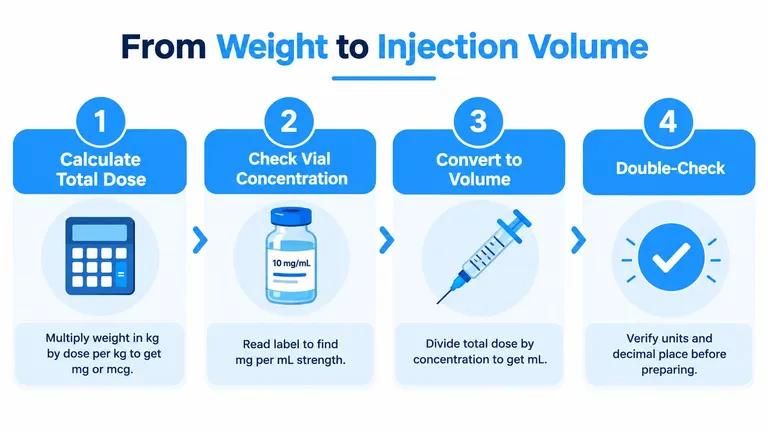
Once you know the total dose, you still need to determine how much liquid contains it. The safest approach is a continuous chain:
- Calculate the prescribed dose in mcg or mg.
- Determine the concentration of the reconstituted vial.
- Convert the desired dose into milliliters.
- Convert milliliters into syringe units if your syringe uses units.
Use one mass unit throughout each step. If the prescribed dose is in micrograms and the vial concentration is in milligrams per milliliter, convert one of them before dividing.
Start with the total dose
Suppose a protocol specifies a dose of 2 mcg/kg per dose for a person weighing 75 kg.
75 kg × 2 mcg/kg = 150 mcg
The units cancel, leaving 150 mcg. Convert that to milligrams if the vial concentration will be expressed in mg/mL:
150 mcg ÷ 1,000 = 0.15 mg
This is the desired amount of medication, not yet the amount of liquid to draw.
Calculate the reconstituted concentration
Assume a vial contains 5 mg of peptide and is reconstituted with 2 mL of diluent. The concentration is:
5 mg ÷ 2 mL = 2.5 mg/mL
You can also express that concentration in micrograms:
2.5 mg/mL × 1,000 = 2,500 mcg/mL
Keeping both forms visible makes the next step easier. Since the desired dose is 150 mcg, use 2,500 mcg/mL rather than mixing 0.15 mg with a microgram concentration.
Convert dose to milliliters
Injection volume = desired dose ÷ concentration
150 mcg ÷ 2,500 mcg/mL = 0.06 mL
The mass units cancel, leaving milliliters. The result is the volume of reconstituted solution that contains the desired dose.
Convert milliliters to syringe units
For a U-100 insulin syringe, 1 mL corresponds to 100 syringe units, so:
0.06 mL × 100 units/mL = 6 units
That final number only applies when the syringe scale and concentration convention match the calculation. Read the syringe label and confirm the intended device. Don’t assume that every syringe uses the same unit relationship.
Before drawing: Check the vial’s total amount, the actual diluent volume, the resulting mg/mL, the desired dose, the syringe type, and the decimal position.
The reconstitution volume changes concentration. More diluent creates a more dilute solution, while less diluent creates a more concentrated solution. The medication amount in the vial hasn’t changed, but the volume needed for a particular dose will change. For a separate conversion workflow, see how to convert mcg to syringe units.
Worked Examples That Show the Math in Action
The following examples are arithmetic demonstrations, not prescribing instructions. Each uses a hypothetical peptide protocol and assumes the stated vial, diluent, syringe, and dose have already been selected by an appropriate clinician or protocol.
Example one uses a moderate dose and a dilute vial
Given
- Weight: 60 kg
- Prescribed dose: 1 mcg/kg per dose
- Vial: 5 mg
- Reconstitution volume: 2 mL
- Syringe: U-100
Calculation
60 kg × 1 mcg/kg = 60 mcg
The vial concentration is:
5 mg ÷ 2 mL = 2.5 mg/mL = 2,500 mcg/mL
The injection volume is:
60 mcg ÷ 2,500 mcg/mL = 0.024 mL
Convert to syringe units:
0.024 mL × 100 units/mL = 2.4 units
The small volume should prompt a device and clinical-practicality check. Arithmetic precision doesn’t automatically mean a volume is easy or appropriate to measure.
Example two uses a higher weight and a stronger dose
Given
- Weight: 75 kg
- Prescribed dose: 2 mcg/kg per dose
- Vial: 5 mg
- Reconstitution volume: 2 mL
- Syringe: U-100
Calculation
75 kg × 2 mcg/kg = 150 mcg
The concentration remains:
5 mg ÷ 2 mL = 2,500 mcg/mL
Then:
150 mcg ÷ 2,500 mcg/mL = 0.06 mL
0.06 mL × 100 units/mL = 6 units
Compared with the first example, both the body weight and prescribed amount per kilogram differ, so the final volume changes accordingly.
Example three uses a more concentrated reconstituted solution
Given
- Weight: 90 kg
- Prescribed dose: 1.5 mcg/kg per dose
- Vial: 10 mg
- Reconstitution volume: 1 mL
- Syringe: U-100
Calculation
90 kg × 1.5 mcg/kg = 135 mcg
The vial concentration is:
10 mg ÷ 1 mL = 10 mg/mL = 10,000 mcg/mL
The injection volume is:
135 mcg ÷ 10,000 mcg/mL = 0.0135 mL
Convert to syringe units:
0.0135 mL × 100 units/mL = 1.35 units
This example shows why vial size alone doesn’t tell you the injection volume. The reconstitution volume and concentration determine how much liquid contains the calculated dose.
| Example Scenario | Weight and Dose | Vial and Concentration | Final Injection Volume |
|---|---|---|---|
| Example one | 60 kg at 1 mcg/kg | 5 mg in 2 mL, 2,500 mcg/mL | 0.024 mL, 2.4 U-100 units |
| Example two | 75 kg at 2 mcg/kg | 5 mg in 2 mL, 2,500 mcg/mL | 0.06 mL, 6 U-100 units |
| Example three | 90 kg at 1.5 mcg/kg | 10 mg in 1 mL, 10,000 mcg/mL | 0.0135 mL, 1.35 U-100 units |
Use the table to compare patterns, not to select a dose. A change in weight changes the total dose when the prescribed amount per kilogram stays fixed. A change in concentration changes the volume required even when the desired dose stays fixed.
Common Mistakes to Avoid and How to Catch Them
The most dangerous errors often happen before the multiplication. A person may calculate accurately from the wrong unit, wrong weight, wrong regimen expression, or wrong vial concentration. Medication-safety education has identified decimal, mathematical, and regimen-expression mistakes as a major category of dosage errors, with an older patient-safety analysis attributing 59.5% of dosage errors to those types of mistakes, as discussed in this Pharmacy Times analysis of dosage miscalculations.
Confusing per dose with per day
mg/kg/dose describes one administration. mg/kg/day describes the total amount across the day. If a daily amount is divided into multiple intervals, the prescribed schedule determines the portion given at each interval.
Write the regimen in words before calculating: “total for one dose” or “total across 24 hours.” Don’t split a single-dose prescription just because it sounds high, and don’t give a daily total at every scheduled interval.
Using pounds as kilograms
If the prescription says mg/kg or mcg/kg, convert pounds to kilograms before multiplying. A pound value entered directly into a kilogram formula inflates the calculated dose because the units don’t match.
Keep the conversion visible in your notes. If a scale reports pounds and the protocol requires kilograms, stop at that conversion rather than carrying the pound number into the next line.
Moving a decimal during mass conversion
Micrograms and milligrams differ by a factor of 1,000. Write 1 mg = 1,000 mcg and show the division or multiplication. This is safer than trying to remember which direction the decimal moves.
A quick estimate also helps. If a result suddenly becomes much larger or smaller after changing mg to mcg, pause and recalculate.
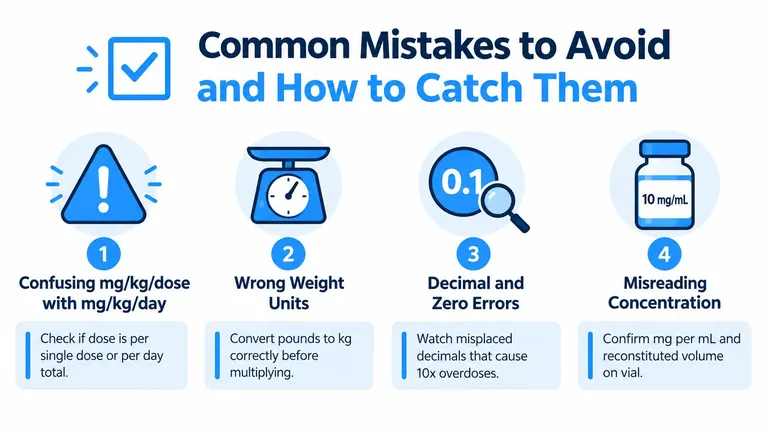
Misreading the vial after reconstitution
The powder amount in a vial isn’t the same as the concentration of the finished liquid. Divide the total medication amount by the actual final liquid volume, then verify whether the label or protocol expresses strength in mg/mL or another unit.
Use this short check before preparing a dose:
- Confirm the weight: Is it in kilograms, and is it the correct weight type?
- Confirm the regimen: Is the prescription per dose or per day?
- Confirm the mass unit: Are both dose and concentration in mg or both in mcg?
- Confirm the concentration: Did you use the reconstituted volume?
- Confirm the syringe: Does the unit conversion match the device?
- Confirm the decimal: Does the result make sense compared with the starting values?
Stop and ask a pharmacist or prescriber if any part of the label, concentration, dose frequency, or syringe scale is unclear. A second calculation is useful, but it can’t resolve an ambiguous prescription.
Putting It All Together With PepFlow for Consistent Dosing
Manual math gives you a way to audit the result. A calculator can then reduce repetitive work by keeping the vial amount, reconstitution volume, concentration, desired dose, and syringe conversion in one workflow. The important habit is to verify the inputs before trusting the output.
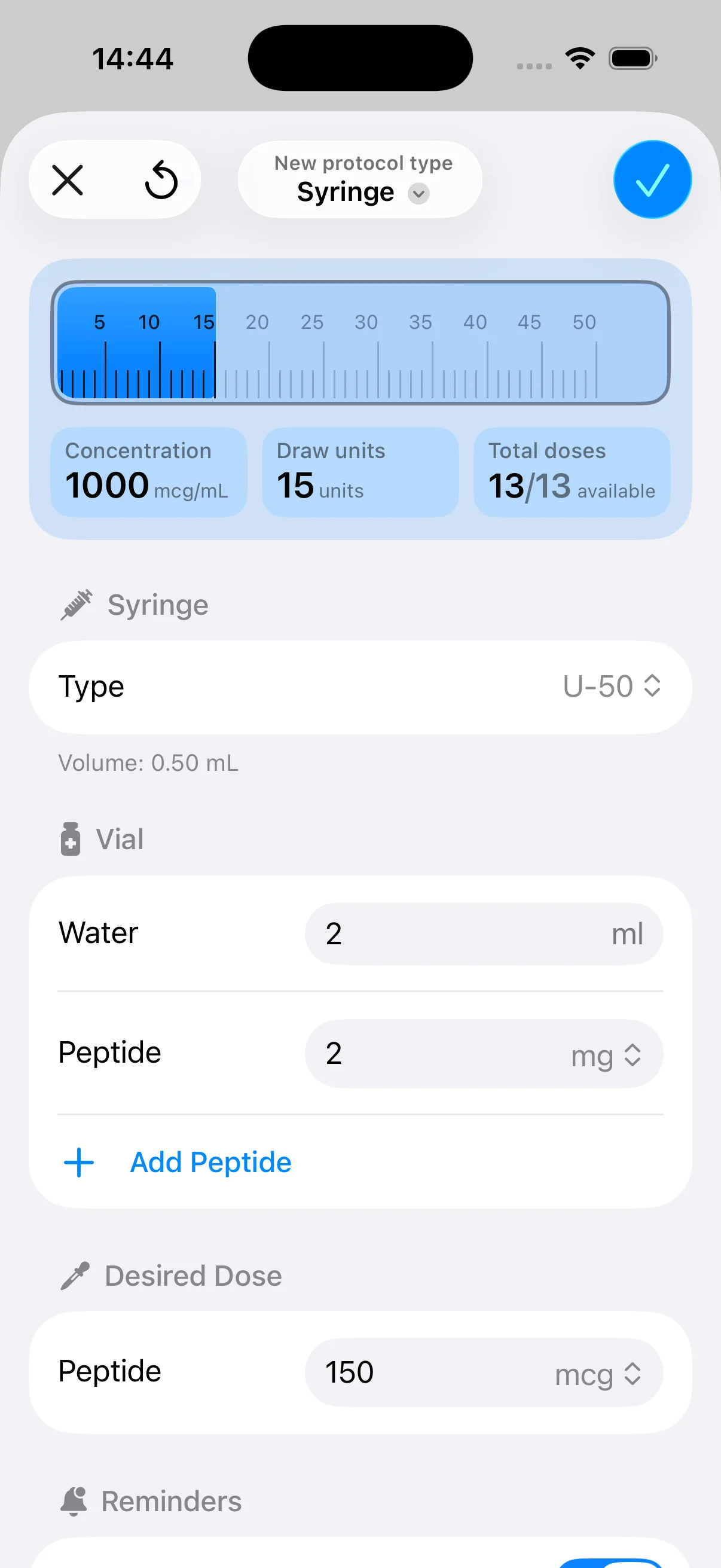
PepFlow is an iOS app for peptide dosing and scheduling. It can work through vial configuration, concentration, dose selection, microgram or milligram units, injection volume, and syringe-unit conversion. Its protocol features also support flexible schedules, reminders, countdowns, dose logs, and routine tracking. These functions organize a user’s selected protocol, but they don’t determine whether that protocol is medically appropriate.

A sensible setup sequence is straightforward:
- Record the prescribed dose and whether it is per dose or per day.
- Enter the correct weight and weight type.
- Enter the vial amount and reconstitution volume exactly as provided.
- Confirm the displayed concentration.
- Compare the app’s total dose, milliliters, and syringe units with your hand calculation.
- Use reminders and dose logging only after the clinical instructions and inputs are confirmed.
You can also use the PepFlow peptide calculator as a calculation aid. Keep the core safety rule in place: an app supports organization and arithmetic, but it isn’t a substitute for professional medical advice, prescription review, or pharmacist guidance.
PepFlow brings weight-based dose math, vial concentration, injection-volume conversion, and protocol reminders into one practical workflow. Visit PepFlow to review the calculator and scheduling tools, then verify your setup with a qualified healthcare professional before preparing or changing any dose.