You’re holding a vial labeled 10 mg/mL and a syringe marked in units. The instruction in front of you says 5 mg. Nothing on either object tells you how many millilitres that is.
That gap between what the label states and what you’re asked to take is where most injection confusion starts. It isn’t carelessness. Three different numbers get discussed as though they were one: the volume the container holds, the concentration printed on it, and the dose that enters a body.
Get those three straight and the rest of the arithmetic follows on its own, including the records worth keeping afterwards.
Table of Contents
- Volume Injection Terms Explained
- How Concentration Turns Volume Into a Dose
- Why a Vial’s Fill Volume Is Not a Dose
- Single-Dose and Multidose Containers Change the Record
- Where Large-Volume Products End and Small-Volume Products Begin
- Verify the Product Before You Trust the Volume
- Log Concentration, Volume and Dose Before Each Injection
Volume Injection Terms Explained
Start with the biggest category, because it sets the vocabulary. Large-volume parenteral products are injectables given in volumes of 100 mL or more, which in practice means intravenous bags used in hospitals and infusion clinics. Small-volume presentations sit below that line, in vials, ampoules and prefilled syringes, and that’s where most individually measured doses come from.
Three words then get used interchangeably and shouldn’t be. Concentration is the amount of active ingredient in each millilitre, printed as something like 10 mg/mL. Fill volume is the nominal volume the container is labeled to hold. Dose is the amount of active ingredient administered, and you only reach it by combining the first two.
| Term | Meaning | Typical volume or form | Why it matters |
|---|---|---|---|
| Large-volume parenteral | Injectable product given in 100 mL or more | 100 mL and above, often IV bags | Usually tied to supervised infusion |
| Small-volume injection | Vials, ampoules and prefilled syringes below 100 mL | Below 100 mL | Most individually measured doses come from these |
| Concentration | Amount of active ingredient per mL | Stated on the label, for example 10 mg/mL | Converts a volume into a dose |
| Fill volume | Volume the container is labeled to hold | Nominal labeled volume | Includes excess for residual hold-up, so it is not the dose |
| Dose | Amount of active ingredient actually given | Calculated from concentration and volume drawn | Cannot be read from volume alone |
| Single-dose container | Meant for one patient and one injection | Labeled for discard after use | Opening date is the key record |
| Multidose container | Designed for repeated withdrawals | Generally 30 mL or less | Needs beyond-use tracking across uses |
Containers divide into two behaviors. A single-dose container serves one use and is then discarded. A multidose container is built for repeated withdrawals, so its first puncture starts a clock that has to be tracked. That distinction decides what you write down, not just where you store the vial.
If the material science of one injectable family interests you, how dermal fillers work covers composition and what these products do once they’re in tissue. For the arithmetic, this explanation of what concentration actually means is the right starting point.
One rule covers most of it. Read the concentration before you read the volume, every time, and never assume the number on the vial is the dose.
How Concentration Turns Volume Into a Dose
Dose equals concentration multiplied by volume drawn. That single line resolves most of the confusion around volume injection products, because it shows why a large number on the vial says nothing about the amount you receive.

Work one case through. A preparation labeled 10 mg/mL, drawn at 0.5 mL, delivers 5 mg. Draw a full millilitre from the same vial and you get 10 mg. The vial hasn’t changed. The draw has.
Three numbers get confused here, and keeping them apart is the whole skill. Fill volume is how much liquid the container holds. Concentration is how much active ingredient sits in each millilitre. Dose is what ends up in the syringe. Only the third one is the dose, and you cannot reach it without the second.
The Same Volume, Different Doses
The rows below are arithmetic examples, not recommendations. They exist to show the multiplication, and the third row is the one worth staring at.
| Labeled concentration | Volume drawn | Dose delivered |
|---|---|---|
| 5 mg/mL | 1 mL | 5 mg |
| 5 mg/mL | 2 mL | 10 mg |
| 10 mg/mL | 0.5 mL | 5 mg |
| 10 mg/mL | 2 mL | 20 mg |
Two millilitres at 5 mg/mL gives 10 mg. The same two millilitres at 10 mg/mL gives 20 mg. Identical syringe reading, double the exposure. That is the entire argument against reading volume as dose.
Keep the Units Consistent First
Before multiplying anything, put the numbers in one system. Volumes belong in millilitres, masses in milligrams or micrograms, and international units stay in international units, since they measure biological activity rather than weight. A 500 mcg label is 0.5 mg, and mixing those two up is a thousandfold error, not a rounding one.
Concentration works like a price per litre. Two vials of very different sizes at the same 10 mg/mL hold different totals, and only the concentration converts either volume into a mass you can compare with a prescribed dose.
Reconstitution inserts another step. When a powder is mixed with a diluent, the concentration depends on how much liquid you add, so the same vial can yield noticeably different strengths depending on the volume used. The dry label describes the powder. The mixed label describes what you draw.
The same arithmetic governs injectables built around a measured concentrate. With PRP for chronic pain recovery, the platelet concentration in each millilitre, not the millilitres alone, decides what the injection delivers.
A Four-Step Check Before You Draw
- Read the labeled concentration and write down the units exactly as printed.
- Convert the volume to millilitres if your syringe measures in units, which is where dose and volume most often part ways. How to read insulin syringes explains how the unit markings map to millilitres.
- Multiply concentration by volume to get the dose in the same mass unit as the label.
- Compare that result with the prescribed or labeled dose before the needle goes anywhere near the container.
If step four doesn’t match, nothing else about the draw matters.
Why a Vial’s Fill Volume Is Not a Dose
A vial marked 10 mL can look like the amount about to go into the syringe. It is not. Fill volume, concentration, and dose are three separate numbers, and the first never stands in for the third.
Fill volume is a quality and usability parameter. The FDA guidance on allowable excess volume and labeled vial fill size explains why injectable containers carry a small, scientifically justified excess. Without that extra liquid, a user cannot withdraw and administer the labeled dose once fluid stays behind in the vial, the syringe, and the needle.
That leftover is physical. Liquid clings to glass, pools at the shoulder of the vial, and sits in the hub of the syringe. The excess covers those losses. The same guidance expects the labeled fill to be checked against the container’s shape, the withdrawal technique, and the product’s intended dosing regimen, because each of those changes how much comes out.
When Overfill Stops Being Helpful
A little extra liquid works like the spare margin in a measuring cup: it lets you pour the marked amount after some sticks to the sides. Pour in far more than one serving needs, and the full cup no longer tells you what that serving is.
The FDA guidance notes that an unreasonably large fill can let someone withdraw an unintended additional dose, or pool material from several vials. Both raise dosing risk and contamination risk. Manufacturers are directed to keep the maximum fill volume reasonable and to match vial size to the labeled use.
A Worked Example With a 10 mL Vial
Take a 10 mL vial labeled at 10 mg/mL. Multiply those two figures and the container holds 100 mg in total. A single dose drawn from it might be 5 mg. At 10 mg/mL, that dose is half a millilitre, not the 10 mL printed on the vial.
All three numbers can be true together. The fill is 10 mL. The concentration is 10 mg/mL. The dose is 5 mg. The volume on the label describes the container, not the injection.
Volume can’t establish a dose. Dose depends on concentration and on how accurately the draw matches the intended volume.
A usable record keeps four fields apart. Write the nominal volume (the vial size), the concentration as labeled, the reconstitution state (powder, diluent added, or ready to use), and the remaining volume after the draw. Fold them into one note that only says “10 mL vial,” and the entry no longer shows whether the injection was 5 mg or something else.
Single-Dose and Multidose Containers Change the Record
The FDA defines a single-dose container as a sterile parenteral product intended for one patient and one injection or infusion. It isn’t generally required to meet antimicrobial-effectiveness testing requirements, and it’s labeled for discard after use. Multidose containers are designed for repeated withdrawals, and preservative effectiveness and beyond-use controls sit inside the product’s regulatory framework (FDA guidance on single-dose and multidose containers).
The container type therefore decides what your record must hold. With a single-dose vial, the discard rule ends the story at first use, so the date of use is enough. With a multidose vial, the opening date starts a countdown that runs across sessions, and the beyond-use date is the point where whatever remains stops being usable.
WHO injection-safety guidance supports safety-engineered syringes for intramuscular, intradermal and subcutaneous injections, and its training materials call for a new sterile syringe and needle for every injection. Reusing a needle to withdraw from a multidose vial saves nothing worth saving.
What the Two Containers Demand of a Log
Consider a multidose vial opened on day one and used across several sessions. The log needs the opening date and a beyond-use date, because those two entries are what separate “I used this on day four” from “I used something that had already expired.” A single-dose vial in the same routine needs only its use date, since nothing carries forward.
That difference resolves a common argument with yourself later. A missed entry and a discarded preparation look identical in memory. They don’t look identical in a log that recorded the container.
- Container type tells you whether the contents carry forward at all.
- Opening or first-use date anchors every later calculation.
- Reconstitution date applies whenever a diluent entered the vial.
- Route and injection volume describe what was given, not what was planned.
Write down the container, not just the product. A product name alone can’t tell a clinician whether the vial in question was opened yesterday or six weeks ago.
Those fields also keep a review conversation concrete. When treatment history comes up, “the multidose vial, opened on this date, this route, this volume” gives a clinician something to work with. A product name on its own doesn’t.
Where Large-Volume Products End and Small-Volume Products Begin
A bag marked 100 mL and a small draw from a vial can both be called “the volume.” They are not the same kind of number. Large-volume parenteral products are injectables administered in volumes of 100 mL or more, and that threshold separates them from the vials, ampoules and prefilled syringes that carry most individually measured injections (PharmaSalmanac analysis of the parenterals market).

Above the line, the products are mostly intravenous nutrition and electrolyte solutions: amino-acid solutions, mannitol, dextrose, lactated Ringer’s injection, Ringer’s injection and sodium chloride. Hospitals use them for fluid replacement, hydration, electrolyte management and parenteral nutrition. A clinician hangs the bag and sets a rate. The printed fill says how much solution the container holds. It does not, by itself, say what dose that infusion delivered.
Fill volume, concentration, and dose
Three figures travel with every injectable, and mixing them up is easy once the container gets large.
Fill volume is the liquid in the container. Concentration is how much active ingredient sits in each unit of that liquid. Dose is the amount given. A measuring cup works the same way: the mark on the cup is capacity, the strength of the mixture is concentration, and the pour is the dose. A full cup is not automatically one serving.
On a large-volume infusion, the treating team records the bag and the rate, because those two entries, read with the solution’s concentration, are what turn container size into an administered amount. A 100 mL bag of a dilute solution and a 100 mL bag of a concentrated solution can share a fill volume and still represent different doses. Time on the pump changes the total again.
Small presentations use the same three figures, with the measuring shifted to you. The vial, ampoule or prefilled syringe still has a fill volume. Concentration still has to be known. The dose is concentration multiplied by the volume you draw, not the volume printed on the container. Those are the entries you measure, repeat and later try to reconstruct. A volume written down without its concentration cannot be turned back into a dose.
Verify the Product Before You Trust the Volume
The FDA warns that fillers sold directly to the public may be fake, contaminated or unapproved, and states that approved fillers are prescription products intended for injection by licensed healthcare professionals (FDA consumer guidance on dermal fillers). Read that again as a purchasing rule rather than a warning label.

The assumption worth challenging is that easier access means better value. Lower price and online availability may represent higher uncertainty, not a saving. The agency also identifies counterfeit products as an ongoing concern and advises clinicians to inspect packaging authenticity, which is work done by the person holding the box, not the person holding a payment card.
Does the Approval Match the Body Area
A product marketed for facial volume isn’t automatically authorized for body contouring. FDA materials specifically warn that injectable silicone and fillers are not approved for body contouring or enhancement, where serious injury can occur. Approval attaches to a site and an indication, so “approved” on its own is an incomplete answer.
Reversibility belongs in the same conversation. Hyaluronic-acid fillers can be dissolved with hyaluronidase, while other materials carry different management options, and one recent systematic review put vascular occlusion estimates between 0.01% and 0.05% (University of Sassari research repository). Rare isn’t the same as impossible, and the rare event is exactly when a written record earns its keep.
That is how that verification looks in practice, including the packaging checks a clinician performs before opening anything.
A Record You Can Hand to a Clinician
Documentation isn’t product promotion, and it isn’t dosing advice. It’s history, and it’s the thing that makes a delayed reaction easier to assess.
- Brand and lot number, copied exactly, so a batch problem can be traced rather than guessed at.
- Expiration date and storage conditions, because a product kept warm or frozen isn’t the product that was tested.
- Injection site and volume, recorded separately, since site problems and volume problems present differently.
- Provider name and aftercare instructions, so a second clinician knows who to contact and what was already advised.
If any of those details can’t be confirmed, stop and speak to a licensed clinician before going further. A record with a gap is a question worth asking out loud.
Log Concentration, Volume and Dose Before Each Injection
The routine takes under a minute and saves an hour of reconstruction later. Run it before the needle, not after.
- Write the labeled concentration precisely as printed, units included. If the label reads 5,000 IU/mL, that’s the entry, not 5,000.
- Record the volume drawn in millilitres, plus the syringe type and the graduation you read. A U-100 syringe and a 1 mL syringe describe the same draw in different language.
- Calculate the dose and compare it with what the clinician instructed. Anything that doesn’t reconcile is a question for a professional, not something to round off.
- Add the container details: type, opening or first-use date, reconstitution date, route and injection volume.
A log built this way answers a better question than “did I take it.” It answers “what exactly did I take, from which container, at what strength, and when did that container stop being good.” Those answers are what make a review appointment useful instead of a memory test.
Unit conversion is where entries drift most often, and reducing the math in peptide dosing covers the shortcuts that keep a milligram from turning into a microgram.
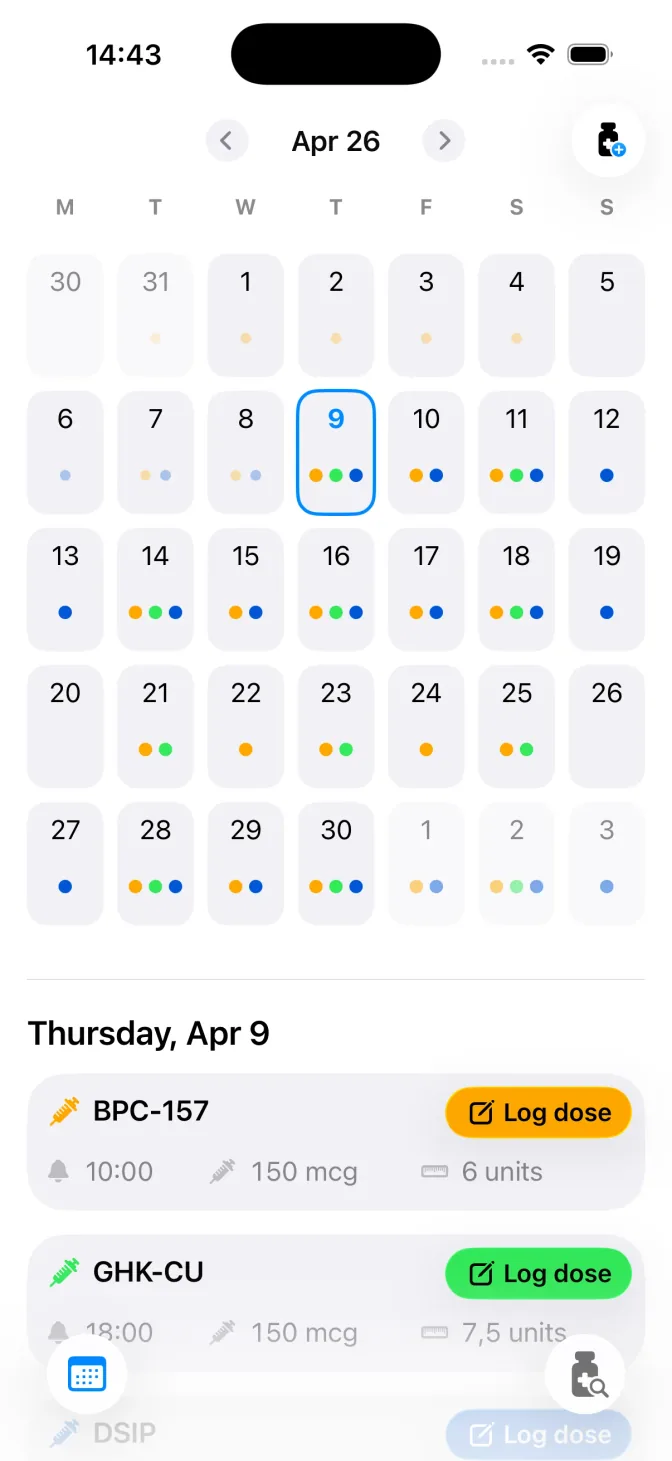
PepFlow fits into this as record-keeping, not advice. Our website calculator uses entered syringe, vial, water-volume and target-dose values to calculate concentration, syringe draw and doses per vial, while on iPhone and iPad preparation information does not generate a medication dose or syringe draw. PepFlow records and organizes the instructions you choose. It does not choose treatments or determine medically appropriate doses.
Before you inject, check each entry against the label and against your clinician’s written instructions. A number that doesn’t match either one belongs in a conversation, not in a syringe.
PepFlow keeps the numbers you already decided on in one place, so concentration, volume and dose sit side by side instead of in your head. Log a draw, save the preparation details, and your history shows what you took and when, which is what makes the next review appointment productive. Visit PepFlow to see how protocol tracking, reminders and dose history work together.