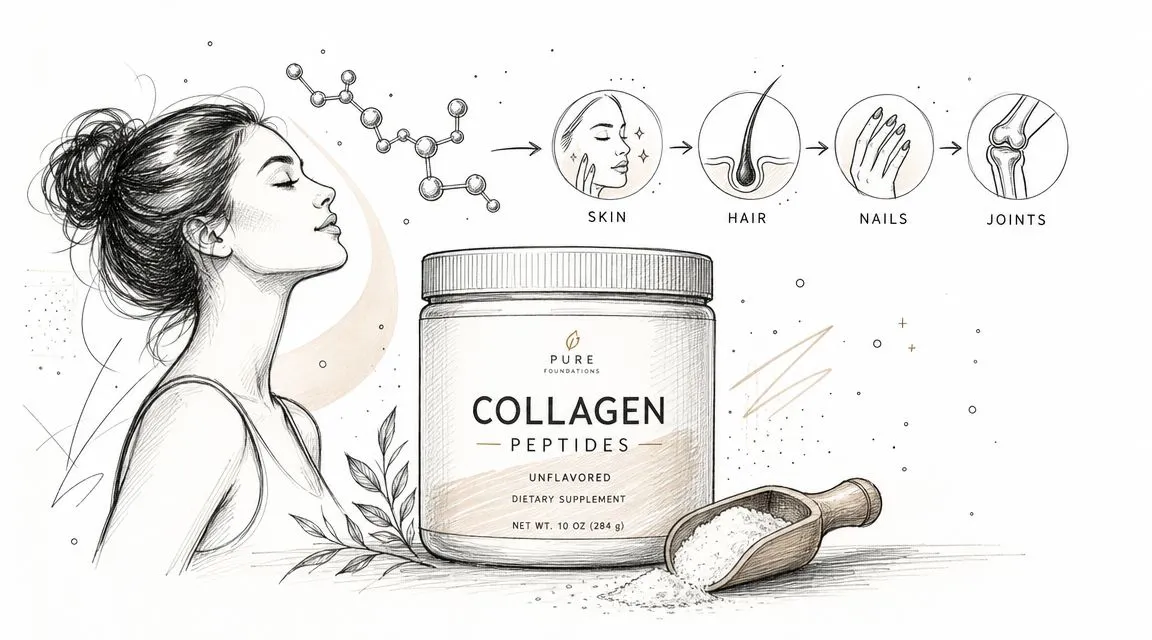
You’re probably here because you’ve seen Vital Proteins Collagen Peptides everywhere. It shows up in coffee routines, “glow” posts, gym bags, and grocery aisles, and the pitch is always tempting: better skin, stronger nails, happier joints, maybe all of the above.
That kind of buzz can make a smart person more skeptical, not less. That’s a good instinct. With Vital Proteins Collagen Peptides for women, the useful question isn’t “Is collagen amazing?” It’s “What does this product do, what does the evidence support, and how long would I need to use it before deciding whether it’s worth it?”
This guide takes the cautious, evidence-first route. No miracle language. No pretending collagen is a magic anti-aging fix. Just a clear look at what Vital Proteins is, how collagen peptides work, where the research is strongest, and where expectations need to stay realistic.
Table of Contents
- Why Everyone Is Talking About Collagen
- Understanding How Collagen Peptides Work
- The Vital Proteins Formulation Decoded
- Real Benefits of Collagen for Women
- How to Use Vital Proteins for Best Results
- Safety and Considerations Before You Start
- Common Questions About Collagen Peptides
Why Everyone Is Talking About Collagen
Collagen sits at the intersection of beauty, fitness, and healthy aging, which is exactly why it gets so much attention. It sounds simple enough to fit into a morning routine, but broad enough to promise benefits for skin, nails, joints, and recovery. That combination makes it extremely marketable.
For women, the appeal is easy to understand. A single scoop feels easier than redesigning your whole diet, sleep routine, or strength program. If a supplement might support skin or connective tissue, it can sound like a low-effort win.
The problem is that collagen marketing often blurs three different ideas into one message:
- Structural support: Collagen is part of the body’s connective tissue framework.
- Cosmetic hope: Many people buy it mainly for skin appearance.
- Protein confusion: Some assume collagen works like a complete protein powder, which it doesn’t.
Most confusion around collagen starts when people expect one product to do everything. It won’t.
Vital Proteins became a familiar name because it packaged collagen in a way that feels easy to use. The product is visible, convenient, and simple to mix into everyday foods and drinks. That matters because supplements people can use consistently are the ones they’re more likely to stick with.
Still, visibility isn’t proof. If you’re deciding whether Vital Proteins Collagen Peptides for women deserves a place in your routine, you need a better filter than popularity. You need to know what collagen peptides are, what this formula contains, and which claimed benefits hold up best under scrutiny.
Understanding How Collagen Peptides Work
Collagen is a structural protein, not a beauty gimmick
Collagen is best thought of as a support protein. It helps form the framework of skin, tendons, ligaments, cartilage, and other connective tissues. That’s why collagen supplements are more logically tied to structure and tissue support than to broad claims about “total wellness.”
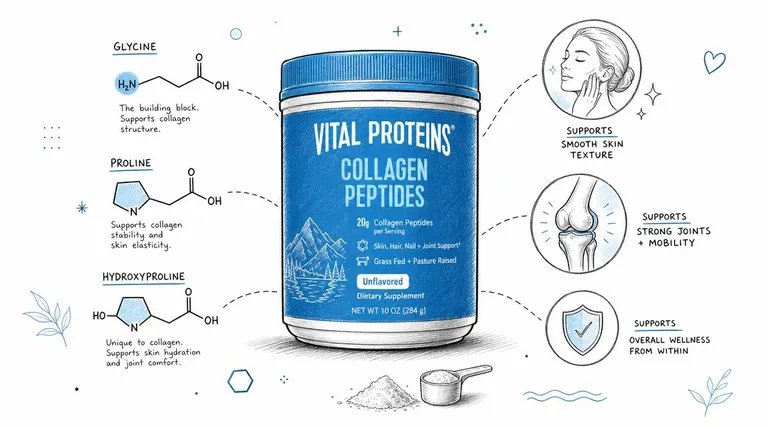
What makes collagen different from many other proteins is its amino acid profile. Vital Proteins notes that collagen is rich in glycine, proline, and hydroxyproline, which are especially relevant to connective tissue, but are underrepresented in muscle-building proteins. That’s one reason collagen can support extracellular matrix remodeling in skin, tendons, ligaments, and joint cartilage, while not being optimized for maximizing muscle protein synthesis on its own, as described by Vital Proteins.
If you’ve ever wondered why collagen and whey aren’t interchangeable, that’s the core answer. They serve different purposes.
Why peptides are different from whole collagen
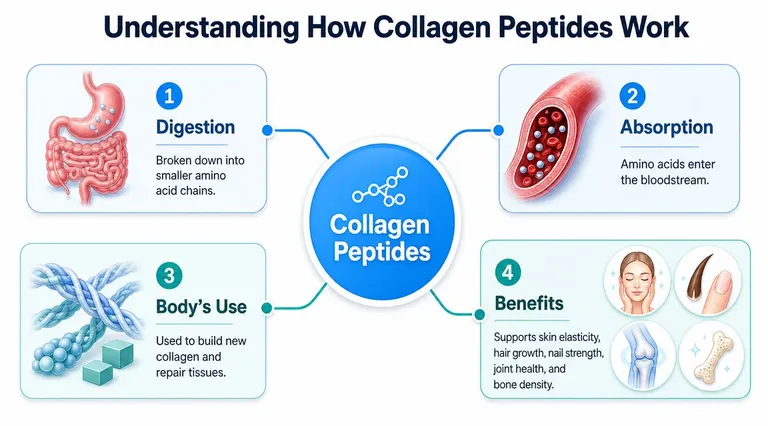
A useful analogy is to think of collagen as a long chain. Collagen peptides are that chain broken into smaller links. “Hydrolyzed” means the protein has been processed into smaller peptide fragments that dissolve more easily and are easier to use in powders.
That’s why Vital Proteins mixes into coffee, smoothies, or yogurt more easily than gelatin would. It’s built for convenience and daily use, not for forming a gel.
If you want a deeper primer on the terminology, this explainer on what collagen peptides are is a helpful companion, especially if “hydrolyzed,” “peptides,” and “collagen protein” have started to blur together. Some shoppers also compare collagen categories across broader peptide products, including resources like ArtNaturals peptides, to understand how different peptide supplements are positioned.
Here’s the practical takeaway:
- For skin, nails, and joints: Collagen makes mechanistic sense.
- For muscle-building goals: Use collagen as a complement, not your primary protein source.
- For daily planning: Treat it like a maintenance habit, not a rescue supplement you remember once in a while.
Practical rule: Use collagen for connective tissue goals. Use complete proteins for overall protein intake and muscle-focused goals.
The Vital Proteins Formulation Decoded
What’s actually in the blue tub
The standard unflavored Vital Proteins Collagen Peptides product is positioned as a single-ingredient bovine-hide collagen powder. The company also markets the unflavored version as free of artificial sweeteners, colors, and flavors. That simplicity is part of the appeal. You’re not buying a long ingredient panel dressed up as collagen.
For many women, that raises the first important decision point. This is bovine-derived, so it won’t fit vegetarian, vegan, or some religious dietary patterns. If source matters to you, that question comes before any discussion of benefits.
A simple formula can also make it easier to judge tolerance. If you try it and don’t feel good using it, there are fewer extra ingredients muddying the picture.
What label language means in practice
A few common terms on collagen tubs deserve translation into normal language.
- Hydrolyzed: The collagen has been broken into smaller peptides so it dissolves more easily.
- Bovine: The source is cattle, specifically bovine hide in this product line.
- Single ingredient: You’re getting collagen peptides without a long list of flavoring agents in the unflavored version.
That matters because the product is easier to fit into a routine when it doesn’t fight with the taste of your coffee or smoothie. It also means you can compare it more clearly with other collagen formats. If you like looking at other formulations for perspective, GutRx Collagen Bt 3 is one example of how some brands package collagen differently around broader wellness goals.
The bigger point is this: formula language can sound technical, but the consumer-level questions are straightforward.
| Label term | What it means for you |
|---|---|
| Hydrolyzed collagen peptides | Mixes easily and is designed for routine use |
| Bovine hide | Animal-derived source, not vegetarian |
| Unflavored single ingredient | Fewer extras, easier to add to foods and drinks |
If you’re evaluating Vital Proteins Collagen Peptides for women, the formulation is less mysterious than it first appears. It’s a simple connective-tissue supplement, not an all-in-one nutrition powder.
Real Benefits of Collagen for Women
Skin is where the evidence is strongest
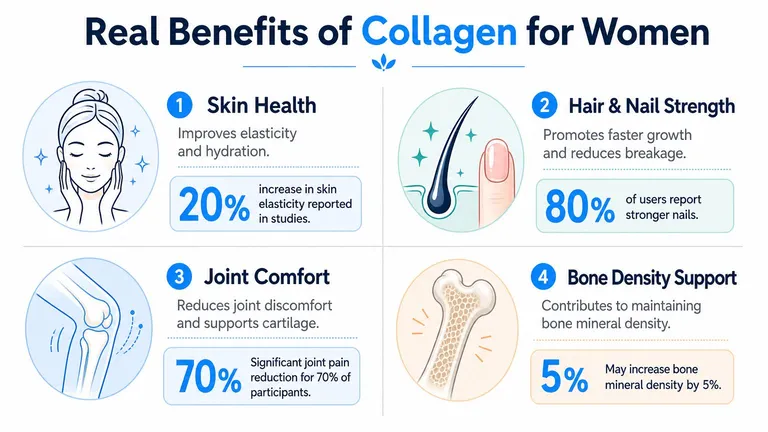
If your main reason for trying collagen is skin, you’re looking at the most evidence-backed use case. A 2025 dermatologist review summarized that many human studies find improvements in skin hydration and elasticity after at least 12 weeks of continued collagen peptide use, and it also noted a May 2025 meta-analysis covering 23 studies and about 1,500 total participants that found collagen peptides improved skin hydration, elasticity, and wrinkles, as summarized in this BarBend review of Vital Proteins Collagen Peptides.
That’s the detail most marketing leaves out. The timeline matters. If someone tries collagen for two weeks and expects visibly different skin, they’re judging it too early.
Better evidence for collagen usually means one thing. Daily use over time, not random use when you remember.
Hair and nails require more caution
Hair and nails are popular reasons women buy collagen, but the evidence here should be treated more cautiously than the skin data. Mechanistically, it’s plausible that a collagen-rich amino acid profile could support tissues involved in appearance and structure. That doesn’t mean every user will notice faster hair growth or dramatically stronger nails.
Skepticism helps; if your top goal is hair, collagen might be worth trying, but it shouldn’t replace a broader look at diet quality, iron status, protein intake, stress, sleep, and hormonal factors.
For readers comparing broader beauty-and-wellness perspectives, these collagen insights for modern wellness are useful as a consumer education piece, but the strongest evidence still clusters around skin rather than dramatic hair claims.
Joints and connective tissue are a practical use case
Collagen makes a lot of sense for connective tissue support. That’s less flashy than “glowing skin,” but often more grounded in how collagen works biologically. Because collagen contributes amino acids relevant to the extracellular matrix, women who train regularly or want support for tendons, ligaments, and cartilage often find this use case easier to understand than beauty messaging.
That doesn’t mean collagen is a treatment for joint conditions. It means the mechanism fits the tissue target better than many people realize.
Some people also explore collagen in relation to digestive comfort and connective tissue more broadly. If that topic interests you, this overview of collagen peptides for gut health adds context without turning collagen into a cure-all.
Bone health is plausible but not a shortcut
Bone support is another area where collagen gets mentioned often. That idea isn’t unreasonable, since collagen is part of the body’s structural matrix. But women should be careful not to hear “bone support” and assume collagen can substitute for resistance training, adequate overall protein, or medical care when needed.
Collagen may fit into a bigger bone-health plan. It is not the whole plan.
A quick way to think about the evidence:
| Benefit Area | Level of Evidence | Typical Timeframe for Results |
|---|---|---|
| Skin | Strongest support among common consumer use cases | Often after sustained daily use over at least 12 weeks |
| Hair | More limited and less predictable | Unclear, likely requires longer-term consistency |
| Nails | Plausible, but expectations should stay modest | Gradual, not immediate |
| Joints and connective tissue | Mechanistically sensible and practical | Best judged over consistent ongoing use |
| Bone support | Supportive role, not a stand-alone solution | Long-term habit, not a quick result category |
The skeptical view is often the correct one here. Collagen isn’t instant. It isn’t dramatic for everyone. But for women interested in skin support and connective tissue support, it has a more credible case than many supplements sold with similar hype.
How to Use Vital Proteins for Best Results
Get the dose right first
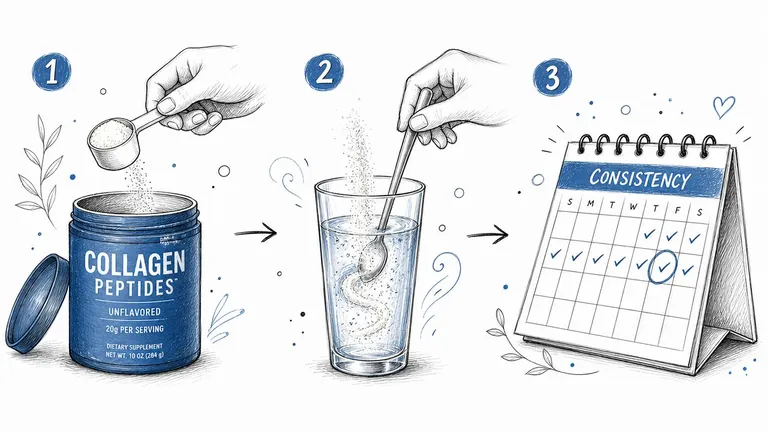
Label reading matters more than internet opinions. Vital Proteins states that one full serving is 20 g per day, and the company says current research suggests 10–20 g of collagen peptides daily as a practical intake range. A peer-reviewed analysis in PMC found that effective amounts of functional collagen peptides reported in the literature are typically 2.5–15 g/day, which places the brand’s serving size at the higher end of the effective range, according to this PMC analysis of collagen peptide intake.
What should you do with that?
A practical approach is:
- If you want to follow the product label: Use the full serving.
- If you’re comparing against research ranges: Recognize that Vital Proteins sits on the higher end of what appears effective in published literature.
- If you’re sensitive to supplements: Start more cautiously and assess tolerance before making it a daily habit.
Timing matters less than repetition. Morning, afternoon, or evening can all work. With food or without food is usually more about personal preference and digestive comfort than a proven performance edge.
Make consistency easy
The best collagen routine is the one you’ll repeat. For most women, that means attaching it to something that already happens every day.
Good options include:
- Coffee or tea: Easy if you already have a morning ritual.
- Smoothies: Useful if you want collagen to disappear into a larger meal.
- Yogurt or oatmeal: Better for people who dislike drinking supplements.
- Soups or soft foods: Helpful if you want variety without another sweet shake.
Here’s a simple rule. Don’t build a “perfect” collagen routine that lasts four days. Build a boring routine you can keep.
After you’ve chosen your mixing method, it helps to anchor the habit to a cue such as breakfast, your post-walk drink, or your evening tea. Some people also use reminder tools to make daily supplement routines easier to track. A planning app like PepFlow can be used to organize recurring supplement schedules and reminders when consistency is the main challenge.
For a quick demonstration, this walkthrough shows one common way people use collagen powder day to day:
If you miss a day, don’t overthink it. Just return to your normal routine the next day.
Safety and Considerations Before You Start
Who should pause and ask a clinician
Collagen supplements are often framed as universally simple, but “simple” doesn’t mean “automatic fit for everyone.” If you’re pregnant, breastfeeding, managing a medical condition, or taking medications, it’s sensible to check with your clinician before starting.
This product is bovine-derived, so source matters for allergies, intolerances, ethics, and dietary rules. Women who avoid animal products won’t find this a match. Women with a history of digestive sensitivity may also want to introduce it gradually and watch for how they feel.
Possible issues are usually discussed in practical terms rather than dramatic ones. Some people report bloating, fullness, or mild digestive discomfort when starting collagen powders. If that happens, the first question isn’t “Is collagen bad for me?” It’s often “Am I using a serving size and routine that my digestion tolerates well?”
For broader context on women-specific supplement questions, this guide to peptides for women can help you think more carefully about product fit and individual considerations.
How to read the label like a careful buyer
Supplement labels can be noisy, but a few checkpoints matter.
- Ingredient simplicity: A single-ingredient formula is easier to evaluate.
- Source clarity: Know whether the collagen is bovine or marine.
- Third-party testing: Certifications can add reassurance about product quality and screening.
- Use case honesty: If the product sounds like it supports everything, treat that as a red flag.
Choose supplements that make it easy to know what you’re taking. Confusing labels usually don’t help the buyer.
A careful buyer also keeps expectations in line with reality. Collagen can be part of a wellness routine. It shouldn’t be asked to compensate for low total protein intake, poor sleep, no strength training, or a stressful lifestyle.
Common Questions About Collagen Peptides
Is this vegetarian or vegan
No. The standard Vital Proteins Collagen Peptides formula discussed here is sourced from bovine hide, so it isn’t vegetarian or vegan.
Will collagen make me gain weight
Collagen is still a protein supplement, not a fat-gain trigger on its own. Weight change depends on your broader diet, energy intake, and habits over time. For most women, the more useful question is whether collagen fits their routine and goals, not whether the ingredient itself has some unique tendency to cause weight gain.
What’s the difference between collagen peptides and gelatin
They come from similar raw material, but they behave differently in the kitchen and in a routine. Collagen peptides are processed to dissolve more easily, especially in drinks and soft foods. Gelatin thickens and gels, which makes it better for recipes than for a quick scoop in coffee.
That difference is one reason peptides are a popular choice for daily convenience.
How long should I try it before judging results
Give it enough time to be fair. If your goal is skin support, think in terms of regular daily use across weeks, not a few scattered servings. If your goal is joints or general connective tissue support, consistency matters even more than impatience.
The women who get the clearest answer from collagen are usually the ones who do two things well: they use it regularly, and they judge it against a specific goal rather than hoping for every possible benefit at once.
If you already know consistency is your weak spot, PepFlow can help you organize recurring supplement or peptide routines with reminders and tracking, so you can evaluate products based on actual use instead of guesswork.