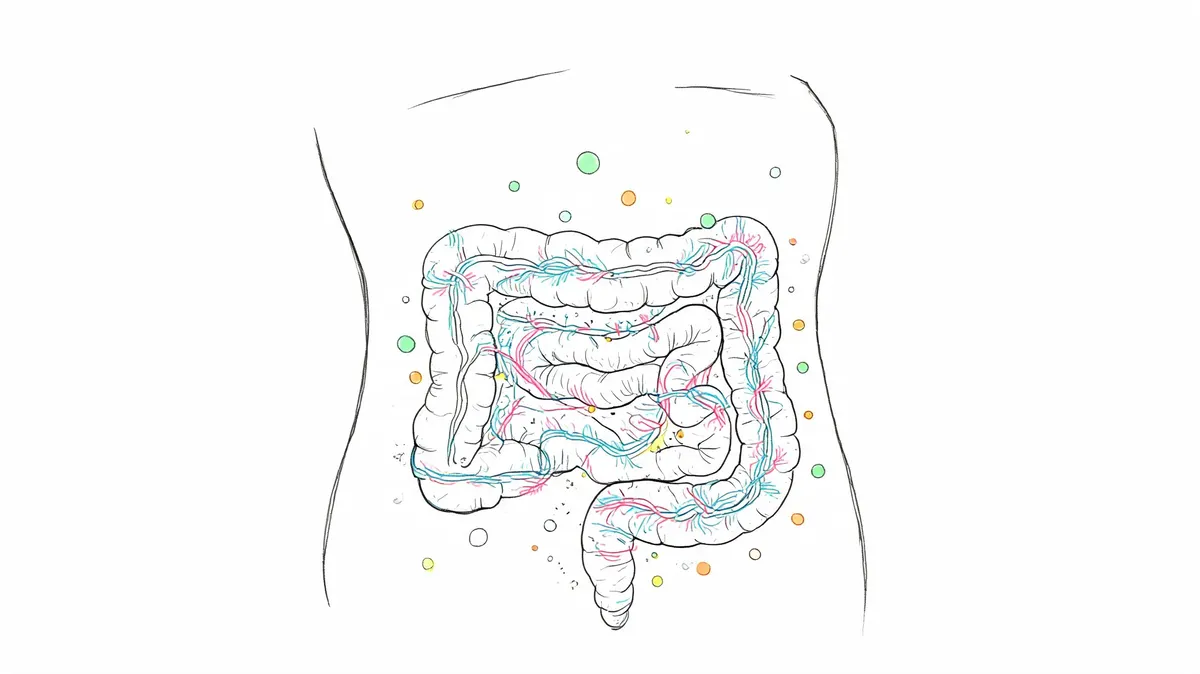
You wake up feeling mostly fine, eat a normal breakfast, and by mid-morning your stomach feels tight, puffy, or strangely unsettled. Not sick enough to cancel your day. Just uncomfortable enough to keep noticing it. A lot of people live in that gray zone for months, sometimes years, trying probiotics, fiber tweaks, or elimination diets without a clear answer.
That’s where interest in collagen peptides for gut health starts. Collagen is widely known as a supplement for skin, joints, or recovery. Fewer realize that collagen is also part of the body’s internal structure, including the tissues that help support the digestive tract. If your gut lining is like the wall of a house, collagen is part of the framing that helps hold everything together.
That doesn’t mean collagen is magic. It does mean the topic deserves a careful look, especially if you want a practical routine you can follow and track rather than another vague wellness promise.
Table of Contents
- The Growing Link Between Collagen and Digestive Wellness
- What Exactly Are Collagen Peptides
- How Collagen Peptides Support Gut Health
- Reviewing the Clinical Evidence on Collagen and Digestion
- How to Choose the Right Collagen for Your Gut
- Your Actionable Guide to Using Collagen Peptides
- Safety Side Effects and Realistic Expectations
The Growing Link Between Collagen and Digestive Wellness
A common pattern goes like this. Someone starts taking collagen for training recovery, skin, or general wellness. Then they notice something unexpected. Their stomach feels calmer. They feel less bloated after meals. Their bathroom routine becomes more predictable. That experience has pushed more people to ask whether collagen may support digestion in a more direct way.
Part of the reason this idea makes sense is structural. Your gut isn’t just a food tube. It’s a living barrier that has to do two jobs at once. It must let nutrients in while keeping unwanted material out. That barrier depends on proteins, connective tissue, and constant repair.
Collagen fits naturally into that conversation because it’s one of the body’s core structural proteins. The same broad idea that makes collagen useful for skin and connective tissue also makes it relevant to the digestive tract. It supplies amino acid building blocks that researchers think may help support the tissues involved in gut integrity and digestive comfort.
A lot of “gut issues” aren’t dramatic. They’re recurring low-grade problems that people normalize until something finally helps.
If you’re already working on food quality, sleep, hydration, and meal habits, collagen may be one useful addition rather than a standalone fix. For readers who want broader lifestyle support alongside supplementation, these tips for better gut health offer a helpful foundation.
What Exactly Are Collagen Peptides
Collagen is a protein, but not all collagen supplements behave the same way in the body. That’s where many people get confused. The term collagen peptides refers to collagen that has already been broken down into smaller pieces through hydrolysis.
Think of whole collagen like a thick rope. It has useful material in it, but it’s bulky. Collagen peptides are that same rope cut into many short lengths of string. Smaller pieces are easier to mix, easier to digest, and easier for the body to absorb.

Why the peptide form matters
If you’re buying collagen for digestive support, the hydrolyzed form matters more than marketing language about “premium” or “beauty blend.” The goal is practical absorption. Peptides dissolve well in water, coffee, tea, and shakes, and they’re made to be more usable than intact collagen.
That’s why product labels often say hydrolyzed collagen, collagen hydrolysate, or collagen peptides. In everyday terms, those labels are pointing to the same core idea. The protein has been pre-broken into smaller chains.
For a plain-language explanation of understanding collagen peptide absorption, that overview is useful if you want the supplement science without a lot of jargon. PepFlow also has a straightforward primer on what collagen peptides are if you want a quick definition before comparing products.
What collagen peptides are not
They aren’t fiber. They aren’t probiotics. They don’t work like digestive enzymes either.
That matters because people often expect collagen to act like a direct “gut symptom remover” the same way an enzyme blend or a laxative might. It doesn’t. A better analogy is raw material. If your gut lining needs maintenance, collagen peptides may help by supplying building blocks the body can use.
How Collagen Peptides Support Gut Health
Collagen’s role in digestion gets easier to understand when you separate it into a few mechanisms. Not all of them are proven equally well in humans, but together they explain why interest in collagen peptides for gut health has grown.
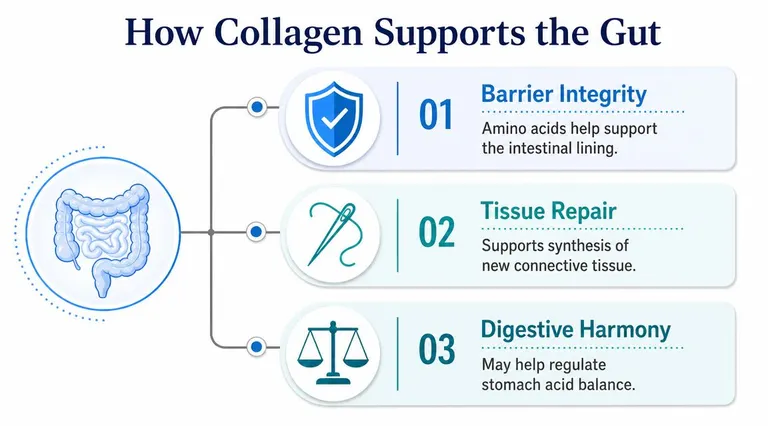
Gut barrier support
Your intestinal lining is selective by design. It’s supposed to allow digested nutrients through while acting as a boundary against larger unwanted substances. You can think of it as a finely screened border crossing, not an open doorway.
Collagen is rich in amino acids commonly discussed in gut support, including glycine and proline. Researchers also discuss glutamine when talking about gut lining maintenance. In practical terms, these amino acids help explain why collagen is often described as scaffolding for the gut lining. The body still has to do the repair work, but it needs material to work with.
Some laboratory findings have also suggested collagen hydrolysate may support proteins involved in barrier integrity and may help reduce inflammatory signaling in cell models. That’s useful mechanistic context, but it’s still different from proving structural healing in people.
The microbiome connection
The most interesting part of the current research may be the microbiome. Instead of assuming collagen works only by “patching” the gut lining, some researchers think part of the benefit may come from changing the microbial environment more quickly than tissue repair would.
A study on fish collagen-derived peptides found that collagen treatment changed the gut microbiota by reducing the Firmicutes/Bacteroidetes ratio, a marker linked with obesity risk. After 10 days, Bacteroidetes increased to 64% and Firmicutes decreased to 31%, compared with water-treated controls showing 38% Bacteroidetes and 54% Firmicutes. The shift was detectable within 3 days in that model, according to the published study on collagen peptides and gut microbiota.
That doesn’t mean you should treat one ratio as your personal report card. It does mean collagen may influence the gut ecosystem faster than people expect.
Practical rule: If you feel a change quickly, that doesn’t automatically mean placebo. It may reflect microbiome effects that occur sooner than tissue-level repair.
Tissue repair and inflammation support
There’s also a more traditional explanation. The digestive tract is always renewing itself. Cells turn over. Mucosal surfaces get challenged by food, stress, training load, and illness. In that setting, a steady source of collagen peptides may act like spare material for maintenance.
People interested in inflammation-related recovery may also want to read PepFlow’s guide to the best peptides for inflammation, which gives broader context on where collagen fits compared with other peptide-related compounds.
The key takeaway is simple. Collagen may support the gut through structure, microbiome effects, and general tissue support. That’s more nuanced, and more believable, than saying it “heals everything.”
Reviewing the Clinical Evidence on Collagen and Digestion
Mechanisms are helpful, but a crucial question for many is: Has this been tested in humans?
The strongest human signal in the material you provided comes from an 8-week clinical study on collagen peptide supplementation for digestive health. In that study, 93% of participants reported significant reductions in bloating and improvements in bowel habits, and participants consumed 20 grams daily. Many reported noticeable differences within the first few days, according to the clinical study on collagen and digestive symptoms.

What human data suggests
That study matters for two reasons.
First, it looked at symptoms people care about. Not just lab markers. Bloating, bowel habits, and digestive comfort are the outcomes that determine whether a supplement feels useful in daily life.
Second, the dose gives readers something practical. The protocol used 20 grams per day, which gives you a realistic reference point instead of leaving you guessing between a token scoop and a full serving.
There’s also supporting practitioner feedback in the same evidence set, with reports of positive outcomes involving bloating, stomach cramps, flatulence, acid reflux, and irregular bowel movements. That doesn’t carry the same weight as a large randomized trial, but it adds clinical context.
What the timeline means in real life
The timing is one of the most useful parts of the evidence. If someone notices less bloating quickly, that fits with the idea that symptom relief may happen before any meaningful structural repair.
That matters because many supplement users quit too early or expect the wrong kind of result. If you try collagen for a few days and feel nothing, that doesn’t prove it won’t help. If you feel better quickly, that doesn’t prove your gut lining has been rebuilt either.
A more grounded reading is this:
- Short-term: some people may notice symptom changes early
- Longer-term: steadier bowel habit changes may take more consistent use
- Best use case: tracking day-to-day symptoms rather than chasing dramatic claims
The evidence is promising for digestive comfort. It’s still emerging for bigger claims about deep gut repair.
How to Choose the Right Collagen for Your Gut
Once people decide to try collagen, they often get stuck in the supplement aisle. Marine, bovine, type I, type II, grass-fed, hydrolyzed. The labels make it sound more complicated than it needs to be.
For gut support, the main practical question is whether the product provides hydrolyzed collagen peptides from a source you’ll tolerate and use consistently. Type labels can help, but consistency matters more than obsessing over tiny product differences.
Types that matter most
For digestive support, people usually focus on Type I and Type III collagen because they’re commonly associated with connective tissues relevant to body structure. Type II is more often discussed in the context of cartilage and joint products.
Source matters mostly for preference and tolerance:
- Bovine collagen: commonly chosen because it’s widely available and often associated with Type I and III collagen
- Marine collagen: often preferred by people avoiding bovine products
- Chicken collagen: usually selected more for joint-focused formulas than gut-focused routines
If you want a broader supplement overview, this science-backed digestive wellbeing roadmap is useful for comparing collagen with other categories rather than treating it as the only option.
Collagen source and type comparison for gut health
| Source | Primary Collagen Types | Key Benefits for Gut | Considerations |
|---|---|---|---|
| Bovine | Type I and Type III | Common choice for general structural support and broad availability | Not suitable if you avoid bovine products |
| Marine | Primarily Type I | Useful alternative for people who prefer fish-derived collagen | Flavor, cost, and sourcing quality vary |
| Chicken | Often associated with Type II | Better known in joint-focused products than gut-focused routines | Usually not the first pick for digestive support |
A few buying filters matter more than the source debate:
- Choose hydrolyzed collagen peptides: This is the form commonly chosen for easy mixing and practical absorption.
- Check the ingredient list: Simpler is better. You don’t need a long list of flavor systems and fillers.
- Look for quality testing: Reputable brands commonly discuss purity and testing standards.
- Match the product to adherence: If you hate the taste or texture, you won’t take it long enough to learn anything.
Your Actionable Guide to Using Collagen Peptides
The hardest part of gut supplements usually isn’t starting. It’s using them long enough, and consistently enough, to judge whether they’re helping.

A simple protocol to start
A practical starting point is the dose used in the clinical material: 20 grams per day. In one clinical summary, 93% of participants taking 20g daily reported reduced bloating, with initial improvements felt within about 2 days, while more significant effects on bowel habits emerged after 6 to 8 weeks, according to the clinical summary on collagen timing and digestive response.
That gives you a simple protocol:
-
Start with 20 grams daily
Use the amount that aligns with the evidence provided, not a random “wellness scoop.” -
Pick one daily anchor
Put it in coffee, tea, water, a smoothie, or a post-workout shake. The best time is the time you’ll repeat. -
Consider splitting the dose
Some people prefer dividing it into two smaller servings across the day for comfort and adherence. -
Run the trial long enough
Give it a fair window. Quick symptom shifts can happen, but steadier digestive pattern changes may take longer.
What to track and when
Individuals often track the wrong things. They focus only on whether they feel “better” in a general sense, which is too vague to be useful. Track specific symptoms instead.
Use a simple daily log with these items:
- Bloating level: none, mild, moderate, strong
- Bowel regularity: more regular, less regular, unchanged
- Post-meal comfort: calm, gassy, cramped, heavy
- Consistency of use: yes or no
That kind of record helps you separate real patterns from guesswork.
Here’s a good point to add a short explainer on routine and consistency:
Don’t judge collagen on one day. Judge it on a repeated pattern across your chosen trial window.
A useful expectation framework looks like this:
- Early window: watch for changes in bloating or day-to-day digestive comfort
- Middle window: look for more stable bowel habit trends
- Longer window: decide whether the effect is strong enough to keep in your routine
If nothing changes after a fair trial, that’s still useful information. It means you tested it diligently.
Safety Side Effects and Realistic Expectations
Collagen peptides are generally viewed as a low-friction supplement, but “safe” doesn’t mean “limitless” or “guaranteed.” A smart approach is to treat collagen as one supportive tool inside a larger digestive strategy.
What collagen can do well
For many people, the most realistic use of collagen is support for digestive comfort, especially bloating and bowel regularity. It’s easy to mix, simple to dose, and usually easier to stick with than a complicated stack.
Quality still matters. Choose products from reputable brands that clearly explain sourcing and testing. If a product hides behind vague blend names or overloaded ingredient lists, skip it.
People can also react differently to powders, flavoring systems, or the serving size itself. If a full serving feels too heavy at first, using a smaller amount and building up can be a practical move.
Where people overstate the evidence
This is the part many wellness articles skip. Strong human evidence for collagen “healing leaky gut” is still limited.
Symptom changes, such as less bloating, would not by themselves show that collagen repaired the intestinal barrier. Given the limited human evidence, it is more accurate to describe collagen as possible support for digestive comfort than as a proven fix for gut permeability.
That doesn’t make collagen useless. It makes the conversation more honest.
If you’re exploring broader peptide-related risks and tolerability questions, PepFlow’s guide to side effects of peptides is a helpful companion read.
A balanced expectation looks like this:
- Reasonable expectation: less bloating, improved comfort, better routine tracking
- Unreasonable expectation: assuming collagen alone will diagnose, cure, or reverse a complex gut condition
- Best mindset: test, log, review, then decide
If you want an easier way to stay consistent with any structured wellness protocol, PepFlow helps you organize schedules, reminders, and logs so you can track what you’re taking and when. That kind of consistency matters when you’re trying to figure out whether a supplement like collagen is helping your routine or just taking up space on the counter.