
You’re probably seeing the same pattern everywhere. One clinic talks about peptides for weight loss. A skincare brand talks about peptides for wrinkles. A wellness account bundles together recovery, hormones, libido, gut health, and “anti-aging” as if they all belong to one clean category.
That’s where most women get stuck.
A woman in her late 30s with rising central weight, sleep disruption, and early perimenopause questions does not need the same conversation as a postmenopausal woman focused on skin quality and joint comfort. Someone looking at a collagen powder also isn’t evaluating the same kind of product as someone being offered an injectable peptide through a telehealth clinic.
The useful question isn’t “Are peptides good for women?” It’s which peptide category matches your goal, your life stage, and your risk tolerance. That’s the filter missing from most online advice, and it’s the only way to make sense of peptides for women without getting pulled into hype.
Table of Contents
- Navigating the Buzz Around Peptides for Women
- Understanding Peptides A Simple Explainer
- Key Peptide Categories Relevant to Women
- A Closer Look at Popular Peptides and Their Evidence
- Why Life Stage and Hormones Matter for Women
- The Critical Guide to Safety Sourcing and Legality
- Planning and Tracking Your Protocol for Success
Navigating the Buzz Around Peptides for Women
A common real-world scenario looks like this. You search for peptides for women because you’re tired, your body composition has changed, your skin feels different, and your recovery isn’t what it used to be. Within minutes, you’re looking at collagen powders, GLP-1 medications, libido injections, growth hormone secretagogues, and cosmetic serums that all use the same word, peptides, as if they belong in one bucket.
They don’t.

That confusion is built into the way the topic gets marketed. Most content on peptides for women fails to differentiate protocols by life stage or phenotype, mixing goals like fat loss, recovery, and cognition without clear decision rules. A better approach asks which outcomes have the strongest human evidence by age and what remains speculative, as noted in this overview of women’s peptide use.
The real problem is category confusion
The phrase “peptides for women” sounds specific, but it is broad. It can refer to:
- Prescription metabolic drugs such as GLP-1 receptor agonists
- Dietary supplements such as collagen peptides
- Topical cosmetic ingredients aimed at skin signaling
- Compounded or investigational injectables discussed in recovery and longevity spaces
Those are not interchangeable. They don’t share the same level of evidence, the same delivery method, or the same safety profile.
Practical rule: Don’t evaluate peptides as one trend. Evaluate them as separate product classes with different goals.
A smarter starting point is simple. Match the conversation to the reason you’re interested in them in the first place. If your priority is abdominal weight gain in perimenopause, you need metabolic evidence. If your priority is skin texture, you need topical formulation logic. If your priority is joint support and healthy aging, oral collagen peptides may deserve more attention than injectable wellness products.
That shift alone makes the topic much easier to understand.
Understanding Peptides A Simple Explainer
At the simplest level, peptides are short chains of amino acids. They work as signaling molecules. The easiest way to think about them is as small keys that fit specific biological locks. When the key fits, a cell gets a message to do something, such as regulate appetite, support collagen pathways, or influence a repair process.
That’s why one peptide can have a very narrow use and another can sit inside a skin cream. The term tells you something about structure, not whether the product is automatically effective.
Peptides are not all the same thing
Women often hear peptides discussed alongside hormones, proteins, and supplements as if those words are interchangeable. They’re not.
A few distinctions help:
- Peptides vs proteins. Peptides are shorter chains. Proteins are larger and more structurally complex.
- Peptides vs hormones. Some hormones are peptides, but not all peptides are hormones.
- Peptides vs skincare ingredients. A topical peptide serum aims for local skin effects. It is not trying to act like a systemic injectable.
If you’ve ever wondered why skincare companies describe peptides as targeted signals, that framing is useful. In cosmetic formulations, peptides are often presented as intelligent skincare messengers, which is a consumer-friendly way to describe cell-signaling behavior in the skin.
Why this matters before you buy anything
Understanding the mechanism keeps you from expecting the wrong outcome from the wrong product.
A collagen powder is not a shortcut to the effects of a prescription metabolic peptide. A peptide serum is not a hormone treatment. A compounded injectable marketed for “anti-aging” should not be assumed to have the same evidence base as a regulated medication.
For a broader foundation, this plain-language guide on what peptides are is useful if you want the terminology cleaned up before comparing options.
The word “peptide” sounds precise. In practice, it covers products that differ radically in evidence, route, and clinical purpose.
That’s why women do better when they stop asking whether peptides work in general and start asking which peptide, for which outcome, delivered how.
Key Peptide Categories Relevant to Women
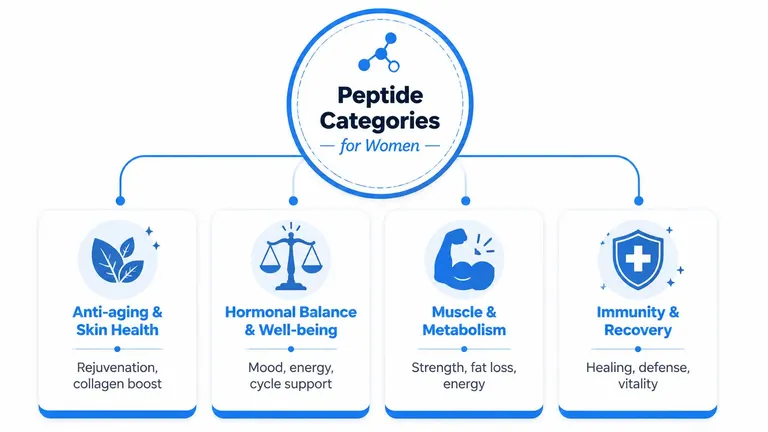
The cleanest way to understand peptides for women is to sort them by goal, not by internet popularity. When women come into this topic, the usual priorities are metabolic health, skin aging, sexual health, and general recovery. Those goals sit in different peptide categories, and mixing them creates bad decisions.
Think in categories not in brand names
One of the most important distinctions is route dependence. Peptide efficacy changes based on how the product is delivered. Cleveland Clinic notes that topical cosmetic peptides may help boost collagen and elastin production, while these products are designed for local dermal signaling rather than systemic endocrine effects, as explained in their review of peptides for skin.
That means a woman choosing peptides should separate topical cosmetic peptides from injectable metabolic peptides. The mechanism, dosing strategy, and expected outcomes are entirely different.
Here’s the practical map.
Overview of peptide categories for women’s health
| Category | Primary Goal | Common Examples | Administration |
|---|---|---|---|
| Metabolic health | Appetite control, weight management, insulin sensitivity | Semaglutide, tirzepatide | Injectable prescription use |
| Skin and cosmetic support | Texture, elasticity, visible aging concerns | Palmitoyl tripeptide-1 and other cosmetic peptides | Topical skincare |
| Structural support | Joint comfort, skin support, connective tissue support | Collagen peptides | Oral powder, capsule, beverage mix |
| Sexual health | Specific libido-related indication in a narrow population | Bremelanotide (PT-141, Vyleesi) | Prescription injectable |
A few trade-offs matter here:
- Metabolic peptides are the most clinically grounded choice when the goal is fat loss or improved metabolic control.
- Topical peptides make sense when your target is the skin itself, not whole-body hormone effects.
- Collagen peptides sit in the supplement lane. They’re better judged by steady long-term use than by “cycles.”
- Sexual-health peptides have a narrow approved use and should not be casually expanded into a general menopause claim.
If a product promises help with skin, libido, weight, energy, recovery, and hormone balance all at once, treat that as a marketing bundle, not a clinical category.
Women usually get better results when they choose the category that matches the actual complaint in front of them. If the complaint is central weight gain and insulin resistance tendencies, start with metabolic evidence. If the complaint is skin texture and firmness, start with topical peptide logic. If the complaint is joint comfort and aging connective tissue, oral collagen has a more practical role than many trend-driven injectables.
A Closer Look at Popular Peptides and Their Evidence
The discussion needs more honesty at this point. Some peptide categories have meaningful human evidence. Others are still mostly discussed through clinic marketing, online anecdotes, or extrapolation from mechanism.
GLP-1 peptides for metabolic health
For women dealing with weight gain, especially around perimenopause, GLP-1 receptor agonists are the most evidence-based peptide category in routine practice. Midi Health notes that semaglutide and tirzepatide are the only peptides consistently shown to support meaningful fat loss, with large trials often showing roughly 10 to 20 percent body-weight reduction when paired with lifestyle changes in their review of peptides for weight loss.
That matters because this category has a clear therapeutic target. These drugs reduce appetite, slow gastric emptying, and improve glycemic control. Those mechanisms line up with problems many women report during midlife, especially increased central adiposity and worsening insulin resistance.
The trade-off is that these are not casual wellness add-ons. They belong in a medical framework that includes screening, side-effect monitoring, and contraindication review.
Collagen peptides for skin joints and daily function
If the goal is skin support, joint comfort, or connective-tissue support, collagen peptides are one of the most grounded nonprescription options. A 2025 NIH/PMC review of collagen peptides reported that daily supplementation with 10 to 20 g for 6 to 9 months produced measurable benefits in pain management, mental and physical wellness, and activities of daily living. The same review noted that the physical component score in females improved significantly at 20 g/day (p = 0.013).
That tells you two useful things.
First, collagen peptides are not a quick-fix category. The better-supported use pattern is daily, long-term intake. Second, this is a supplement category, not an injectable hormone-like therapy, so the expectations should be different.
For women in perimenopause and beyond, collagen can make sense when the concern is gradual decline in skin quality, joint tolerance, or physical function rather than dramatic body-composition change.
Where evidence gets thinner
This is the lane where women need the most restraint.
Peptides discussed for recovery, “anti-aging,” or growth hormone support often sound compelling online, especially names such as BPC-157, GHK-Cu, ipamorelin, or broader growth hormone secretagogue protocols. Some are popular in wellness and performance circles. Some have plausible mechanisms. But the evidence base is not uniform, and it is not smart to treat the whole category as established care.
The most grounded way to think about these products is:
- Topical cosmetic peptides may be reasonable when the goal is local skin support.
- Compounded or investigational injectables require much more caution because evidence, regulation, and sourcing can vary sharply.
- “Anti-aging” bundles often overpromise by combining real biology with weak protocol standardization.
If you want a broader comparison of cosmetic and age-related peptide options, this guide to peptides used in anti-aging discussions is a useful companion, especially for separating topical skincare logic from systemic protocols.
A peptide can be interesting long before it is well validated. Women should not mistake mechanistic plausibility for reliable clinical evidence.
That’s the central sorting rule. Right now, the best-supported conversations in women’s peptide use sit with GLP-1s for metabolic outcomes and collagen peptides for long-term structural support. Everything else needs more careful scrutiny.
Why Life Stage and Hormones Matter for Women
A peptide protocol that looks reasonable on paper can still be a poor fit if it ignores life stage. That’s one of the biggest misses in peptide advice aimed at women.

A woman in her reproductive years may be evaluating peptides around skin, training recovery, body composition, or sexual health. In perimenopause, the pattern often shifts toward sleep disruption, central fat gain, less predictable energy, and changing musculoskeletal resilience. Postmenopause, skin thinning, metabolic drift, and connective-tissue concerns often become more prominent.
The same peptide can land differently at different stages
That’s why one-size-fits-all protocols usually underperform.
For example, a woman in perimenopause looking at metabolic peptides may have a very different risk-benefit calculation than a woman in her early 30s who is primarily interested in aesthetic outcomes. The first question is not “What’s trending?” It’s “What problem are we solving in this hormonal context?”
A good overview of the broader hormone conversation is this naturopathic guide for women, especially if you’re trying to understand how symptoms can overlap rather than assuming everything is a peptide issue.
Here’s a useful way to think about matching life stage to peptide type:
-
Reproductive years
Keep the target narrow. Skin concerns belong in topical skincare. A libido concern deserves a separate conversation from body-composition goals. -
Perimenopause
Prioritize metabolic clarity. This is often where women benefit most from distinguishing evidence-backed weight-management approaches from vague anti-aging protocols. -
Postmenopause
Focus on realistic outcomes. Structural support, skin quality, and long-term function may matter more than chasing broad rejuvenation claims.
A short visual explainer can help frame how women’s physiology changes across stages:
Questions worth asking before you start
Before any peptide conversation gets practical, these questions matter:
-
What is my actual goal
Weight change, skin texture, libido, joint comfort, and recovery are not interchangeable. -
What is my current life stage
Cycling, perimenopause, and postmenopause create different symptom patterns and different priorities. -
Am I trying to solve a hormone problem with the wrong tool
Sometimes a woman is really asking about estrogen status, sleep, thyroid function, or insulin resistance rather than needing a peptide.
The best peptide choice for women is often the one that fits the stage you’re in, not the one with the strongest social media momentum.
The Critical Guide to Safety Sourcing and Legality
A lot of peptide advice gets too casual in this area.
Most women don’t run into trouble because they picked the wrong buzzword. They run into trouble because they underestimate the gap between approved medication, supplement, cosmetic ingredient, and unregulated injectable.
What is actually approved and what is not
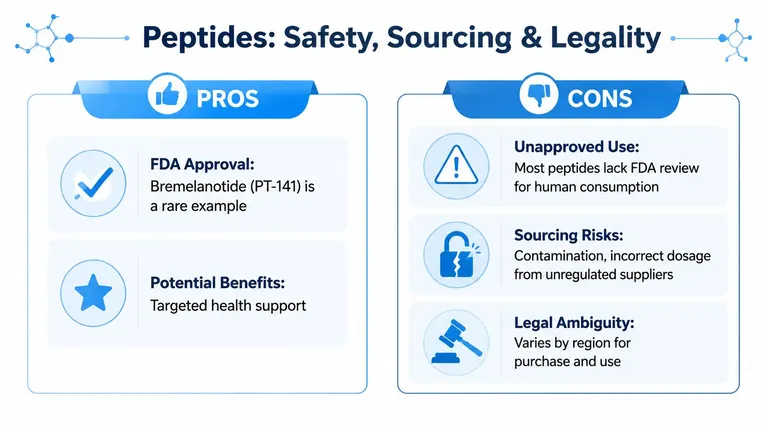
There is one especially important milestone in women’s peptide care. Bremelanotide (PT-141, Vyleesi) became the first FDA-approved peptide-based treatment for hypoactive sexual desire disorder in premenopausal women in June 2019, after clinical trials showed improved sexual desire and related distress. As of 2026, no peptide is FDA-approved specifically for menopause symptom management, according to this review of peptides for menopause.
That distinction matters. It shows that peptide pharmacology has reached mainstream regulatory acceptance in one narrow women’s-health indication, but it does not validate the broader peptide market for menopause, wellness, or anti-aging.
Where women make preventable mistakes
The biggest mistakes are practical.
-
Buying from weak sources
If the supplier, compounding process, or chain of custody is unclear, contamination and concentration errors become real concerns. -
Treating all peptides like they have the same oversight
A collagen supplement, a prescription GLP-1, and a gray-market injectable should never be treated as equivalent products. -
Ignoring dosing precision
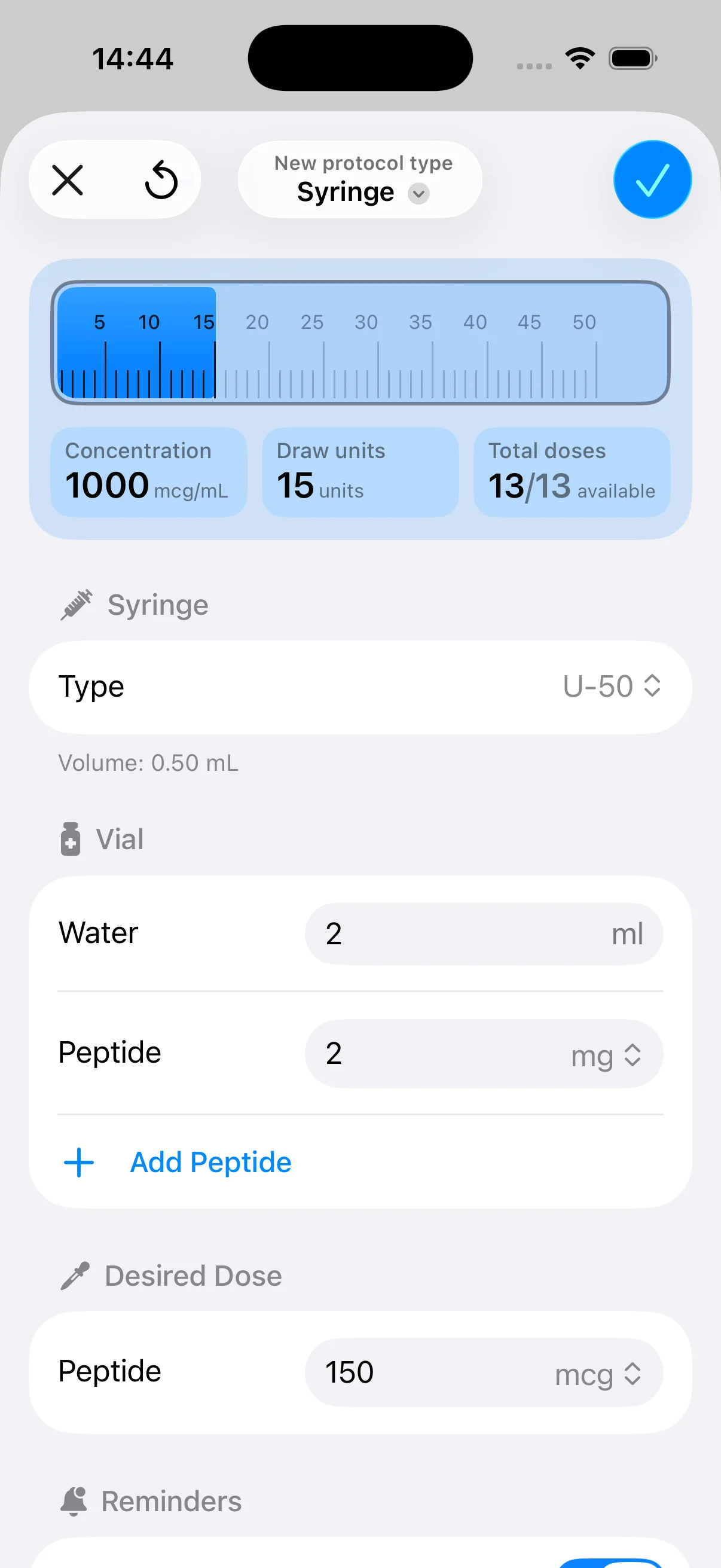
The practical challenge with many peptide protocols is not just deciding to use them. It’s measuring and delivering microgram-level doses accurately and consistently. -
Starting without a monitoring plan
If a peptide can materially affect appetite, metabolism, or other clinical outcomes, it also deserves follow-up.
For readers who want to understand why sourcing and verification matter so much, this explainer on peptide purity testing is worth reading before purchasing anything.
Safety problems often begin before the first dose. They begin at sourcing, labeling, reconstitution, and measurement.
Women should be especially cautious when a seller leans heavily on words like “research,” “wellness,” or “anti-aging” while staying vague on formulation, legality, and medical oversight. If the product category is potent enough to change physiology, casual handling is not acceptable.
Planning and Tracking Your Protocol for Success
A woman starts a peptide protocol in perimenopause hoping for steadier appetite, better training recovery, or fewer skin changes. Three weeks later, she is unsure what is helping, what is a side effect, and whether the last dose adjustment was smart or impulsive. That usually comes down to poor tracking, not poor intentions.
A useful protocol starts with one outcome that fits your life stage and current goal. For a woman focused on metabolic health, that may be appetite, waist measurement, energy, or GI tolerance. For skin aging, it may be changes in texture, healing time, or how the skin responds over a full cycle. For recovery or body composition, it may be training performance, soreness, sleep quality, and whether the protocol is sustainable.
Keep the plan simple enough to evaluate.
Write down the exact product, concentration, dose, timing, and start date. If your protocol changes around your menstrual cycle, perimenopause symptoms, or a new strength block, log that too. Those details matter because hormones, sleep, stress, and food intake can all change how a peptide feels in everyday life.
Use a short review window with your clinician instead of making frequent casual adjustments. Weekly self-checks and a defined reassessment point often work better than changing the plan every time you have a good or bad day. The goal is to identify patterns, not react to noise.
A practical checklist:
- Choose one primary goal
- Record the exact product, concentration, and dose
- Log timing, missed doses, and any dose changes
- Track benefits, side effects, sleep, appetite, and cycle-related changes
- Set a review date before changing the protocol
Women often do best with fewer variables at once. If you start a peptide, change your training plan, cut calories hard, and add new supplements in the same week, you lose the ability to tell what is driving the result.
Consistency gives you information you can use with a qualified clinician. Poor records leave you guessing.