You’re holding a printout, a portal screenshot, or a breath device slip, and the number on it looks official but not obvious. It says BAC, maybe with a percent sign, maybe with g/L, maybe with mg/dL, and your first question is simple: what does this mean in practical terms?
That confusion is common because BAC is a concentration, not a count of drinks. It tells you how much ethanol is present in a given amount of blood, and the same underlying reading can be written in different unit systems depending on the country, the lab, or the device.
Table of Contents
- Why BAC Units Confuse Most People
- The Common Units Used to Report BAC
- Converting Between BAC Units With Worked Examples
- Legal Limits and How the Units Change Them
- How BAC Is Measured and Why the Unit Matters
- Why a Single BAC Number Is a Poor Guide to Impairment
- Putting It Together With a Practical BAC Checklist
Why BAC Units Confuse Most People
A person can look at a hospital note, a police report, or a lab result and see a number that feels precise but still leaves them guessing. One slip might say 0.08%, another might say 0.8 g/L, and a third might show 80 mg/dL. Those can describe the same alcohol concentration, but only if you know which unit system the writer used.
BAC is a concentration, not a drink count
BAC means blood alcohol content or blood alcohol concentration. In plain language, it describes how much alcohol is dissolved in blood. It is not a tally of beer, wine, or cocktails, because drink size, strength, and timing all change the result.
Sugar in tea provides a useful comparison. A spoonful in a small cup tastes much stronger than the same spoonful in a large pot, because concentration depends on the amount of liquid around the substance. BAC works the same way, except the substance is ethanol and the liquid is blood.
That’s why a person can’t safely compare readings unless the unit is clear. A number by itself is incomplete. If you don’t know whether the report is using percent, grams per liter, or milligrams per deciliter, you can misread the actual level.
Practical rule: before you compare any two BAC readings, identify the unit first, not the number.
The rest of the guide is built on that idea. Once you can recognize the unit, the conversions become straightforward. Once you can convert, legal limits and lab results start making sense across countries and devices.
The Common Units Used to Report BAC
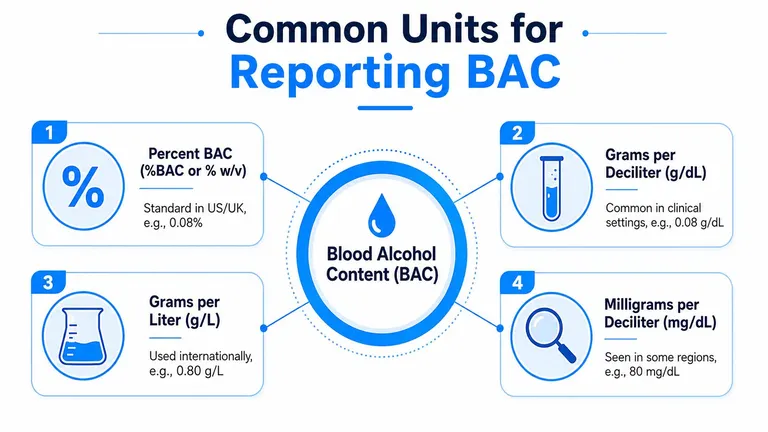
BAC gets reported in several unit systems, and each one looks different even when it points to the same concentration. That’s where readers get tripped up. The value may not be changing much at all, only the way it’s written.
Percent BAC and related forms
Percent BAC is often written as %BAC or % w/v. The percent sign tells you the reading is being expressed as a fraction of blood volume. In the U.S. context, people commonly talk about 0.08% BAC, which is the style many readers recognize first.
A useful mental picture is a drop of dye in a glass of water. The glass looks tinted because the dye is mixed through the whole volume, not sitting as a separate layer. BAC percent works that way, except the measure is mass of ethanol per blood volume.
Grams per deciliter and grams per liter
g/dL means grams per deciliter, and a deciliter is one-tenth of a liter. If liters feel abstract, think of a deciliter as a small measuring cup. This unit appears often in clinical-style reporting because it fits neatly with blood concentration language.
g/L means grams per liter, and it is common in international reporting. The same concentration can be written in grams per liter instead of percent, which is why a value that looks larger on paper is not necessarily a stronger result in reality.
The unit matters more than the raw digits. 0.08 g/dL is not the same as 0.08 g/L, because the volume base is different.
Milligrams per deciliter, milligrams per 100 milliliters, and milligrams per milliliter
mg/dL and mg/100 mL are closely related ways of expressing the same blood concentration style. They often show up in clinical labs because smaller mass units are easier to print when the quantity is tiny relative to the volume of blood.
mg/mL is a much denser-looking unit, because the denominator is only a milliliter. If you see it in a report, stop and check carefully. It can look familiar but mean something different from a deciliter-based value.
Promille and where it appears
Promille, written as ‰, means per thousand. It is common in parts of Europe and can be easier to compare with g/L because the scale is similar in spirit. Readers often confuse 0.5 written as promille with 0.5%, but those are not the same thing.
Quick check: if the number has a percent sign, a slash, or the per-mille symbol, read the symbol before you read the digits.
For a broader unit-conversion mindset, a lot of readers use the same careful approach they’d use in dosage math, such as in PepFlow’s conversion guide. The habit is the same, identify the unit first, then do the math.
Converting Between BAC Units With Worked Examples
BAC conversions become manageable once you treat them as label changes, not science mysteries. The trick is to keep the concentration itself in view while translating the unit around it. That’s why a single worked example helps more than memorizing a pile of isolated equivalences.
The core conversion relationships
Here is the clean way to think about the common forms:
- Percent BAC to g/dL: the number is treated as grams per 100 mL of blood.
- g/dL to g/L: multiply by 10 because a liter contains 10 deciliters.
- g/L to mg/dL: the numeric value changes because grams become milligrams and liters become deciliters.
- mg/100 mL to mg/dL: those are equivalent ways of naming the same volume basis.
- mg/mL: convert carefully, because the denominator is much smaller than in deciliter-based units.
- Promille: per-thousand style, often aligned with g/L in everyday comparison.
The most important thing is not to mix the volume base. If the denominator changes, the number changes with it.
| Unit | Symbol | Equivalent Form | Example Value |
|---|---|---|---|
| Percent BAC | %BAC | grams per 100 mL | 0.08% |
| Grams per deciliter | g/dL | grams per 100 mL | 0.08 g/dL |
| Grams per liter | g/L | grams per 1000 mL | 0.8 g/L |
| Milligrams per deciliter | mg/dL | milligrams per 100 mL | 80 mg/dL |
| Milligrams per 100 milliliters | mg/100 mL | milligrams per 100 mL | 80 mg/100 mL |
| Milligrams per milliliter | mg/mL | milligrams per 1 mL | 0.8 mg/mL |
| Promille | ‰ | per thousand | 0.8‰ |
A full conversion from 0.08% BAC
Start with 0.08% BAC. In percent form, that means 0.08 grams of alcohol per 100 mL of blood, which is the same as 0.08 g/dL.
Now convert to grams per liter. Since 1 liter = 10 deciliters, multiply 0.08 g/dL by 10. That gives 0.8 g/L.
Next convert grams to milligrams. 0.8 g/L becomes 800 mg/L. Since 1 liter = 10 dL, that is 80 mg/dL. The same value can also be written as 80 mg/100 mL, because 100 mL = 1 dL.
For mg/mL, divide 80 mg/dL by 100, because 1 dL = 100 mL. That gives 0.8 mg/mL.
For promille, the comparison is easy to remember. 0.08% BAC equals 0.8‰. That’s because percent is per hundred and promille is per thousand.
The sanity check matters. 0.08% should not magically become a number that looks ten times larger or smaller without a unit change explaining it. If the digits jump in a way that doesn’t fit the scale, the conversion is wrong.
A simple memory rule
If the volume base gets ten times smaller, the number gets ten times larger.
That rule keeps you from mixing up deciliters, liters, and milliliters when the same blood concentration is written in different formats.
Legal Limits and How the Units Change Them
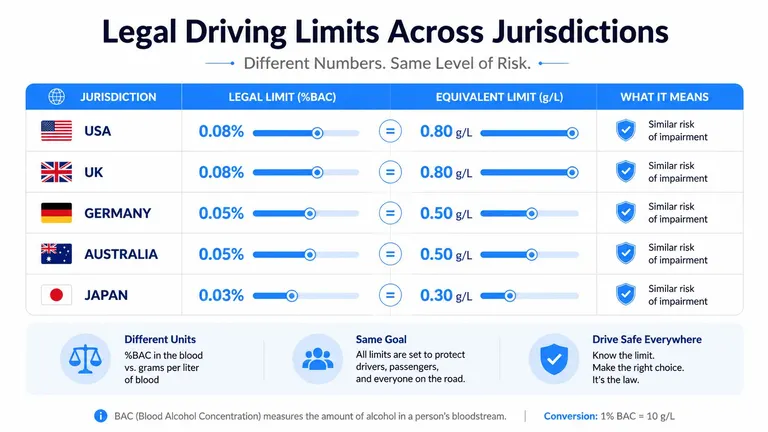
Legal BAC limits look simple until they’re written in different unit systems. Then people compare numbers that aren’t on the same scale. A reading that seems low in one format can sit exactly at a legal threshold in another.
Same risk, different writing
A common U.S. limit is written as 0.08% BAC, while many European rules are often expressed as 0.5 g/L or 0.05% depending on the jurisdiction. The number looks different because the unit is different. That alone can cause readers to think one country is stricter or looser when they’re only seeing a different scale.
The same trap shows up with lower-threshold and zero-tolerance regimes. A person who sees 0.02 in one source may assume it means the same thing everywhere, but context decides whether that number is percent, promille, or a device output in a different format.
Why direct comparison can fail
A device that prints g/L cannot be compared directly with a report printed in %BAC unless you convert first. If you don’t, you can misjudge whether a result is above or below the limit. That mistake matters in both court settings and everyday driving advice.
If you want a jurisdiction-specific legal overview for Florida, Florida’s legal BAC limit is a useful reference point. The key is not the state name itself, but the habit of checking which unit the rule uses before treating the number as familiar.
A reading of 0.5 is especially easy to misread. In one context it may sit comfortably inside a per mille framework, while in another it could be interpreted as a percent-style figure, which would be far more serious. The digits are identical, the legal meaning is not.
Courtroom lesson: the number doesn’t speak for itself. The unit, jurisdiction, and measurement method all have to line up before the result is meaningful.
How BAC Is Measured and Why the Unit Matters
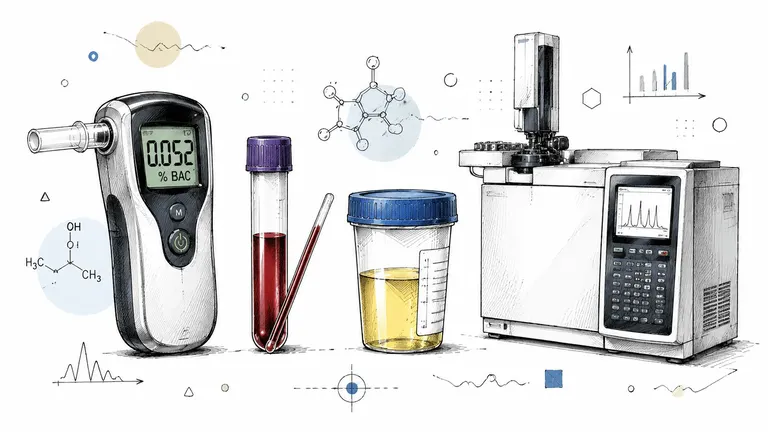
The unit on a BAC report comes from the measurement pipeline, not from the alcohol itself. Breath devices estimate a blood value from breath alcohol, blood tests measure directly from a sample, and other tests use their own reporting conventions. Each path creates a slightly different place where the number can shift.
Breath, blood, urine, and surface estimates
Breathalyzers use sensor technology to estimate alcohol in breath and then translate that into an implied blood reading. Blood tests measure a drawn sample and are usually treated as the most direct route to a concentration result. Urine tests and transdermal or saliva estimates can also appear, but their numbers don’t always map cleanly onto a blood-based interpretation.
That conversion step is where units become more than formatting. If a breath device uses the wrong assumption or a report is read without checking the method, the number can be misunderstood even if the math on the page looks tidy.
Why the conversion step can drift
In breath testing, the reported BAC depends on the way breath alcohol is translated into blood alcohol concentration. That means the device isn’t “reading blood,” it’s estimating it. Small differences in sampling conditions can change the result that gets printed, which is one reason the output unit must be read together with the method.
For courtroom-level language on breath testing procedure, Georgia breathalyzer test information is a practical companion source. It helps reinforce the idea that a printed number is the end of a process, not the beginning of one.
If you’re already used to checking dose math in other contexts, the same caution applies here, and How to Read Insulin Syringes shows why reading a scale carefully matters in any measurement task. Different tools print different units, and a wrong assumption at the scale level can break the whole interpretation.
A printed BAC number can look exact even when it came from an estimate. That’s why the method, the unit, and the report format all need to be checked together.
Why a Single BAC Number Is a Poor Guide to Impairment
Two people can share the same BAC reading and look very different in real life. One may seem unsteady, while the other feels only slightly off. The number is real, but it doesn’t tell the whole story of how alcohol is affecting the person.
The same reading can mean different things
BAC is influenced by body weight, sex, drinking pace, food in the stomach, tolerance, fatigue, medications, and time since the last drink. Those factors change how alcohol is absorbed, distributed, and experienced. That means the same reading can land very differently from one person to the next.
A driver at 0.08% BAC is not automatically in the same functional condition as another person with the same number. One may have just finished drinking, while another may be several hours past the last drink and metabolizing alcohol downward. The reading is a snapshot, not a full performance test.
Impairment is context-dependent
A legal limit is not a perfect safety line. It is a policy threshold. Real-world impairment can show up below that line, especially when fatigue, medication, or rapid drinking are involved. That’s why a single number should never be treated like a complete description of someone’s ability to think, react, or drive.
A BAC reading tells you concentration, not competence.
This is also why witnesses and attorneys often argue about surrounding facts, not just the number. Timing matters. Food matters. The person’s usual drinking pattern matters. The printed result is only one part of the story, and sometimes not the most informative one.
Putting It Together With a Practical BAC Checklist
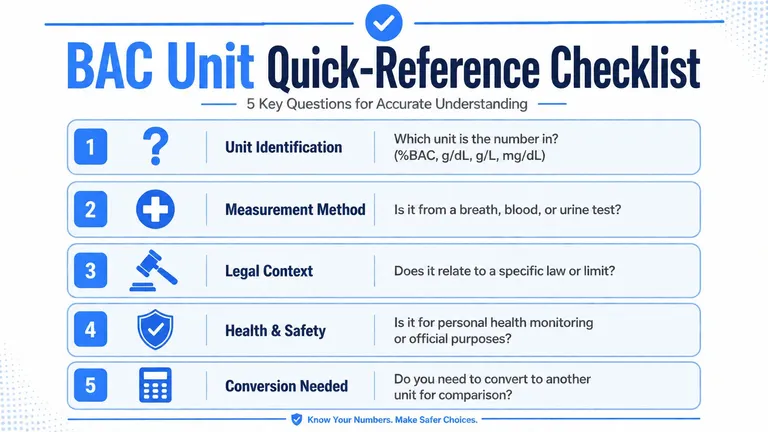
When you see a BAC figure, slow down and run five questions in order. First, which unit is it in. Second, is it from breath, blood, or urine. Third, what legal context applies. Fourth, is this for health monitoring or an official record. Fifth, do you need to convert it before comparing it with another result.
If you get stuck, compare the reading against the unit first, not your memory of the number. A lab report, a roadside device, and a court exhibit can all describe the same alcohol concentration in different ways. That’s normal, not suspicious.
A quick refresher on the comparison problem also helps in other measurement systems, and PepFlow’s peptide calculator app is a good example of why correct unit handling matters before any result is trusted. The same habit applies here, identify the scale, verify the method, then interpret the value.
PepFlow helps people work through unit-sensitive calculations by turning a target amount into practical syringe draw units and concentration summaries. If you want a reminder of how careful unit handling prevents avoidable mistakes, visit PepFlow and use that same precision mindset anytime you read a BAC number.