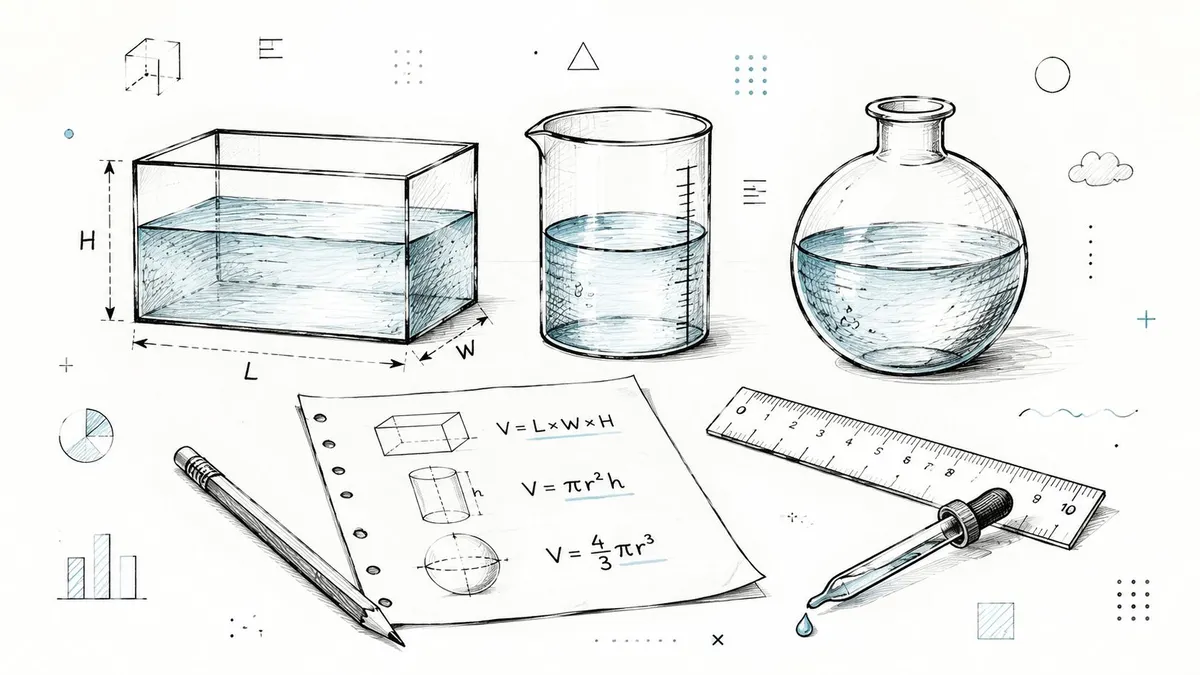
You’re probably here because you need a number you can trust, not a fuzzy estimate. Maybe you’re filling an aquarium, checking how much water a storage container holds, mixing a lab solution, or trying to reconstitute a peptide vial without guessing. In all of those cases, the same question shows up fast: how much water volume is in this container, or should be added to it?
That sounds simple until the units start changing, the container isn’t a perfect box, or the result has to connect to a real task like dosing. A rough guess might be fine for watering plants. It’s not fine when concentration matters. In chemistry-style work, small measurement errors can ripple into the final mixture, and that’s exactly why learning how to calculate water volume is more than basic geometry.
Table of Contents
- Why Calculating Volume Accurately Matters
- Core Formulas for Common Container Shapes
- Mastering Unit Conversions for Volume
- Worked Example Reconstituting a Peptide Vial
- Practical Tips for Accurate Measurements
- Frequently Asked Questions About Volume Calculation
Why Calculating Volume Accurately Matters
A student in a lab can get away with being slightly off on a rinse beaker. They can’t be casual when preparing a solution that depends on concentration. The same is true at home. If you’re filling a tank, a cooler, or a hydration system, the difference between “looks about right” and “measured correctly” changes the outcome.
For outdoor planning, that can mean carrying too little water. For longer trips, practical resources on essential water storage for adventurers help translate capacity into real packing choices. The math matters because your container has limits, and your plan depends on knowing them.
In supplement and peptide contexts, volume matters for another reason. Volume determines concentration. If you add more or less diluent than intended, the liquid may still look fine, but the amount per draw changes. That’s where people often get tripped up. They focus on the amount of material in the vial and forget that the final concentration depends on the water added.
Practical rule: If the task depends on concentration, volume isn’t just a container question. It’s part of the dose calculation.
Accuracy also helps you catch impossible setups before you start. If a container’s internal volume is smaller than what you plan to add, the math warns you immediately. If your calculated volume seems too large for the vessel in front of you, that’s a sign to recheck dimensions, units, or both.
A lot of confusion comes from mixing two separate ideas:
- Container capacity: How much liquid the vessel can physically hold.
- Working volume: How much liquid you intend to have inside it.
- Target concentration: How much substance you want per unit volume after mixing.
Those aren’t interchangeable. Once you separate them, the rest becomes much easier.
Core Formulas for Common Container Shapes
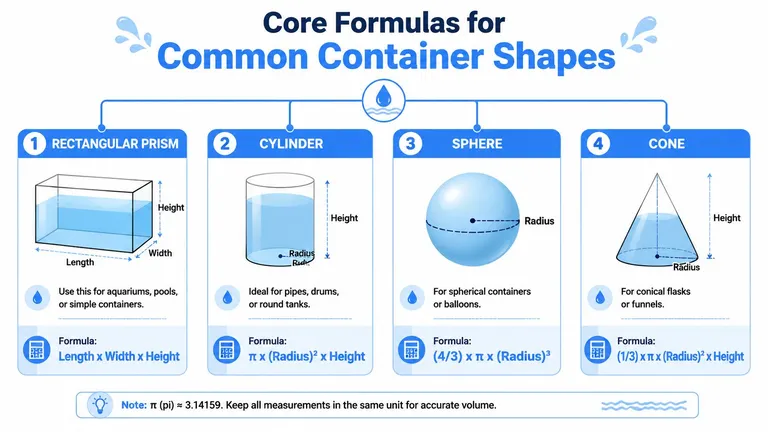
Most water volume problems begin with one question: what shape is the container closest to? You don’t need perfect geometry in every situation, but you do need a reasonable model. A fish tank is usually treated as a rectangular prism. A barrel or vial is often modeled as a cylinder. Some specialty vessels are closer to spheres.
If you’re sizing an aquarium or comparing setups, it also helps to understand ideal tank dimensions before you calculate capacity. Shape changes more than appearance. It changes volume, footprint, and usable water depth.
Rectangular Tanks
This is the easiest and most common case.
For a rectangular container:
Volume = Length × Width × Depth
Use the internal dimensions of the container, not the outside measurements. If your answer is in cubic feet, a standard water-operations method is to convert to gallons by multiplying by about 7.47 to 7.48 gallons per cubic foot. The U.S. Forest Service operator guide states that gallon capacity is volume multiplied by 7.48 gallons per cubic foot in rectangular tanks and similar systems, which is why this method shows up across tanks, pools, and utility calculators (U.S. Forest Service water math guide).
Example setup:
- Length: inside distance from one end to the other
- Width: inside side-to-side distance
- Depth: actual water depth if partially filled, or full inside height if filled completely
If a tank is full, multiply all three dimensions. If it’s only part full, use the current water depth, not the tank’s total height.
A rectangular pool or tank doesn’t care what you call it. If the shape is box-like, the math is still length times width times depth.
Cylindrical Containers
Use a cylinder formula for drums, vertical round tanks, many bottles, and most vials.
Volume = π × r² × h
Where:
- r is the radius
- h is the height of the liquid or container interior
- π is the circle constant used in round-shape calculations
A common mistake is using the diameter where the formula needs the radius. Radius is half the diameter. If you measure straight across the opening and get the diameter, divide that value by two before squaring it.
Worked idea:
- Measure the internal diameter.
- Divide by two to get radius.
- Square the radius.
- Multiply by π.
- Multiply by the height of the liquid column.
This works well for round laboratory glassware, water drums, and peptide vials that are shaped like simple cylinders.
Spherical Vessels
Spheres are less common in everyday water storage, but the formula is useful for specialty containers and for understanding how curved shapes differ from straight-sided ones.
Volume = (4/3) × π × r³
Where r is the radius from the center to the inner wall.
This formula changes fast because the radius is cubed. That means a small measuring error affects the result more strongly than it would in a rectangular container. If you’re working with anything close to spherical, careful measurement matters even more.
Here’s a simple way to choose the formula:
| Container type | Best starting model | Main measurement focus |
|---|---|---|
| Aquarium or box tank | Rectangular prism | Length, width, depth |
| Drum, vial, pipe section | Cylinder | Radius and height |
| Round vessel | Sphere | Radius |
If a shape doesn’t fit one of these cleanly, don’t force it. Use the closest model only when the approximation is reasonable.
Mastering Unit Conversions for Volume
You can do the geometry perfectly and still end up with an answer that isn’t useful. That happens when the result sits in cubic units, but your real task needs gallons, liters, milliliters, or a fill amount you can measure directly.
Why Cubic Units Aren’t Always Enough
A container formula often gives volume in cubic inches, cubic centimeters, or cubic feet. That’s mathematically correct, but operationally incomplete. In day-to-day work, people usually need to know how full a tank is, how much water to pour, or how much solution a syringe pull represents.
General explainers often stop too early. A more practical view is that the useful question may not be “what is the cubic volume?” but “what does that mean in the unit I’m handling?” The same issue shows up in everyday brewing and mixing. A kitchen guide like this French press coffee ratio guide works because it converts abstract ratios into usable amounts. Volume math should do the same.
Sometimes the formula is the easy part. The hard part is expressing the answer in the unit your container, syringe, or measuring tool actually uses.
For peptide workflows, that’s why tools that convert between concentration and draw volume are useful. If you need to move from a target microgram amount to a liquid measurement, a guide on converting mcg to mL helps connect the concentration math to an actual pull.
Common Volume Unit Conversions
Here’s a compact reference table. Use it as a checkpoint after you calculate shape-based volume.
| From | To | Multiply by |
|---|---|---|
| cubic foot | gallons | 7.47 to 7.48 |
| cubic foot | approximate gallons for quick pool-style estimation | 7.5 |
That first line is the operational standard used in the verified water-system guidance already discussed. The second is a practical approximation often used in pool-style estimates.
A clean example looks like this:
- You calculate a rectangular container’s interior volume in cubic feet.
- You want the answer in gallons.
- Multiply the cubic-foot value by 7.47 to 7.48, depending on the calculator or reference you’re using.
If you’re working in small-scale lab or supplement tasks, your measuring tools may already be marked in milliliters. In that case, convert your result into the same unit your tool uses before drawing or pouring anything. Matching the output unit to the tool prevents a lot of avoidable mistakes.
Worked Example Reconstituting a Peptide Vial
Now, water volume stops being a general geometry exercise and becomes a concentration problem.
From Vial Label to Water Volume
Say you’re holding a vial of lyophilized peptide and a separate vial of bacteriostatic water. You want the finished solution to be easy to measure consistently. Before adding anything, there are two different questions to answer:
- How much liquid can the vial physically hold?
- How much water should I add to get the concentration I want?
Those are related, but they are not the same question.
If the vial is cylindrical, you can estimate its internal capacity with the cylinder formula. That helps you avoid overfilling. Measure the vial’s internal diameter and usable internal height, then calculate the approximate container volume as a cylinder.
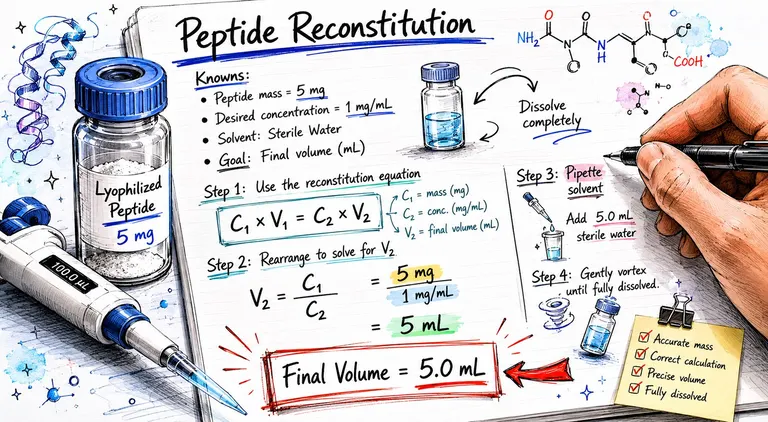
But when reconstituting, the more important decision is usually the final liquid volume you choose to add. That volume sets the concentration of the finished solution. A practical walkthrough on how to reconstitute peptides is helpful because it keeps the sequence straight: read the vial, choose the water volume, then calculate concentration and draw amount.
Where Container Volume and Reconstitution Differ
Here’s the point many people miss. You usually do not fill the vial to its full geometric capacity. Instead, you add a deliberate amount of water that creates a workable concentration.
For example, if a person wants a concentration that’s simple to measure in a syringe, they may choose a round final volume that makes each draw easier to interpret. The vial must be large enough to hold that liquid comfortably, but the selected water volume comes from the concentration plan, not from the vial’s maximum capacity.
That’s why reconstitution is a two-part check:
- Capacity check: Can the vial physically hold the planned liquid volume?
- Concentration check: Does that water volume produce the mixture strength you intended?
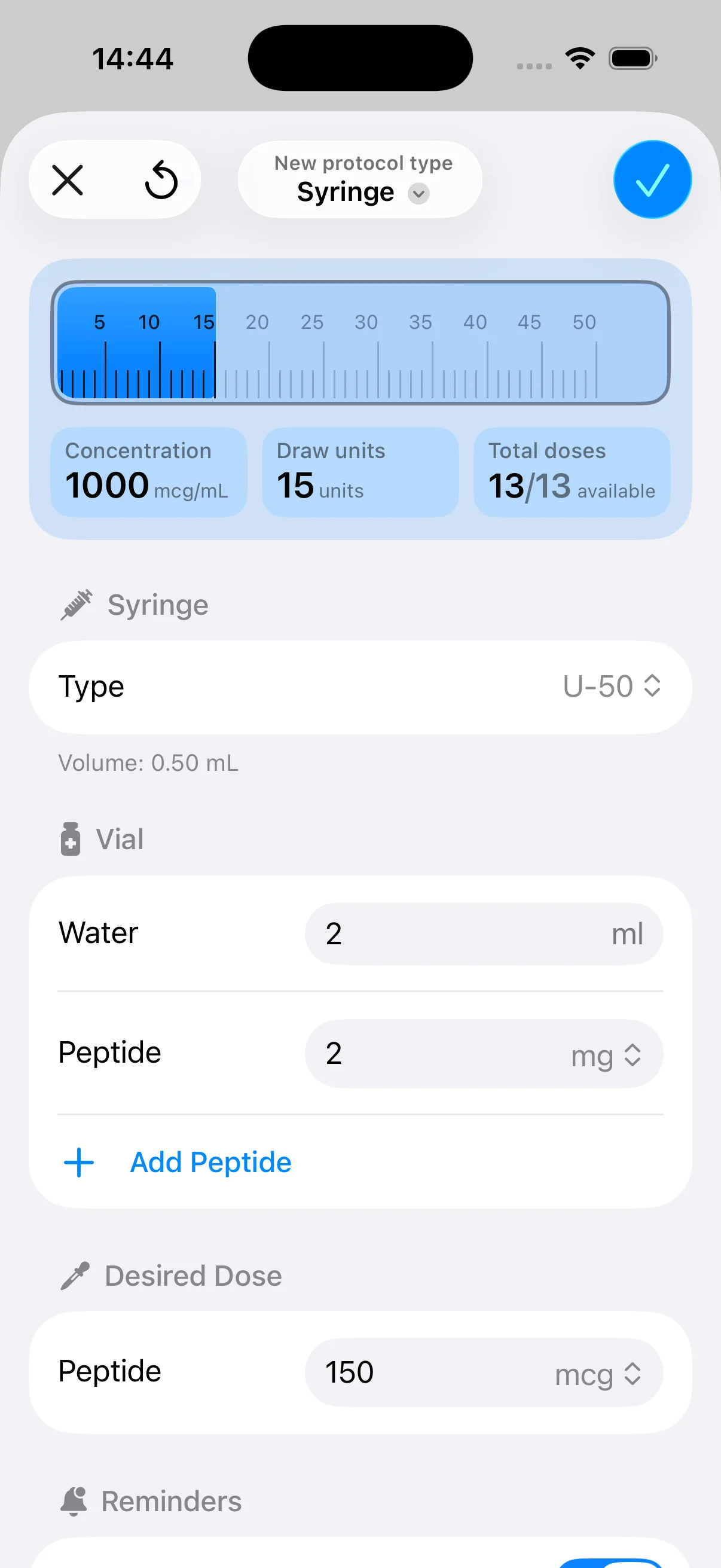
If you prefer to verify the math with a calculator instead of doing every step by hand, PepFlow includes a peptide reconstitution calculator that lets you enter the bacteriostatic water volume and view the resulting concentration and syringe pull measurement. That’s useful when the arithmetic is simple in theory but easy to mistype in practice.
A short visual walkthrough can also help when you want to see the process instead of reading it.
The chemistry-teacher way to think about it is this: first make sure the vessel can hold the solution, then make sure the chosen volume creates the concentration you want. Never reverse those priorities, and never assume “full vial” means “correct reconstitution.”
Practical Tips for Accurate Measurements
Most volume errors don’t come from the formula. They come from poor measurement habits.
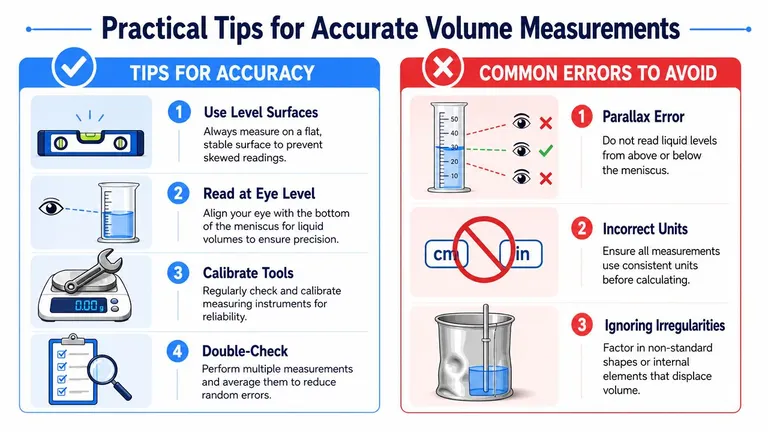
Measurement Habits That Prevent Errors
Use these as a quick checklist before you trust your answer.
- Measure inside, not outside: For tanks, cups, and vials, internal dimensions determine liquid volume. Wall thickness steals space.
- Keep units consistent: Don’t mix inches with centimeters in the same calculation unless you convert first.
- Read liquid levels correctly: In graduated containers, read at eye level so the meniscus doesn’t trick you.
- Use actual liquid depth for partial fills: If the container isn’t full, use the water height, not the total height.
- Repeat important measurements: If the result matters for dosing or solution prep, measure twice.
Read the tool at eye level, write down the unit immediately, and check whether you measured the inside or the outside. Those three habits prevent a surprising number of errors.
For storage or reconstitution work, it also helps to understand how the material itself behaves in the vial. If you’re handling lyophilized material, this overview of freeze-dried peptides adds useful context for why liquid is added carefully rather than casually.
When Simple Formulas Stop Working
Some containers refuse to behave like clean textbook shapes. A major trouble spot is the non-prismatic or tilted container. In those cases, a simple length × width × depth approach can mislead you because the liquid shape changes with angle, segment height, or cross-sectional geometry. That’s why special cases like inclined tanks and partially filled horizontal cylinders are treated separately in engineering-style explanations such as this discussion of measuring water in a tank.
A mistake to avoid is forcing an awkward shape into a familiar formula just because it looks close enough. For better accuracy, either break the shape into simpler parts or use a method designed for that geometry.
Frequently Asked Questions About Volume Calculation
How do I estimate the volume of an irregular container
If the shape is irregular and small enough to handle safely, the water displacement method is often the simplest practical estimate. You place the object or inner form into water and observe the change in volume. For larger irregular containers, break the shape into smaller geometric sections and add them together.
How do I calculate the volume of a partially filled container
Use the current liquid depth, not the full height of the container. In a simple rectangular container, replace total height with water depth. In curved or tilted containers, partial-fill calculations get more complicated because the liquid cross-section changes as the level changes.
Does water temperature affect volume
Yes. Water volume can shift with temperature. In many everyday tasks, the effect is small enough that it won’t matter much, but in careful lab-style work, temperature is one more reason to measure consistently and avoid casual approximations.
What matters more in reconstitution, vial size or target concentration
Both matter, but in different ways. Vial size tells you the physical limit. Target concentration tells you how much water you should add for the intended mixture. For dosing accuracy, concentration is usually the deciding factor, while vial size acts as the constraint.
If you regularly calculate reconstitution volumes, convert concentration into draw amounts, or track repeating peptide schedules, PepFlow is a practical way to reduce manual math and keep your protocol organized.