You’re holding a vial labeled in milligrams, a syringe marked in units, and a protocol written in micrograms. The arithmetic looks simple until you’re deciding whether the decimal belongs before or after a zero. In peptide preparation, that small visual difference can change the amount you draw by an order of magnitude.
The safest approach is to treat unit conversion of mass as a controlled measurement process, not casual mental math. Confirm the units, convert the mass, calculate concentration, convert the target dose to a volume, and then check whether the final syringe position makes sense. This educational guide focuses on that reasoning. It doesn’t replace instructions from a qualified clinician or the product’s validated preparation guidance.
Table of Contents
- Why Mass Conversion Matters in Peptide Protocols
- The Metric Ladder for Mass Units
- Understanding Mass Versus Weight in Science
- Core Conversion Tables for Quick Reference
- Calculating Concentration After Reconstitution
- Converting Microgram Doses to Syringe Units
- Common Dosing Errors and How to Avoid Them
- Precision and Rounding Rules for Safety
- Using Digital Tools to Verify Your Math
- Quick Reference Guide and FAQ
Why Mass Conversion Matters in Peptide Protocols
A common preparation moment starts with a dry vial, a prescribed or planned target dose, and a syringe that measures volume rather than mass. The vial may identify its contents in mg, while the intended dose appears in µg. The syringe doesn’t display either mass unit. It displays liquid volume or syringe markings.
That creates three separate questions:
- How much total peptide mass is in the vial?
- What concentration results after adding liquid?
- What liquid volume contains the intended mass?
If you skip the first conversion, you can misread the scale before you even begin. One milligram equals one thousand micrograms, so confusing those labels creates a very large dose discrepancy. The decimal error isn’t a minor rounding issue. It changes the unit itself.
Treat the vial and syringe as different measurement systems
The vial describes mass. The added liquid describes volume. The syringe reports the volume you draw. Concentration connects those systems by expressing mass per unit of volume.
A useful conceptual review of peptide biology is medical peptide therapy explained, but preparation math still needs to be checked independently. For a separate primer on the broader topic, see this guide to unit conversion.
Practical rule: Never draw a dose until the vial mass, reconstitution volume, concentration, target mass, and syringe type all appear in the same calculation chain.
Write the chain on paper. If the protocol says micrograms and your concentration is in milligrams per milliliter, convert one of them before dividing. Keeping the mass units consistent is the simplest protection against a misplaced decimal.
The Metric Ladder for Mass Units
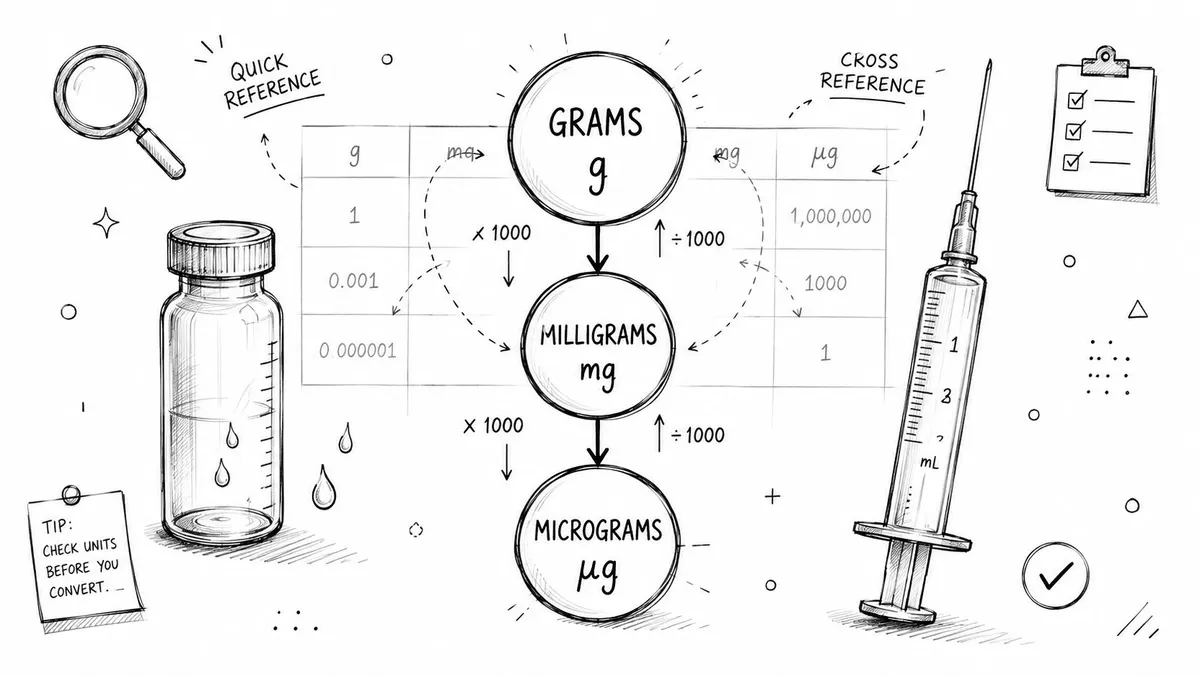
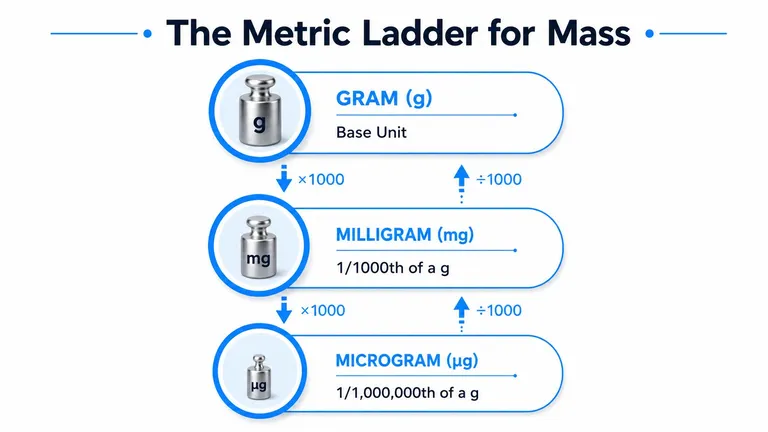
The metric system is built around powers of one thousand for the units most relevant to peptide handling. Start with the gram, then move downward to the milligram, then to the microgram.
- Gram, g: the reference unit in this small ladder.
- Milligram, mg: one-thousandth of a gram.
- Microgram, µg or mcg: one-thousandth of a milligram, and one-millionth of a gram.
Move down by multiplying
When converting grams to milligrams, multiply by one thousand. When converting milligrams to micrograms, multiply by one thousand again.
For example:
- 1 g = 1,000 mg
- 1 mg = 1,000 µg
- 1 g = 1,000,000 µg
To convert 5 mg to micrograms, multiply by one thousand:
5 mg × 1,000 = 5,000 µg
To convert 250 µg to milligrams, divide by one thousand:
250 µg ÷ 1,000 = 0.25 mg
The decimal-point shortcut works because each step represents a factor of one thousand. Moving down the ladder shifts the decimal three places to the right. Moving up shifts it three places to the left.
µg and mcg mean the same mass unit
Labels use both µg and mcg. The first uses the Greek letter mu, while the second spells out “mc” to reduce the chance of confusion in some clinical or digital systems. Treat them as equivalent notations unless a product’s instructions define a different convention.
Don’t confuse IU with µg. Micrograms describe mass. International units describe biological activity and depend on the substance. A conversion from mass to IU requires a validated substance-specific relationship, not a generic metric rule.
Understanding Mass Versus Weight in Science
Everyday speech often uses “weight” when it means mass. Scientific measurement separates the terms. Mass describes the amount of matter in an object, while weight is the force produced by gravity acting on that mass. NIST explains this distinction in its guidance on SI units for mass.
That difference matters because mass remains the quantity used in a peptide label and dose calculation. A vial containing a stated peptide mass isn’t asking you to calculate local gravitational force. You’re working with the amount of substance, then placing that amount into a known liquid volume.
Why scales still need care
A balance uses mechanical or electronic behavior to infer mass. Its reading depends on calibration, setup, resolution, and technique. A consumer scale may be useful for broad household measurements, but it isn’t automatically suitable for small laboratory quantities.
The language becomes especially important when you move between practical and scientific contexts. NIST’s explanation also gives relationships such as 1,000 kilograms equaling 1 megagram or metric ton, showing how mass units remain connected across scales. The same principle applies at the micro-scale, even though the numbers are much smaller.
For peptide preparation, don’t use a kitchen scale to determine a small dose. Use the labeled vial amount and validated preparation instructions, then calculate the liquid volume. If the product documentation is unclear, stop and ask a pharmacist, prescriber, or qualified clinician rather than inferring the amount.
Core Conversion Tables for Quick Reference
A reference table can reduce mental arithmetic during preparation. The values below use the exact metric relationships between grams, milligrams, and micrograms.
Common peptide mass conversions
| Grams (g) | Milligrams (mg) | Micrograms (µg) |
|---|---|---|
| 0.001 g | 1 mg | 1,000 µg |
| 0.002 g | 2 mg | 2,000 µg |
| 0.005 g | 5 mg | 5,000 µg |
| 0.010 g | 10 mg | 10,000 µg |
| 0.250 g | 250 mg | 250,000 µg |
| 1 g | 1,000 mg | 1,000,000 µg |
The vial sizes commonly encountered in peptide discussions can therefore be read directly. A 2 mg vial contains 2,000 µg, a 5 mg vial contains 5,000 µg, and a 10 mg vial contains 10,000 µg.
Smaller units require another conversion
A nanogram, written ng, is smaller than a microgram. The metric ladder continues downward by another factor of one thousand:
- 1 µg = 1,000 ng
- 1 mg = 1,000,000 ng
Use nanograms only when the substance documentation and measuring method support that level of precision. A syringe may not provide a practical way to measure a liquid volume corresponding to a very small mass. The table helps with conversion, but it doesn’t guarantee that the resulting quantity can be drawn accurately.
Convert the mass first, then ask whether your equipment can measure the resulting volume with adequate precision.
Keep the table separate from concentration math. The table converts mass units only. It doesn’t tell you how much liquid to draw, because that depends on the reconstituted volume.
Calculating Concentration After Reconstitution
Once dry peptide is combined with liquid, the key quantity becomes concentration, which describes how much mass exists in a given volume.
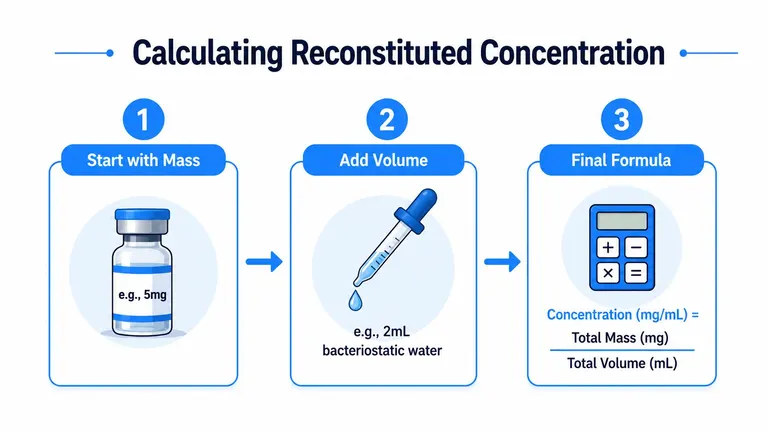
The basic formula is:
Concentration = Total mass ÷ Total volume
For a solution expressed in milligrams per milliliter:
Concentration (mg/mL) = Total peptide mass (mg) ÷ Total liquid volume (mL)
Suppose a vial contains 10 mg and the preparation instructions specify adding 2 mL of compatible diluent. The calculation is:
10 mg ÷ 2 mL = 5 mg/mL
That means each milliliter of the resulting solution contains 5 mg of peptide, assuming the labeled mass and final volume are accurate and the preparation has been performed as directed.
Keep the units aligned
If the target dose is written in micrograms, convert it to milligrams before using a concentration in mg/mL. For example, 250 µg equals 0.25 mg. Mixing 250 with a concentration stated in mg/mL would produce the wrong result because the mass units don’t match.
The powder’s physical volume is often treated as negligible in basic calculations, but the practical final volume may differ from the amount of liquid added. Follow the product-specific instructions rather than assuming that the labeled added volume always equals the final measurable volume.
For a separate walkthrough of this calculation, consult how to calculate final concentration. A product-specific resource, such as Peptide Warehouse USA’s BPC-157 reconstitution guide, may also help organize the inputs, but it cannot replace clinical or manufacturer instructions.
A visual walkthrough can reinforce the order of operations:
Write the vial amount and liquid volume on the preparation record. If you later forget how the solution was made, the concentration cannot be reconstructed safely from memory.
Converting Microgram Doses to Syringe Units
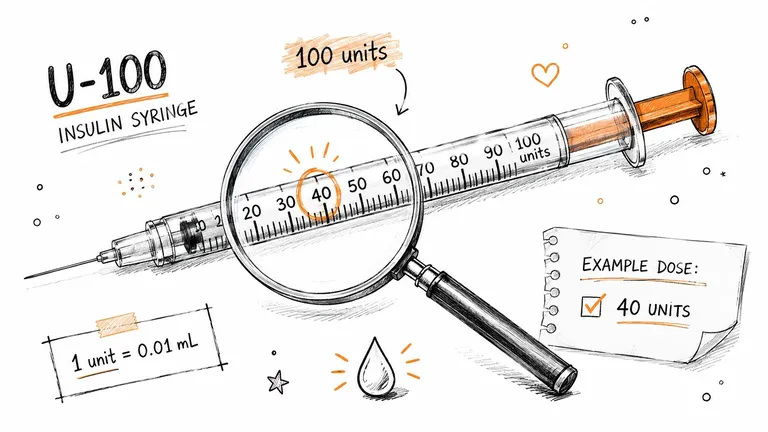
A U-100 insulin syringe measures liquid volume using units. On a U-100 syringe, 100 units correspond to 1 mL, so one unit corresponds to a small fraction of a milliliter. The syringe units are volume markings, not micrograms and not international units of biological activity.
Start with a target dose in the same mass unit as the concentration. If the target is 250 µg, convert it to 0.25 mg. Then use:
Volume (mL) = Desired dose (mg) ÷ Concentration (mg/mL)
With a concentration of 5 mg/mL:
0.25 mg ÷ 5 mg/mL = 0.05 mL
Convert the volume to U-100 syringe units by multiplying the milliliter value by 100:
0.05 mL × 100 = 5 units
Use the label on the syringe
Not every syringe uses the same scale. The U-100 relationship applies only when the syringe is labeled U-100. Don’t transfer the same unit reading to a different syringe type without checking its instructions.
For the same 5 mg/mL concentration, a 500 µg target equals 0.5 mg:
0.5 mg ÷ 5 mg/mL = 0.1 mL
On a U-100 syringe, that volume corresponds to 10 units. The second example is larger because the target mass is larger, not because the concentration changed.
The phrase “units” can create confusion in other medical contexts. A discussion of Botox unit volume for patients concerns a different product and dosing convention, so don’t use it to infer peptide syringe calculations. For a focused walkthrough, see how to convert mcg to syringe units.
Common Dosing Errors and How to Avoid Them
The most dangerous mistake is treating mg and µg as interchangeable. They aren’t. A milligram contains one thousand micrograms, so a protocol written in one unit must be converted before you compare it with a vial or concentration written in the other.
Other errors happen after the conversion:
- Read the syringe scale carefully: Confirm whether the barrel is U-100 and identify the actual graduation marks.
- Inspect the liquid level: Read the plunger’s leading edge consistently, rather than estimating from the barrel or cap.
- Record the added volume: Don’t rely on memory if the vial is used more than once.
- Check the concentration: Recalculate from the vial mass and final volume before drawing.
- Separate mass from IU: Don’t invent an IU conversion when the product documentation hasn’t provided one.
Run a pre-draw sanity check
Before preparing a dose, write the following in one place:
- Vial mass and unit.
- Added or final liquid volume.
- Concentration and unit.
- Target dose and unit.
- Calculated volume.
- Syringe type and final marking.
Then reverse the calculation. Multiply the concentration by the volume you plan to draw. If the result doesn’t return to the intended mass, stop.
A plausible-looking syringe position doesn’t prove that the dose is correct. The units must agree at every step.
Cloudiness, particles, an unusual color, damaged packaging, or uncertainty about sterility isn’t a math problem. Don’t inject a solution that looks wrong or was prepared outside the product’s instructions. Ask a qualified professional or follow the manufacturer’s safety guidance.
Precision and Rounding Rules for Safety
Rounding belongs at the end of a calculation, not in the middle. Early rounding changes the concentration or dose used in the next step, and that difference can become larger when you convert between mass and volume repeatedly.
NIST recommends using exact conversion factors, canceling units, repeating the calculation, and checking whether the result makes sense in context. Its metric and SI unit conversion guidance provides that verification approach. Apply it by writing units beside every number, not just the numerical values.
Use the equipment’s real resolution
If the calculated volume falls between syringe marks, don’t automatically round up or down. First determine whether the syringe can measure that volume reliably. A device with finer graduations may be necessary, or a clinician may need to select a concentration that produces a practical draw volume.
Avoid adding false precision. Recording a long decimal doesn’t make a syringe capable of delivering that exact amount. Your final stated dose should reflect both the calculation and the measuring instrument.
Metrology remains an active field. NIST notes that the international realization of the kilogram is being updated in 2026 with a consensus adjustment of 1 kg − 12 µg, which illustrates why traceability and precision aren’t merely academic concerns. That adjustment isn’t a reason to alter a peptide calculation, but it is a reminder to use controlled units, documented methods, and appropriate measurement standards.
Check for error propagation
If the vial amount is uncertain, the final volume is uncertain. If the syringe reading is imprecise, the administered volume is also imprecise. These uncertainties can compound, so don’t describe a result as exact when the inputs or equipment aren’t exact.
For high-stakes dosing, have a pharmacist or clinician independently review the complete calculation. A second check is more useful when the reviewer sees the original units and assumptions rather than only the final syringe mark.
Using Digital Tools to Verify Your Math
A calculator can reduce repetitive arithmetic, but it can’t correct an incorrect input. Use a digital tool as a second check after you’ve written the calculation manually.
Enter the information in a fixed order:
- Vial mass: Include the number and unit, such as mg.
- Reconstitution volume: Use the instructed liquid volume and unit.
- Target dose: Enter µg or mg exactly as written.
- Syringe type: Confirm whether the device is U-100 or another scale.
- Output: Review the calculated volume and syringe marking.
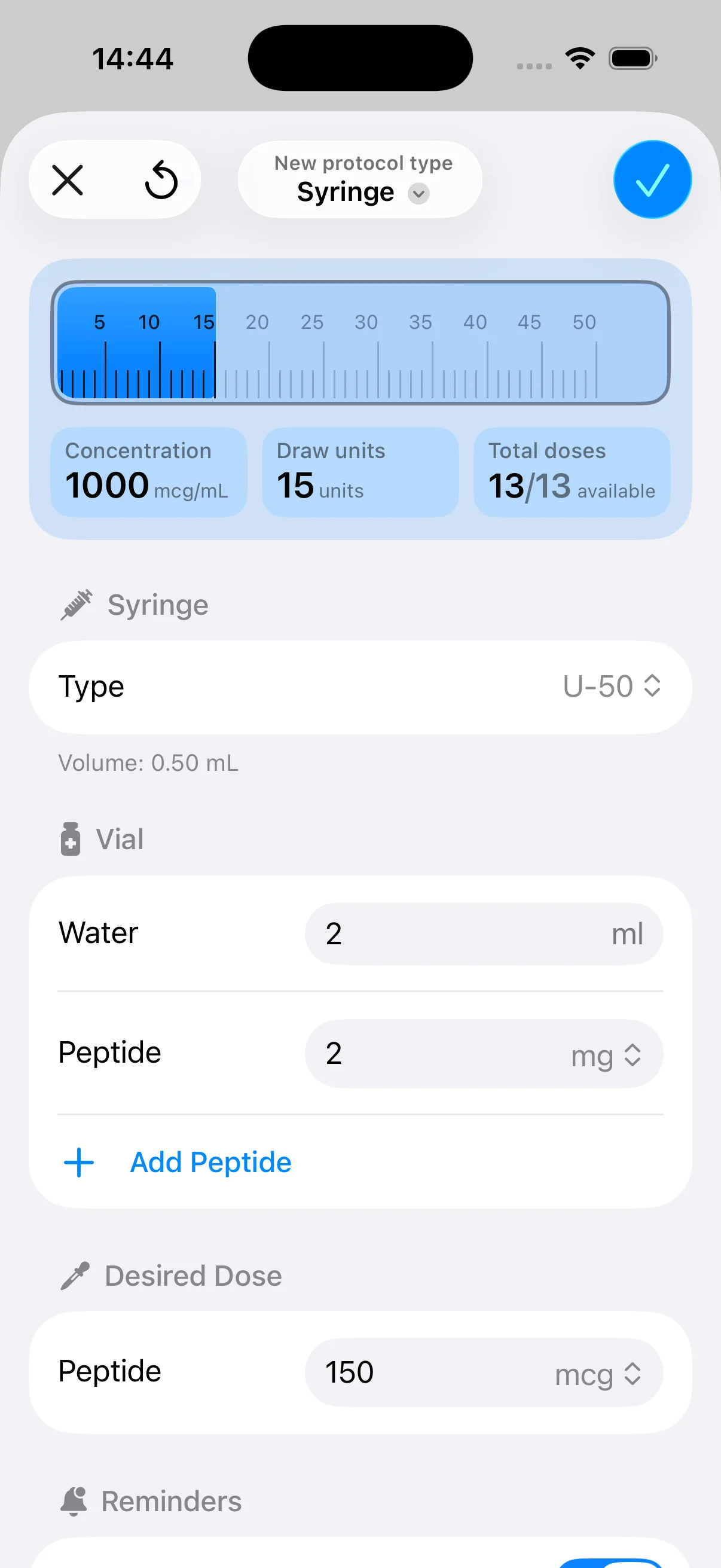
PepFlow is an iOS app that handles peptide dose calculations involving vial configuration, concentration, desired mass, and practical syringe units. It also supports protocol scheduling, reminders, countdowns, widgets, and dose logging. Use any calculator, including PepFlow, only as a verification aid. Compare its output with the handwritten formula and investigate any disagreement before preparing the dose.
A useful digital workflow saves the vial concentration with the preparation date and keeps the target dose separate from the syringe volume. That prevents a future change in dose or concentration from being mistaken for the original setup.
The calculator should show its assumptions. If it hides the conversion between micrograms and milligrams, you lose an important opportunity to catch a unit-entry error. Choose tools that let you inspect the inputs and reproduce the result independently.
Quick Reference Guide and FAQ
Core formulas
- Concentration = total mass ÷ total volume.
- Volume = desired mass ÷ concentration.
- For U-100 syringes, syringe units = volume in mL × 100.
- Convert µg to mg by dividing by one thousand.
If the solution looks cloudy: Don’t inject it. Check the product instructions and contact a qualified professional.
If the plunger sticks: Don’t compensate by guessing the volume. Replace the device if appropriate and confirm the marking system.
If you forgot the added volume: Don’t estimate. Reconstruct it from reliable records or ask for professional guidance.
Does µg mean mcg? Yes, they’re alternate notations for micrograms.
Does IU equal µg? No. IU requires a substance-specific relationship.
Should you change storage or stability conditions? Follow the product’s official instructions or the guidance of a pharmacist or prescriber. This article can’t establish stability after reconstitution.
Use PepFlow to organize vial details, convert target microgram doses into practical syringe measurements, and verify the calculation chain before preparation. Set the protocol schedule and reminders only after a qualified professional has confirmed that the product, dose, concentration, and administration instructions are appropriate for you.