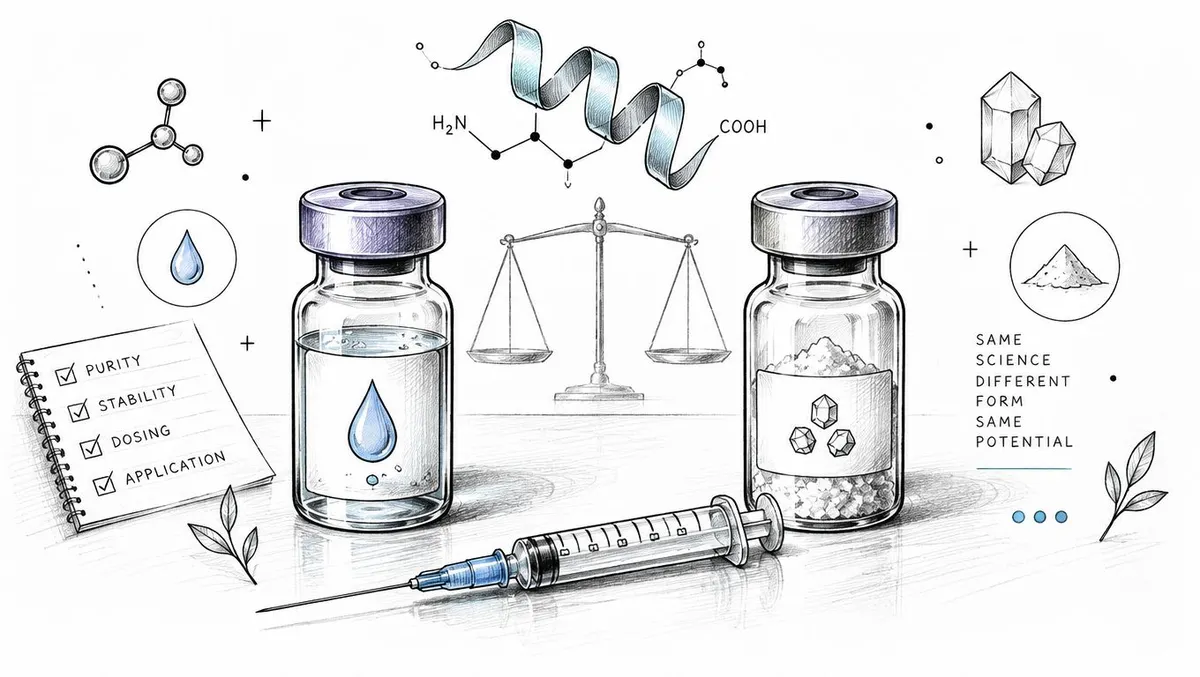
The popular advice is to use whichever sterile diluent is available. That shortcut is wrong. Sterile water for injection and normal saline are not interchangeable defaults, because the final solution depends on the medication or peptide, the administration route, the required concentration, and how long the reconstituted vial will be kept.
The right question isn’t “Which liquid dissolves the powder?” It’s “Which diluent produces an acceptable, stable, tolerable solution for this specific route and product?” That distinction matters for ordinary injectables, compounded preparations, and peptide protocols alike. A practical overview of the broader preparation problem is available in this peptide reconstitution solution guide, but the final authority remains the product monograph, pharmacy protocol, or prescriber’s instructions.
Table of Contents
- Why the Diluent Choice Is Not as Simple as It Looks
- The Chemistry Behind Sterile Water and Normal Saline
- Side-by-Side Comparison of Sterile Water and Normal Saline
- Real-World Scenarios for Peptide Reconstitution
- A Safe Reconstitution Workflow Step by Step
- Quick Decision Matrix and Recommendation
- Shortages, Preservatives, and the Multi-Dose Trap
Why the Diluent Choice Is Not as Simple as It Looks
A vial on the shelf doesn’t determine the correct diluent. The route of administration comes first. A solution intended for subcutaneous or intramuscular use has different local tolerability considerations from a solution intended for intravenous push. With IV administration, the final osmolarity and concentration can affect vascular tolerance immediately. ASHP warns that using normal saline for some IV-push reconstitutions can create hyperosmotic solutions and may cause infusion-site reactions, so “saline is isotonic” isn’t enough to make every saline admixture safe. ASHP’s sterile water guidance makes that route-specific risk clear.
Peptide chemistry is the second variable. Saline adds sodium and chloride ions. Those ions may be perfectly acceptable for one formulation, yet affect solubility, aggregation, or precipitation in another. Some peptide-focused guidance also flags ionic interactions and precipitation as reasons saline may be unsuitable for particular compounds, especially when the molecule is chemically sensitive or the formulation is not fully characterized. Don’t assume that a peptide that dissolves in water will behave identically in saline.
The third variable is post-reconstitution handling. Sterile water for injection contains no preservative, and plain preservative-free saline doesn’t automatically become a multi-dose product just because it is isotonic. Repeated punctures create contamination risk, while storage can affect peptide integrity even when the solution still looks clear.
Practical rule: Choose the diluent from the product instructions and route first. Use availability, injection comfort, and storage convenience only after compatibility has been established.
For a hospital injectable, follow the approved label exactly. For a research peptide, require compound-specific information from the supplying laboratory, including identity, purity, recommended solvent, concentration limits, and stability instructions. If that information is missing, the responsible choice isn’t to guess between sterile water and saline. It’s to pause preparation until a qualified pharmacist or clinician can assess the formulation.
The Chemistry Behind Sterile Water and Normal Saline
The basic chemistry explains why the two liquids behave differently. Sterile water for injection is hypotonic by itself, with no sodium or chloride added. DailyMed states that it is intended for dilution or dissolution and must be made approximately isotonic before intravenous administration. One FDA label specifies that a vehicle based on sterile water should reach an osmolarity of at least 112 mOsmol/L before IV use. The DailyMed labeling reference is the appropriate starting point for that distinction.
Normal saline begins from a different position. It is a 0.9% sodium chloride solution, with an osmolarity of about 308 mOsm/kg, and contains approximately 154 mEq/L of sodium and 154 mEq/L of chloride, according to the cited diluent comparison. That composition makes it closer to physiologic osmolality and often more comfortable for tissues when the final preparation remains compatible and appropriately concentrated. This sterile water and saline chemistry comparison provides those composition details.
Core chemistry comparison
| Property | Sterile Water for Injection | 0.9% Sodium Chloride |
|---|---|---|
| Baseline tonicity | Hypotonic by itself | Isotonic solution |
| Osmolarity | Approximately 0 mOsm/kg in the cited comparison | About 308 mOsm/kg |
| Main dissolved ions | None added | Sodium and chloride |
| Preservative | No preservative | Depends on the specific product |
| IV use | Must be adjusted to approximately isotonicity when required | Often suitable as an isotonic vehicle when the product label permits |
| Main formulation concern | Final solution can be too hypotonic | Added ions can affect compatibility or precipitation |
The absence of ions can be useful when a formulation is sensitive to ionic strength. It can also create a problem when the resulting preparation is administered directly into tissue or a vein without appropriate adjustment. Saline may reduce osmotic discomfort, but it can push some medication solutions toward saturation. ASHP specifically warns that normal saline can contribute to crystallization in certain high-concentration preparations, including cefazolin sodium.
Preservation is a separate issue from tonicity. A sterile liquid isn’t automatically a preserved multi-dose liquid. The label must identify the product as suitable for the intended use, and the reconstituted preparation still needs an aseptic process and a product-specific beyond-use decision. For practical handling principles, a water for injection handling guide can supplement, but not replace, official labeling and pharmacy standards.
Side-by-Side Comparison of Sterile Water and Normal Saline
The most useful comparison isn’t “which one is better?” It’s “which trade-off does this preparation need?” Sterile water minimizes added ionic content, while saline starts closer to physiologic tonicity. Neither advantage overrides a product-specific incompatibility.
| Variable | Sterile Water | Normal Saline |
|---|---|---|
| Tonicity | Hypotonic until the dissolved product changes the final solution | Isotonic before reconstitution |
| Ionic content | No added sodium or chloride | Adds sodium and chloride |
| Solubility behavior | May suit formulations where added ions are undesirable | May support a comfortable final solution, but can cause compatibility problems in some formulations |
| Peptide stability | Can avoid some ion-related interactions | May create ionic interactions, precipitation, or aggregation in sensitive compounds |
| Injection comfort | Final tonicity may be less comfortable if not appropriately adjusted | Often better tolerated when the final preparation is compatible |
| Multi-dose suitability | Plain sterile water has no antimicrobial protection | Plain preservative-free saline also lacks a reliable multi-dose safeguard |
| Primary decision | Use when the formulation requires water without added ions or the label specifies it | Use when the label permits an isotonic vehicle and the formulation tolerates saline |
The solubility question deserves discipline. If a peptide remains cloudy, forms visible particles, or develops a precipitate after gentle mixing, don’t keep adding diluent and don’t attempt to force dissolution with vigorous agitation. A clear appearance also doesn’t prove chemical stability. Visual clarity is a screening step, not a stability study.
For peptide protocols, the compound’s charge, sequence, concentration, and excipients matter. An aggregation-prone or charge-sensitive sequence may respond poorly to added ions, while another water-soluble preparation may tolerate saline without an obvious issue. The correct choice therefore comes from compound-specific data, not from a blanket claim that sterile water is purer or saline is gentler.
Comfort and storage are different decisions
Saline may make a compatible preparation more comfortable at the injection site, but it doesn’t solve contamination risk. Likewise, sterile water may be useful when ionic strength must stay low, but its preservative-free status means the vial can’t be treated as a convenient multi-dose container after entry.
Do not confuse bacteriostatic water with sterile water for injection. Bacteriostatic water is a different labeled product with a preservative, and it has its own route, population, and formulation restrictions. The same applies to preserved saline. Read the actual vial label rather than relying on the word “saline” or “water.”
Real-World Scenarios for Peptide Reconstitution
Consider a subcutaneous peptide preparation intended for repeated use. If the product documentation permits preserved saline, saline may be a reasonable choice when injection comfort matters and the peptide has no known issue with sodium or chloride. If the documentation specifies sterile water, the more comfortable option is still the wrong option.
Scenario one, a routine subcutaneous peptide
A researcher has a lyophilized BPC-157 vial and wants a subcutaneous preparation for a structured protocol. The decision should begin with the supplier’s documented solvent recommendation, not with a preferred internet protocol. If preserved saline is explicitly compatible, it may support a more comfortable final solution for subcutaneous use. If only sterile water is specified, use sterile water and accept that the preparation may require a shorter handling window.
Decision: Use the documented compatible diluent, administer only by the permitted route, refrigerate if the product instructions require it, and discard according to the assigned beyond-use date.
Scenario two, a concentrated multi-dose preparation
A lab wants a higher-concentration stock and is considering sterile water to avoid adding ions. That can be sensible only if the compound remains stable at the target concentration and the preparation is intended for prompt use or handled under a validated sterile process. Sterile water doesn’t provide antimicrobial protection after the vial is entered.
A clear solution isn’t enough. The lab should document the peptide mass, solvent volume, calculated concentration, preparation conditions, storage conditions, and discard date. If the vial will be accessed repeatedly, the preservative status becomes a central part of the risk assessment.
Decision: Choose sterile water only when the formulation data support it, keep the preparation under the specified storage conditions, and assign a conservative, documented discard date.
Scenario three, a shortage-driven substitution
A sterile water shortage can create pressure to substitute normal saline. Don’t make that substitution by category. Review the product label, administration route, final concentration, and known compatibility risks. Some products permit saline, while others require sterile water or another specified vehicle. ASHP’s shortage materials discuss the practical need to identify medication-specific alternatives rather than treating one substitute as universally acceptable. The sterile water shortage FAQ is useful context for that decision.
Decision: Substitute only after a pharmacist or product monograph confirms compatibility, then document the replacement diluent and use the revised beyond-use instructions.
A Safe Reconstitution Workflow Step by Step
Safe reconstitution is a controlled process, not a quick mixing task. Prepare in a clean area, gather the correct diluent and sterile equipment, verify the vial identity and instructions, and keep unrelated materials away from the work surface.
-
Prepare the workspace. Wash and dry your hands, inspect the surface, and check that the vial, diluent, syringe, and needle are intact and within date. Don’t proceed if the powder, stopper, or solution looks compromised.
-
Disinfect the vial tops. Use an appropriate alcohol swab and allow the stopper to dry before puncturing. Touching the disinfected surface or inserting a needle before it dries defeats the purpose of the cleaning step.
-
Equilibrate the materials. Follow the product instructions for temperature. Avoid abrupt temperature changes that can encourage condensation, foaming, or handling errors.
-
Draw the specified volume. Use a new sterile syringe and needle. Confirm the volume against the labeled concentration and the intended final preparation. Never estimate the volume by eye.
-
Inject slowly. Direct the diluent down the inside wall of the vial rather than onto the powder cake. Slow delivery reduces foaming and mechanical stress, particularly in formulations containing surfactants or larger peptide fragments.
-
Mix gently. Swirl or roll the vial. Don’t vortex or shake it aggressively. Inspect the finished solution for particles, persistent cloudiness, unexpected color, or incomplete dissolution.
-
Label and store. Record the product, lot, diluent, volume, concentration, preparation date and time, storage condition, and calculated beyond-use date. Follow the shortest applicable limit from the product label, institutional policy, sterility standard, or validated stability data.
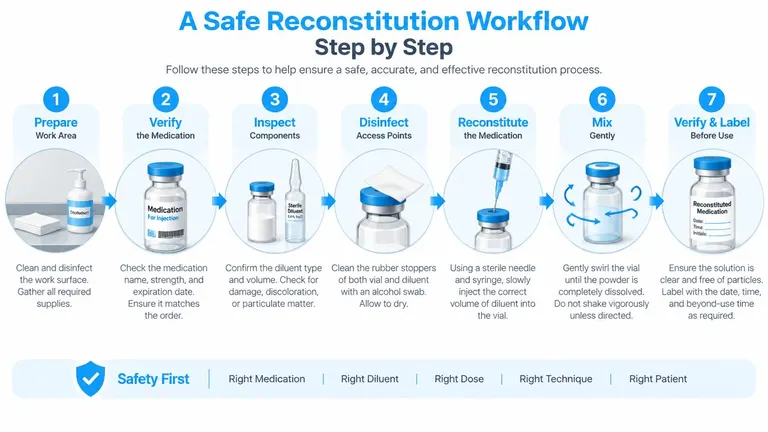
The peptide reconstitution workflow guide can help organize the calculation and preparation sequence, but it can’t establish compatibility or replace a licensed professional’s judgment.
For storage, remember the key distinction: preservative-free sterile water is intended for single use, and plain saline is also not automatically suitable for repeated withdrawals. DailyMed describes sterile water as a dilution or dissolution product, while ASHP emphasizes its lack of antimicrobial protection. Never pool residual diluent, never reuse a discarded syringe or needle, and don’t extend a beyond-use date because the solution still appears clear.
The following video can provide a visual supplement to written instructions:
Quick Decision Matrix and Recommendation
A useful matrix should expose uncertainty rather than hide it. There is no defensible universal solvent for every BPC-157, GHK-Cu, thymosin fraction, GLP-1 analogue, or growth hormone secretagogue preparation. Those categories contain different formulations, concentrations, excipients, and instructions.
| Peptide class | Recommended diluent | Preferred route | Concentration | Refrigerated BUD |
|---|---|---|---|---|
| BPC-157 | Use the compound-specific instruction. Preserved saline may be acceptable only when documented | Product-specific | Monograph-defined | Product-specific |
| GHK-Cu | Confirm compatibility because copper-containing chemistry may be formulation-sensitive | Product-specific | Monograph-defined | Product-specific |
| Thymosin fractions | Follow the supplying laboratory or pharmacy instruction | Product-specific | Monograph-defined | Product-specific |
| GLP-1 analogues | Use the approved product’s labeled diluent and handling instructions | Product-specific | Monograph-defined | Product-specific |
| Growth hormone secretagogues | Confirm the specific molecule, formulation, and route before selecting a diluent | Product-specific | Monograph-defined | Product-specific |
A practical decision sequence
Choose sterile water when the product requires it, when added ions create a documented compatibility concern, or when the preparation is intended for prompt single-use handling. Don’t choose it merely because it seems chemically simple.
Choose normal saline when the product label permits it, the final solution remains compatible, and an isotonic vehicle is appropriate for the route. Don’t choose it solely to reduce injection discomfort if the formulation has not been evaluated in saline.
For repeated withdrawals, verify whether the actual product is preserved. Bacteriostatic does not mean universally safe, indefinitely stable, or appropriate for every route. It only addresses one part of the handling problem.
My default recommendation is conservative: for subcutaneous or intramuscular peptide protocols, use the diluent specified by the compound documentation. If the documentation permits both options, preserved saline can be reasonable when comfort and multi-dose handling matter, while sterile water can be reasonable when the formulation requires low ionic strength or prompt use. Verify the current certificate of analysis and product instructions before preparing the vial.
Shortages, Preservatives, and the Multi-Dose Trap
Shortages expose the weakest assumption in reconstitution advice: that a different sterile liquid is automatically an acceptable substitute. It isn’t. Normal saline may be appropriate for one medication and unsuitable for another, particularly when the final preparation is concentrated, administered by IV push, or sensitive to ionic interactions.
The preservative question is just as important. Isotonicity does not equal antimicrobial protection. Plain sterile water has no preservative, and preservative-free saline doesn’t gain one through reconstitution. A preserved diluent may slow microbial growth, but it doesn’t excuse repeated contamination, careless stopper handling, or storage beyond the assigned limit.
A single-dose vial also doesn’t become a legitimate multi-dose vial after someone adds a preserved diluent. The vial designation, preparation environment, route, institutional policy, and validated stability information all matter. If a product is labeled for single use, repeated entry should be treated as a safety issue, not a storage convenience.
| Diluent | Preservative status | Post-puncture use window | Peptide stability risk | Acceptable routes |
|---|---|---|---|---|
| Sterile water for injection | Preservative-free | Follow single-dose labeling and validated instructions | Low ionic protection does not guarantee chemical stability | Only the routes and products specified by labeling |
| Preservative-free normal saline | Preservative-free | Follow the container and preparation instructions | Added ions may affect sensitive formulations | Only when product compatibility is established |
| Preserved normal saline | Contains a product-specific preservative | Use only within the labeled or validated period | Preservative may not suit every peptide or population | Only permitted routes and formulations |
| D5W | Product-specific | Follow product and institutional handling requirements | Osmolarity and chemical compatibility can change after reconstitution | Select protocols only, never as a universal substitute |
| Lactated Ringer’s | Contains multiple electrolytes | Follow product-specific instructions | Ionic interactions and precipitation may be relevant | Select infusion applications only, when specifically permitted |
D5W and lactated Ringer’s aren’t general-purpose peptide solvents. They may be acceptable in selected protocols, especially where a clinician or pharmacist has confirmed route and compatibility, but their additional components create more variables than sterile water or saline. An IV infusion decision should be made under clinical supervision, not adapted from a subcutaneous protocol.
The same logic applies to peptide storage. A vial used repeatedly should have a documented preparation date, diluent, storage condition, handling limit, and discard date. If no validated stability information exists, don’t manufacture a long beyond-use period from internet anecdotes. For a focused comparison of bacteriostatic water and saline handling, consult this bacteriostatic water versus normal saline guide, then confirm the result against the actual product documentation.
The safest substitution rule is simple: never replace sterile water with saline, or saline with sterile water, without confirming compatibility for the specific compound and route. If the vial is already cloudy, particulate, discolored, leaking, or past its documented use period, discard it rather than attempting to rescue it.
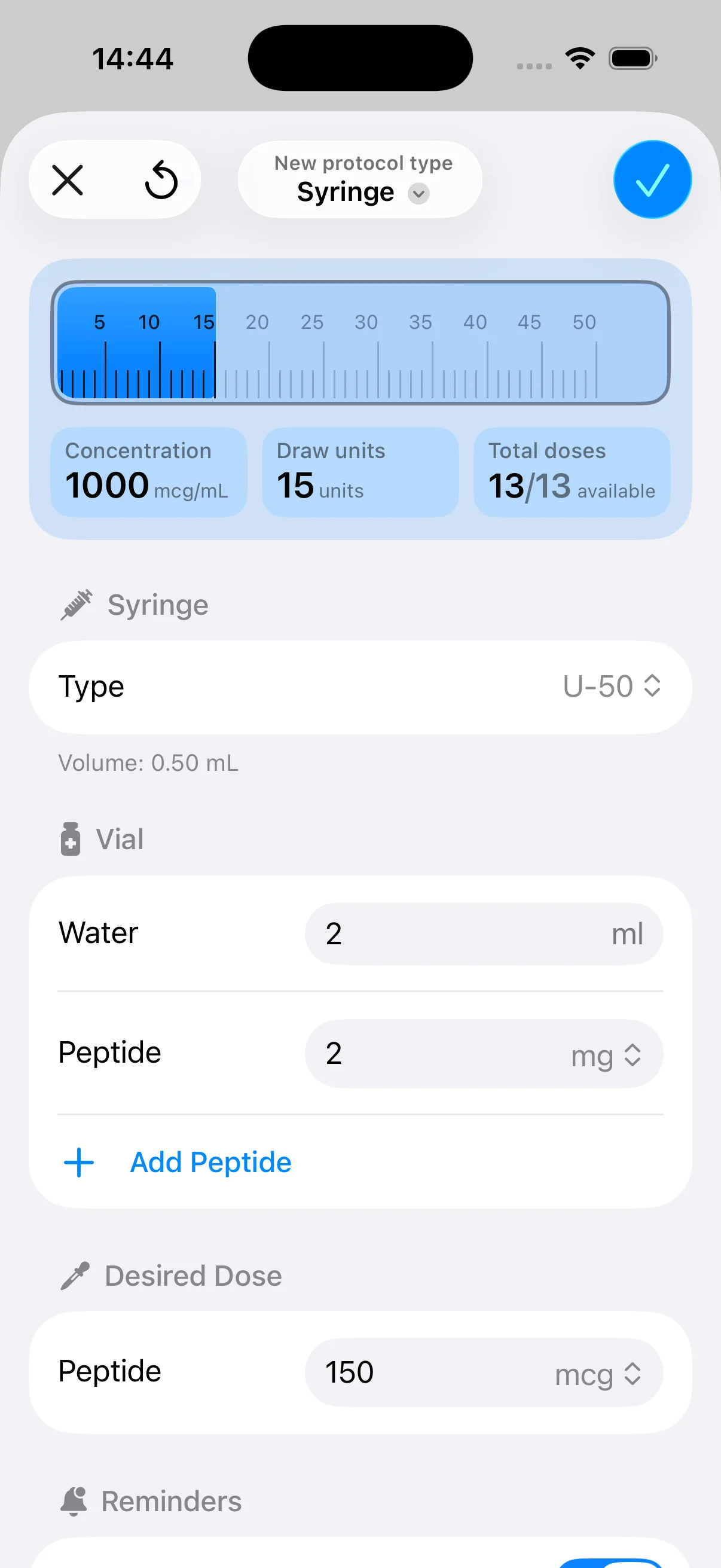
PepFlow helps you calculate peptide concentrations and injection volumes from vial strength and solvent volume, then organize dosing schedules, reminders, and dose history in one place. Use PepFlow to reduce manual calculation and scheduling errors, while relying on a pharmacist or clinician for diluent compatibility, sterility, and medical decisions.