
You’ve probably been in this exact spot. There’s a peptide vial on the table, a syringe nearby, and two possible diluents in front of you. One says bacteriostatic water. The other is normal saline. Both are sterile. Both show up in medical settings. That makes them seem interchangeable until you start reading labels and realize they aren’t solving the same problem.
Most of the confusion comes from how these products get discussed online. People often reduce the choice to “which one stays sterile longer” or “which one hurts less.” That misses the decision. The better question is which solution makes sense for your specific use case, your handling pattern, and the formulation environment your peptide will sit in after reconstitution.
A peptide user doing repeated subcutaneous dosing over time is making a different decision than a clinician using saline as a flush. Someone trying to minimize repeated vial entries is thinking about one kind of risk. Someone trying to preserve isotonicity is thinking about another. If you don’t separate those issues, the advice gets muddy fast.
Table of Contents
- Introduction to Choosing Your Diluent Wisely
- What Each Diluent Is
- Head to Head Comparison of Formulation and Handling
- Safety Tolerability and Preservative Tradeoffs
- Real World Use Cases and When to Choose Each
- Practical Preparation Storage and Handling Workflow
- Clear Recommendation for Your Situation
Introduction to Choosing Your Diluent Wisely
You reconstitute a peptide on Sunday, plan to draw small doses through the week, and pause when you see two sterile options on the counter. One vial is bacteriostatic water. The other is normal saline. The label choice matters because these products create different solution environments once the powder is mixed.
That is why this decision tends to feel harder than it first appears. You are not just picking a sterile liquid. You are choosing between different priorities: tonicity, preservative exposure, and how the vial will be handled after reconstitution.
The decision peptide users are usually trying to make
For peptide users, the practical question usually falls into one of these situations:
- Repeated small-dose use: You expect to puncture the same vial more than once over days or weeks.
- Single preparation event: You are preparing a dose for near-term use and do not need a preserved multi-dose setup.
- Comfort and tolerability concerns: You want to sort out how isotonicity and preservatives may affect injection experience.
- Protocol uncertainty: You have directions from a prescriber, pharmacy, or manufacturer and want to understand the logic behind them.
The same peptide can lead to different answers depending on which of those situations applies.
A clearer way to frame the choice
Online discussions often flatten this into a vague sterility debate. That framing hides the details that change day-to-day use. Both products are manufactured as sterile injectables. The more useful distinction is the formulation itself and what happens after the vial is opened, punctured, and used again.
The key distinction is preserved hypotonic water versus preservative-free isotonic saline.
That short comparison explains why each product fits a different job. Bacteriostatic water adds a preservative, which changes how people think about repeated vial entry. Normal saline adds sodium chloride, which changes tonicity and makes it relevant in situations where an isotonic solution is preferred.
A simple way to picture it is a decision matrix. One axis is how many times the vial will be entered. The other is what solution environment you want the peptide sitting in. Peptide reconstitution often pushes users to weigh preservative exposure against multi-dose handling. Clinical flush use points in a different direction because the goal there is usually an isotonic saline solution, not a preserved reconstitution medium.
That is the lens to use for the rest of the comparison. It keeps the choice grounded in formulation and handling instead of broad claims about one product being universally better.
What Each Diluent Is
Start with the label, because the label tells you what problem the product was built to solve.
Bacteriostatic water for injection is sterile water that contains benzyl alcohol as a preservative. The NCBI StatPearls monograph on bacteriostatic water describes it as a diluent used to dissolve or dilute certain injectable drugs, with the preservative added to limit bacterial growth after entry. For peptide users, that preservative is the part that changes handling logic. A vial intended for more than one puncture raises a different question than a one-and-done diluent.
It also helps to notice what bacteriostatic water does not contain. There is no sodium chloride in the vial. So the starting solution is water plus preservative, not a salt-balanced fluid. If saline is like body-matching saltwater, bacteriostatic water is closer to a preserved mixing medium.

Normal saline, usually labeled 0.9% sodium chloride injection, is a different formulation. It is sterile water with sodium chloride added to create an isotonic solution. FDA labeling for sodium chloride injection describes it as a sterile saline solution used in clinical settings as a diluent and, in appropriate products, as a flush or fluid component. The key point is simple. Saline is built around tonicity, not preservative-based multi-dose handling.
That distinction clears up a lot of confusion. People often group these products together because both sit near injectable workflows. But they answer different formulation questions.
| Product | What the formulation is telling you |
|---|---|
| Bacteriostatic water | Sterile water with preservative. Chosen when repeated vial entry is part of the plan and preservative exposure is acceptable. |
| Normal saline | Sterile isotonic salt solution. Chosen when the solution environment should match physiologic tonicity more closely and preservative is not wanted. |
A practical analogy helps here. Choosing between them is less like picking between two brands of the same item and more like choosing between preserved mixing water and body-matched saltwater. For peptide reconstitution, users often focus on whether the vial will be entered again. For clinical flush use, the bigger concern is usually that the fluid is isotonic.
That is why sterility alone does not settle the choice. Both are sterile products. The more useful question is what sits in the vial after you mix, and what happens after the stopper is punctured.
Head to Head Comparison of Formulation and Handling
A practical comparison starts with the decision you are making. Are you trying to create the right solution environment for the peptide, or are you trying to support repeated vial entry after reconstitution? Those are different jobs, and the label on the diluent is pointing you toward one priority or the other.
Bacteriostatic Water vs Normal Saline at a Glance
| Criterion | Bacteriostatic Water | Normal Saline (0.9% NaCl) |
|---|---|---|
| Main composition | Sterile water with benzyl alcohol preservative | Sterile water with sodium chloride |
| Preservative | Yes | No |
| Tonicity | Hypotonic | Isotonic |
| Ionic environment | Non-ionic | Salt-containing |
| Typical handling logic | Built for repeated puncture workflows | Usually treated as single-use or short-hold once opened |
| Common practical role | Reconstitution where preserved multi-dose handling matters | IV diluent and flush use where isotonicity matters |
Formulation differences that change real use
The easiest way to sort these products is to separate three questions: tonicity, preservative exposure, and multi-dose handling.
Bacteriostatic water answers the handling question first. It gives you sterile water plus a preservative, so the workflow is better suited to a vial that may be entered more than once. Normal saline answers the tonicity question first. It gives you a 0.9% sodium chloride environment that is isotonic from the start, but without preservative support for repeated access.
A simple analogy helps. One product works like preserved mixing water. The other works like body-matched saltwater. If two users say they are choosing a “diluent,” they may still be solving different problems.
That is why formulation details matter at the bench. A peptide user may care most about what sits in the vial over several doses. A clinic flushing an IV line cares more about isotonicity and standard clinical compatibility.
Handling differences that affect day-to-day use
Handling is where the confusion usually starts.
If the plan involves repeated withdrawals from the same reconstituted vial, bacteriostatic water fits that workflow more naturally because the preservative is part of the design. Plain saline does not bring that same protection after opening, so the practical assumption is usually single-use or very limited hold based on product instructions and setting.
That does not mean saline is “bad” for all reconstitution. It means saline is not chosen because it solves the multi-dose handling problem.
A cleaner way to decide is to match the diluent to the task:
| Situation | The question that matters most | Better fit |
|---|---|---|
| Peptide reconstitution with planned repeated vial entry | Do I need preservative support for multi-dose handling? | Bacteriostatic water, if the peptide is compatible |
| Peptide reconstitution for immediate use | Do I need a preservative at all? | Either may be considered based on compatibility and use plan |
| Clinical flush use | Do I need isotonic fluid for line flushing? | Normal saline |
| Dilution where salt content may change the solution environment | Do I want to avoid adding sodium chloride at the start? | Bacteriostatic water, if compatible |
Why the same two products get used so differently
Clinical staff and peptide users often reach different conclusions because the handling pattern is different. Hospitals use normal saline heavily for flushes and many dilution tasks because isotonic fluid makes sense in that context. Peptide users often focus on repeated small withdrawals from one vial over time, which shifts the decision toward preservative exposure and stopper re-entry.
If you are sorting out how long a preserved vial can stay in use after opening, this guide on bacteriostatic water shelf life is the more relevant question than sterility alone.
The short version is simple. Choose saline when tonicity is the main priority. Choose bacteriostatic water when multi-dose handling is the main priority and preservative exposure is acceptable.
Safety Tolerability and Preservative Tradeoffs
Two vials can both be sterile and still create different tradeoffs once you start using them. That is the part people often miss.
For peptide users, the practical question is not just “Which one is cleaner?” It is “What happens to tonicity, preservative exposure, and repeated vial entry after I mix this?” Those three factors usually explain differences in practice better than broad claims about one diluent being safer across the board.
Tolerability depends on more than one variable
Injection comfort is influenced by several inputs at the same time: the peptide itself, the concentration after reconstitution, the injection volume, the route, and whether the final solution is closer to isotonic or hypotonic. The preservative can matter too, but it is only one piece of the picture.
That is why comfort claims get overstated online.
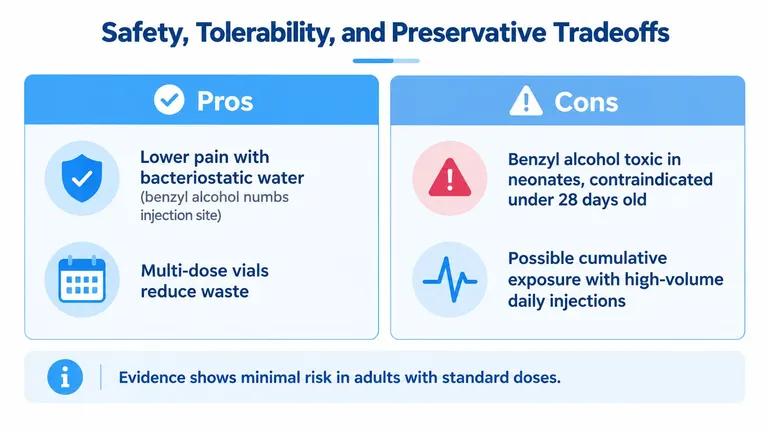
A hypotonic diluent such as bacteriostatic water can behave differently from isotonic saline at the tissue level, because the dissolved salt content changes how the final solution compares with the body’s normal fluid balance. At the same time, bacteriostatic water contains benzyl alcohol, which changes the experience in a different way. Those effects do not reduce to a single rule like “bacteriostatic water hurts less” or “saline is always gentler.”
A useful analogy is recipe balance. Salt, water, and concentration all change the final mixture, and the final mixture is what the tissue “sees.” Looking at only one ingredient misses the outcome that matters.
The preservative solves one problem and creates another decision
Benzyl alcohol is included to support multi-dose handling. That benefit matters most when the same vial will be entered more than once over time. If that is your use pattern, preservative support may fit the workflow better than plain saline.
But preservative exposure is still an exposure. If the vial will be mixed and used promptly, the practical upside of a preserved diluent may be smaller. In that case, the decision shifts back toward compatibility, tonicity, and what the product instructions allow.
Use this workflow logic:
- Repeated vial entry planned? Preservative support becomes more relevant.
- Single-use or near-immediate use planned? Preservative benefit may be limited.
- Need to keep sodium chloride out of the starting mix? Bacteriostatic water may fit better if the peptide is compatible.
- Need an isotonic final environment from the start? Saline has a clearer logic.
- Label or protocol specifies a diluent? Follow that direction rather than substituting casually.
For a plain-language overview of formulation, storage, and intended use, see this guide to bacteriostatic water injection.
The often-missed middle option
There is also a third product that changes the conversation. Bacteriostatic 0.9% sodium chloride injection is not the same as plain normal saline, and it is not the same as bacteriostatic water. DailyMed describes it in the DailyMed labeling for bacteriostatic sodium chloride as isotonic sodium chloride in water for injection with benzyl alcohol as the preservative.
That option matters because it separates two questions people often mash together. One question is whether you want isotonic saline. The other is whether you want preservative support for repeated handling. Bacteriostatic saline addresses both, but it still adds sodium chloride, so it may not be the right fit for peptides where the salt environment could change solubility or stability.
A cleaner way to frame the decision is this: plain saline prioritizes tonicity, bacteriostatic water prioritizes preserved multi-dose handling without added salt, and bacteriostatic saline sits between them when both isotonicity and repeated access matter.
Real World Use Cases and When to Choose Each
The choice gets practical. The best diluent depends less on internet preference and more on what you’re doing.
Common situations where bacteriostatic water fits
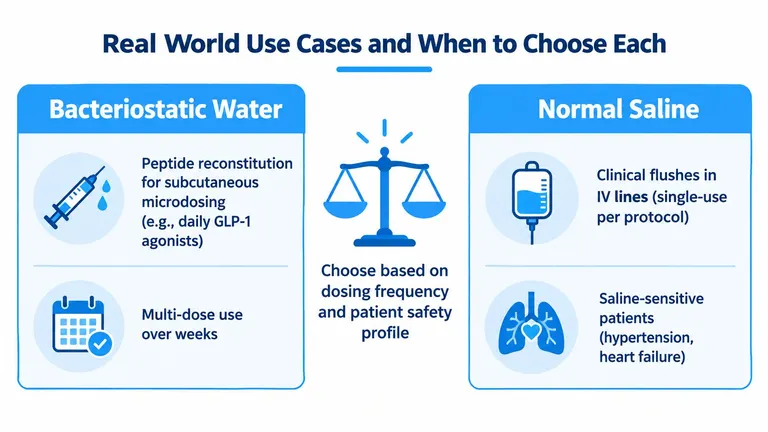
Bacteriostatic water often makes the most sense when someone is reconstituting a peptide for repeated subcutaneous use over time and wants a preserved diluent that doesn’t add sodium chloride to the vial. That’s especially relevant when the product instructions permit that approach and the user wants to avoid changing the solution environment with salt immediately.
It can also make sense when repeated access is unavoidable and preserving the vial between uses is part of the workflow. In that situation, users aren’t choosing it because it’s “cleaner.” They’re choosing it because the handling model matches the protocol.
Common situations where normal saline fits
Normal saline fits best when isotonicity is the point. The classic example is clinical flush use, where saline’s role is already well established. It also fits when a product specifically calls for saline or when the formulation benefits from an isotonic starting point.
What it usually doesn’t solve well is the “I want to open this and keep using it repeatedly as if it were a preserved multi-dose diluent” problem. That’s not what plain saline is built for.
Decision matrix for everyday use
| Situation | Better fit to consider | Why |
|---|---|---|
| Peptide reconstitution with repeated small withdrawals | Bacteriostatic water | Preserved multi-dose handling may align better |
| One-time dilution for near-term use | Normal saline or product-specific direction | Preservative may not add value |
| IV flush context | Normal saline | Isotonic flush role fits established clinical use |
| Salt-sensitive peptide behavior concern | Bacteriostatic water | Avoids immediate sodium chloride load |
| Need isotonicity and repeated access | Ask about bacteriostatic saline | Preservative plus isotonic salt solution |
If the product labeling, prescriber, or compounding pharmacy specifies a diluent, that instruction outranks general preference.
Where readers often overgeneralize
The phrase “for peptides, always use bacteriostatic water” is too broad. So is “saline is safer because hospitals use it.” The right answer changes with route, frequency, handling, and compatibility.
Some people navigating broader hormone or peptide treatment decisions also want more structure around home-based protocols and follow-up. In that context, this overview of at-home TRT options can be useful because it shows how supervised remote treatment models think about logistics, supplies, and consistency rather than just the medication itself.
Neither diluent is a universal winner. Context decides.
Practical Preparation Storage and Handling Workflow
Choosing the right diluent is only half the job. The other half is using it consistently and cleanly.

Before you puncture anything
Start with the label, not memory. Confirm the vial name, concentration, preservative status, and expiration details. “Looks like saline” or “I usually use bac water” isn’t enough when products can look similar on a tray.
A simple pre-check helps:
- Match the product name: Verify that you’re holding bacteriostatic water, normal saline, or another specifically labeled diluent.
- Confirm the protocol direction: Use the diluent named by the prescriber, manufacturer, or pharmacy when one is given.
- Inspect the vial: Don’t use a product with particles, cloudiness, or a compromised seal.
- Prepare the surface: Clean workspace, clean stopper, clean hands.
During reconstitution
Most practical errors happen in the math and the sequence. Users may know which diluent they want, then still misread syringe units or forget to document the final concentration.
That’s where a written workflow matters more than confidence.
- Recheck the amount of peptide in the vial.
- Add only the intended diluent volume.
- Label the vial with the reconstitution date and resulting concentration.
- Record the dose in the same units you’ll measure.
For readers who want a calculation-focused walkthrough, this article on BAC water reconstitution is useful because it stays close to the concentration and measurement side of the process.
After preparation
Storage discipline matters most once the vial leaves your hand and goes back into routine use. If you’re using a repeated-dose protocol, track first puncture date, planned dose schedule, and remaining volume together. Don’t rely on memory after a long week.
Some people also benefit from a structured injection reference when moving from vial math to technique. If your protocol includes semaglutide or a similar subcutaneous routine, these instructions on how to inject semaglutide safely offer a clear technique refresher.
A short visual primer can also help with handling habits:
Keep your tracking system simple
A good system doesn’t need to be elaborate. It just needs to prevent mix-ups.
- Use one naming convention: Write the peptide name and concentration the same way every time.
- Log the puncture date immediately: Don’t plan to add it later.
- Separate calculation from administration: Do the math once, then follow the same measured dose each time unless the protocol changes.
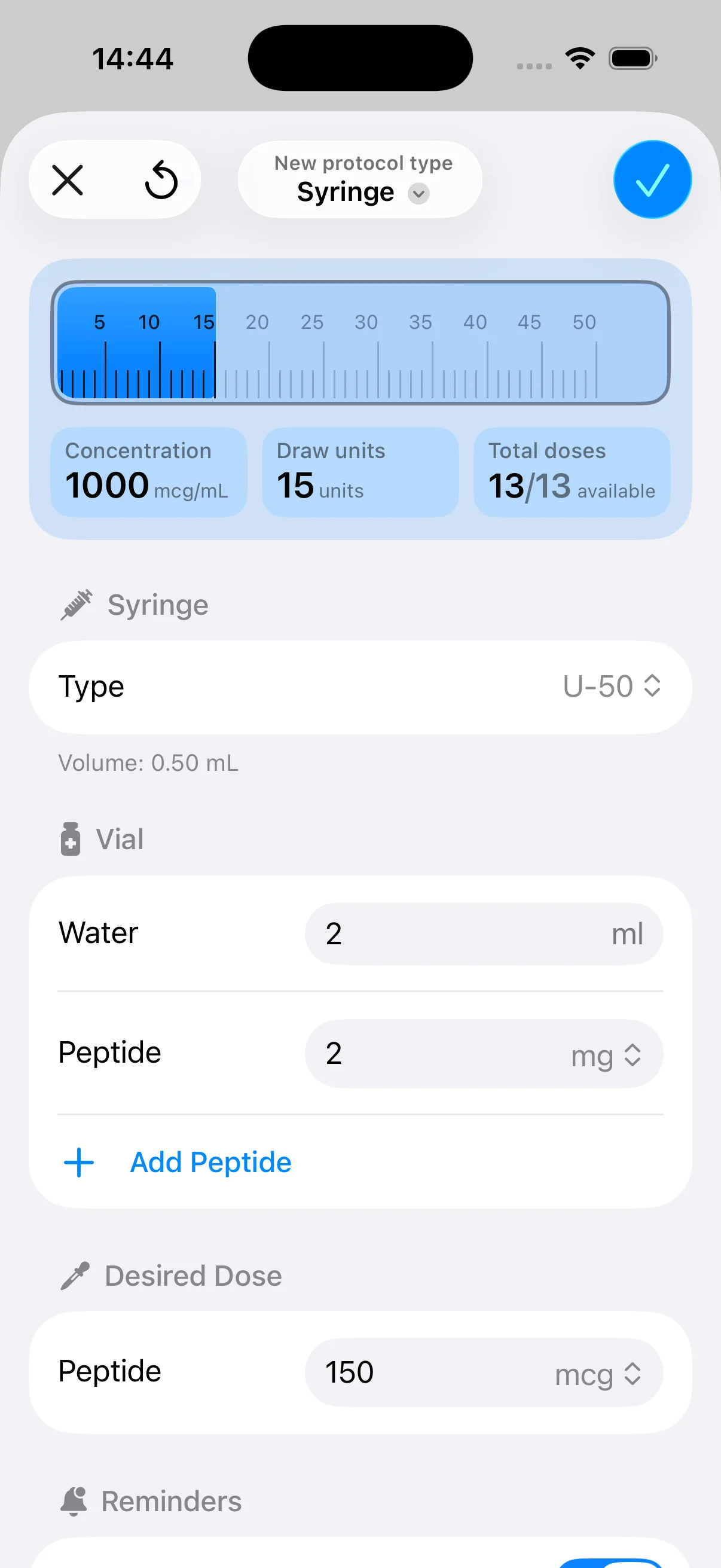
If you want a digital option for concentration math and scheduling, PepFlow is one tool that helps users convert target amounts into syringe units and track recurring peptide protocols. It’s a planning aid, not medical advice, but it can reduce manual calculation mistakes and missed-dose confusion.
Clear Recommendation for Your Situation
A simple way to decide is to match the diluent to the job the vial needs to do.
If the plan is peptide reconstitution with repeated withdrawals over several days or weeks, bacteriostatic water is usually the better fit when the product labeling allows it. The key advantage is not “more sterile” water. It is that the formulation is built for multi-dose handling, where the vial will be punctured, stored, and used again.
If the plan is a saline-based clinical task, such as a flush or a protocol that specifically calls for an isotonic diluent, choose normal saline. Salt changes the feel and function of the solution. In that setting, tonicity is the main requirement, not preservative coverage.
A helpful way to frame the choice is this:
- Repeated peptide dosing from one vial: prioritize multi-dose handling. Bacteriostatic water often fits best if permitted by the label.
- Flushes or saline-specific dilution: prioritize isotonicity. Normal saline fits that purpose.
- Need both isotonicity and preservative support: check whether bacteriostatic saline is the product the protocol calls for.
That last point matters because many people compare only two options when the question has three parts. What tonicity does the medication need? Will the vial be entered more than once? How much preservative exposure is acceptable for the dosing pattern?
Ask a prescriber or pharmacist before switching diluents if any of these apply:
- The medication label names a specific diluent
- You want to change diluents mainly to improve injection comfort
- You are not sure whether added salt could affect the product
- You expect very frequent microdosing and want to weigh preservative exposure carefully
- The vial’s appearance, storage, or handling history is unclear
The safest choice is the one that matches both the formulation requirements and how the vial will be handled.
For most peptide users, the decision is less about a generic “which one is safer” question and more about fit. Match the vial to its use pattern. Choose based on tonicity, preservative exposure, and whether the product will be single-use in practice or entered repeatedly over time.
PepFlow helps you turn that decision into a repeatable routine. If you’re reconstituting peptides and want support with concentration math, dose-to-unit conversion, scheduling, and reminders, visit PepFlow to see how it fits into a safer, more organized workflow.