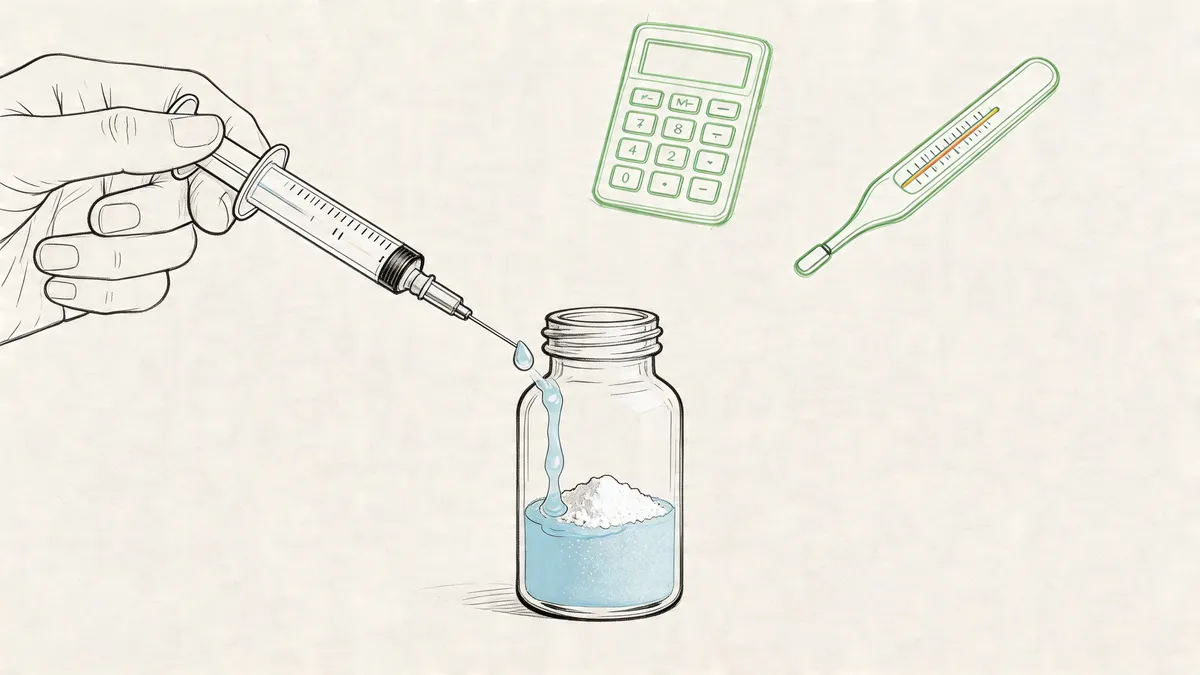
You’ve got a vial of lyophilized peptide in one hand, a syringe in the other, and that brief moment of hesitation, which few acknowledge. The powder looks simple. The process isn’t. One wrong solvent, one rushed injection into the vial, or one decimal error in the math can turn a clean protocol into a wasted vial.
That’s why peptide reconstitution solution is often underestimated. Reconstitution isn’t just mixing powder with water. It’s the point where sterility, solubility, dosing accuracy, and storage life all converge. If you handle this step well, everything that follows gets easier. If you handle it poorly, every later dose is built on a bad foundation.
Table of Contents
- Your First Step to Peptide Protocol Success
- Choosing Your Peptide Reconstitution Solution
- The Sterile Reconstitution Process Explained
- Mastering Dosing Calculations and Volume
- Proper Storage for Stability and Potency
- Using PepFlow to Plan and Track Your Protocol
- Frequently Asked Reconstitution Questions
Your First Step to Peptide Protocol Success
A peptide vial starts as inert powder. Reconstitution is what turns it into a usable solution, but it also locks in the quality of everything that follows. Concentration, dose volume, sterility, and storage life all depend on what happens in these first few minutes.
The practical mistake is treating reconstitution like a minor prep task. It isn’t. It’s the first operational step of the protocol itself. If the solvent is wrong, the peptide may not dissolve cleanly. If the technique is sloppy, contamination risk rises. If the math is off, every dose after that is off too.
A good approach feels a lot like writing lab work that someone else could repeat without guessing. If you want a useful framework for that mindset, this guide on how to write a clear lab procedure is worth reading. The same discipline applies here. Clear steps reduce avoidable errors.
Practical rule: Reconstitution should be boring, repeatable, and documented. If it feels improvised, tighten the process.
Precision matters because peptides don’t forgive rough handling. The best outcomes usually come from simple habits done consistently: clean surfaces, correct diluent, slow addition, patient mixing, accurate calculations, and disciplined storage.
Choosing Your Peptide Reconstitution Solution
You open a fresh vial, add the wrong diluent out of habit, and the powder turns into a stubborn film that will not fully clear. At that point, sterile technique can still be perfect and the protocol is already off track. Solvent choice sets the working conditions for solubility, repeat withdrawals, and how much confidence you can have in every measured dose afterward.
A quick comparison
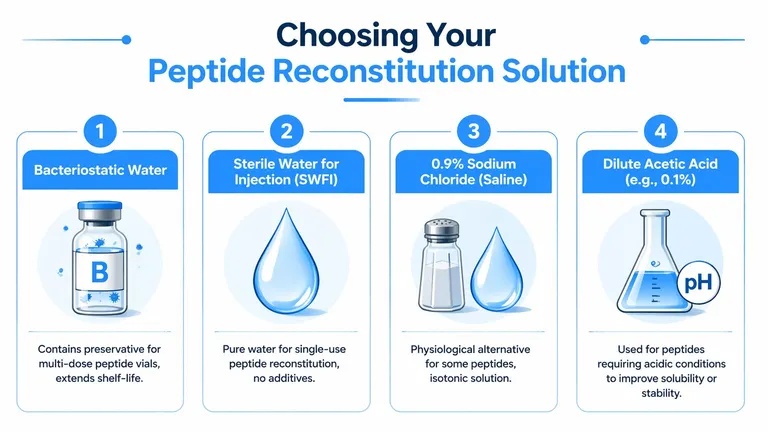
Some peptides dissolve cleanly in plain sterile water. Others do not. JPT notes in its peptide reconstitution guidance that a common correction for poorly dissolving basic peptides is switching from neutral water to 0.6% acetic acid in water, especially for sequences rich in arginine or lysine.
| Solution Type | Composition | Best For | Shelf Life (Reconstituted) |
|---|---|---|---|
| Bacteriostatic Water | Sterile water with 0.9% benzyl alcohol | Multi-dose use where repeated withdrawals are expected | Commonly handled as up to 28 days refrigerated |
| Sterile Water for Injection | Sterile water with no preservative | Single-use reconstitution | Short-term, single-use preference |
| 0.9% Sodium Chloride (Saline) | Sterile isotonic saline | Situations where an isotonic option is preferred | Depends on handling and protocol |
| Dilute Acetic Acid | Weak acid in water, commonly 0.6% when needed for solubility support | Peptides that don’t dissolve well in neutral water, especially basic sequences | Use depends on peptide and handling plan |
How to decide in practice
Bacteriostatic water is the practical default when the vial will be accessed more than once. The preservative helps limit microbial growth, which matters any time repeated withdrawals are part of the plan. The trade-off is that you are choosing a preserved diluent, so it should match the handling plan and the peptide’s intended use. If you want a focused explanation of that option, PepFlow’s guide on what bacteriostatic water is used for is a useful reference.
Sterile water for injection is the cleanest simple option. No preservative, no added salt, fewer variables. That makes it a good fit for single-use preparation or cases where you want the least complicated solvent system. It is less forgiving once a vial is in active use because there is no antimicrobial preservative covering repeated access.
Saline can be appropriate, but only for a reason. Use it when the peptide data sheet, protocol, or application calls for an isotonic solution. Do not treat saline as a universal substitute for sterile water. It may be acceptable for one peptide and a poor choice for another.
Dilute acetic acid solves a specific problem. Some basic peptides resist neutral water and sit as clumps or a cloudy suspension even with patient mixing. A mild acidic diluent often clears that up more effectively than aggressive shaking, which can create foam and wasted time without fixing the underlying solubility issue.
The right solvent is the one that matches the peptide, the withdrawal pattern, and the concentration you need to work with.
One point that deserves discipline is water quality terminology. Many people mix up purified water types and assume they are interchangeable with sterile injectable diluents. They are not. If you need a quick refresher on lab water terminology, Deionised Water vs Distilled Water explains the distinction clearly. For peptide work, the practical choice should still start with sterile, injectable-grade products rather than general-purpose lab water.
This is also where digital planning helps. Manual reconstitution decisions are easy to document poorly, especially when concentration, diluent choice, and dose volume all interact. PepFlow closes that gap by keeping the chosen solvent, target concentration, and dosing math in one place, which reduces the chance of solving the solubility problem but introducing a calculation error instead.
The Sterile Reconstitution Process Explained
A vial usually gets compromised in the first minute, not because the peptide was poor, but because the bench was crowded, the stoppers were still wet with alcohol, or the solvent hit the cake too hard.
Set up the workspace first
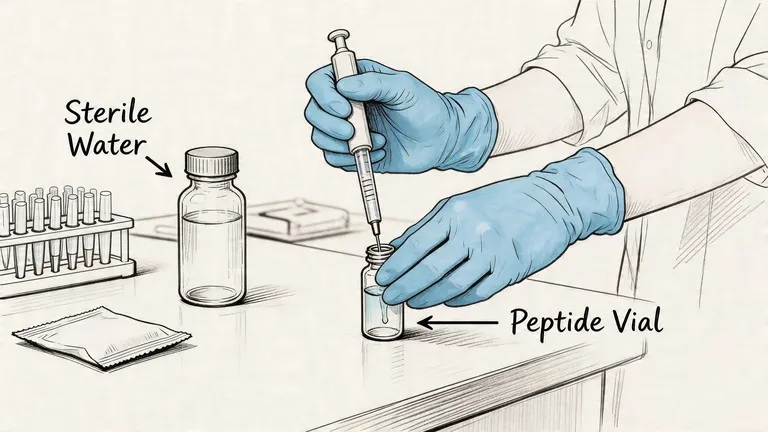
Clear the surface before you touch the vial. Put down only what you need: peptide vial, diluent, alcohol wipes, a new sterile syringe, and the needle you will use. Reaching back into drawers or across a cluttered bench is how clean hands turn into questionable technique.
Wipe both vial stoppers with 70% isopropyl alcohol and let them air dry fully. Dry time matters because the stopper is being disinfected during contact and evaporation, not just wiped clean. Ultra Labs also notes that careful stopper prep, controlled wall-side solvent addition, and patient dissolution improve outcomes during peptide reconstitution in practical bench use, as outlined in their peptide reconstitution guide.
If you work in a more formal lab environment, broader sterilization practices matter too. For anyone building cleaner bench habits, this overview of an autoclave for laboratory use is a useful companion read, even though the vial reconstitution step itself depends mainly on aseptic handling rather than terminal sterilization.
Add the solvent with control
Draw up the planned volume of diluent. Then insert the needle and angle it toward the inner glass wall of the peptide vial at roughly 45 degrees. Let the solvent run down the side.
That slower addition protects the lyophilized peptide from direct impact and reduces foaming. If the vial pulls hard from pressure differences, pause and steady your hand rather than forcing the plunger. Controlled hands matter more here than speed.
I treat this as a precision step, not a routine one. A rushed injection can leave you with bubbles, splashed powder on the stopper, or a stubborn film on the glass that takes longer to dissolve than the peptide itself.
For readers who want a cleaner way to pair the right reconstitution volume with the concentration they plan to use later, a peptide reconstitution calculator guide helps prevent the common mistake of choosing volume by guesswork and then trying to fix the math afterward.
A clean reconstitution usually looks uneventful. That is the point.
For readers who want to watch the hand motion and setup sequence, this demonstration is useful:
Let dissolution finish on its own
Once the solvent is in, leave the vial alone for a moment. Then swirl gently or invert it slowly if needed. Rolling the vial softly between your hands is fine. Shaking is a poor trade because it adds agitation without solving the underlying issue when solubility is marginal.
Watch the solution, not the clock. A properly dissolved vial should look uniform and clear for that peptide and solvent combination. If you still see suspended flecks or a thin film stuck to the glass, give it more time before changing tactics.
Use a simple check at the end:
- Inspect clarity: Look for a uniform solution without visible particles or flakes.
- Keep agitation gentle: Swirling and slow inversion are usually enough.
- Wait before intervening: Some vials clear with time alone.
- Troubleshoot methodically: If material remains, reassess solvent choice, concentration, and handling before blaming the peptide.
Good sterile work is repetitive by design. PepFlow fits well into that approach because it keeps the chosen diluent, target concentration, and reconstitution notes tied to the protocol, which makes repeat runs easier to reproduce without relying on memory.
Mastering Dosing Calculations and Volume
A vial can be mixed perfectly and still be dosed badly. The usual failure point is not sterile technique. It is bad arithmetic, sloppy unit conversion, or a syringe reading that was never written down clearly.
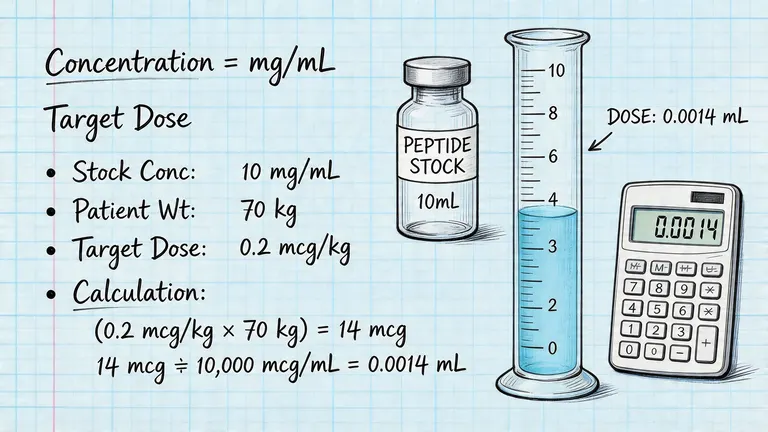
The core math that matters
Start with concentration:
Concentration (mg/mL) = peptide mass (mg) ÷ diluent volume (mL)
Then convert that concentration into the volume needed for each dose:
Dose volume (mL) = target dose (mg) ÷ concentration (mg/mL)
For microgram-based protocols, convert carefully. 1 mg = 1000 mcg. That single step is where a lot of preventable errors happen.
The practical point is simple. Adding more diluent does not increase the amount of peptide in the vial. It changes the concentration, which changes the draw volume required for each dose.
A manual example that stays consistent
Use a 10 mg vial with a target dose of 1 mg.
If you add 1 mL of diluent, the concentration is 10 mg/mL. A 1 mg dose requires 0.1 mL, which is 10 units on a U-100 insulin syringe.
If you add 2 mL, the concentration becomes 5 mg/mL. A 1 mg dose now requires 0.2 mL, or 20 units.
If you add 5 mL, the concentration is 2 mg/mL. A 1 mg dose requires 0.5 mL, or 50 units.
Same vial. Same total peptide mass. Same 10 total doses at 1 mg each. Only the liquid volume per dose changes.
That trade-off matters in real use. A more dilute vial can make very small doses easier to measure, especially when the calculated draw would otherwise land at a tiny syringe increment. The downside is more injection volume and, in some cases, more handling over the life of the vial. A more concentrated vial reduces volume per shot, but it raises the penalty for a small reading mistake.
Where manual dosing goes wrong
The recurring mistakes are predictable:
- Mixing up mg and mcg
- Forgetting that insulin syringe units are volume markings
- Writing down the peptide amount but not the final concentration
- Changing reconstitution volume on the next vial and reusing the old draw amount
I treat the syringe only as the final display. The sequence is vial mass, added volume, concentration, target dose, then syringe units. If any one of those is missing, the rest can drift.
One habit worth keeping: Label the vial or your protocol sheet with all four values before the first draw: total peptide mass, total diluent added, concentration, and dose volume in mL or syringe units.
Manual calculation is still worth learning because it lets you catch bad assumptions fast. For repeated use, though, a calculator reduces transcription errors and keeps the protocol consistent across vials. PepFlow is useful here because it ties the math to the actual protocol instead of leaving dose notes scattered across screenshots and paper labels. If you want a cleaner setup, this guide to the best peptide reconstitution calculator shows how to convert vial size and target dose into practical draw volumes without redoing the math every time.
Proper Storage for Stability and Potency
Reconstitution ends when the powder dissolves. Stability management starts right after that. If the vial sits warm, bright, or repeatedly handled, the quality you preserved during mixing can still slip away.
What protects the vial after mixing
Store reconstituted peptide in the refrigerator at 2 to 8°C when the handling instructions for that solvent support refrigerated use. Keep the vial protected from unnecessary light exposure. The original carton works well. So does simple foil wrapping if needed.
Bacteriostatic water is usually chosen when repeated withdrawals are expected because its preservative supports a 28-day sterility window, as discussed in the product-focused overview from Happy Peptides’ reconstitution solution page. That sterility window is useful, but it shouldn’t be confused with guaranteed full potency for every peptide across that entire period.
Where people lose potency
The more realistic question isn’t just “Is it still sterile?” It’s “Is it still potent enough to trust?” The same Happy Peptides reference notes that while sources often cite 28-day sterility, unpublished studies suggest 10 to 30% potency loss after 14 days at 4°C for some hydrophilic peptides. That doesn’t mean every peptide behaves that way. It means storage decisions should stay conservative.
A few habits reduce the usual damage:
- Label immediately: Record the reconstitution date on the vial or storage container.
- Avoid repeated warming: Don’t leave the vial out while you do unrelated prep.
- Limit freeze-thaw exposure: If you freeze aliquots, thaw once and use that aliquot without refreezing.
- Keep handling clean: Every extra puncture and touch is another chance to compromise the vial.
If you want a more detailed storage framework, this guide on how to store reconstituted peptides is a practical follow-up.
Using PepFlow to Plan and Track Your Protocol
A vial gets mixed correctly on day one. The preventable errors usually show up on day five or day twelve, when the concentration was written in one note, the reconstitution date in another, and the planned dose lives in someone’s memory.
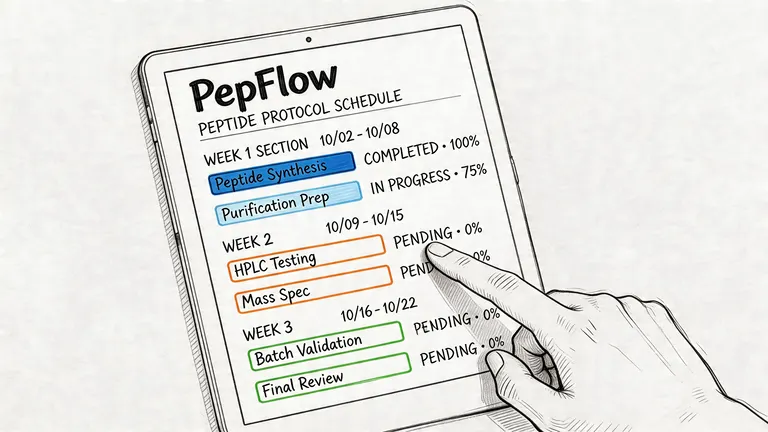
Why protocol management matters
Once a peptide is reconstituted, every later decision depends on the original setup. Solvent volume, peptide mass, concentration, draw volume, reconstitution date, and discard timing all stay connected. If one of those details gets logged incorrectly, the dosing error carries forward until someone catches it.
The practical problem is simple. A target dose in milligrams only becomes a usable syringe volume after the vial concentration is recorded correctly. Change the diluent volume and the draw volume changes with it, even though the peptide mass in the vial stays the same. Volume conversion is tied directly to how the vial was prepared, which is why accurate tracking needs to start at reconstitution, not after the first injection.
I have found that manual systems break down in predictable ways. Screenshots get outdated. Notebook entries miss a date. A vial in the refrigerator looks familiar enough that someone assumes they remember the concentration. That is usually how a clean prep turns into an unreliable protocol.
What a cleaner system looks like
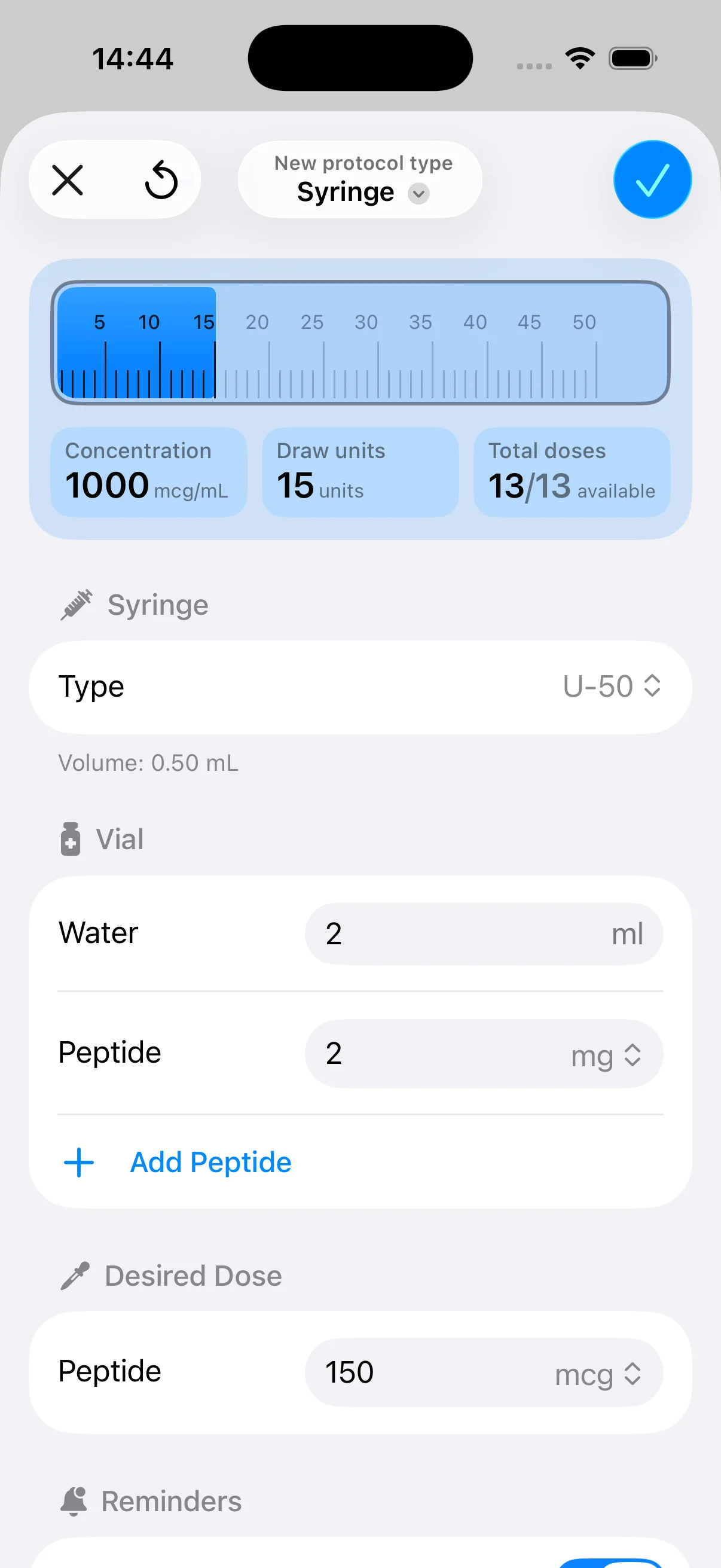
PepFlow closes that gap between calculation and execution. Instead of treating reconstitution math as a one-time task, it keeps the vial setup attached to the actual protocol so the planned dose, draw volume, schedule, and remaining supply stay in one record.
That is the part many calculators miss.
A useful system should handle the full chain of decisions:
- Record the starting vial setup: peptide amount, diluent used, total added volume, and reconstitution date
- Convert dose to draw volume automatically: based on the exact concentration you created
- Track each administration: so remaining volume and remaining doses update from real use
- Flag timing issues: including missed doses, upcoming administrations, and when a vial should be retired
- Keep protocol history in one place: so adjustments are documented instead of guessed later
For careful users, the value is not convenience alone. It is error control. If the app knows the vial concentration and the intended dose, it can reduce the common arithmetic mistakes that happen when people keep recalculating from memory or from old notes. That makes PepFlow more than a peptide calculator. It functions as the working protocol log, which is what keeps reconstitution details useful after the vial is already in circulation.
Frequently Asked Reconstitution Questions
Some of the most useful questions show up after the first vial, not before it. Troubleshooting tends to be specific and practical, so it helps to keep the answers tight.
| Question | Answer |
|---|---|
| Can I use more water to create more doses? | No. Dose count depends on peptide mass divided by target dose. More solvent only changes the liquid volume per dose. |
| What if the peptide doesn’t dissolve in sterile water? | Don’t force it with shaking. Reassess the solvent choice. Some peptides dissolve better in a mild acidic solution, especially basic sequences. |
| Should I shake the vial to speed things up? | No. Gentle swirling is the safer approach for peptide integrity and clean dissolution. |
| Is bacteriostatic water always the best choice? | It’s usually the practical choice for multi-dose use because of the preservative. It isn’t automatically the right choice for every peptide or every protocol. |
| How long should I keep a mixed vial? | Follow the solvent-specific handling window, refrigerate appropriately, and stay conservative about potency over time rather than focusing only on sterility. |
| What if I see particles after mixing? | Give the vial more time first. If particles persist, review the solvent choice and handling technique before assuming the peptide is unusable. |
The best reconstitution habits aren’t complicated. They’re disciplined. Choose the solvent for the peptide, not for convenience. Add it gently. Let the vial dissolve without force. Calculate from first principles. Store the finished solution like it matters, because it does.
PepFlow is a strong fit if you want the calculation and scheduling side handled cleanly. It helps convert vial strength and diluent volume into usable draw amounts, then keeps the full protocol organized with reminders, logging, and cycle tracking. If you’re tired of handwritten notes, scattered screenshots, and second-guessing syringe units, it’s a practical way to run a tighter protocol.