SS-31 is FDA-approved only for Barth syndrome, while claims about energy, recovery, aging, or general mitochondrial health remain investigational. In the strongest randomized human kidney study, involving 14 patients, renal blood flow in the SS-31 group rose from 202 ± 29 to 262 ± 115 mL/min three months after revascularization, but that result doesn’t establish a wellness benefit.
That distinction is the surprising part. SS-31, also called elamipretide, is a real clinical molecule with human trial data and measurable physiological signals, yet the broad “mitochondrial support” story has moved faster than the evidence. A compound can restore selected mitochondrial functions in damaged tissue and still fail to improve a major functional endpoint in people.
The useful question, then, isn’t whether SS-31 has a compelling mechanism. It does. The useful question is which proposed benefits have shifted meaningful human outcomes, which remain preclinical, and which are mostly marketing language.
Table of Contents
- What SS-31 Is and Why It Matters
- The Mitochondrial Mechanism Behind the Hype
- Preclinical Evidence for Bioenergetic Rescue
- Clinical Trial Signals Worth Taking Seriously
- Endurance, Recovery, and Longevity Claims Graded Against the Data
- Caveats, Approval Status, and What 2026 Trial Data Could Change
- A Balanced Verdict on SS-31 Peptide Benefits
What SS-31 Is and Why It Matters
SS-31, or elamipretide, is a synthetic tetrapeptide developed as a mitochondrially targeted drug. It is not a conventional workout supplement, a general antioxidant, or another over-the-counter peptide sold through a wellness catalogue. Readers unfamiliar with peptide chemistry can review this synthetic amino acid chains explained for useful background. SS-31 is better assessed as a pharmaceutical research program than as a generic research chemical.
Its proposed value depends on where it acts. Rather than circulating broadly through conventional cell-surface receptors, SS-31 is designed to reach the inner mitochondrial membrane and interact with cardiolipin, a lipid involved in mitochondrial structure and respiratory-chain organization. That targeting provides a coherent biological rationale for disorders involving mitochondrial and muscle dysfunction, but the mechanism alone cannot establish a clinical benefit.
Approval is narrower than the public conversation
The clinical record shows progression from preclinical work to human testing by the late 2010s and early 2020s. SS-31 also became the first peptide in its class to enter clinical trials for heart failure. In a single-infusion study of reduced-ejection-fraction heart failure, a review in Circulation: Heart Failure described the treatment as safe and well tolerated. Separate Barth syndrome research reported improvements in skeletal muscle performance and patient-reported fatigue after 48 weeks of total exposure, consisting of 12 weeks randomized treatment and 36 weeks open-label treatment (review and Barth syndrome evidence).
That trial design matters. A randomized period can provide a comparator, while a longer open-label period can show whether changes persist, but it cannot separate continued treatment effects from expectation, natural variation, or other influences as cleanly as a sustained controlled comparison.
The evidence supplied for this analysis identifies Barth syndrome as the only FDA-approved indication. Proposed uses in heart failure, dry age-related macular degeneration, kidney injury, muscle aging, endurance, and general wellness remain investigational.
Why wellness claims need tighter language
The same molecule may be credible in one disease and unproven in another. Barth syndrome involves a specific mitochondrial disorder, whereas “more energy,” “faster recovery,” and “slower aging” describe broad outcomes with multiple biological causes. Evidence of improved muscle performance in a defined disease therefore does not validate every claim linked to SS-31’s mechanism.
A practical evidence grade separates randomized human endpoints, smaller physiological signals, animal findings, and marketing extrapolation. SS-31 appears across all these categories, but they answer different questions. Mechanistic promise can justify further trials. It cannot, by itself, establish a general wellness benefit.
The Mitochondrial Mechanism Behind the Hype
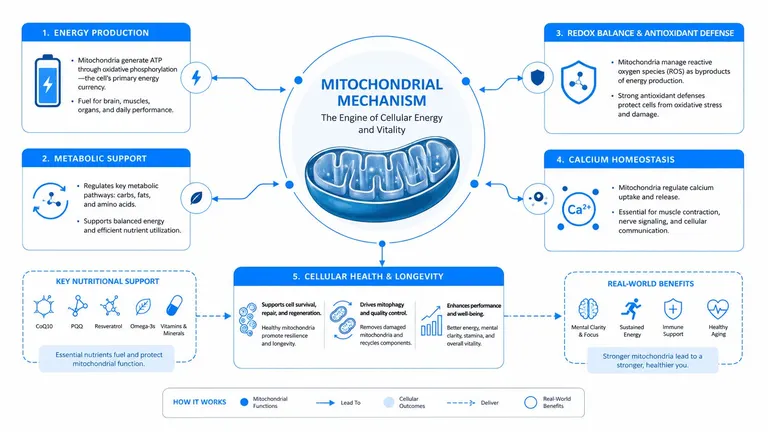
Mitochondria produce energy through a highly organized inner membrane. One of the membrane’s important structural lipids is cardiolipin, which helps support the respiratory machinery and the folded architecture known as cristae. A useful analogy is to picture cardiolipin as scaffolding bolts that keep the electron transport chain in the right geometry. If those bolts become damaged, the machinery may remain present but work less efficiently.
The electron transport chain passes electrons through respiratory complexes and uses that flow to establish the gradient required for ATP synthesis. Damaged membrane organization can increase electron leak, promote reactive oxygen species, and reduce the efficiency of energy production. SS-31’s rationale is to stabilize this vulnerable environment rather than act as a broad stimulant.
How targeting creates the proposed effect
SS-31 is an aromatic-cationic sequence designed to interact with cardiolipin through electrostatic and hydrophobic forces. The supplied research background describes the compound as concentrating 1,000 to 5,000-fold at the inner mitochondrial membrane, but that quantitative mechanism claim comes from the research material rather than the verified data list, so it should be treated as background rather than as a standalone clinical fact.
The downstream hypothesis is still clear. By interacting with cardiolipin, SS-31 may preserve membrane potential, reduce electron leakage, improve respiratory coupling, and lower mitochondrial ROS. Those are mechanistic outcomes. They can explain why researchers study the compound in muscle, heart, kidney, and retinal disease, but they don’t automatically predict better endurance or longer human life.
The mechanism is a map, not a destination
The distinction matters because mitochondrial performance sits underneath many different diseases. A kidney affected by reduced blood flow, a failing heart, an inherited cardiolipin disorder, and a healthy athlete seeking faster recovery don’t present the same biological problem. Improving one mitochondrial measurement may help one population while leaving another population’s limiting factor unchanged.
That is also why readers exploring fatigue should first understand the broader clinical context in this guide to fighting chronic fatigue, rather than assuming that every fatigue symptom indicates the same mitochondrial defect. SS-31 may be relevant to a defined mitochondrial disorder, but symptom similarity isn’t diagnostic proof.
A practical comparison of mitochondrial-targeted approaches is available through PepFlow’s SS-31 and MOTS-c discussion. The key analytical point is that SS-31 is proposed to stabilize mitochondrial structure, not to serve as a universal energy enhancer.
Preclinical Evidence for Bioenergetic Rescue
Preclinical findings support a specific mitochondrial effect, not a general wellness promise. In aged muscle and heart tissue, SS-31 has been associated with lower mitochondrial ROS and protein oxidation, better electron-transport coupling, and a more reduced thiol redox state, as summarized in this review of mitochondrial and tissue findings.
Human failing-heart tissue provides a useful mechanistic test. SS-31 improved activity in respiratory complexes I, III, and IV, with no reported effect on complexes II or V. That pattern is more consistent with selective repair of impaired respiratory organization than with broad stimulant activity. It also points to a possible restoration of supercomplex function after mitochondrial damage.
What the animal work can and can’t establish
Aged muscle and heart models expose tissue to biological stress, making them more informative than isolated chemical assays for this question. Their results support three linked possibilities: SS-31 may improve energy production in damaged mitochondria, reduce oxidative pressure, and preserve the arrangement of respiratory machinery.
The outcome measures still limit the conclusion. Improved redox chemistry or respiratory-complex activity does not demonstrate that a healthy adult will run farther, recover faster, or live longer. Animal dosing, administration route, disease severity, metabolism, and performance tests may differ substantially from human protocols. Many studies also prioritized biochemical or tissue endpoints over direct functional measures such as grip strength or sustained treadmill performance.
| Model or tissue | Dose and route | Key finding | Year or source |
|---|---|---|---|
| Aged muscle and heart tissue | Preclinical administration, protocol-specific | Reduced mitochondrial ROS and protein oxidation, with improved respiratory coupling and redox state | Mitochondrial tissue review |
| Human failing-heart tissue | Ex vivo tissue analysis | Improved complexes I, III, and IV, with no reported effect on complexes II and V | Human failing-heart tissue findings |
| Damaged mitochondrial systems | Model-specific | Selective restoration of respiratory supercomplex function rather than broad stimulation | Mechanistic evidence review |
The strongest interpretation is therefore limited but meaningful. Bioenergetic rescue appears consistent enough across tissue models to justify human testing. The evidence does not yet establish that correcting mitochondrial measurements produces broad improvements in energy, endurance, recovery, or longevity. Those outcomes require direct clinical evaluation rather than inference from mechanism.
Clinical Trial Signals Worth Taking Seriously
SS-31 has generated real human signals, but they remain concentrated in specific diseases and physiological endpoints. The Barth syndrome program provides the clearest disease-specific example. The reported trial involved 48 weeks of total exposure, with improvements in skeletal muscle performance and patient-reported fatigue, alongside signals of increased cardiac stroke volume.
Those findings connect mitochondrial biology with outcomes that matter to patients. Their scope remains narrow. Barth syndrome is a rare inherited mitochondrial disorder, so the results cannot be transferred directly to healthy adults seeking more energy or athletes seeking greater training capacity. The distinction between mechanistic promise and clinical proof is central here.
The kidney study offers the sharpest quantitative signal
A randomized, double-blind, placebo-controlled phase IIa study examined 14 patients with severe atherosclerotic renal artery stenosis. Three months after revascularization, the SS-31 group was the only group to show increased renal blood flow, rising from 202 ± 29 to 262 ± 115 mL/min. Renal cortical perfusion also increased from 1.99 ± 0.8 to 2.9 ± 1 mL/min/mL. The study reported lower systolic blood pressure and improvements in serum creatinine and estimated GFR compared with placebo (renal artery stenosis trial).
The significance is that this was an organ-level physiological result in a randomized human study, not merely a cellular laboratory marker. Its limitations are equally important. The sample was small, the participants had a specific vascular disease, and the findings support additional research rather than a general kidney-health recommendation.
Why mixed endpoints change the interpretation
Heart-failure research is less consistent. Early human work described acute administration as safe and well tolerated, while later programs did not establish a broad benefit across primary endpoints. A clinical overview also describes no significant improvement in the 6-minute walk test or fatigue scores in a randomized crossover trial, despite sustained benefits reported during a 168-week open-label extension (clinical overview and mixed endpoint discussion).
| Indication | Trial or phase | Primary endpoint result | Notable secondary signals |
|---|---|---|---|
| Barth syndrome | Phase 2/3 | Evidence of functional improvement after extended exposure, requiring indication-specific interpretation | Improved skeletal muscle performance, fatigue reports, and signals of increased cardiac stroke volume |
| Atherosclerotic renal artery stenosis | Randomized phase IIa | Renal blood flow and cortical perfusion improved in the SS-31 group | Blood pressure, serum creatinine, and estimated GFR also improved versus placebo |
| Heart failure with reduced ejection fraction | Early and later clinical studies | Mixed, with some primary endpoints not significantly improved | Cardiac-physiology signals did not establish a general heart-failure treatment effect |
| General endurance or longevity | No completed human outcome trial identified in the verified evidence | Unestablished | Mechanistic and preclinical rationale only |
The clinical record therefore supports a graded conclusion. SS-31 has disease-specific human signals, including functional outcomes in Barth syndrome and renal perfusion changes in renal artery stenosis. Heart-failure endpoints remain mixed, and no cited trial has tested the peptide in healthy adults for endurance or longevity. That absence limits what can responsibly be inferred from its mitochondrial mechanism.
Endurance, Recovery, and Longevity Claims Graded Against the Data
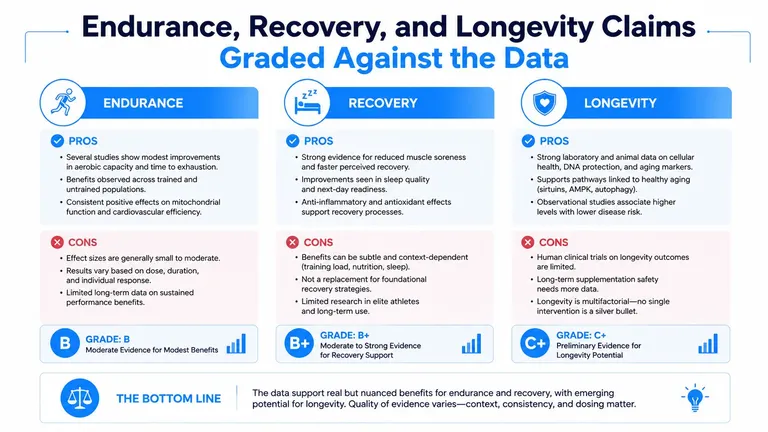
Popular SS-31 content often treats mitochondrial support as a proxy for performance. That shortcut fails because performance depends on the whole organism, including cardiovascular delivery, neuromuscular coordination, training status, nutrition, sleep, and disease burden. The available evidence supports a graded interpretation, not a single answer.
A four-tier evidence scale
Proven means a relevant human outcome has been demonstrated in the approved disease context. Supported means randomized human evidence shows a meaningful physiological or patient-reported signal, but the evidence is narrow or incomplete. Preclinical means the finding comes from animal or tissue research. Unproven means the claim lacks a completed human outcome trial.
| Claim | Grade | Analyst’s reading |
|---|---|---|
| Improved function in Barth syndrome | Proven in a narrow indication | Human evidence supports disease-specific functional and fatigue-related benefit, but not general wellness use |
| Improved renal perfusion in severe renal artery stenosis | Supported | A small randomized human study found organ-level changes, but the finding doesn’t establish broad kidney optimization |
| Endurance in healthy adults | Mechanism only | No completed human endurance randomized controlled trial is identified in the verified evidence |
| Recovery in trained athletes | Preclinical signal at most | Animal and mechanistic findings don’t establish reduced soreness or faster human recovery |
| Longevity and healthspan | Unproven | No human trial has demonstrated longer life, reduced frailty, or improved aging outcomes |
| Skin or topical anti-aging effects | Marketing | The verified evidence doesn’t provide peer-reviewed human outcome data for this claim |
Why endurance is the easiest claim to overstate
If SS-31 improves mitochondrial coupling in aged or damaged muscle, better exercise tolerance is biologically plausible. But plausible isn’t the same as demonstrated. A healthy athlete may already have functioning mitochondria, and the bottleneck in performance may lie elsewhere.
The same caution applies to recovery. Reduced oxidative stress in an animal model doesn’t prove that a trained person will experience less soreness, lower inflammation, or better adaptation. Readers comparing peptide claims with practical interventions can also consult information on premium recovery equipment UK, but equipment choices and peptide claims should be evaluated separately.
Longevity is the largest leap. SS-31 can improve selected features of aged tissue in experimental settings, yet no verified human outcome trial has shown extended lifespan or a meaningful reduction in age-related disability. A cardiolipin mechanism may justify research into aging. It doesn’t justify presenting SS-31 as an established longevity therapy. The same evidence filter applies to broader peptide discussions in PepFlow’s longevity guide.
Evidence rule: A better mitochondrial measurement is a promising intermediate result. It becomes a benefit only when the relevant human endpoint improves.
Caveats, Approval Status, and What 2026 Trial Data Could Change
The regulatory boundary is narrower than online discussions often suggest. The verified evidence identifies Barth syndrome as the only FDA-approved indication for elamipretide. Applications involving aging, general mitochondrial health, athletic performance, heart failure, dry AMD, muscle aging, or kidney protection remain investigational.
Approval for one disease does not establish efficacy, safety, dosing, or lawful marketing claims in unrelated populations. The same molecule can be studied elsewhere, but each proposed use requires its own evidence and regulatory decision.
Product quality is a separate risk
Clinical trials use defined manufacturing, controlled administration, eligibility criteria, and monitored outcomes. An online vial labeled “research-grade SS-31” may lack those safeguards. The available evidence brief warns that compounded or research-grade products sold online for wellness use are unregulated and can vary in quality.
The uncertainty therefore extends beyond whether SS-31 works. Product identity, purity, sterility, concentration, storage, and labeling may be difficult to verify, particularly with an injectable. A research vial should not be treated as equivalent to an approved pharmaceutical product.
What future readouts could clarify
The supplied evidence indicates that phase 3 work continues in dry AMD, with expected 2026 developments that could broaden or constrain future indications. Those results may support disease-specific use, reveal limits in translating mitochondrial biology into clinical function, or produce another mixed outcome, as noted in the current clinical overview cited earlier.
The most informative details will be methodological and clinical:
- Population: Whether participants have a defined mitochondrial disease or are otherwise healthy.
- Comparator: Whether allocation is randomized and placebo controlled.
- Endpoint: Whether the study measures function, symptoms, organ physiology, or only biomarkers.
- Duration: Whether any improvement persists beyond a short treatment window.
- Replication: Whether independent studies reproduce the result.
A favorable biomarker does not by itself establish a meaningful patient benefit. The interpretation should also account for adverse events, dropout rates, prespecified endpoints, and whether the result applies to the population being discussed.
Readers reviewing regulatory terminology can consult this FDA-approved peptide drugs list for broader context. Any future approval would still need to be interpreted indication by indication, rather than as evidence for generalized wellness or longevity use.
A Balanced Verdict on SS-31 Peptide Benefits
SS-31 deserves more respect than a typical gray-market wellness peptide, and more skepticism than its marketing usually receives. It has a coherent mitochondrial target, a substantial research history, and randomized human evidence showing measurable physiological changes in selected diseases. It also has mixed clinical endpoints, narrow applicability, and no established human longevity outcome.
Three evidence tiers
The strongest tier is disease-specific human benefit. Barth syndrome research reported improvements in skeletal muscle performance and patient-reported fatigue after extended exposure, along with signals of increased cardiac stroke volume. The renal artery stenosis study adds a separate, notable human signal, with improved renal blood flow and cortical perfusion in the SS-31 group.
The middle tier is promising but incomplete. Mitochondrial rescue in aged tissue, selective restoration of respiratory complex activity in failing-heart tissue, and renal microvascular changes all support the biological hypothesis. These findings justify continued trials. They don’t support prescribing SS-31 to healthy adults for generalized energy or aging.
The weakest tier includes broad wellness promises. Longevity, athletic endurance, routine recovery, skin rejuvenation, and “mitochondrial optimization” remain unproven in completed human outcome trials identified by the verified evidence. The 2026 review’s mixed functional findings reinforce the need to separate sustained open-label signals from successful randomized primary endpoints.
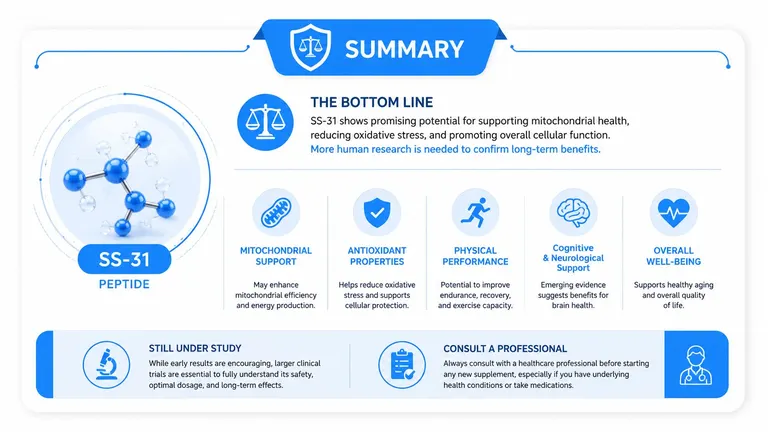
The analyst’s verdict is therefore conditional. SS-31 convincingly predicts improved mitochondrial resilience in specific damaged systems, and some human studies have measured meaningful organ or symptom changes. It doesn’t yet justify the conclusion that a healthy person will gain endurance, recover faster, or age more slowly.
Readers interested in access should prioritize legitimate clinical-trial pathways and qualified medical evaluation over gray-market sourcing. The next major inflection point will come from disease-specific trial results, not from testimonials.
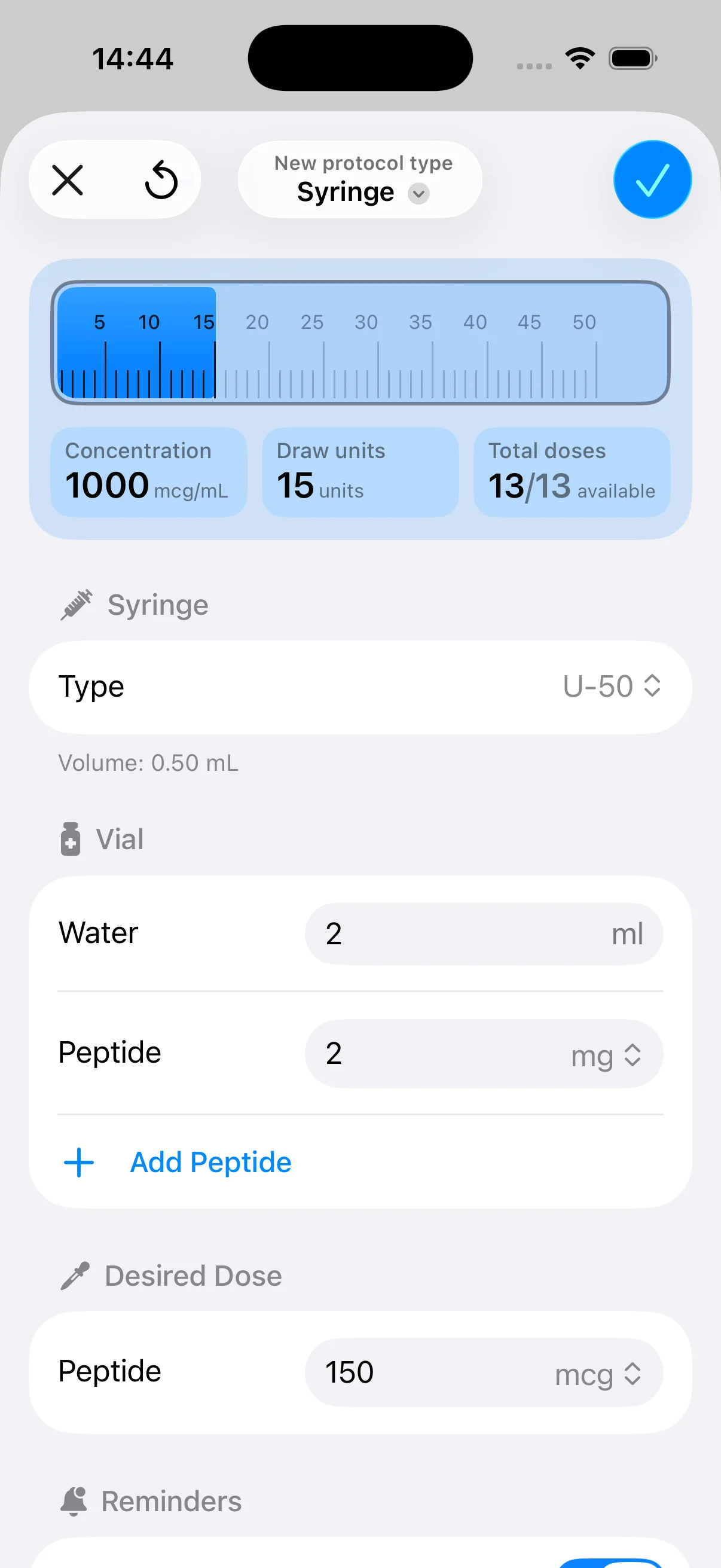
PepFlow helps users organize peptide schedules with a dosage calculator, concentration and injection-volume planning, reminders, countdowns, and dose-history tracking. Visit PepFlow to manage routines more consistently while keeping medical decisions and investigational use under qualified professional guidance.