
Considering SS-31 before MOTS-c, you’re already past the beginner stage. You’re not asking what these peptides are. You’re asking whether the order matters, or whether you’ve inherited a rule that sounds smart but isn’t as solid as people claim.
That’s a worthwhile question. A lot of peptide guidance turns into ritual. One person says, “repair first, then optimize,” and suddenly a preference becomes a protocol. The problem is that mitochondria aren’t a single switch. They’re a system. When two compounds support different parts of that system, the more useful question isn’t “What’s the rule?” It’s “What am I trying to change first?”
People usually encounter this debate while building a recovery, performance, or longevity plan. They may also be comparing options like Advanced peptide treatments through clinician-guided programs, or trying to understand where mitochondrial support fits alongside broader discussions about peptides for energy support. The confusion starts when forum wisdom presents sequencing as mandatory rather than strategic.
What helps is a framework. Think in terms of structure, signaling, tolerance, and goals. Once you understand those pieces, the “SS-31 first” idea stops feeling like dogma and starts looking like one of several reasonable choices.
Table of Contents
- The Ultimate Question About Mitochondrial Peptides
- Meet Your Mitochondrial Support Team SS-31 and MOTS-c
- The Sequencing Debate Should You Take SS-31 First
- Designing Your Protocol Timing and Administration
- Informational Protocol Templates and Stacking
- How PepFlow Helps You Manage Complex Protocols
- Safety Contraindications and Responsible Use
The Ultimate Question About Mitochondrial Peptides
The core question behind SS-31 before MOTS-c isn’t about order alone. It’s about whether sequence changes outcome in a meaningful way, or whether sequence mostly changes how you observe and manage the protocol.
That distinction matters because these compounds are often discussed as if one prepares the body for the other in a strict, stepwise chain. That can be a neat story, but neat stories can hide weak assumptions. If one peptide supports mitochondrial structure and the other influences metabolic signaling, you may not need to force a waiting period unless your specific goal calls for it.
Why readers get stuck here
Most confusion comes from mixing together three different ideas:
- Mechanism questions: Does one compound need the other to work?
- Testing questions: Do you want to know which one is causing a benefit or side effect?
- Strategy questions: Are you trying to repair, optimize, or maintain?
Those aren’t the same question, but they’re often treated as if they are.
Practical rule: A staggered start can be useful for observation. It isn’t automatically proof of pharmacological necessity.
A coach, clinician, or informed user might still prefer SS-31 first. That can make sense when someone wants a cleaner baseline, a gentler introduction, or a structure-first approach. But that’s different from saying simultaneous use is wrong.
What a better decision framework looks like
Instead of asking, “What’s the peptide rule?” ask these:
- What’s my primary goal right now? Recovery, endurance, metabolic flexibility, or long-term maintenance.
- Do I need cleaner feedback? Starting one compound first can make your response easier to interpret.
- Am I dealing with urgency or experimentation? If you’re trying to support multiple mitochondrial functions at once, a concurrent start may be more logical.
That shift makes the discussion more useful. You’re no longer memorizing protocol folklore. You’re choosing a strategy that matches the reason you’re using the compounds in the first place.
Meet Your Mitochondrial Support Team SS-31 and MOTS-c
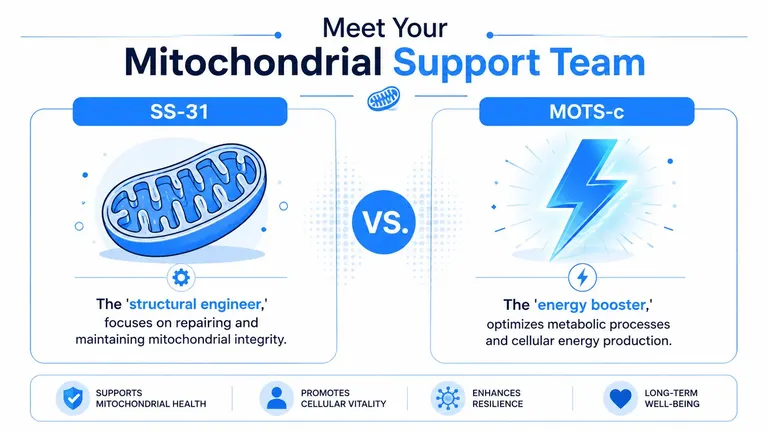
People lump SS-31 and MOTS-c together because both are discussed in the mitochondrial world. That’s accurate, but incomplete. They don’t do the same job.
Why these two get paired
SS-31 is best understood as a mitochondrial stabilizer. It’s a synthetic tetrapeptide that targets cardiolipin on the inner mitochondrial membrane, where it helps stabilize the cardiolipin-cytochrome c interaction and support electron transport chain efficiency. In one study, 8 weeks of treatment in aged mice nearly doubled treadmill endurance, with an approximate 30% increase from the animals’ pre-treatment baseline, while untreated aged mice declined during the same period, as described in this overview of SS-31 and MOTS-c differences.
MOTS-c is usually framed differently. It’s a naturally encoded mitochondrial peptide associated with metabolic regulation and stress-response signaling. In plain language, it doesn’t mainly act like a structural patch. It acts more like a messenger that influences how the system uses fuel and responds to demand.
If you want the quick mental model, use this:
- SS-31 repairs the power plant’s internal wiring and membrane stability
- MOTS-c helps management run the plant more efficiently
That’s why people stack them. One is focused more on infrastructure. The other is focused more on operations.
For readers who want a product-specific overview of SS-31 itself, this SS-31 peptide profile is a useful reference point.
A simple way to picture the difference
Think of a city power station.
SS-31 is the engineer inspecting damaged insulation, tightening vulnerable connections, and reducing electrical waste inside the building. If the internal membrane environment is unstable, energy production gets sloppier and oxidative stress becomes harder to control. SS-31 is designed to work right at that point.
MOTS-c is the operations manager changing how fuel gets allocated across the grid. It doesn’t primarily reinforce the walls. It changes priorities, improves responsiveness, and helps the system adapt to energy demand.
When people say the peptides are “synergistic,” what they usually mean is simple: they support different bottlenecks in the same larger energy system.
That difference is the key to the sequencing debate. If two compounds compete for the same receptor or depend on the same immediate pathway, order can matter a lot. When they address different layers of mitochondrial function, order becomes more flexible.
The Sequencing Debate Should You Take SS-31 First
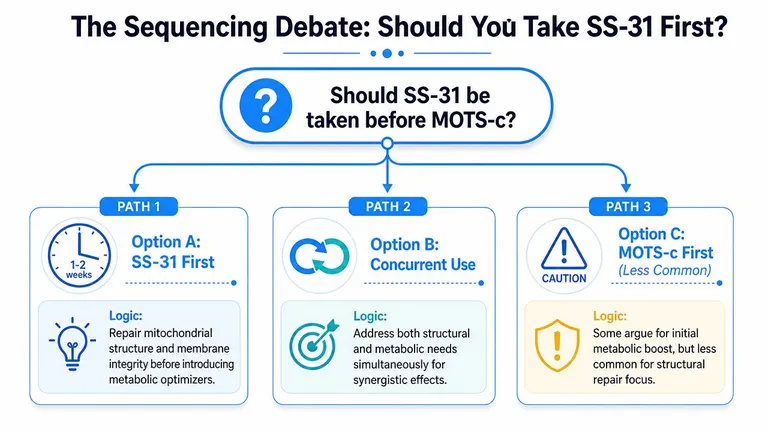
A lot of protocol guides repeat the same advice: start SS-31, give it a short runway, then add MOTS-c. The logic sounds clean. Stabilize the membrane first, then add the signal that pushes broader metabolic adaptation.
Why the rule sounds convincing
There are practical reasons someone might choose that order:
- Cleaner observation: If you start SS-31 alone, it’s easier to notice what changes before adding another variable.
- Cautious onboarding: Some people prefer to introduce one compound at a time.
- Structural-first philosophy: If your main concern is mitochondrial wear and oxidative stress, beginning with the stabilizer feels intuitive.
That’s all reasonable. It’s just not the same as proving that one must come first.
Later in the discussion, some people also fold in cycling questions. That muddies the issue because sequencing and cycling are separate decisions. A person can start both together and still use a defined course, or start SS-31 alone and later move into ongoing maintenance.
A deeper discussion of combination planning appears in this NAD, MOTS-c, and 5-Amino-1MQ stack overview, which helps show how mitochondrial and metabolic tools are often layered by goal rather than by rigid hierarchy.
Where the logic gets overstated
The stronger claim would be: you need SS-31 first because MOTS-c won’t work properly unless SS-31 has already prepared the membrane. That claim isn’t supported by strong pharmacological data.
According to this guide to the SS-31 and MOTS-c mitochondrial stack, there is no strong pharmacological data proving one must load SS-31 before MOTS-c. The same source explains that they act on different pathways, with SS-31 framed around structural conservation and MOTS-c around AMPK-mediated signaling, which makes a simultaneous start equally effective for most users.
The best argument for SS-31 first is usually organizational, not mechanistic.
That doesn’t make the staggered approach useless. It makes it optional.
To see how this debate is being discussed in newer longevity conversations, this video is often referenced:
If your goal is fast, broad support across both mitochondrial structure and metabolic signaling, starting together can be sensible. If your goal is careful self-observation, SS-31 first may still be the better fit. The key point is that strategy should drive sequence, not online dogma.
Designing Your Protocol Timing and Administration
People often jump from the sequencing debate straight into dosing chatter. That’s usually backwards. Start with the reason for the protocol, then decide how tightly structured it needs to be.

In clinician-guided settings, these compounds are commonly discussed in the context of subcutaneous injection, careful sourcing, and individualized scheduling. This article is educational only, so the useful focus is decision logic rather than prescriptive numbers.
Start with the goal not the habit
A practical protocol usually falls into one of these lanes:
- Acute support: Someone wants a focused period of mitochondrial support during a recovery push or heavy training block.
- Optimization: Someone wants both structural and metabolic support, but still wants a defined start, midpoint review, and endpoint.
- Maintenance: Someone is thinking in longer time horizons and cares more about consistency than about hard on/off blocks.
Cycling becomes relevant. Some users assume every peptide protocol must cycle because that feels disciplined. But the rationale changes depending on what you’re trying to accomplish.
The emerging guidance referenced in the video above notes that, for longevity purposes, SS-31 is often used as an ongoing maintenance protocol without defined off-periods, because the mitochondrial benefit is considered continuous and may not improve by cycling. That same discussion still leaves room for more bounded use when the goal is acute repair or short-term experimentation.
A repair-style protocol and a maintenance-style protocol don’t have to follow the same rhythm.
What to discuss with a clinician
A good conversation covers logistics, not just enthusiasm.
| Decision point | Why it matters |
|---|---|
| Primary goal | Helps determine whether you want a staggered start or a concurrent one |
| Tolerance tracking | Makes it easier to separate response from noise |
| Schedule style | Clarifies whether you’re building a short course or a maintenance routine |
| Administration basics | Reduces inconsistency in how doses are handled over time |
You also want clarity on how you will judge whether the protocol is useful. Some people track exercise tolerance. Others look at recovery quality, daily energy steadiness, or training consistency. If you’re vague at the start, you’ll usually be vague at the midpoint too.
A simple rule helps here. The more compounds you combine, the more you need a tracking plan. Without one, a complex protocol becomes guesswork with expensive packaging.
Informational Protocol Templates and Stacking
Examples are helpful because they show how the same mechanisms can lead to different designs. These are informational templates for discussion purposes only, not medical instructions.
Sample informational protocol templates
| Protocol Goal | Phase 1 (Weeks 1-2) | Phase 2 (Weeks 3-12) | Notes |
|---|---|---|---|
| Foundation first | SS-31 only under clinician guidance | Add MOTS-c if tolerated and still aligned with goals | Useful when someone wants clearer attribution and a gentler start |
| Synergistic start | SS-31 and MOTS-c begin together under clinician guidance | Continue combined approach with scheduled review | Fits users who care more about broad support from day one than clean isolation |
| Longevity maintenance | Establish a clinician-guided combination plan focused on consistency | Continue maintenance approach with periodic reassessment | Best framed around long-term routine, adherence, and monitoring rather than strict sequencing |
The foundation first model is the classic version of SS-31 before MOTS-c. It works well for people who are cautious, sensitive to changes, or want to know what each compound is doing before combining them. Its biggest strength is interpretability.
The synergistic start model is often the better match for someone who already understands both compounds and isn’t trying to run a mini experiment on themselves. If the two peptides support different pathways, there may be no reason to delay the combined effect just to satisfy protocol tradition.
The longevity maintenance model changes the question again. Here, the issue isn’t “Which one first?” so much as “What routine can I follow consistently and review responsibly?” In that context, sequencing matters less than sustainability, monitoring, and whether the plan still matches the person’s broader health picture.
Decision lens: If your top priority is clarity, stagger. If your top priority is comprehensive support, starting together may be more logical.
Stacking only makes sense when each addition solves a different problem. Once you understand that principle, you stop building protocols by imitation and start building them by purpose.
How PepFlow Helps You Manage Complex Protocols
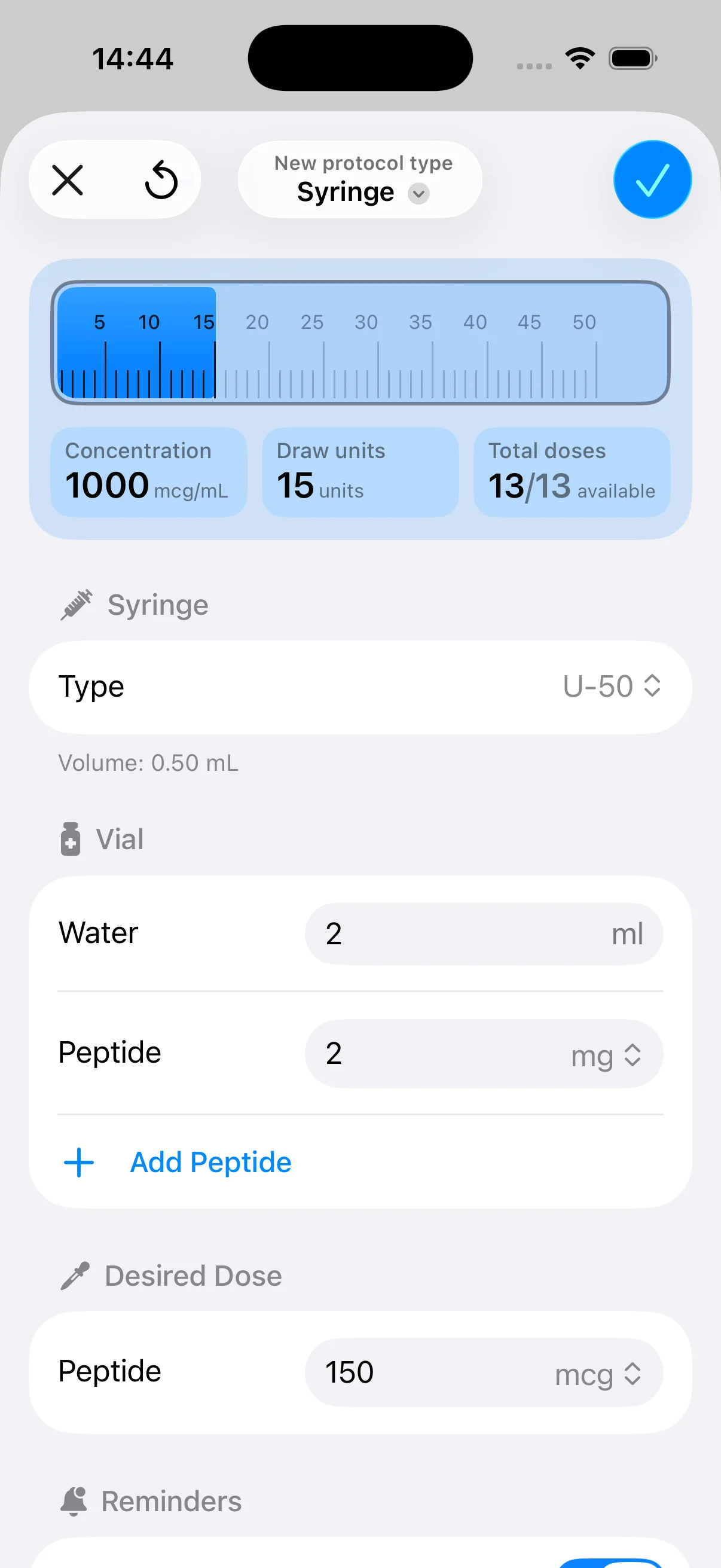
The hard part of peptide use often isn’t theory. It’s execution. Once a person is juggling vial concentrations, microgram targets, injection timing, start dates, review points, and optional pauses, simple mistakes become very easy.

Where people make avoidable mistakes
Most protocol errors are boring, not dramatic:
- Math errors: confusing dose amount with syringe units
- Schedule drift: missing the planned cadence and then “making up” doses inconsistently
- Poor records: forgetting when a compound was started or changed
- Mixed goals: changing timing, compounds, and frequency all at once, then not knowing what caused what
These issues matter more when someone is comparing a staggered start against concurrent use. If your notes are sloppy, you can’t learn much from the protocol either way.
What organized tracking changes
PepFlow is built for exactly this type of structure. It gives users a dosage calculator that converts desired microgram amounts into practical unit measurements, plus a flexible scheduler for cycled or ongoing protocols. Reminders, countdowns, logging, and history make it easier to follow the plan you intended instead of the one you vaguely remember.
That’s useful whether you’re discussing SS-31 before MOTS-c or starting both together. The app doesn’t replace medical judgment. It helps with precision, routine, and adherence, which are the parts people most often underestimate.
Safety Contraindications and Responsible Use
SS-31 and MOTS-c should be approached carefully and with qualified medical oversight. These aren’t casual wellness accessories. They belong in informed discussions about goals, contraindications, sourcing quality, administration, and follow-up.
What responsible use looks like
Responsible use includes a few essential requirements:
- Work with a qualified clinician: Especially if you’re combining compounds or have an existing condition.
- Use reputable sourcing: Purity and handling matter.
- Track your response: Energy, recovery, training tolerance, and general function should be reviewed systematically.
- Stay conservative with assumptions: Feeling better doesn’t automatically prove the mechanism you think is responsible.
SS-31 does stand apart from many compounds in this space because it has moved through FDA-regulated Phase 3 clinical trials for primary mitochondrial myopathy, establishing a substantial body of data on clinical safety and mechanism for improving cellular energy production, even though the pharmaceutical program was later interrupted. That background is one reason many people take interest in it, but it still doesn’t make self-directed use risk-free.
A good decision is a monitored decision
The biggest safety mistake is treating peptide advice like a recipe. A real protocol should account for your reason for use, your tolerance, your timing, and your ability to monitor what happens next.
If you remember one point from this article, let it be this: SS-31 before MOTS-c is a strategy, not a law. For some people, it will be the cleanest way to begin. For others, especially those seeking broad mitochondrial support from the start, simultaneous use may be just as reasonable.
If you want help organizing peptide schedules without doing manual math every time, PepFlow gives you a simpler way to calculate doses, map out timing, and stay consistent with complex protocols.