You’ve got the vial on the counter, the dropper bottle in one hand, and a search tab open because half the web says SNAP-8 is a skincare serum ingredient while the other half sounds like it’s talking about a research peptide protocol. That confusion is the central problem. If you don’t separate topical cosmetic use from subcutaneous-style dosing, you end up mixing instructions that were never meant to live together.
The good news is that SNAP-8 is straightforward once you pick a lane. For cosmetic use, the guidance is mostly about finished-formula concentration, clean application, and consistency. For research-style use, the issue is reconstitution math, dose conversion, and tracking. The mistake most beginners make is trying to do both mentally at once.
Table of Contents
- What SNAP-8 Actually Is and Which Route You Are Using
- Reconstituting SNAP-8 Without Damaging the Vial
- Applying SNAP-8 Topically the Right Way
- Calculating a Subcutaneous-Style Dose If You Are Following That Path
- Setting Up PepFlow to Track Your Doses and Schedule
- Common Mistakes and How to Troubleshoot Them
- Storing, Cycling, and Sticking With the Routine
What SNAP-8 Actually Is and Which Route You Are Using
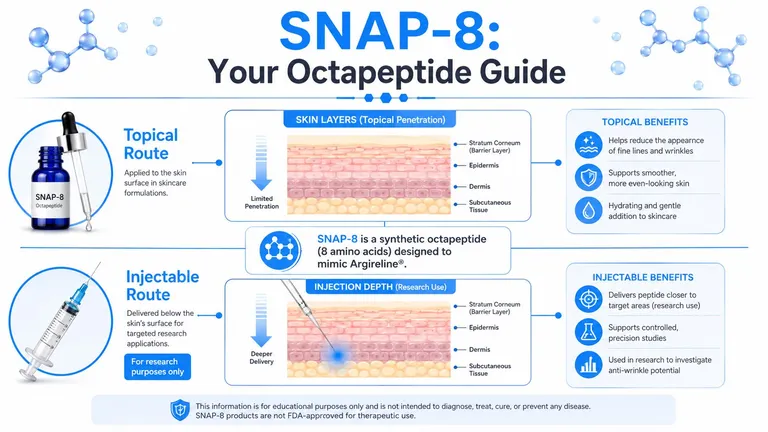
SNAP-8 is a synthetic octapeptide, which means it’s an eight-amino-acid chain designed as an elongated version of Argireline, also known as acetyl hexapeptide-8. In practical terms, that matters because most public protocol writeups place SNAP-8 in topical anti-wrinkle use, not injection use. The cosmetic conversation is about serums and creams, not clinic-style procedures.
The route confusion starts when people read one guide that talks about 3% to 10% finished-product concentrations and another that mentions a subcutaneous once-daily protocol with microgram-range dosing. Those are different workflows with different assumptions, different risks, and different ways of thinking about the product. You need to choose one before you start measuring anything.
Cosmetic use and evaluation windows
For topical use, the usual frame is twice-daily application to expression-line areas like the forehead, crow’s feet, and glabellar lines. Major protocol writeups commonly point to a visible-evaluation window of 4 to 8 weeks of consistent use, which is a realistic time horizon for cosmetic tracking, not an overnight change. A separate peer-style profile also cites manufacturer-reported wrinkle-depth reductions of up to 63%, with a more conservative average near 35% after 28 days of twice-daily topical use, while also warning that real-world results depend heavily on formulation quality and use pattern. The most honest reading is that the promise is gradual smoothing, not a dramatic reset. The profile is here if you want the full context: SNAP-8 extended Argireline peptide profile.
If you’re building a skincare routine, a related overview of peptide-friendly skin care can help you place SNAP-8 in the bigger picture. I’d use the Healtsy collagen benefits overview as a broader reference point for how peptide routines get framed in cosmetic care.
Route choice comes first
The practical decision is simple. If you’re making a serum or cream, you’re in the topical route. If you’re reading a protocol with micrograms, syringes, and daily titration, that’s a different workflow entirely. Don’t blur them together because the concentration logic, storage habits, and expectation-setting are not the same.
For a broader primer on how peptide ingredients are discussed in skincare, this internal explainer is useful: what are peptides in skin care. It sits in the same cosmetic lane as SNAP-8’s topical use.
Practical rule: commit to one route before you calculate anything, because the math only makes sense after the route is clear.
Reconstituting SNAP-8 Without Damaging the Vial
The first question people ask is how much diluent to add. The answer depends on the target concentration, but the method stays the same. Start with the peptide weight, decide the total final solution weight or volume, and use the formula (weight of peptide / total final solution weight) × 100 = % concentration to work backward to the strength you want. That’s the key calculation for turning a stock vial into a usable solution.
Add the diluent slowly
Add the diluent slowly down the vial wall, not in a rush. Gentle handling matters because peptide integrity is easier to preserve when you avoid high-shear movement, so inversion or very light stirring is the preferred mix style. Don’t shake the vial, and don’t whip air into it just to make the contents look uniform faster.
That same logic is why neutral guides advise against rough handling and contamination-prone shortcuts. If you’re coming from other peptide workflows, the discipline is the same, and this peptide recovery and gut health review from BotoxBarb is a good reminder that protocol care matters as much as the ingredient itself. The chemistry may differ, but the handling standard is familiar.
Patch test and store it cold
After you’ve mixed the vial, patch test the finished product on the inner forearm for 24 to 48 hours before facial use. That step catches irritation early without risking a full-face reaction. Once mixed, move the material to the refrigerator for better stability.
A clean reconstitution is less about looking scientific and more about avoiding the three failures that waste product, contamination, wrong strength, and rough handling.
If you want a clean reference for freeze-dried handling basics, the internal guide on freeze-dried peptides is the right companion read.
Applying SNAP-8 Topically the Right Way
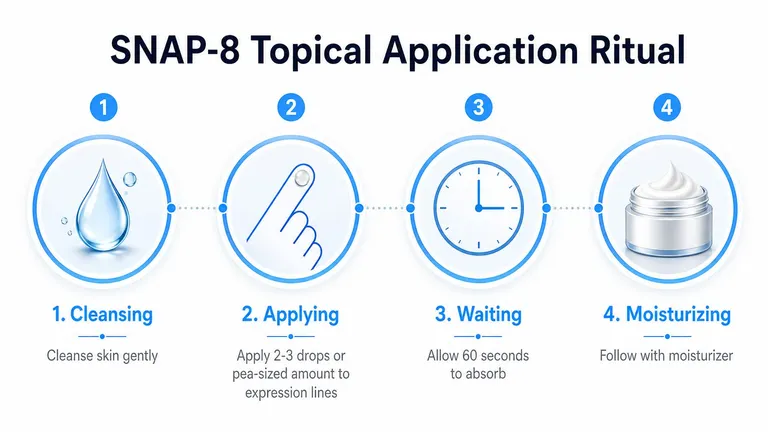
Topical SNAP-8 works best as part of a plain, repeatable skin routine. The rhythm is simple. Cleanse, apply, wait, moisturize, and in the morning finish with broad-spectrum SPF. That routine sounds basic because it is, and basic is what usually survives long enough to matter.
The daily ritual
Use a pea-sized amount or 2 to 3 drops across the areas that move the most, usually the forehead, crow’s feet, and glabellar or smile-line zones. Apply it to clean, dry skin, then give it about 2 to 5 minutes to absorb before layering moisturizer. The goal is to let the peptide sit where you placed it instead of rubbing it around until half of it ends up on your fingers.
The practical benchmark across neutral guides is twice-daily use for at least 4 to 8 weeks before judging results. That doesn’t mean you’ll see a dramatic transformation on day 10. It means you give the routine enough time to show whether it’s doing anything at all.
What not to layer over it
Avoid putting SNAP-8 in the same step with strong acids or alcohol-based products, and don’t rub the area aggressively after application. Those habits can work against stability or barrier comfort, and they’re easy to avoid once you treat SNAP-8 like a delicate leave-on serum instead of a hard-working exfoliant.
The concentration numbers often quoted for topical formulas, 3% to 10% finished product, and the stock-to-finished-product math that leads to roughly 0.0015% to 0.005% active peptide after dilution from a typical 0.05% stock solution, are formulation guide values, not independently verified clinical standards. That distinction matters. It keeps expectations honest and stops people from treating cosmetic formulation math like a drug label.
Calculating a Subcutaneous-Style Dose If You Are Following That Path
Some public sources describe a subcutaneous once-daily protocol in the 330 to 1,000 mcg/day range with titration over 8 to 12 weeks. That is a very different use case from topical skincare, and the safety picture is also different. The most specific human-safety data in the available material is the 2016 JDD study cited in the technical guide, where 29 participants used a multi-peptide serum containing acetyl octapeptide-3 for 14 weeks of twice-daily topical application and no adverse events were reported. That topical safety context does not automatically transfer to injection-style use.
The math beginners usually miss
If you’re following a research-style protocol, the calculation starts with vial concentration. For example, a 5 mg vial reconstituted with 2 mL of diluent gives you 2,500 mcg/mL. If your target is 500 mcg, a 0.2 mL draw gets you there. The point is not that this is the right protocol, the point is that the unit conversion has to be exact if someone is choosing that path.
A lot of newcomers stop at the microgram target and forget to convert it into draw volume. That’s where bad math creeps in. Once the vial strength is set, the rest is simple division, not guesswork.
Why this route needs separate judgment
The public web content is inconsistent here. Most accessible guides frame SNAP-8 as a topical serum or cream ingredient at roughly 1 to 2 times daily, while a minority of pages present an injection workflow with different dosing logic. That lack of consensus is the reason I treat the subcutaneous-style route as a separate decision, not a variation of skincare. If the protocol you’re reading uses syringes, micrograms, and titration, you’re no longer in a cosmetic routine.
Setting Up PepFlow to Track Your Doses and Schedule
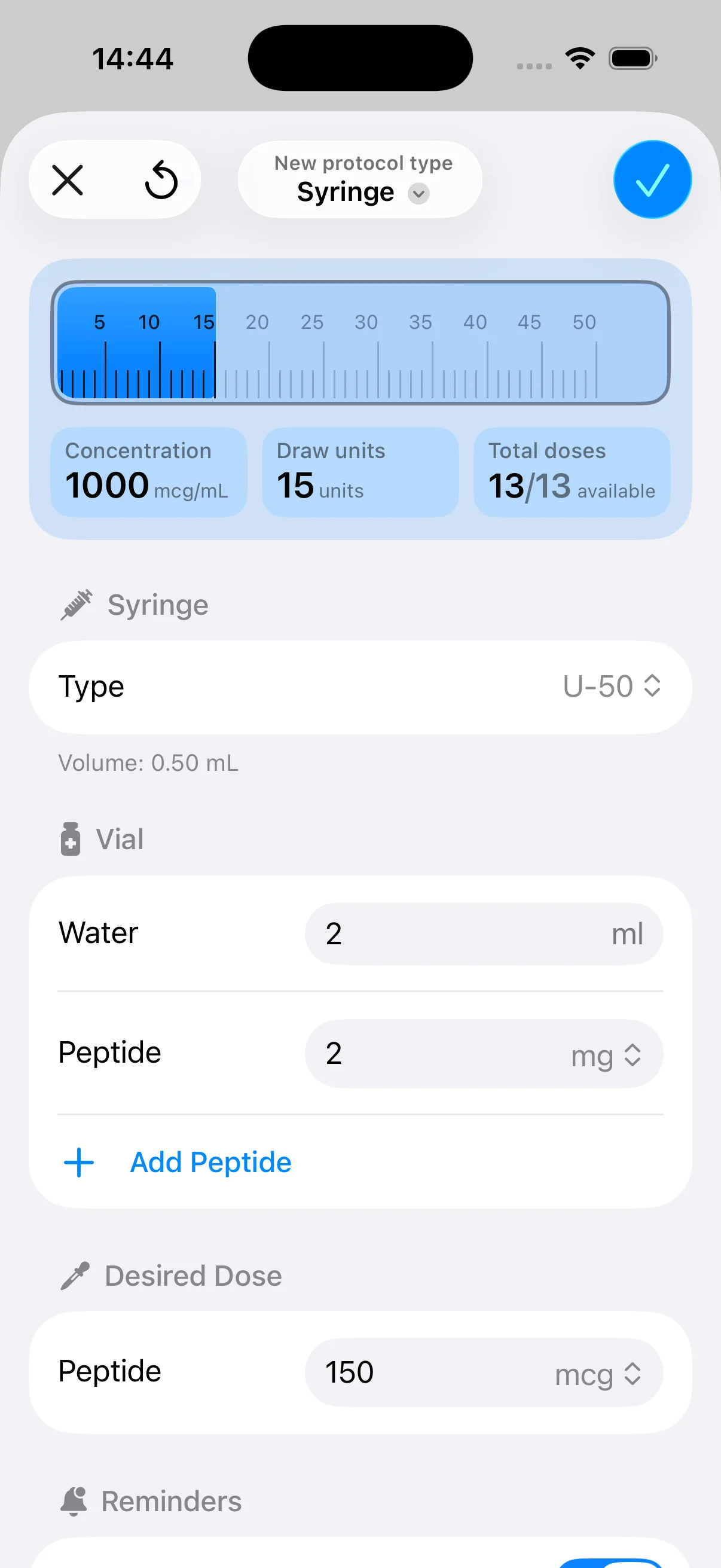
The cleanest way to use a planning app is to make it reflect the exact workflow you’ve already chosen. PepFlow is useful here because it’s built to convert vial setup into dose math, then keep the schedule visible without asking you to re-derive the numbers every time. It’s a planning and organization tool, not medical advice, which is exactly how it should be used.
Configure the vial first
Start by entering the peptide name, the total mg in the vial, the diluent volume, and the resulting concentration. That gives the calculator enough information to convert a target microgram amount into a practical draw volume automatically. If your route is topical, the same habit still helps because it keeps the product identity and concentration recorded in one place.
Build the schedule you actually intend to follow
Next, create the protocol with a start date, the frequency you’ve chosen, and any pause period if your regimen uses one. A twice-daily topical routine belongs in one kind of cadence, while a daily research-style workflow belongs in another. The app’s job is to enforce the route you committed to, not blur it.
Keep the routine ambient
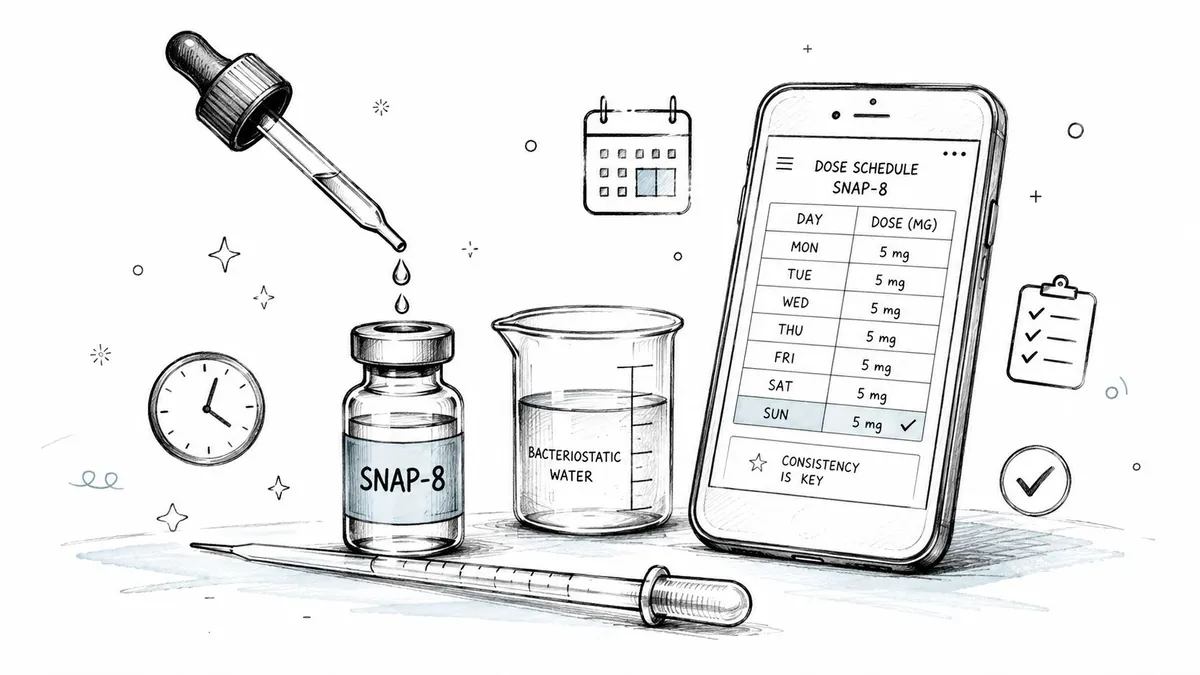
Turn on reminders, live activities, and widgets so the schedule stays visible without you checking notes all day. Then use the log-dose action and history view to make the routine auditable week by week. That matters because a 4 to 8 week evaluation window is only useful if your record shows whether you stayed consistent.
For the product itself, the main site is PepFlow, and the calculator workflow is built around dose planning, vial configuration, and schedule tracking.
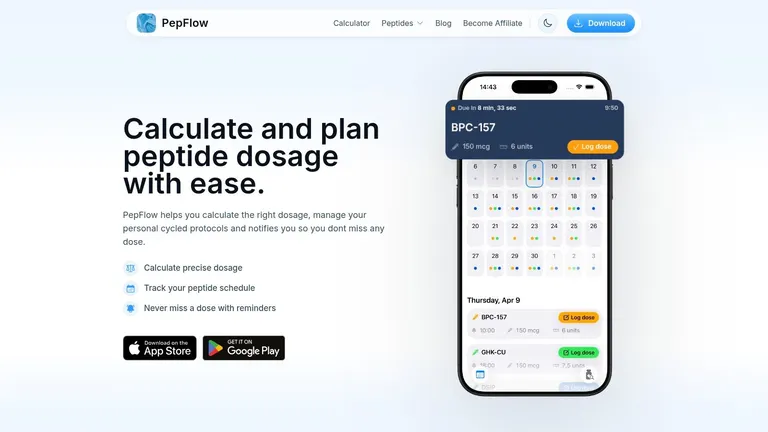
The value of a tracker is not perfect math on day one, it’s making drift obvious before a week of missed steps becomes a month of wasted product.
Common Mistakes and How to Troubleshoot Them
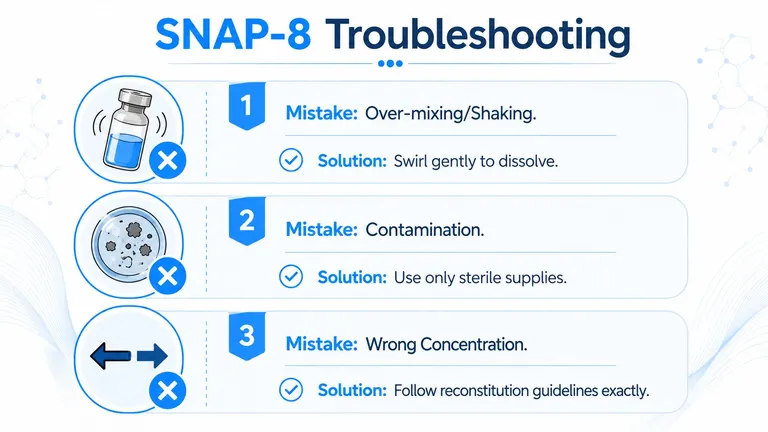
Most first-time failures come from three places, overmixing, contamination, and wrong concentration math. If the vial turns cloudy, the skin gets irritated, or the results never change after weeks of use, the problem is often process, not the peptide itself. That’s why the fix is usually simple once you identify the symptom.
Match the symptom to the cause
- Cloudy or stressed-looking vial, usually means the vial was shaken or handled too hard. The fix is to mix gently by inversion and avoid high-shear agitation.
- Skin irritation or redness, often points to contamination, skipped patch testing, or layering with strong acids or alcohol-based products. The fix is to use sterile supplies, patch test for 24 to 48 hours, and simplify the surrounding routine.
- No visible change after 8 weeks, often comes from inconsistent timing, under-dosing, or a finished product that was mixed at the wrong strength. The fix is to verify the math, stick to twice-daily use, and review the log before changing anything.
The topical safety signal is reassuring when the product is used as directed. In the 2016 JDD study cited earlier, 29 participants used a multi-peptide serum with acetyl octapeptide-3 for 14 weeks twice daily and reported no adverse events. That doesn’t validate DIY injection deviations, but it does show the topical lane has a real human-use record.
A clean log is often the fastest troubleshooting tool you have. If the timing drifts, the schedule changes, or the product is being used inconsistently, a tracker like PepFlow makes the pattern visible before you waste another week guessing.
Storing, Cycling, and Sticking With the Routine
Once the vial is mixed, keep it in the refrigerator and treat the routine like a short-cycle experiment, not a forever decision. Most guides converge on an evaluation window of 4 to 8 weeks, which is enough time to tell whether the routine is worth continuing or whether the current setup isn’t doing enough. If irritation persists, results stay flat after that window, or your goals shift, re-evaluate instead of doubling down on habit.
The same kind of discipline shows up in broader tracking systems, including full stack peptide monitoring, where the point is consistency and documentation rather than improvisation. That is the lesson here. Whether you’re using a topical cosmetic routine or a separate research-style protocol, the history view matters because it shows what happened week by week, not what you think happened.
PepFlow provides that accountability layer by keeping the schedule, the logs, and the concentration record in one place. It’s a personal-use planning tool, not medical advice, and the win is not perfect math on day one. The key lever is steady execution over several weeks.
If you want to stop second-guessing your peptide setup, use PepFlow to record your vial, set the right schedule, and keep your SNAP-8 routine visible from the first day to the last. It helps you separate topical and research-style workflows, track what you did, and avoid the kind of drift that ruins results.