You’re probably here because peptides have started showing up everywhere. A serum says “Matrixyl.” A moisturizer highlights “copper peptides.” Another promises firmer skin, fewer lines, and “clinical-grade repair,” but doesn’t explain what any of that means. If you’re science-curious, that gets frustrating fast.
The short answer is that peptides are small chains of amino acids that can act like messengers in the skin. The useful answer is more nuanced. Some peptides have a reasonable scientific basis. Some are mostly marketing shorthand. And if you also follow wellness or recovery spaces, there’s another layer of confusion because topical skincare peptides are not the same thing as injectable research peptides.
Table of Contents
- Why Peptides Are Suddenly Everywhere in Skincare
- How Peptides Signal Your Skin to Rebuild
- Decoding the Different Types of Skincare Peptides
- How to Combine Peptides with Retinoids Vitamin C and Acids
- Topical Creams vs Injectable Protocols A Key Distinction
- How to Choose and Use Peptide Products Effectively
- Common Questions About Peptides in Skincare
Why Peptides Are Suddenly Everywhere in Skincare
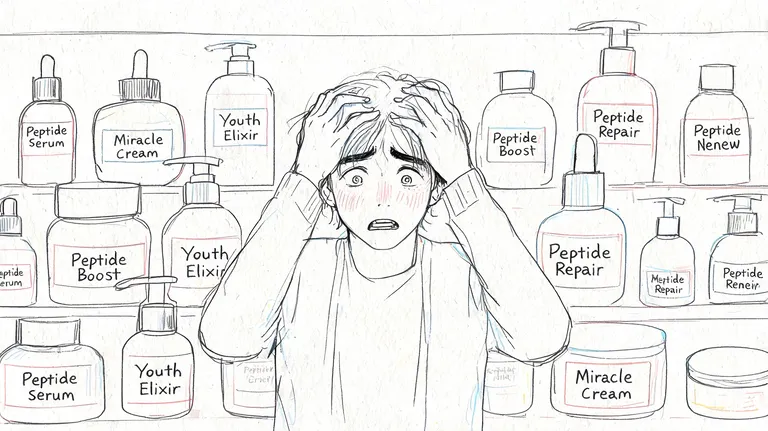
Walk into a beauty store right now and you’ll see peptide cleansers, peptide eye creams, peptide neck creams, peptide masks, and peptide sunscreens. The language is confident. The science, at least in the way most brands explain it, usually isn’t.
That flood of products isn’t random. The global peptide skincare market was valued at approximately USD 2.7-7.8 billion in 2025 and is projected to reach USD 4.9-16.2 billion by 2032-2034, according to MetaStat Insight’s peptide skincare market report. That kind of growth tells you peptides aren’t a passing fad. They’ve become a major commercial category.
Why consumers are paying attention
People want ingredients that sound more targeted than “anti-aging.” Peptides fit that demand because they seem precise. They sound biochemical, not cosmetic. For many shoppers, they feel like a middle ground between basic moisturizers and harsher actives.
They also appeal to readers asking a very practical question: what are peptides in skin care supposed to do? In the simplest terms, they’re meant to help skin look firmer, smoother, or more resilient by nudging specific cellular processes.
Practical rule: Treat “peptide” as a category, not a verdict. Seeing the word on a label doesn’t tell you whether the formula is strong, stable, or well tested.
Why the confusion is reasonable
Brands often use the same umbrella term for ingredients that behave very differently. A peptide can be included to signal collagen production, to carry a mineral, or to support a formula’s broader repair story. That means two peptide products may have little in common besides the label.
If you want a broader plain-English primer before going deeper, this overview of peptides is a useful place to orient yourself. The important point is that curiosity about peptides is justified. Blind trust in peptide marketing isn’t.
How Peptides Signal Your Skin to Rebuild
If proteins are full paragraphs, peptides are short sentences. They’re made of amino acids, but they’re much smaller than large structural proteins like collagen and elastin. That small size is why they’re interesting in skincare. They can act as signals.
A useful analogy is a text message. Your skin doesn’t “see” a peptide and magically become younger. Instead, certain peptides can send a message that nudges cells toward a response, such as making more support proteins.
The basic mechanism
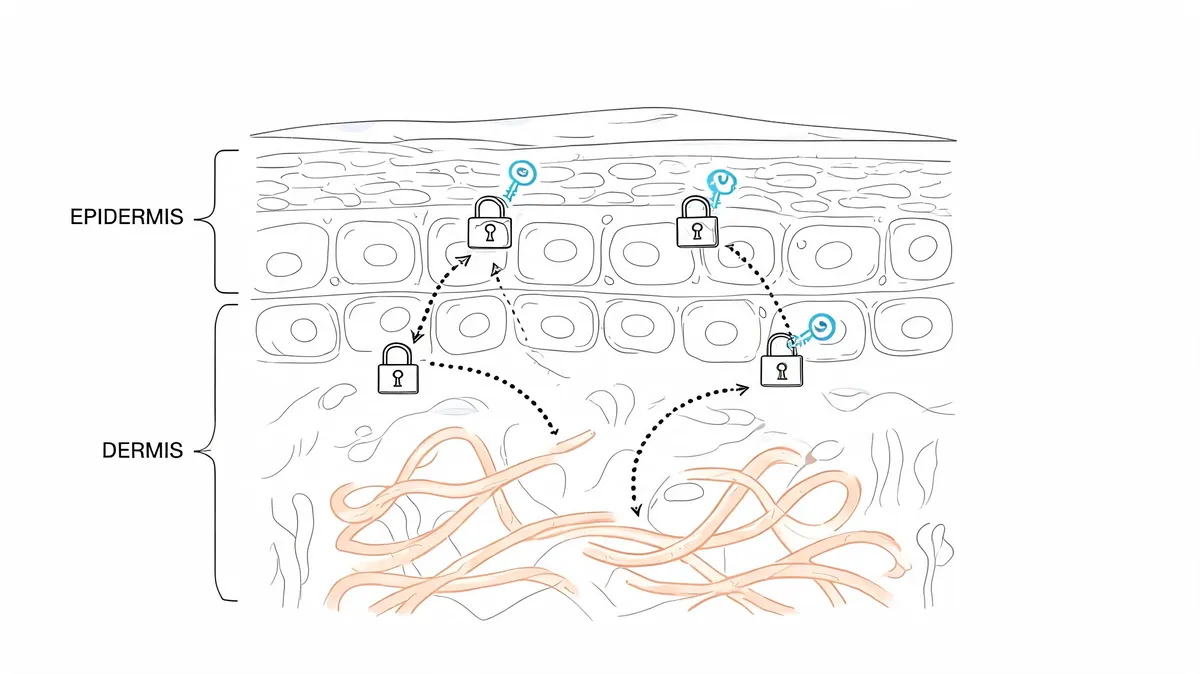
Your skin contains cells called fibroblasts. These are key builders in the dermis, the layer involved in firmness and structural support. Certain peptides, especially signal peptides, interact with pathways that tell fibroblasts to increase production of components like collagen and elastin.
According to a review in the National Library of Medicine database, signal peptides are the most validated type and stimulate fibroblasts to increase production of collagen and elastin. The same review explains that peptides can influence intracellular signaling pathways involved in skin repair and matrix production.
What that means in plain language
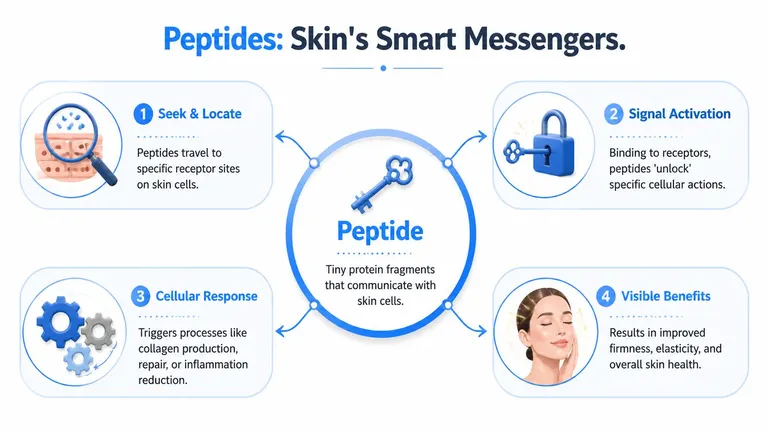
Think of a signal peptide as a key that fits a very specific lock. If it reaches the right place in a workable formula, it can trigger a response from the cell. That doesn’t mean dramatic overnight changes. It means a gradual push toward repair or support.
Here’s the sequence in simple terms:
- A peptide is applied in a serum or cream.
- Some peptides interact with skin targets involved in signaling.
- Fibroblasts respond by increasing production of structural components.
- Visible changes may follow over time, such as smoother texture or improved firmness.
Many people expect peptides to act like exfoliating acids or retinoids, where you can feel something happening. Most peptides don’t work that way. They’re quieter ingredients.
Where hype outruns evidence
This is the part many articles skip. The same NLM review notes that many over-the-counter products lack clinical validation, and that peptide enthusiasm is being amplified on social media, with #peptide surpassing 233 million TikTok views in that review’s discussion of consumer interest.
That doesn’t mean peptides are useless. It means you should separate mechanistic plausibility from proven product performance. A peptide may have a credible biological role, while the serum containing it may still be underdosed, poorly packaged, or never properly tested.
The practical takeaway
When people ask what are peptides in skin care, the most accurate answer is this: they’re small amino acid chains that can communicate with skin cells, but not every peptide does the same job, and not every peptide product has meaningful evidence behind it.
Decoding the Different Types of Skincare Peptides
“Peptides” is too broad to be useful on its own. To make sense of labels, divide them by function. That’s where peptide skincare becomes easier to read.
Four categories that matter
Some peptides are better thought of as messengers. Others are more like delivery helpers or modulators. These are the four buckets you’ll see most often in skincare discussions.
| Common Peptide Types in Skincare | |||
|---|---|---|---|
| Peptide Type | Primary Function | Common Example(s) | Best For |
| Signal peptides | Encourage fibroblast signaling linked to collagen and elastin support | Matrixyl, Palmitoyl Pentapeptide-4 | Fine lines, firmness, early loss of elasticity |
| Carrier peptides | Deliver trace elements or support repair pathways | Copper peptides, GHK-Cu | Dullness, barrier support, visible photoaging |
| Neurotransmitter-inhibiting peptides | Aim to soften expression-related movement signals | Argireline | Dynamic lines, especially forehead or eye area |
| Enzyme-inhibiting peptides | Help limit processes that break down skin structure | Soy or rice-derived peptide approaches | Support against visible environmental aging |
Signal peptides
These are the most discussed for a reason. They’re the category with the clearest scientific footing in skincare. Their purpose is to mimic fragments your skin may interpret as a cue to rebuild or reinforce structural proteins.
You’ll often see trade names like Matrixyl in this group. These formulas are usually marketed for firmness, crow’s feet, or “bounce.” They’re best understood as slow, supportive ingredients rather than dramatic resurfacing agents.
Carrier peptides
Carrier peptides help shuttle an element to where it’s needed. The most famous example is GHK-Cu, a copper peptide. According to Biossance’s overview of peptides in skincare, copper peptides act as antioxidants and potent collagen stimulators, with data showing a 70% increase in collagen I/III production in fibroblasts and 31% wrinkle reduction in clinical trials.
That’s why copper peptides have such a loyal following. They don’t just sit in the “anti-aging” lane. People also use them for visible recovery, brightness, and barrier support.
Copper peptides are one of the clearest examples of why peptide type matters. “Contains peptides” is vague. “Contains GHK-Cu” is actionable.
Neurotransmitter-inhibiting peptides
These get compared to injectable wrinkle relaxers in marketing, often too loosely. A formula with Argireline is typically meant to soften the look of expression lines by influencing signaling related to muscle contraction at a cosmetic level. That’s very different from a medical procedure, and consumers should keep that distinction clear.
Enzyme-inhibiting peptides
This category gets less attention than it should. These peptides aim to interfere with enzymes that contribute to breakdown of collagen or other structural damage. They can make sense in routines focused on environmental aging and preservation, not just correction.
If you want a useful companion read on supporting collagen more broadly, Cape Cod Plastic Surgery’s collagen insights help place peptides alongside other evidence-based strategies.
For readers comparing options, this guide to the best peptides for anti-aging can also help you map names to goals without treating every peptide as interchangeable.
How to Combine Peptides with Retinoids Vitamin C and Acids
Most confusion about peptides isn’t about what they are. It’s about where they fit once you already use stronger actives. That’s a significant routine problem.
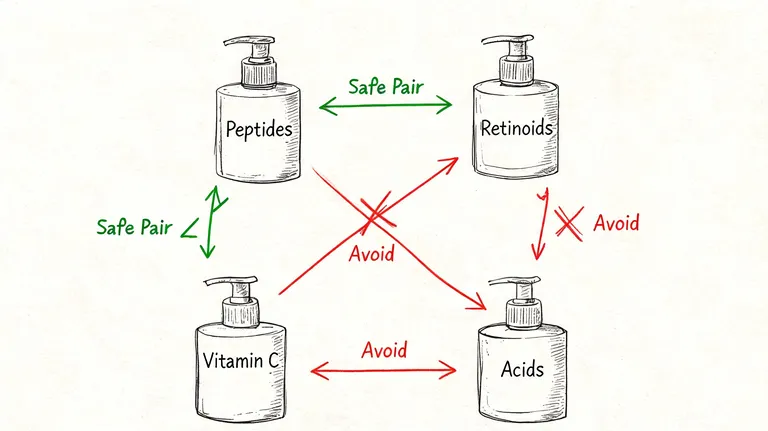
Peptides and retinoids
This is usually the easiest pairing. Retinoids drive renewal but can also cause dryness, stinging, and flaking. Peptide serums or creams often fit well around them because they tend to be gentler and can support a routine aimed at barrier comfort and firmness.
A simple approach works well:
- Night option one: Retinoid first, peptide moisturizer second.
- Night option two: Peptide serum first, then retinoid, if the formula is lightweight and non-irritating.
- Sensitive skin approach: Alternate nights rather than forcing everything into one routine.
Peptides and vitamin C
People often get nervous, especially around copper peptides. A practical, conservative approach is to separate them. Use vitamin C in the morning and copper peptides at night if you want both without second-guessing compatibility.
For non-copper signal peptide products, the pairing is usually less controversial in day-to-day skincare. Still, if your skin is reactive, separation is often simpler than trying to create the “perfect” stack.
For a broader overview of how these ingredients can complement one another, Mesoderm RX’s look at skincare powerhouses is a helpful reference.
Peptides and acids
AHAs and BHAs exfoliate. Peptides signal. Those are different jobs, and they don’t always need to happen at the same time. If your routine already includes glycolic, lactic, or salicylic acid, the easiest strategy is usually to avoid overcomplicating the same session.
Try one of these patterns:
- Morning peptides, evening acids
- Peptides on recovery nights
- Acids only a few times weekly, peptides daily
Clinical common sense: If a routine is making your skin red, shiny, tight, or stingy, the answer usually isn’t another active. It’s less friction.
A brief visual walkthrough can help if you’re trying to map layering order in real life.
A simple way to think about stacking
Use peptides as the support team in your routine. Let retinoids handle renewal. Let vitamin C handle antioxidant support. Let acids handle exfoliation. Peptides often make the most sense as the ingredient that fills the gap between “active treatment” and “skin comfort.”
Topical Creams vs Injectable Protocols A Key Distinction
Standard beauty articles often become inadequate. For many readers, especially in biohacking, athletic recovery, or longevity circles, “peptides” doesn’t just mean serums. It may also mean research peptides used in injectable protocols.
Those are not the same category, and mixing them together creates a lot of bad assumptions.
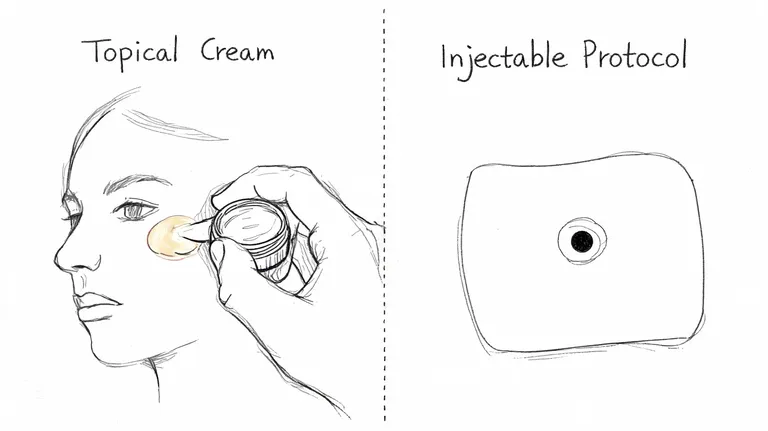
What topical peptides are designed to do
Topical cosmetic peptides are formulated for the skin surface and upper skin layers. Their goals are visible and cosmetic: improved firmness, smoother texture, better hydration support, and a softer look to lines.
They are not designed to create systemic tissue effects. Even when they work well, they work within the limitations of topical delivery.
What injectable research peptides are aiming at
Injectable protocols are discussed in a very different context. Compounds like BPC-157, TB-500, and in some settings GHK-Cu, are pursued for deeper tissue repair, inflammation-related goals, or recovery support. Delivery is different. Bioavailability is different. The intended outcome is different.
According to ISDIN’s article on peptides in skincare, mainstream topical peptide guides usually don’t address this distinction. That matters because topical peptides show a 10-20% collagen boost in 12-week studies, while injectables like GHK-Cu yield 50-70% wound healing acceleration in trials. Those are different endpoints reached through different delivery methods.
A cream can improve the look and feel of skin. It can’t be assumed to reproduce the same effects people seek from subcutaneous peptide protocols.
Why this matters for advanced users
A lot of forum questions come down to this: can a peptide cream match an injectable result? Usually, that’s the wrong comparison. A topical formula may be excellent for cosmetic support while still being a poor substitute for a protocol aimed at systemic recovery.
That’s also why readers exploring storage, prep, and handling often need separate education from skincare advice. If you’re trying to understand the practical side of peptide formats, this primer on freeze-dried peptides helps clarify another area where beginners often get lost.
For people comparing wellness clinics and educational material around peptide therapy, ProMD Health Columbia’s peptide services give a useful example of how the medical-wellness side frames these interventions differently from cosmetic skincare.
The clean distinction
If your goal is firmer-looking skin, topical peptides belong in the conversation. If your goal is deeper tissue repair or systemic recovery, topical skincare is not the same tool.
That one distinction clears up a surprising amount of confusion.
How to Choose and Use Peptide Products Effectively
A peptide product is only as good as its formula. The ingredient category matters, but the label details matter more.
What to look for on the bottle
Start with specifics, not slogans.
- Named peptides: Look for ingredient names such as GHK-Cu, Palmitoyl Pentapeptide-4, Matrixyl, or Argireline rather than vague “peptide complex” language.
- Protective packaging: Airless pumps or opaque containers are usually better choices than wide-mouth jars, especially for formulas meant to stay stable over time.
- Formula type: Serums often make more sense than very heavy creams when your main goal is delivery before sealing in with moisturizer.
How to use them well
Most peptide products fit best after cleansing and before a heavier cream. If the formula is a serum, apply it to slightly damp skin, then follow with moisturizer. If you’re combining with stronger actives, keep the routine calm enough that you can tell what’s helping and what’s irritating.
A few practical habits matter more than chasing novelty:
- Be consistent: Peptides are usually gradual ingredients.
- Don’t stack five peptide products at once: You won’t know which one your skin likes.
- Match the peptide to the goal: Copper peptides for repair-focused routines. Signal peptides for firmness-focused routines.
A note on peptide cycling
An emerging topic in advanced skincare is peptide cycling. According to Alastin’s peptide overview, this can involve 4-8 week protocols, and recent studies they discuss report that cycled peptides can reduce senescence-related collagen loss by 25%.
That doesn’t mean everyone needs a complicated schedule. It means some experienced users prefer structured use rather than mindless daily accumulation of actives.
If you’re analytical by nature, cycling can be useful. If you’re inconsistent, a simple daily routine will usually beat a perfect protocol you never follow.
Common Questions About Peptides in Skincare
Are peptides safe for sensitive skin
Often, yes. Many peptide products are gentler than acids or retinoids. But the full formula matters. Fragrance, strong exfoliants, or poorly chosen combinations may still irritate sensitive skin.
How long do peptides take to work
Think in weeks, not days. Some products may improve hydration or softness sooner, but visible firmness changes usually require patience and consistent use.
Can I use peptides every day
Usually yes, especially with topical skincare products designed for regular use. The more important question is whether the rest of your routine is balanced.
Can you overdo peptides
You can overdo complexity. Using multiple peptide products alongside retinoids, acids, vitamin C, and exfoliating toners may create confusion even if peptides themselves are not the most irritating part. A cleaner routine is often more effective.
Are expensive peptide creams always better
No. Price doesn’t guarantee meaningful concentration, good packaging, or clinical validation. Look for transparency and a sensible formula before you look at luxury branding.
What are peptides in skin care in one sentence
They’re small amino acid chains used in skincare to signal or support processes related to firmness, repair, and skin resilience, though the quality of evidence varies widely by peptide and product.
If you’re managing peptide protocols beyond skincare and want help staying organized, PepFlow can help you calculate doses, structure cycled schedules, and keep your routine consistent with reminders and simple tracking. It’s built for people who want less guesswork and better adherence, especially when protocols get more detailed.