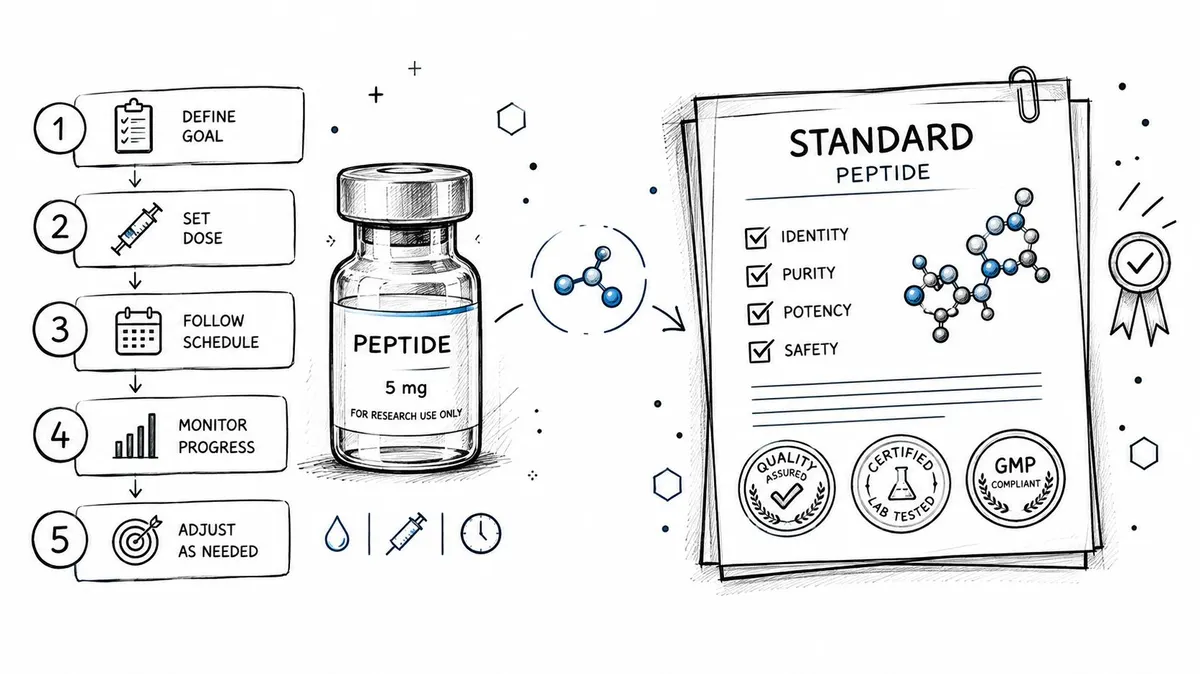
Are you following a dosing protocol, or are you claiming that your entire peptide workflow meets a broader standard? Those descriptions sound interchangeable in casual conversation, but they govern different parts of the work. One tells a person or system what to do next. The other defines the expectations that make records, measurements, and implementations comparable.
That distinction matters in peptide research, wellness tracking, and clinical-style documentation. A schedule can be operationally clear while using inconsistent units or incomplete records. Conversely, a beautifully formatted record can still conceal an unclear sequence for preparation, administration, pauses, or missed doses. Reliable workflows need both: a protocol that coordinates action and standards that make the resulting evidence understandable and repeatable.
Table of Contents
- Why Protocol and Standard Matter for Peptide Workflows
- What Is a Protocol in Peptide Research
- What Is a Standard in Peptide and Clinical Workflows
- Comparing Protocol and Standard for Dosing and Compliance
- How PepFlow Maps to Protocol and Standard
- Practical Use Cases Across Different Regimen Workflows
- Implementation Recommendations for Safer, Clearer Regimens
Why Protocol and Standard Matter for Peptide Workflows
A practitioner opens a client record and sees, “Use the peptide on the usual schedule.” The client’s calendar says something different. One log records the intended amount, another records syringe markings, and neither identifies the vial concentration used for that entry. Nobody can tell whether a missed reminder represents a skipped dose, a delayed dose, or a change in the regimen.
That’s not merely a terminology problem. It’s a workflow failure caused by treating a protocol as though it were a complete standard. The protocol may have described when an action should occur, but it didn’t establish how the action should be documented, which units should be used, or what evidence would demonstrate that the workflow was followed.
In practical terms, a protocol governs the sequence. It can specify preparation, timing, frequency, pause periods, and responses to deviations. A standard establishes shared expectations around terminology, records, measurement, quality, and verification. The distinction aligns with the history of Internet engineering, where RFCs have included experimental protocols, guidance, best practices, and formal standards. The RFC series began in April 1969, and by the end of 2020, it contained 8,711 published RFCs, but not every RFC was itself an Internet standard (RFC Editor’s history of the RFC series).
Practical rule: If a document tells someone what to do but doesn’t define how the action must be recorded and checked, it’s probably a protocol, not a complete standard.
For peptide workflows, unclear language can affect dose calculations, cycle planning, reminder behavior, vial preparation records, and follow-up discussions with a qualified professional. Anyone researching a treatment option should separate educational information from individualized medical direction, including when they browse peptide treatments.
A useful operational discipline is to document the schedule independently from the evidence of execution. The schedule says what should happen. The log says what happened, when it happened, and under which preparation assumptions. A structured approach to adherence helps preserve that distinction instead of relying on memory or informal messages.
What Is a Protocol in Peptide Research
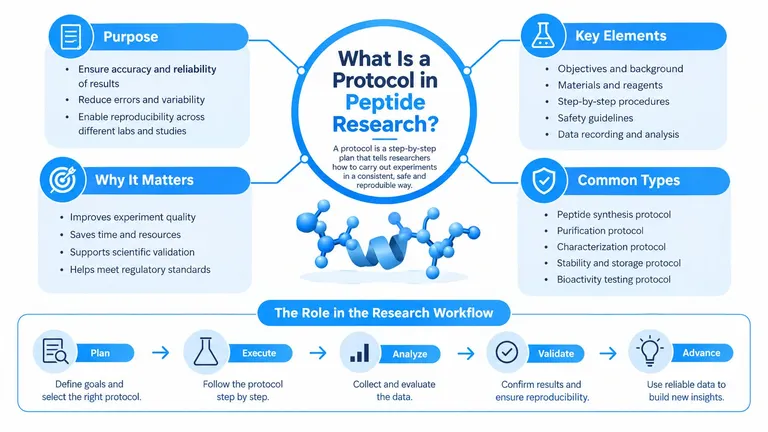
A protocol is an operational rule set. It describes the actions, sequence, timing, conditions, and responses that allow people or systems to perform a defined activity consistently. In technical communication, that can include message formats, sequencing, state transitions, error handling, and timing behavior. In a peptide workflow, the same logic appears in more familiar terms: what happens before administration, what schedule is followed, how a pause is handled, and what gets recorded after an event.
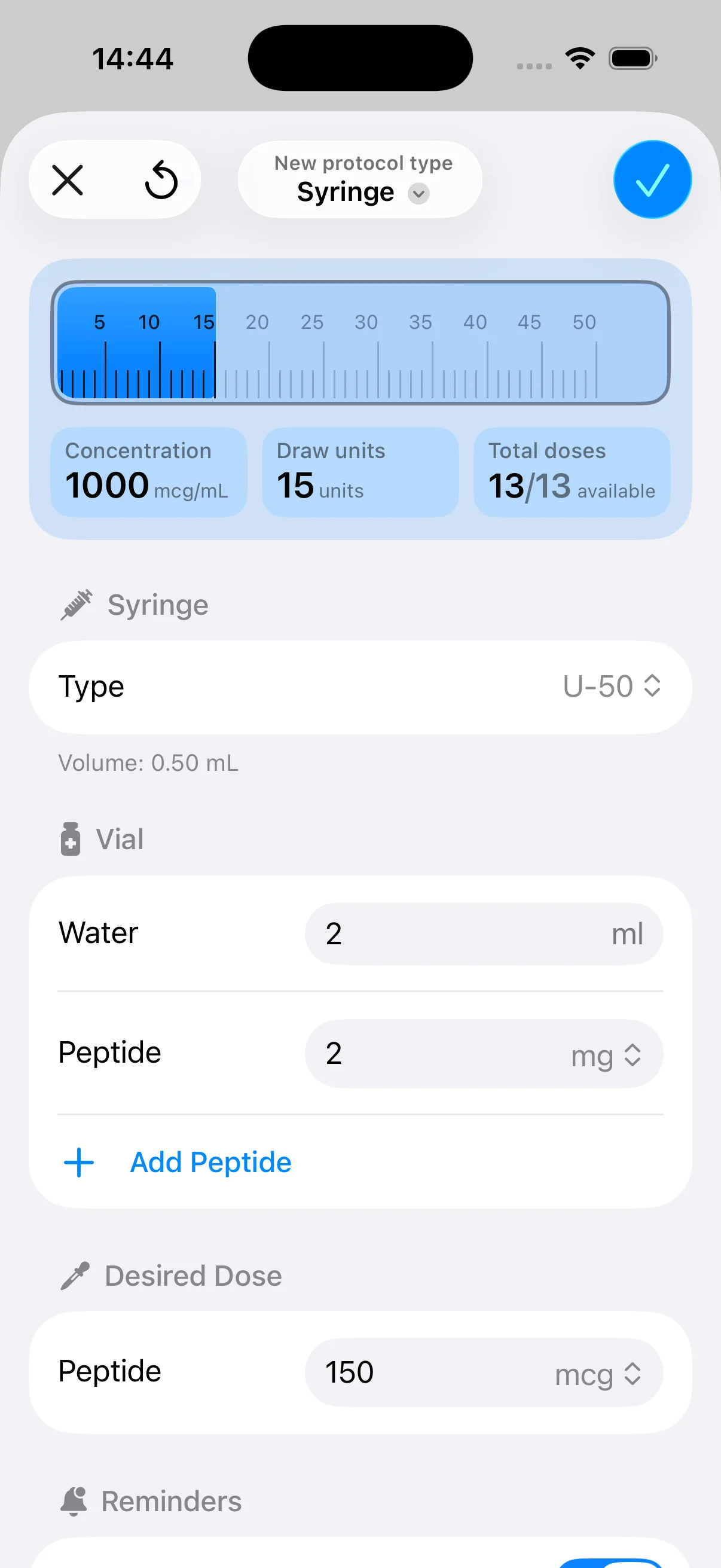
A protocol might define a prescribed frequency, a cycle structure, a start date, and a pause period. It may also specify which vial concentration is being used, how the intended quantity is converted into a practical measurement, and what a user should do when a reminder is missed. Those details describe behavior, not institutional authority. They tell the workflow how to operate.
Protocol behavior in daily practice
Consider the workflow as a sequence of states:
- A regimen is created with an intended schedule.
- A vial configuration and concentration are recorded.
- The system calculates the corresponding administration volume or unit entry.
- A reminder signals that an action is due.
- The user logs the action, postpones it, or marks it as missed.
- The history records the outcome for later review.
Each transition needs an explicit rule. If a user changes the vial concentration, the calculation must be revisited. If an administration is delayed, the record should distinguish delay from omission. If a cycle includes a pause, the pause should be represented as part of the schedule rather than hidden in a note.
The protocol therefore answers, “How does this workflow behave?” It coordinates a person, a calculator, a calendar, and a record. It doesn’t automatically decide whether the units are documented according to a shared convention, whether the records can be exchanged with another system, or whether an independent reviewer could verify compliance.
What a protocol doesn’t establish
A protocol can be widely used without being formally standardized. It can also be technically detailed and still leave important governance questions unanswered. Who approved the revision? Which fields are mandatory? How are deviations reviewed? What evidence shows that two people interpreted the instructions in the same way?
That boundary is why protocol management for peptide schedules should include version awareness, explicit assumptions, and an audit trail. A practitioner reviewing AOD-9604 dosing research should treat external information as context to evaluate with an appropriately qualified professional, not as an automatic substitute for individualized clinical direction.
A strong protocol is executable. It makes the next action clear, defines exceptions, and records enough context to reconstruct what occurred. It becomes more dependable when a separate standard supplies the conventions used to compare, verify, and govern that execution.
What Is a Standard in Peptide and Clinical Workflows
What must remain consistent when several people prepare, document, or review a peptide dosing workflow? A standard is a formally agreed baseline that defines the information and conditions required for reliable work. It may cover terminology, units, data formats, quality criteria, testing methods, documentation, or interoperability. A standard usually does not prescribe every action in a live workflow. It sets the rules that allow different protocols, users, and systems to produce records that can be compared and reviewed.
That distinction affects daily dosing documentation. A standard can require a consistent identifier for the preparation, a recorded concentration, separate fields for intended and administered quantities, and the date and status of each entry. It can identify mandatory fields, distinguish them from advisory fields, and specify how versions are named, approved, and replaced. These choices reduce ambiguity when a schedule changes, a dose is delayed, or another person reviews the record.
ISO describes standards as tools for turning varied practices into reusable requirements, specifications, guidelines, or characteristics. ISO was founded in 1947, and its first published standard, ISO/R 1:1951, addressed reference temperature for industrial length measurements. By 2017, ISO reported more than 22,000 standards and membership of 163 national bodies, illustrating the institutional and consensus-based use of the term (ISO’s overview of its history and standards work). ISO standards are generally voluntary, although governments and procurement authorities may reference them in mandatory requirements.
Baselines for consistent records
Standard-like requirements in a peptide workflow may include:
- Unit clarity: The record separates the prescribed quantity, the calculated quantity, and the practical administration measurement.
- Terminology control: The same labels carry the same meaning for practitioners, researchers, patients, and software.
- Traceability: Each entry connects to the relevant preparation, concentration, schedule version, and time.
- Conformance evidence: A reviewer can confirm that required fields were completed and that deviations received the required handling.
- Interoperability: Exported data remains understandable when another compatible system or reviewer receives it.
These requirements govern the record rather than dictate the dosing action. A protocol may specify when an action should occur. The standard can require the record to capture the interval, reference date, current status, and actual completion in defined fields. That distinction matters during routine administration because a missed reminder, a changed preparation, or a late entry should remain interpretable after the event.
A standard also does not automatically create legal or clinical authorization. A documentation convention can improve accountability without serving as regulatory approval, prescribing direction, or evidence that a particular regimen is appropriate. The applicable authority, approved workflow, and qualified clinical oversight still determine what may be done.
Conformance is more than appearance
A polished document can still fail review. One entry may contain a calculated quantity while another contains only a syringe marking. Both records may look tidy, yet they do not communicate the same information. Conformance requires testable requirements, stable terminology, complete fields, and a review method that can identify missing or inconsistent data.
For the same reason, peptide purity testing guidance belongs in a separate evidence category from a dosing schedule. Testing describes evidence about a material or process. The protocol describes actions over time. The standard defines shared criteria for documenting and checking both.
Comparing Protocol and Standard for Dosing and Compliance
The fastest way to apply the distinction is to assign every workflow question to one of two categories. If the question asks what happens next, it belongs primarily to the protocol. If it asks what must be true, recorded, or verified, it belongs primarily to the standard.
| Criterion | Protocol | Standard |
|---|---|---|
| Primary question | How should the workflow operate? | Which requirements must an implementation satisfy? |
| Dosing schedule | Defines timing, frequency, cycle structure, and pauses | Defines how those values are named, recorded, and checked |
| Vial configuration | Uses concentration and preparation assumptions in the calculation sequence | Establishes required fields and consistent reporting conventions |
| Missed action | Specifies whether to log, defer, pause, or escalate according to approved instructions | Defines how the deviation and resolution must be documented |
| Reminder system | Triggers notifications and status changes | Supports consistent records of due, completed, delayed, or missed actions |
| Governance | May be informal, local, or practitioner-defined | Usually reflects agreed requirements, version control, and conformance expectations |
| Interoperability | Coordinates exchanges between users or systems | Defines shared formats, semantics, and compatibility criteria |
| Verification | Tests whether the sequence behaves as intended | Tests whether mandatory requirements and documentation criteria are met |
Use both layers, not one substitute
A dosing calculator can follow a protocol correctly and still produce records that another reviewer can’t interpret. A standardized log can capture every required field while the underlying schedule remains ambiguous. Neither layer compensates for the absence of the other.
The IETF makes this relationship concrete in its standards process. A protocol specification advancing toward Internet Standard needs at least two independent implementations to interoperate correctly, including all features and options (IETF implementation reports). The lesson transfers well to health-related workflow design: a claimed specification should be tested across independent implementations and realistic edge conditions, not accepted because its label sounds authoritative.
For peptide documentation, interoperability means more than exporting a file. A second person should understand the units, preparation assumptions, schedule version, and status history without reconstructing the workflow from private notes. If a system can’t distinguish “planned,” “completed,” “delayed,” and “missed,” it hasn’t fully captured the operational state.
A decision sequence for practitioners
Start by writing the protocol in plain operational language. Identify the schedule, preparation assumptions, reminder behavior, pause rules, and deviation pathway. Then write the standard-like requirements separately, including required fields, naming conventions, review points, and evidence of completion.
Next, test the two layers together. Change a vial configuration, introduce a delayed entry, review a paused cycle, and export the history for another person to interpret. The protocol should produce the correct behavior. The documentation layer should preserve enough information to verify that behavior.
This approach also avoids a common procurement mistake. An “open” or “standard-compliant” label doesn’t prove interoperability by itself. Compatible semantics, data formats, authentication, version negotiation, conformance tests, and cross-implementation evidence still matter, as European interoperability planning emphasizes in its treatment of compatible formats and protocols across sectors (European interoperability planning for data interoperability).
How PepFlow Maps to Protocol and Standard
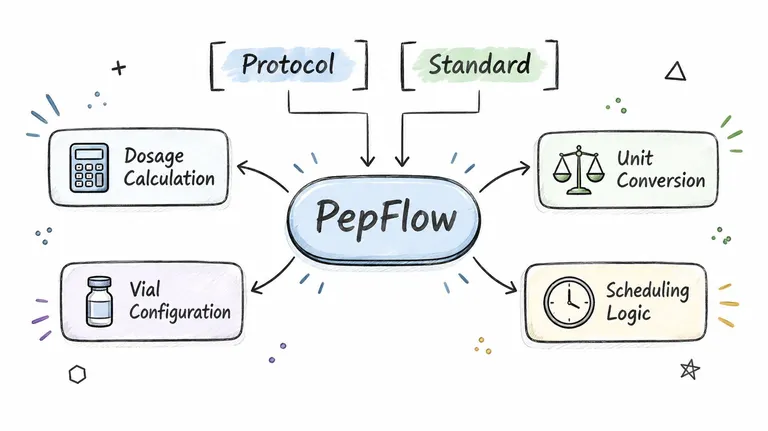
A useful mapping begins with the action layer. In PepFlow, dosage calculation, unit conversion, vial configuration, and scheduling logic represent protocol behavior because they define how a regimen is translated into a sequence of practical actions. The tool can organize a cycle, apply a start date, represent frequency and pauses, and surface reminders connected to the planned schedule.
That doesn’t make the regimen medically appropriate by itself. It means the operational instructions are represented explicitly rather than being left in scattered notes, mental arithmetic, or calendar entries. Any regimen should come from an appropriately qualified professional, and the app should be treated as a planning and organization aid.
The second layer concerns repeatability. History tracking, dose logging, reminders, cycle templates, and status records support standard-like expectations because they make the workflow more consistent and reviewable. They don’t constitute certification, regulatory endorsement, or proof of clinical compliance. They provide a structured environment in which a person can apply their own approved instructions and preserve the resulting record.
A practical mapping
| Workflow need | Protocol function | Standard-like support |
|---|---|---|
| Convert an intended quantity into a usable measurement | Applies calculation rules and vial assumptions | Preserves unit labels and configuration context |
| Plan a cycle | Sets dates, frequency, and pause behavior | Uses repeatable templates and consistent naming |
| Respond to a due action | Sends reminders and updates workflow status | Records whether the action was completed or not |
| Review adherence | Coordinates the event sequence | Maintains history for comparison over time |
| Explain a deviation | Defines the available status or next action | Keeps the reason and outcome visible for later review |
The important boundary is accountability. Software can reduce manual transcription and arithmetic ambiguity, but it can’t validate a product, diagnose a condition, authorize a regimen, or replace professional oversight. A clean record is evidence of organization, not evidence that a treatment decision was correct.
PepFlow’s value in this model comes from making assumptions visible. If the vial configuration changes, the user has a defined place to update it. If the schedule includes a pause, that pause exists in the cycle rather than only in a text message. If an action is logged, the history can distinguish the planned event from the recorded event.
That separation is what makes a digital companion useful. The protocol remains the approved set of actions. The standard-like record provides consistent evidence about how those actions were interpreted and recorded.
Practical Use Cases Across Different Regimen Workflows
A fitness enthusiast following a cyclic regimen needs the protocol layer first. The schedule should show start dates, intended frequency, pause periods, and what status to assign when an event doesn’t occur as planned. The record layer then needs consistent units and timestamps so a later review doesn’t depend on memory.
A biohacker comparing different scheduling approaches faces a different risk. Changing several variables at once can make the history difficult to interpret. Keep the operational schedule versioned, record the preparation assumptions for each period, and avoid treating a polished dashboard as proof that the regimen is safe or effective.
For a wellness practitioner supporting clients, the distinction improves communication. Give each client an operational plan that clearly states what has been authorized, then use a consistent documentation template for planned, completed, delayed, and missed events. That separation reduces the chance that an informal reminder becomes mistaken for a revised clinical instruction.
Students and self-learners benefit from using the two concepts as a teaching exercise. First, write a hypothetical workflow as a sequence of states. Then design the record fields another learner would need to reproduce and review the exercise. This reveals gaps that a definition alone won’t expose, such as unclear concentration assumptions or missing deviation rules.
A practical observation: Most avoidable confusion appears at the handoff between the schedule and the record. Make that handoff explicit.
Across all four situations, the recommendation is the same but the emphasis changes. Users need protocol clarity to know what action is expected, and standard-like consistency to know what the record means later. Neither should be used to justify unsupervised dosing decisions.
Implementation Recommendations for Safer, Clearer Regimens
Begin with a written source of authority. Identify whether the instructions come from a qualified clinician, an approved research plan, or another legitimate source. Don’t convert a general online explanation into a personal regimen merely because it contains a schedule.
Then separate the workflow into two documents or views:
- Operational rules: Record the approved timing, frequency, cycle boundaries, pause instructions, preparation assumptions, and response to deviations.
- Documentation rules: Define the units, required fields, status labels, timestamps, preparation identifiers, and review process.
- Exception handling: Decide how a delayed, missed, or interrupted event is recorded and who must be consulted before the schedule changes.
- Review checks: Test whether another person can interpret the record without relying on private context or informal messages.
Use a calculation and scheduling tool only after the assumptions are clear. Enter the vial configuration carefully, check the unit conversion, confirm the schedule dates, and review pause periods before enabling reminders. Log what occurred rather than editing the original plan, because retrospective changes can erase the difference between intention and execution.
A short workflow check
Ask these questions before relying on a regimen record:
- Behavior: Does the schedule state what happens next and what happens after a deviation?
- Units: Can another reviewer identify the quantity, measurement convention, and concentration context?
- Traceability: Does each recorded event connect to the applicable schedule and preparation?
- Versioning: Can you tell when the instructions changed and which version governed an event?
- Reviewability: Could an independent person understand the record without guessing?
- Escalation: Does the workflow identify when a professional must be consulted rather than allowing an automatic adjustment?
A protocol that passes the first question but fails the rest is operationally incomplete. A record that passes the documentation questions but lacks clear behavior is orderly but unsafe to interpret. Build both layers, review them together, and keep organization separate from medical authorization.
PepFlow offers dosage calculation, unit conversion, vial configuration, cycled scheduling, reminders, dose logging, and history tracking for people organizing structured peptide regimens. Use it to make the protocol and documentation layers easier to manage, then visit PepFlow to see how the workflow fits your planning needs.