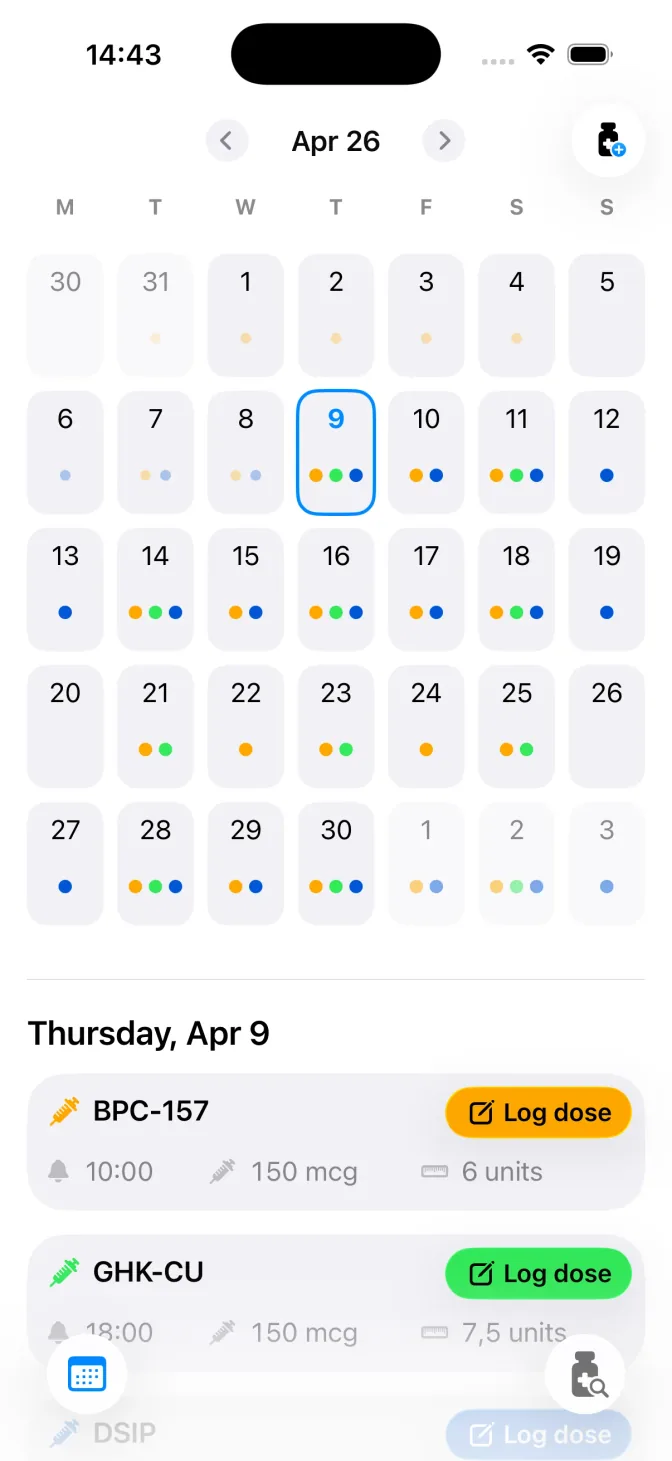
The plan started cleanly enough. A start date, a dose, a day of the week, a note that the cycle runs eight weeks and then pauses. You wrote it in the notes app, screenshotted it, set a repeating alarm, and moved on.
Six weeks later there are three versions of that schedule, one of them with the frequency changed after a phone call you half remember. The alarm on Tuesday fired while you were driving. You think you took the dose that evening, then think you may have moved it to Wednesday. Nothing in the record settles it.
That gap between the plan you wrote and the record of what happened is what this guide is about. Protocol rules aren’t a dosing guide and they aren’t medical advice. They’re the record-keeping conventions that decide whether your routine stays legible months later, when your memory of one specific Tuesday is gone and someone asks you a question you can’t answer.
Table of Contents
- Core Protocol Rules at a Glance
- How to Build a Cycle Plan You Can Follow
- Why Consistency Is Harder Than the Schedule
- Scheduled and Logged Doses Stay Separate
- Handling Missed, Paused and Rescheduled Doses
- When a Clinician Must Set the Rules
- Run the Record Before the Next Dose
Core Protocol Rules at a Glance
A peptide protocol is a written plan: product, dose, frequency, start date, cycle length, and any pause periods. The rules around it are separate from the plan itself. They set how the plan is kept, how each dose is recorded, and how a change gets made without erasing what came before.
Many treat the plan as the hard part and the record as an afterthought. The plan takes ten minutes. The record is the part you’ll rely on in week nine, when the only useful question is what you did.
| Rule | What It Covers | Example |
|---|---|---|
| Set the schedule first | Start date, frequency, cycle length, pause period | Weekly dose starting on a fixed Monday for 8 weeks |
| Log every completed dose | Date, time and amount actually taken | Monday 9:05 p.m., recorded volume, logged the same evening |
| Record exceptions with reasons | Skipped, delayed or paused doses | Dose skipped during travel, marked with the reason |
| Version every change | Original plan kept alongside each update | Schedule change saved as Version 2 with its date |
| Keep clinical decisions with a clinician | Dose selection and side-effect interpretation | Prescriber reviews a reaction before any adjustment |
Those five rules describe organization only. They say nothing about what to take, how much, or whether a routine is appropriate for you. They exist so that the person making those decisions, whether that’s you following written instructions or a clinician reviewing your history, has something accurate to work from.
Where to look first when the routine feels messy
Start with the log, not the schedule. A messy schedule tells you the plan was vague. A missing or incomplete log tells you why the routine drifted, because it shows the days you acted differently from the plan and gives you a date to point at.
If your log is empty and your schedule is elaborate, you have a plan and no evidence. Fix the log first. Everything else in this guide builds on that one habit.
How to Build a Cycle Plan You Can Follow
A cycle plan that survives contact with a real week has seven parts, and they build in order. The start date fixes the calendar, the frequency fixes the intervals, and the cycle length plus any pause fixes when the routine stops.
Four of those steps decide whether the rest of the plan can be read at a glance.

- Confirm the start date and where the instructions came from. Write whether the plan reflects a prescriber’s written instructions or your own notes, and record the date you set it down. When two sources disagree three weeks later, this line tells you which one was in front of you on day one.
- Write the frequency in plain words. “Once weekly, Monday” beats an abbreviation you’ll misread at 6 a.m. Plain words also survive being read by someone else, which is the point of a written plan.
- Set the cycle length and the calculated end date. Eight weeks from a Monday start ends on a specific Sunday. Write that date into the plan rather than counting it out each time you wonder where you are.
- Add every pause with its start date, end date and reason. This is the field people drop. A plan that says “eight weeks on, two weeks off” but records only the eight-week mark has already lost the pause, and the pause is what changes the next start date.
- Choose a reminder lead time that fits the routine. Fifteen minutes ahead works for an evening at home and fails on a commute. Match the lead time to where you’ll be standing when the alert arrives.
- Schedule a review date at the end of each cycle. On that date you compare the log against the plan. Reviewing against memory is how small drifts become invisible.
- Write a short outcome note when the cycle closes. Two lines covering anything that changed: a new instruction, a pause taken early, a dose you moved. This is what makes the next cycle faster to set up than the last.
The pause is the step worth slowing down for. Someone sets an eight-week cycle, adds a two-week pause that starts inside it, and then schedules the next cycle from the original end date instead of from the pause end date. The plan now has two dates that disagree, and whichever one you open next is the one that wins.
What the 80 percent rule can and cannot tell you
The 80% adherence cutoff circulates as though it were settled. A systematic review of adherence thresholds found five studies using thresholds ranging from 46% to 92%, with outcome-linked thresholds of 63% for congestive heart failure and 90% for statin therapy. The review concluded the evidence was too diverse to confirm any single universal cutoff.
Trial practice shows the same looseness. In a review of 34 medication-trial run-in studies, 20 used pill counts, and 13 of the 31 studies that specified a threshold used 80%. The same review found incomplete reporting and judged all included run-ins to have poor methodological quality and critical risk of bias.
Practical rule: a percentage can’t tell you which Tuesday you missed. The dated log can.
For a protocol, that means the plan should preserve its exact frequency, cycle length, pause and dose history instead of being graded against one generic number.
A complete plan ends up looking modest: a version number with a date, a start date with its source, frequency in words, a cycle end date, a pause block with a reason, a lead time, a review date, and an outcome note. Nothing in that list requires a calculation you can’t redo.
Why Consistency Is Harder Than the Schedule
A metronome keeps perfect time. The rowers still drift. The coach on the bank hears it before they do, because the catch lands a fraction late and then a fraction later, and nobody on the water is comparing the blades to the beat.
Schedules drift the same way. Writing “Monday and Thursday” takes a minute. Keeping Monday and Thursday for eleven weeks, through a work trip, a head cold and a week when the supply ran short, is a different job entirely.

So the low adherence figures in the literature describe a common problem, not a personal failing. The U.S. Agency for Healthcare Research and Quality’s research protocol on medication adherence interventions cites the same pattern: 20% to 30% of prescriptions are never filled, and as many as 50% of prescribed medicines are not taken as directed.
Peptide routines sit inside that pattern, not outside it. Studies of diabetes medication adherence show how much the reported rate depends on the ruler used: looking back at pharmacy refill records produces one answer, electronic monitoring that counts doses taken produces another, and insulin use is measured differently again. Same patients, same condition, different answer depending on the method.
Three things follow.
- The number reflects the measure as much as the person. Any single adherence percentage you hear is a statement about a study design as much as about behavior.
- Memory is not a record. You remember the weeks that went well and the dose you nearly missed. You don’t remember the Thursday you moved to Friday, and that’s the entry that matters.
- A dated history shows drift while it’s still small. Two missed doses in a row is a fact you can act on. Two missed doses a month apart is a pattern you can only see if the dates exist.
For the behavioral side of this, including why routines collapse at predictable points, the guide to adherence to a schedule covers the habits around the record. The record itself settles a smaller question: what the plan said versus what happened. Whether a visible drift means the plan should change is a different question, and it belongs to the clinician who wrote it.
Scheduled and Logged Doses Stay Separate
At 8:00 p.m. the phone buzzes. You’re in the kitchen, you swipe the notification away, and you reach the vial at 8:40. An hour later you can’t say whether the 8:00 line in your app means the dose happened or the alarm happened.
That confusion disappears once a protocol treats scheduled and logged as two different objects. The schedule holds the intended date or time, the dose, the cycle and any pause. The administration log holds what occurred: taken, skipped, delayed, or documented some other way. A missed reminder should never be readable as a completed dose, and the only way to guarantee that is to keep the two records apart in the data, not just in your head.
Three rules make the separation hold up.
Fix timestamps once entered. A planned time and a logged time both get written and stay written. If you edit history freely, the log stops being evidence and becomes a second version of your memory.
Require a reason for every skip or pause. “Skipped” alone is a dead end. “Skipped, travel, no fridge access” tells a clinician what happened and tells you whether the same thing will happen next month.
Never shift future doses after an exception. If a dose moves, that’s an explicit, dated edit to the plan, made visible as a new version. An app that reflows the remaining schedule after you tap “skip” has rewritten your plan without telling you.
Versioning is what ties this together. When the schedule changes, the earlier version stays readable, so anyone reviewing the routine can reconstruct what was intended on any past date. That’s the difference between a history and a summary.
The FDA’s patient labeling resources frame the same priority from the other direction: adherence to directions for use is central to a drug’s effectiveness, and patient medication materials exist so that users and clinicians can review how medicines are being taken. A record supports that review. It doesn’t perform it.
Where the record stops: the software documents the routine. Dose selection, treatment changes and the interpretation of any side effect belong to a prescriber or pharmacist.
Handling Missed, Paused and Rescheduled Doses
An alert is not a logged dose. That single sentence resolves most of the confusion around reminders, because it forces three events apart: the notification was delivered, you acknowledged it, and the dose was logged. Receiving a push at 8:00 proves the first and nothing else.
Evidence summarized by the UK Specialist Pharmacy Service treats reminders as layered behavioral support rather than isolated alarms. Simple reminders help, but greater benefit appears when reminders are combined with active follow-up from healthcare professionals, and prompts anchored to a regular daily activity can outperform prompts tied to a precise clock time. An umbrella review cited there found statistically significant adherence improvement in 59% of reviewed simple eHealth interventions that included reminders, while warning that the evidence base carries meaningful risk-of-bias limitations.
| Situation | What to Record | Who Decides |
|---|---|---|
| Dose taken late, same day | Actual time and reason for delay | You log it; a clinician advises if you’re unsure |
| Dose missed, no catch-up planned | Skipped status with the reason | Prescriber or pharmacist gives the instruction |
| Protocol paused | Pause start date, end date and reason | Clinician approves when required |
| Dose rescheduled | Original date and new date | You record it; a clinician sets new timing |
| Side effect after a dose | Symptoms, time of dose and dose amount | Prescriber or pharmacist |
Read the table by column, not by row. The middle column is yours: facts, times, reasons, symptoms, in plain language, recorded when they happen. The right-hand column belongs to someone with clinical training, and no app should be filling it in for you. Software that decides whether to take a catch-up dose has moved from documentation into prescribing.
A missed-dose queue helps here, because it shows what’s still open rather than what’s been closed. Pair it with configurable lead-time alerts, calendar context, and a history that displays due, completed, skipped and overdue events as four distinct states.
Why peptides need more than a checkbox
A taken-or-missed toggle fits a fixed daily pill. It doesn’t fit a routine with a flexible start date, weekly or intermittent dosing, a cycle boundary, a pause, and a dose you moved because you were traveling. The 2025 evidence reflects that complexity. A review of digital adherence tools reported that many digital interventions failed to improve adherence, while a 2025 systematic review found that interactive features, advanced reminders and data sharing looked more promising than simple alerts.
More reminders are not automatically better. A protocol record that keeps the start date, the interval, the cycle end, the pause and the new date for a rescheduled dose gives you something an extra alarm never will: an account of what happened.
Write the decision-maker’s answer into the record when you get it. “Pharmacist advised no catch-up, resume Monday” is one line, and six weeks later it’s the difference between following the instruction and guessing at it.
When a Clinician Must Set the Rules
A well-kept protocol can show what was planned and what was recorded. It cannot establish that a product is safe or appropriate. Questions about a product’s source, concentration, or storage need answers from a qualified professional.

Product availability and related policies can change. For example, the FDA reported that tirzepatide injection had been in shortage since 2022 because of increased demand, and that the shortage was resolved in October 2024. That update describes supply status, not the contents or suitability of any particular product. The FDA’s update on compounded GLP-1 drugs and supply provides context on that change.
Three layers that should never merge
Keep three records conceptually separate:
- Prescriber instructions: what a qualified professional recommended and when. This is the clinical direction to follow.
- Administration record: what you entered about what you did, including the time and status.
- Product information: details such as source, labeling, concentration, storage requirements, and legal status. Ask a pharmacist or other appropriate professional about these.
The distinction matters because a complete record is not a safety assessment. Accurate entries can document a plan without confirming that the product or plan is suitable.
For questions to discuss before beginning a routine, see ProMD Health Easton peptide safety guidance and this overview of peptide therapy and how routines are structured. Ask a pharmacist about the product’s source, label, and storage requirements, and ask the clinician responsible for your care whether the regimen is appropriate for you.
PepFlow can organize the instructions you enter, but it does not choose a treatment or determine a medically appropriate dose. The clinical decision belongs to a qualified professional; the record helps keep that decision distinct from what was taken.
Run the Record Before the Next Dose
Before the next dose, open the current version and read only the four fields that can change today’s action: the active version date, the next scheduled time, whether a pause covers today, and the last administration entry with its status of taken, skipped, delayed or still due.
If today falls inside a pause, or the last entry is due rather than logged, a notification is not permission to proceed. Leave the item open and follow the decision owner named for that exception. Half of good protocol hygiene is refusing to let an alert make a decision it isn’t qualified to make.
PepFlow holds this check on iPhone, iPad and Android by storing the schedule you enter, including start date, frequency, cycle and pause, and by keeping the dose log separate from that schedule. Protocols and settings sync across devices through Apple’s CloudKit, which is fully encrypted and stores data on Apple’s infrastructure. The app records the instructions you choose to enter. It doesn’t select a product, set a medically appropriate dose, or decide a catch-up, and a reminder or a completed log supports organization without proving adherence, product quality or effectiveness. The full mechanics of the dose history are explained in the guide to how logging works.
After the dose, log the actual time and status. At the cycle review date, compare that log against the version that was active when the cycle ran.
PepFlow gives peptide routines a place to live: you enter the protocol once, it tracks start dates, frequencies, cycles and pauses, and it keeps a separate dose log you can read back months later. If your schedule currently exists in three notes apps and your memory, that’s the gap it closes, and none of it asks you to hand over a clinical decision. Take a look at PepFlow and run one cycle with a record you can trust.