
The popular advice to choose peptides because they’re safer than steroids skips the questions that matter most. Peptide describes a type of molecule, not a safety rating. A prescribed medicine with a defined indication and an unidentified vial sold online shouldn’t get the same verdict because both carry that label.
A useful peptides vs steroids comparison starts with the exact product, the outcome you want, and the evidence supporting that use. Approval status, supply integrity, and medical monitoring tell you far more than a broad category name.
Table of Contents
- Peptides and Steroids Side by Side
- What the Evidence Shows for Muscle and Strength
- Risk Profiles and the Labs That Track Them
- Product Quality and Where Supply Chains Fail
- Legal Status and Ethical Lines by Setting
- Choosing the Right Comparison for Your Situation
- Confirm Your Plan With a Clinician Before Acting
Peptides and Steroids Side by Side
Peptides and anabolic steroids aren’t interchangeable drug classes. Some affect overlapping outcomes, such as body composition or hormone activity, but they reach those outcomes through different biological pathways.
Here, anabolic-androgenic steroids, often shortened to AAS, means testosterone-related anabolic agents. It doesn’t mean every medication described as a steroid.
Steroids and peptides compared on six factors
| Factor | Anabolic steroids | Peptides |
|---|---|---|
| Chemical basis | Testosterone-derived androgens | Short amino-acid chains and their analogues |
| Main biological route | Activates androgen receptors and anabolic signaling | Hormone mimicry, releasing-factor signaling, or growth-factor pathways, according to the compound |
| Examples on WADA lists | Nandrolone, stanozolol, androstenedione | Tesamorelin, GHRP-2, GHRP-6, ipamorelin, erythropoietin |
| Sport status | Anabolic agents prohibited under applicable anti-doping rules | Peptide hormones and related substances prohibited at all times |
| Human evidence base | Stronger direct evidence for strength and lean mass | Approved treatments for specific indications alongside products with limited human data |
| Monitoring needs | Blood count, lipids, blood pressure, reproductive hormones | Compound-specific checks selected for the target and indication |
Why the peptide column is a range
The chemical distinction is straightforward. Anabolic steroids act through androgen activity, while peptide-based drugs can mimic hormones, stimulate hormone release, or affect other signaling pathways.
The clinical distinction is less tidy. The peptide column spans established prescription treatments and unapproved online products, so it cannot contain a single answer about effectiveness or risk. Evidence for one peptide doesn’t transfer to another, even when sellers group them under the same performance goal.
Monitoring follows the biological target, not the marketing category. A product affecting red-cell production calls for a different clinical assessment from one affecting glucose regulation.
What anti-doping history tells us
The World Anti-Doping Agency’s 2011 Prohibited List separated anabolic agents from peptide hormones, growth factors, and related substances, with the latter category already including erythropoietin, chorionic gonadotrophin, insulin, growth hormone, and insulin-like growth factor-1. Those examples show why a peptide can have substantial physiological effects without being an anabolic steroid.
The WADA 2015 Prohibited List explicitly named releasing-hormone analogues such as CJC-1295, sermorelin, and tesamorelin, together with growth-hormone-releasing peptides including GHRP-2, GHRP-6, hexarelin, and ipamorelin. These classifications distinguish mechanisms and substances, not gentle drugs from dangerous ones.
Working rule: Compare a named compound, indication, source, dose, and regulatory status. Don’t use an anti-doping category as a safety ranking.
What the Evidence Shows for Muscle and Strength
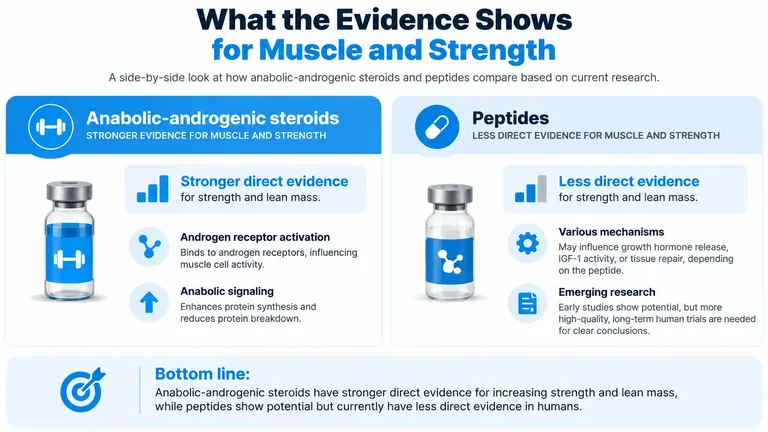
Anabolic-androgenic steroids have stronger direct evidence for increasing strength and lean mass than most peptides marketed for performance. They activate intracellular androgen receptors and increase anabolic signaling, protein synthesis, and adaptation to resistance training.
A meta-analysis summarized in a clinical review of anabolic-androgenic steroids found that short-term AAS use increased strength by approximately 52% more than placebo, with results affected by training status, compound, dose, and study quality. That’s a comparison between study groups, not a prediction of how much stronger an individual will become.
The broad evidence distinction is illustrated below.
A hormone change isn’t a strength result
Peptides are a heterogeneous group. Some have established uses for specific medical conditions, while others have limited human efficacy evidence for the outcomes promoted by sellers.
A study showing that a substance changes hormone concentrations answers a different question from a trial measuring strength. It doesn’t automatically establish better training performance, greater muscle size, or improved injury recovery.
When evaluating a claim, separate the outcomes:
- Biological activity: Did the compound change a hormone or another laboratory marker?
- Body composition: Did investigators measure a meaningful change in lean mass?
- Function: Did participants become stronger or perform better?
- Clinical benefit: Did the treatment improve the condition it was intended to treat?
Even a positive result needs context. A finding in patients receiving treatment for a diagnosed condition may not apply to healthy people pursuing bodybuilding goals.
Make the comparison specific enough to use
A meaningful comparison needs the named compound, route, dose, study population, and measured outcome. Without those details, a claim that peptides build muscle can combine unrelated substances and incompatible evidence.
For readers investigating individual compounds, our guide to peptides discussed for muscle growth provides a place to examine the category more closely. Treat any list as a starting point for evidence questions, not a menu of equivalent treatments.
Keep training organization separate from drug selection, too. If your immediate need is a structured workout routine, GrabGains’ personalized muscle building app is a resource to consider for that task, rather than using a performance-drug comparison to decide how to train.
Stronger evidence of an anabolic effect isn’t evidence of an acceptable personal risk. Effectiveness and safety require separate judgments.
Risk Profiles and the Labs That Track Them
Anabolic steroid use can require systemic endocrine and cardiovascular monitoring. The Merck Manual’s clinical guidance on anabolic-androgenic steroids describes concerns including increased hematocrit, adverse lipid changes, suppression of endogenous reproductive hormone production, and cardiovascular effects, particularly with nonmedical or supraphysiological exposure.
Peptide risk requires a product-specific assessment. A targeted mechanism doesn’t necessarily produce a small effect, and formulation, purity, route, dose, and clinical indication all affect the assessment.
Match the check to the concern
Monitoring markers by health concern
| Concern | Linked to | Check to discuss with a clinician |
|---|---|---|
| Raised red-cell count | Anabolic steroids and erythropoiesis-stimulating peptides | Hematocrit or hemoglobin |
| Blood pressure change | Anabolic steroids and cardiovascular strain | Blood pressure readings over time |
| Lipid disturbance | Anabolic steroids | Lipid panel |
| Suppressed natural hormone production | Androgens and selected hormone-modifying peptides | Reproductive hormone panel, as the clinician directs |
| Blood sugar shifts | Growth-hormone-related peptides | Fasting glucose or HbA1c |
| Growth-signaling changes | Growth hormone and IGF-1-related agents | IGF-1 level, as the clinician directs |
This table is a discussion aid, not a universal testing package. A clinician should select the relevant checks and interpret them alongside your history, symptoms, medications, and examination.
For background vocabulary before an appointment, Venus Health Co.’s guide to making sense of metabolic test results can help you prepare questions. It shouldn’t be used to clear yourself for treatment or explain away an abnormal result.
Connect laboratory results to a dated history
Adherence tracking records what happened. Medical monitoring evaluates what it means. A completed dose entry can’t establish that a treatment remains appropriate.
Build a timeline that lets your clinician compare laboratory dates with actual administrations. Record missed doses, pauses, reactions, and clinician-directed changes rather than preserving only the intended schedule.
For example, a blood sample collected during a pause has a different exposure context from one collected during uninterrupted use. The clinician needs the actual dates, not an assumption that you followed the plan exactly.
Also distinguish a new symptom from an interpretation. Write that ankle swelling started after a product change, rather than recording that the product definitely caused it.
A laboratory result needs clinical interpretation. A dose log supplies context, not a diagnosis.
The marker table identifies what to discuss in bloodwork and clinical checks, not what to take or how to change a dose.
Product Quality and Where Supply Chains Fail
The intended molecule isn’t the only source of risk. Before considering its pharmacology, you need confidence that the product contains what the label says.
FDA enforcement materials warn that unapproved online drugs can be counterfeit, contaminated, inconsistently formulated, or contain different ingredients, and the agency’s warning letter to USApeptide.com documents action against a seller marketing unapproved peptide products. Availability on a website isn’t evidence of pharmaceutical quality.
Separate the sources of uncertainty
- Molecule-specific effects: The intended active ingredient has its own pharmacology and potential adverse effects.
- User behavior: Combining compounds, escalating exposure, or restarting without a reliable history complicates assessment.
- Product integrity: Incorrect identity, concentration, or contamination introduces uncertainty beyond the intended ingredient.
These problems can overlap. Say someone changes suppliers while adding another compound and then develops symptoms. Without product and administration records, the clinician may struggle to identify what changed.
That doesn’t establish that every peptide has poorer quality control than every steroid. Unapproved or illicit supply can make either category unpredictable.
Preserve the product’s history
For each product, retain:
- Supplier details: Name, dispensing pharmacy when applicable, and purchase documentation.
- Product identifiers: Exact label, lot or batch number, and photographs of the packaging.
- Handling history: Date received, recorded storage conditions, and relevant preparation notes.
- Exposure history: Dates used and any symptoms associated with a new vial or supplier.
Record a supplier change as a new reference point, not proof that the replacement is equivalent. Don’t assume that a familiar name on a different vial establishes identical contents.
Our explanation of peptide purity testing can help you understand the questions around product verification. A purity claim alone shouldn’t be treated as approval for human use or proof that an injectable product is suitable.
Ask a pharmacist to confirm the approval status of the exact product in your country. Bring the packaging, rather than relying on a seller’s description.
Legal Status and Ethical Lines by Setting
The legal question isn’t whether peptides or steroids are allowed. Sport rules, medicine approval, prescribing requirements, and import restrictions are separate questions. A favorable answer in one setting doesn’t settle the others.
Sport and prescribed treatment
For tested athletes, anabolic agents and prohibited peptide hormones fall under separate anti-doping categories. The relevant peptide-hormone category applies both in and out of competition, so stopping around an event isn’t a reliable compliance strategy.
Check the exact substance with your federation or anti-doping organization before use. If a clinician recommends treatment, ask what documentation or therapeutic-use process applies rather than assuming a prescription settles eligibility.
For patients, verify whether the exact medicine is approved in your country and what indication the prescriber is treating. Ask whether the proposed use matches that approval or requires a separate explanation of the evidence.
Research labels and personal responsibility
An online research label doesn’t establish that a product is legal to import, possess, sell, or administer. Our explanation of what a research peptide is helps distinguish laboratory terminology from clinical use.
Before acting, resolve the relevant setting:
- Domestic purchase: Confirm the product’s approval and prescription requirements.
- Cross-border supply: Check import rules separately from domestic availability.
- Competition: Obtain substance-specific guidance through the appropriate sporting body.
- Clinical care: Make sure the prescriber knows the treatment goal and all other products involved.
The ethical distinction also matters. Treating a diagnosed deficiency under medical supervision presents a different situation from pursuing a body-composition goal without clinical oversight.
In sport, fairness and eligibility add obligations beyond personal willingness to accept risk. Outside sport, informed decision-making still requires an honest account of what’s known, what’s uncertain, and what alternatives are available.
Choosing the Right Comparison for Your Situation
Start with your goal and whether drug testing applies. Treatment for a diagnosed deficiency, rehabilitation after an injury, and unsupervised physique enhancement aren’t interchangeable decisions.
The approval distinction is important: Harvard Health’s overview of peptides explains that established peptide medicines and inadequately studied products marketed online have substantially different evidence and safety contexts. You can’t transfer the testing behind an approved medicine to an unrelated research product.
Use these questions to identify the decision you face.
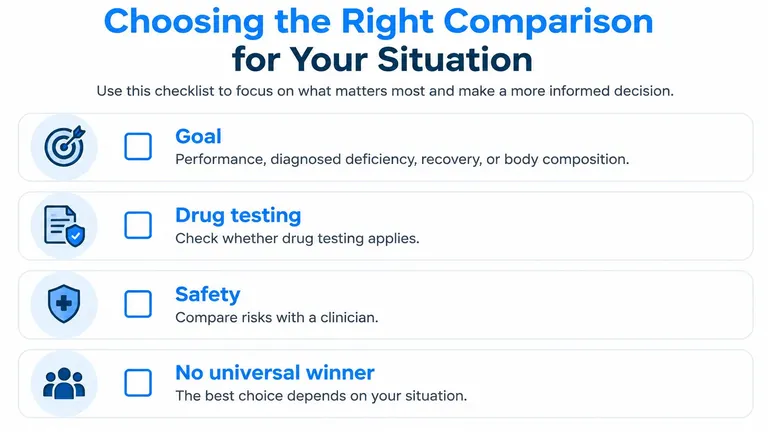
Situations and the question that decides them
| Situation | First question to settle | Why it changes the answer |
|---|---|---|
| Tested athlete | Is the exact compound prohibited under the applicable rules? | Anabolic agents and prohibited peptide hormones can jeopardize eligibility |
| Diagnosed hormone deficiency | Is it an approved medicine prescribed for that indication? | The indication establishes the clinical treatment context |
| Body-composition goal without supervision | Can you obtain clinical assessment and relevant baseline and follow-up checks? | Without monitoring, adverse effects may go unrecognized |
| Recovery with a prescribed peptide | Does the prescriber know about every other product you use? | Combinations and unlisted supplements complicate risk assessment |
| Research-peptide purchase | Can the vial’s identity and purity be verified? | Unapproved supply may contain different or inconsistent ingredients |
What each situation changes
For an athlete, eligibility may settle the issue before a discussion of potential benefits begins. The useful question is whether a permitted, clinically appropriate alternative exists.
For someone with a diagnosed deficiency, the diagnosis should guide treatment. Choosing a peptide because it sounds less aggressive can distract from whether it addresses the actual condition.
For an unsupervised body-composition goal, access to bloodwork alone doesn’t make experimental exposure appropriate. You also need a clinician who can interpret results and assess whether any proposed intervention has a defensible benefit-risk balance.
A prescribed recovery treatment requires a specific outcome, too. Ask what improvement the prescriber expects to measure and what would prompt reconsideration, rather than treating recovery as a catch-all promise.
Don’t extend evidence beyond its setting
Peptide evidence often concerns therapeutic use under controlled conditions. That doesn’t establish the long-term safety of higher-exposure or combined bodybuilding protocols.
A research-product purchase presents an additional problem: confirming identity wouldn’t, by itself, establish effectiveness, an appropriate human dose, or long-term safety. Product verification and clinical evidence answer different questions.
The more useful comparison is approved versus unapproved and monitored versus unmonitored, not peptide versus steroid.
Those distinctions still don’t produce a universal winner. They produce a more specific conversation about whether a particular intervention belongs in your care at all.
Confirm Your Plan With a Clinician Before Acting
Bring a product-level history to the appointment, not just the category name. A clinician can give more useful guidance when the proposed treatment, actual exposure, and unresolved questions are explicit.
Use the illustration as a reminder to verify the product and obtain clinical advice before acting.
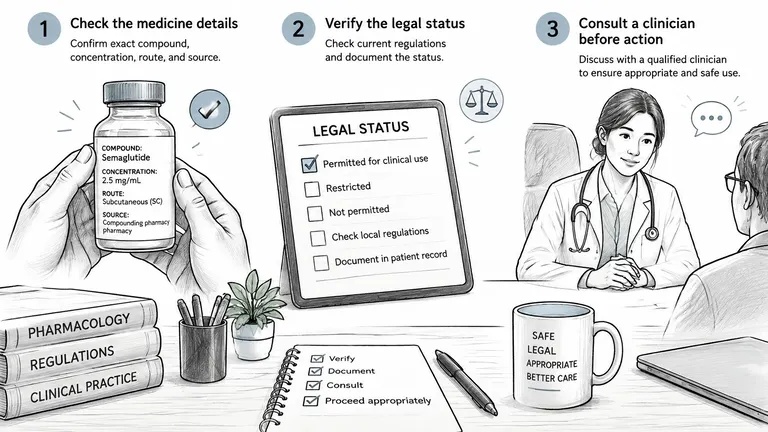
Prepare a usable record
-
Identify the exact product. Write down the compound, labeled concentration, route, and source, and bring the original packaging when possible. This gives the clinician something specific to assess without implying that the label has been independently verified.
-
Resolve the applicable rules. Confirm your country’s requirements and any competition restrictions before purchase or use. Approval, prescribing, import, and sport eligibility need separate answers.
-
Ask which baseline checks are relevant. Discuss a blood count, lipid panel, and the hormone or glucose tests appropriate to the proposed compound and your history. Baseline results provide a reference for later assessment, not permission to self-prescribe.
-
Record what happens. Keep dated entries for administrations, missed doses, pauses, supplier or lot changes, and symptoms. Mark a replacement supplier or new preparation clearly so the clinician can distinguish exposures.
-
Bring the record to follow-up appointments. Include other medicines and supplements, and ask what should be monitored if anything changes. Don’t turn an online interpretation of a result into a self-directed dose adjustment.
-
Get urgent help for concerning symptoms. Chest pain, breathlessness, fainting, sudden swelling, or vision changes warrant urgent medical assessment. Don’t delay care to complete a log or wait for an app reminder.
Keep tracking separate from treatment decisions
At PepFlow, we record and organize your chosen instructions; we don’t choose treatments or determine medically appropriate doses. On iPhone and iPad, you independently enter dose details and optional preparation and syringe information.
We store the personal information you provide, including protocols, dose logs, schedules, and saved preparation details. A record can only reflect what you enter, so reconcile it with your actual use before discussing it with a clinician.
The accompanying video offers another format for reviewing the topic, but it doesn’t replace individualized assessment.
Ask your clinician to document the treatment goal, relevant checks, and circumstances that should prompt contact. A complete history makes that conversation specific and reduces avoidable uncertainty.
PepFlow helps you organize an established routine with schedules, reminders, and a dated dose history, without choosing your treatment or medically appropriate dose. Visit PepFlow to keep your entered product details, pauses, and administrations organized for your next clinician conversation.