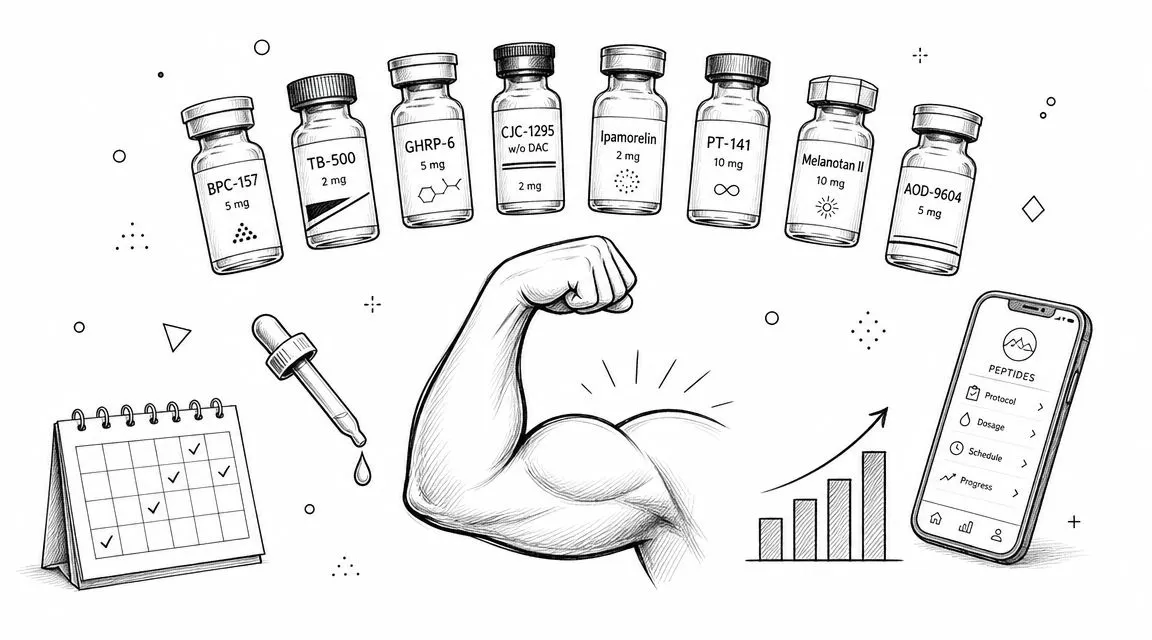
You can train hard, eat well, sleep enough, and still stall because the limiting factor isn’t effort. It’s signal management. Searching for the best peptides for muscle growth often leads to focusing on the compound name, while ignoring the part that usually determines whether a protocol is even coherent: timing, dose math, cycling, sourcing, and tracking.
Peptides sit in a strange middle ground between sports nutrition, recovery support, and experimental performance enhancement. The evidence base is still limited and mixed. A 2021 review in PMC noted that bioactive peptides have shown positive effects on body composition and muscular performance, but much of that work comes from non-athletic or experimental settings rather than large bodybuilding trials. That review also discussed findings such as improved recovery of explosive force, reduced soreness after strenuous exercise, and anabolic signaling relevance through pathways like PI3K/Akt/mTOR. That’s useful, but it’s not the same thing as a settled hypertrophy playbook.
So this guide keeps the hype in check. It covers eight of the most talked-about compounds and, more importantly, how people actually organize protocols around them. If you want a broader view of physique change, Telomyx body composition insights are a solid companion read.
Disclaimer: This information is for educational purposes only. Peptides are largely unapproved for human use and should be considered research compounds. Always consult with a qualified medical professional before considering any new compound or protocol.
Table of Contents
- 1. IGF-1 LR3 (Insulin-Like Growth Factor-1 Long R3)
- 2. BPC-157 (Body Protection Compound-157)
- 3. Ipamorelin
- 4. TB-500 (Thymosin Beta-4)
- 5. GHRP-6 (Growth Hormone Releasing Peptide-6)
- 6. Mod GRF 1-29 (Modified Growth Hormone Releasing Factor)
- 7. Hexarelin
- 8. MK-677 (Ibutamoren, Nutrobal)
- Top 8 Muscle-Building Peptides Compared
- Putting It All Together Choosing and Tracking Your Protocol
1. IGF-1 LR3 (Insulin-Like Growth Factor-1 Long R3)

IGF-1 LR3 gets attention because it sits closer to direct anabolic signaling than many recovery-first peptides. People usually reach for it during dedicated mass phases, especially when training volume is already high and they want a compound that fits a hypertrophy-focused setup rather than a purely healing-oriented one.
That appeal is easy to understand. It’s tied to the same broad signaling territory that lifters care about when they talk about growth pathways. If you’re also monitoring physiology, a clinical-grade IGF-1 blood test gives context for baseline and follow-up discussions with a clinician.
Why people use it
Competitive bodybuilders often place IGF-1 LR3 into off-season phases where the priority is adding tissue while still recovering from repeated hard sessions. In practice, the attraction isn’t just “more growth.” It’s the combination of gym performance, nutrient partitioning discussions, and the belief that recovery quality may improve enough to support better weekly output.
Practical rule: If your training, food intake, and sleep are inconsistent, IGF-1 LR3 usually becomes an expensive distraction rather than a useful variable.
A common real-world scenario is the intermediate or advanced lifter who already tracks training performance tightly and wants a protocol log that lines up injections with training days, rest days, and bloodwork windows.
Protocol handling in practice
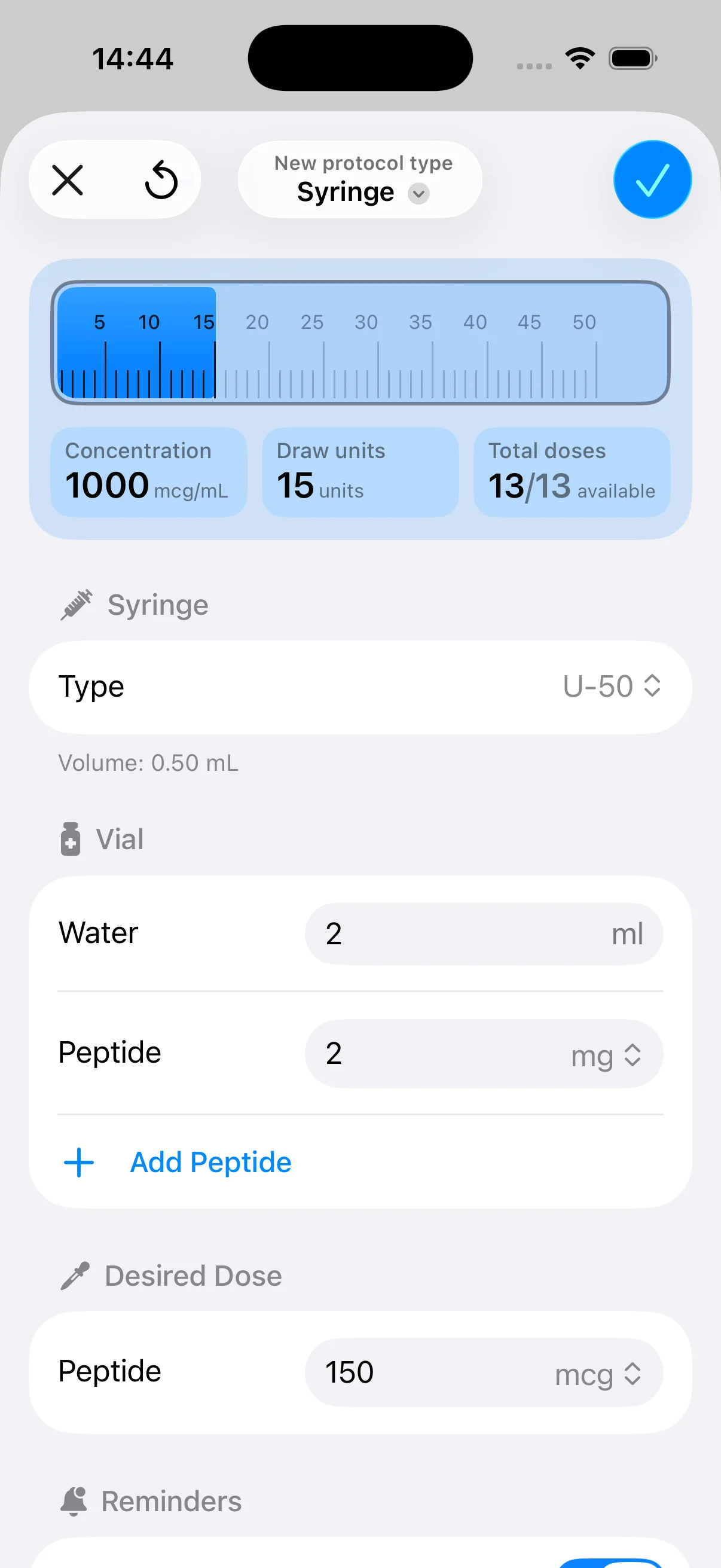
People often make mistakes in this regard. They obsess over the peptide and ignore dose conversion, injection timing, and cycle boundaries. A tool like PepFlow helps with the boring but critical pieces: converting microgram targets into unit measurements, setting post-workout reminders, and keeping a clean history log so you can compare how you felt during different training blocks.
Useful implementation habits include:
- Cycle discipline: Use a built-in cycle planner so on and off periods don’t drift.
- Post-training timing: Many users prefer to anchor administration around training because it improves adherence and simplifies routine.
- Glucose awareness: If a protocol affects appetite, recovery, or blood sugar handling, tracking those changes matters.
- Log everything: Energy, pumps, fullness, soreness, and sleep quality are more useful when they’re written down instead of guessed from memory.
IGF-1 LR3 is one of the compounds where sloppy execution creates most of the downside. Precision matters more here than enthusiasm.
2. BPC-157 (Body Protection Compound-157)
BPC-157 usually isn’t the first thing people think of when they search for the best peptides for muscle growth, but it often becomes the peptide that keeps training moving. A lot of lifters don’t fail to grow because they lack anabolic stimulus. They fail because elbows, shoulders, patellar tendons, or adductors stop tolerating the workload.

That’s the lane where BPC-157 is usually discussed. It’s less about direct muscle gain and more about reducing the friction that keeps athletes from training hard enough, often enough, for growth to happen.
Where it fits best
Think of the powerlifter with a cranky distal biceps tendon, the CrossFit athlete managing shoulder irritation from repeated overhead work, or the bodybuilder whose knee pain limits lower-body volume. In those cases, BPC-157 gets used as a support tool around tissue tolerance and recovery, not as a standalone muscle builder.
If you’re new to the category, it helps to understand the bigger context around what a research peptide is. That “research use” framing isn’t a technicality. It changes how cautiously you should approach sourcing, labeling, and claims.
Execution matters more than theory
BPC-157 is also where practical mistakes show up fast. Public articles often mention subcutaneous use and supplier quality risks, but they usually skip the operational side. A public-facing review of muscle-growth peptides notes that peptide discussions often leave out a key challenge of dosing math, vial concentration, and translating a microgram target into practical unit measurements, especially when users are trying to avoid manual errors in a repeated protocol (practical dosing gap overview).
That’s why planning tools matter here. If you’re trying to run a daily protocol consistently, you need repeatable reminders, a dosage calculator, and a place to log subjective recovery markers.
- Daily adherence: Set recurring reminders so doses don’t slide later and later each week.
- Tissue support: Many users pair BPC-157 discussions with adequate protein intake and collagen-rich nutrition habits.
- Localized tracking: Log pain reduction, range of motion, and training tolerance instead of relying on memory.
- Math control: Reconstitution errors can ruin consistency even when intention is good.
Later in the protocol, many users review how movement quality changed, not just whether discomfort dropped.
A useful explainer on administration and expectations is below.
3. Ipamorelin
Ipamorelin has stayed popular because it fits the person who wants a growth-hormone secretagogue without chasing the harshest-feeling option in the category. It’s usually discussed as a cleaner, more manageable choice for recovery, sleep support, and long-term routine building.
For many users, that matters more than raw intensity. The best peptide protocol is often the one someone can execute consistently for weeks without turning every day into a scheduling mess.
Why it stays popular
The common use case is an athlete or physique-focused lifter trying to improve recovery between dense training sessions. Another is the person building a stack around rhythm and consistency, not brute force. Ipamorelin often comes up in those conversations because it’s frequently paired with GHRH analogs by users seeking a more organized secretagogue approach.
Healthline’s review of peptides for bodybuilding notes that some research reported increases in muscle strength and mass after 8 to 12 weeks of peptide use combined with resistance training, while also stressing that the evidence remains limited and mixed, particularly in well-trained bodybuilders. The same review also notes that growth-hormone secretagogue peptides are banned doping agents in professional sports and are approved only for a few specific medical conditions.
If you compete in tested sport, that restriction matters more than any anecdotal protocol.
Scheduling and tracking
The practical problem with Ipamorelin isn’t usually the concept. It’s missed timing. People who use it often try to keep injections away from meals and insulin spikes because they want a consistent pattern. That gets difficult when work, training, and sleep times move around.
A planning app becomes useful when you need repeat reminders at fixed points across the day. For stack context, CJC-1295 and Ipamorelin protocol basics show why users often think in terms of pulse timing rather than random administration.
Implementation usually looks like this:
- Meal separation: Keep timing consistent relative to food intake.
- Reminder stacking: Use multiple daily reminders if the protocol calls for repeated administration.
- Sleep logging: Record sleep depth, wake frequency, and morning recovery.
- Cycle review: Build planned breaks into the calendar instead of deciding on the fly.
Ipamorelin tends to reward people who like structure. If your schedule is chaotic, your logs need to be tighter.
4. TB-500 (Thymosin Beta-4)
TB-500 sits in the same conversation as BPC-157, but the practical use case often feels broader. People usually discuss it when the issue isn’t one irritated spot. It’s accumulated wear across joints, connective tissue, and repeated movement patterns.
That’s why overhead athletes, grapplers, field sport athletes, and heavy lifters keep bringing it up. It fits the athlete who’s still training, but who no longer bounces back from strain the way they used to.
Best use case
A swimmer trying to manage shoulder load, a power athlete with recurring hip tightness, or a physique competitor whose elbows limit pressing volume may all look at TB-500 from a resilience angle. The logic is simple. If tissue quality and recovery improve enough to preserve training output, physique progress becomes easier to maintain.
This peptide makes the most sense when your actual bottleneck is durability. If your training plan is poor, your calories are too low, or your exercise selection keeps aggravating the same pattern, TB-500 won’t rescue a flawed system.
How people usually run it
The practical side is less glamorous than the peptide name. People need to decide whether they’re running a front-loaded recovery phase, a lower-frequency support phase, or combining it with other recovery interventions such as reduced loading, movement modification, and sleep cleanup.
A scheduling tool helps most with weekly consistency. Users commonly create fixed reminder days, track joint-specific notes, and compare training tolerance before and after the protocol.
- Weekly rhythm: Pick fixed administration days and don’t improvise every week.
- Recovery pairing: Align the protocol with reduced aggravating volume when possible.
- Symptom notes: Log range of motion, stiffness, and post-session irritation by body part.
- Protein basics: Tissue-focused compounds don’t replace adequate protein intake.
TB-500 tends to work best as part of a recovery system, not as a magic patch over reckless programming.
5. GHRP-6 (Growth Hormone Releasing Peptide-6)
GHRP-6 appeals to a very specific user. It’s often the bulking-phase lifter who wants both a growth-hormone secretagogue and stronger appetite drive. That combination can be useful when someone struggles to eat enough to support hard training and tissue gain.
For the right person, appetite isn’t a side effect. It’s the feature.
Who it suits
A bodybuilder in a heavy surplus phase may use GHRP-6 because meal compliance is already the hardest part of the plan. A hardgainer trying to maintain food intake across workdays might also find that angle attractive. In contrast, someone already fighting hunger, fluid retention, or messy food choices usually won’t like how it feels.
That’s an important trade-off. The best peptides for muscle growth aren’t the “strongest” ones on paper. They’re the ones that support your actual weak point.
Field note: If appetite is already easy, GHRP-6 can create more friction than benefit.
What to manage carefully
This compound demands routine. Users often try to time it before meals to take advantage of appetite changes, and many pair it with a GHRH analog for a stronger pulse-oriented setup. That means reminders, meal timing, and stack coordination all need to line up.
Useful tracking points include:
- Pre-meal timing: Set reminders ahead of planned meals instead of dosing reactively.
- Hunger changes: Log whether appetite becomes helpful or disruptive.
- Energy drift: Track lethargy, food focus, and training drive.
- Stack accuracy: If combining with another secretagogue-related compound, document exact timing together.
GHRP-6 is often productive in a surplus. In a cut, it can become a daily test of discipline.
6. Mod GRF 1-29 (Modified Growth Hormone Releasing Factor)
Mod GRF 1-29 is one of those compounds that makes more sense once you stop thinking in single-peptide terms. On its own, it matters. In practice, people usually talk about it as the organizing piece in a paired protocol with a GHRP.
That paired use is the reason it stays relevant. It’s less about novelty and more about stack design.
Why advanced users pair it
Coaches and experienced users often slot Mod GRF 1-29 beside compounds like Ipamorelin or GHRP-6 when they want a synchronized growth-hormone signaling approach. The appeal is precision. If one compound helps trigger one part of the pulse and the other complements it, users can build a cleaner routine around timing.
The operational challenge is obvious. Once two compounds need to be administered on the same schedule, manual tracking gets messy fast. For a practical overview of how users build that kind of stack, peptide stack ideas for muscle growth are useful context.
Practical setup
Software excels compared to handwritten notes. You need synchronized reminders, clean dosing records, and a clear calendar for planned breaks. The more complex the stack, the more likely people are to forget whether they dosed or only meant to.
A workable setup usually includes:
- Simultaneous reminders: Trigger both compounds at the same time if the protocol calls for it.
- Meal-spacing rules: Keep administration windows consistent around food.
- Cycle planning: Preload break periods into the calendar instead of waiting for fatigue or uncertainty.
- Outcome tracking: Log sleep, recovery, soreness, and training output, not just whether the injection happened.
Mod GRF 1-29 isn’t hard because of theory. It’s hard because two-compound consistency always exposes disorganized habits.
7. Hexarelin
Hexarelin usually enters the conversation when someone wants a more aggressive-feeling GHRP option but doesn’t want the same appetite emphasis they’d get from GHRP-6. That makes it interesting during fat-loss phases, recomposition phases, or any setup where food control matters as much as recovery.
It’s a narrower fit than many users expect. Stronger isn’t automatically better if the side-effect profile or rhythm clashes with the rest of the plan.
Why some users choose it over GHRP-6
A competitive athlete in a cut may prefer Hexarelin because hunger management is already difficult enough. A strength athlete trying to preserve training quality while leaning out may also find that trade-off more attractive than the appetite-heavy route.
The key distinction is practical, not theoretical. You choose Hexarelin when you want a secretagogue-oriented protocol that doesn’t pull your nutrition plan off course as aggressively.
Where tracking helps
Hexarelin is the kind of compound that benefits from disciplined on and off planning. Users often structure cycles intentionally to avoid just running it endlessly out of habit. Timing relative to training and meals also matters if someone is trying to keep the protocol repeatable.
Good tracking habits include:
- Cycle boundaries: Pre-schedule off periods so the protocol doesn’t become open-ended.
- Training alignment: Tie reminders to session timing if that improves adherence.
- Appetite notes: Even if hunger effects are lower than with GHRP-6, record them.
- Recovery markers: Keep notes on sleep quality, soreness, and gym readiness.
Hexarelin fits best when the user already knows how they respond to this category. It’s usually not the smartest first experiment.
8. MK-677 (Ibutamoren, Nutrobal)
MK-677 makes this list for one reason more than any other. It removes injection friction. For a lot of people, that’s enough to keep adherence high, which is often more valuable than picking a theoretically ideal protocol they won’t sustain.
It’s also the easiest entry point for people who are peptide-curious but injection-averse, even though it isn’t a peptide itself.
The appeal of an oral option
The common user here is the fitness enthusiast who wants a growth-hormone secretagogue-type approach without syringes, reconstitution, or vial math. Another is the experienced user who’s already running injectable compounds and wants an oral addition because daily routine is simpler.
The broader product environment also matters. A market report covering projected demand from 2025 to 2035 states that nutraceutical and functional-food products hold the largest share of the bioactive peptide market, and specifically points to whey-, soy-, and sea-derived peptides as increasingly popular for muscle recovery and performance, particularly in the USA through functional-food and nutraceutical growth (bioactive peptide market outlook). That’s a useful reminder that most real-world adoption happens through practical, ingestible formats.

How people structure it
Most users keep MK-677 simple on purpose. They anchor it to a fixed daily time, often in the evening, and then track appetite, sleep, and next-day recovery. The oral format makes reminder compliance much easier than with complex injection stacks.
That simplicity is the main advantage. You still need to log effects, avoid casual overconfidence, and pay attention to how appetite or lethargy affect the rest of your plan.
- Fixed timing: Take it at the same time each day to reduce missed doses.
- Sleep notes: Record whether bedtime use helps or hurts sleep quality.
- Appetite logging: Watch whether hunger supports a surplus or disrupts a cut.
- Stack awareness: If combined with injectables, track each variable separately.
MK-677 is convenient. Convenient protocols are often the ones people follow.
Top 8 Muscle-Building Peptides Compared
| Item | Complexity 🔄 | Resources ⚡ | Expected outcomes ⭐📊 | Ideal use cases | Key advantages 💡 |
|---|---|---|---|---|---|
| IGF-1 LR3 (Insulin-Like Growth Factor-1 Long R3) | Moderate, daily SC injections, cycle management needed | Injection, refrigerated; higher cost; 20–40 mcg/day | ⭐⭐⭐ Potent anabolic hypertrophy & recovery; visible in 6–12 weeks | Hypertrophy phases, plateau breaking, elite recovery | Extended half-life reduces dosing frequency; strong muscle & connective support |
| BPC-157 (Body Protection Compound-157) | Low, daily dosing, consistent adherence required | SC/IM/oral; room-temp stable; affordable; 250–500 mcg/day | ⭐⭐ Promotes tendon/ligament & muscle healing; 4–8+ week timeline | Injury rehab, tendon/ligament support, high-volume training recovery | Excellent safety; multi-route use; supports gut and tissue repair |
| Ipamorelin | High, multiple daily injections (2–3×), timing critical | SC injections; short half-life; refrigerated; moderate cost | ⭐⭐ Stimulates endogenous GH with minimal side effects; 6–12 weeks | GH stimulation with reduced cortisol/prolactin risk; recovery & body composition | Selective GH release; minimal cortisol/prolactin elevation |
| TB-500 (Thymosin Beta-4) | Low–Moderate, weekly dosing (1–2×), long protocols | SC/IM; stable refrigerated; 2–4 mg/week; cost-effective | ⭐⭐ Broad tissue repair & angiogenesis; effects in 2–4+ weeks | Overuse injury rehab, chronic joint issues, tissue adaptation | Comprehensive regenerative effects; infrequent dosing; pairs with BPC-157 |
| GHRP-6 (Growth Hormone Releasing Peptide-6) | High, multiple daily injections (2–3×); cycling to avoid tachyphylaxis | SC injections; short half-life; low cost; monitor appetite/prolactin | ⭐⭐⭐ Rapid GH spikes and strong appetite stimulation; 4–12 weeks | Bulking phases needing appetite + GH; GH pulse stacking | Powerful GH secretion and appetite support for caloric surplus |
| Mod GRF 1-29 (Modified GHRH) | High, multiple daily injections (2–3×), best when paired with GHRP | SC injections; refrigerated; moderate cost; timed dosing | ⭐⭐ Reliable GH amplification when stacked; 8–12 weeks for remodeling | GH pulse protocols, elite recovery, longevity stacks | Direct GHRH analog; synergizes with GHRP for amplified GH pulses |
| Hexarelin | High, multiple daily injections (2–3×), timing and cycling important | SC injections; short onset; refrigerated; monitor prolactin/water retention | ⭐⭐⭐ Strong GH response with reduced appetite vs GHRP-6; 4–12 weeks | Cutting/fat-loss phases needing GH benefits without excess hunger | Potent GH stimulation with less appetite increase than GHRP-6 |
| MK-677 (Ibutamoren) | Low, once-daily oral dosing; simple adherence | Oral capsule/powder; room-stable; affordable; 10–25 mg/day | ⭐⭐ Moderate GH/IGF-1 elevation; slow muscle gains over 8–12+ weeks | Users avoiding injections, long-term GH support, convenience-focused | Only oral option; once-daily dosing and consistent 24‑hr GH/IGF-1 support |
Putting It All Together Choosing and Tracking Your Protocol
Choosing the best peptide for muscle growth depends less on internet rankings and more on what problem you’re trying to solve. If you want a more direct hypertrophy-oriented conversation, IGF-1 LR3 usually sits near the top. If your progress keeps getting interrupted by tendon irritation or tissue strain, BPC-157 or TB-500 may be more relevant because they support the ability to keep training. If you’re focused on growth-hormone secretagogue strategies, Ipamorelin, GHRP-6, Mod GRF 1-29, and Hexarelin each offer a different balance of appetite effects, complexity, and routine demands. If convenience matters most, MK-677 is the obvious standout.
That said, what works in practice is usually less dramatic than forum discussions make it sound. People get the most out of these compounds when the basics are already in place: enough calories, enough protein, a training plan that creates progressive overload, and enough sleep to recover from it. When those pieces are missing, peptides often become a way to complicate a simple problem.
The other reality is risk. These compounds sit in a gray area defined by limited evidence, off-label interest, and uneven product quality. The biggest avoidable mistake isn’t usually picking the “wrong” peptide. It’s using a poorly sourced product, guessing at reconstitution, missing doses, changing variables every few days, and then pretending the protocol taught you something useful. It didn’t. It just introduced noise.
Frequently Asked Questions:
- Are these legal? The legal status is complex and varies by region. In the US, they’re commonly sold for research purposes only and are generally not approved for ordinary muscle-building use.
- How do I stack peptides? Stacking usually means combining compounds with complementary roles, such as a GHRH analog with a GHRP. The more moving parts you add, the more important scheduling and logging become.
- What are the biggest risks? Risks include side effects, poor product quality, contamination, inaccurate labeling, and the tendency to run complicated protocols without proper oversight.
Your next move should be deliberate:
- Do your research: Narrow your focus to compounds that match your actual goal, whether that’s growth, recovery support, or easier adherence.
- Consult a professional: A qualified doctor or endocrinologist can help you think through safety, contraindications, and monitoring.
- Plan meticulously: If you proceed, use a structured tracker so dosing math, reminders, and cycle logic aren’t left to memory. Understanding muscle building progress also helps keep expectations grounded in measurable outcomes.
PepFlow fits naturally into that last step. It’s a planning tool for dose calculation, scheduling, reminders, and history tracking. That doesn’t replace medical advice, but it does reduce the avoidable errors that happen when people try to manage peptide protocols with screenshots, sticky notes, and mental math.
If you want a cleaner way to manage research peptide routines, PepFlow helps with dosage calculations, cycled scheduling, reminders, and logging so your protocol is organized, repeatable, and easier to track.