
You’ve probably done the same search spiral many people do when hair thinning becomes hard to ignore. You start with familiar names like minoxidil and finasteride, then drift into forums, ingredient lists, clinic menus, and before long you’re staring at products built around “signal peptides,” “copper peptides,” and “growth complexes” that all sound scientific but rarely tell you what evidence exists.
That gap between scientific language and scientific proof is where most confusion lives. Peptides for hair growth are not nonsense. They’re biologically plausible compounds, and some have meaningful early data behind them. But they’re also heavily marketed, often bundled into formulas that borrow credibility from one ingredient while providing little direct evidence for the finished product.
If you’re sorting through options, it helps to pair research with practical context. Resources that summarize expert advice on hair growth treatments can be useful for understanding how peptides fit alongside more established approaches. The harder task is learning how to separate a promising mechanism from a proven treatment.
Table of Contents
- The Search for Better Hair Loss Solutions
- How Peptides Signal Hair Follicles to Grow
- A Guide to Leading Hair Growth Peptides
- Evaluating the Evidence Clinical Trials vs Marketing Hype
- Application Methods Topical Serums vs Injections
- Safety Side Effects and Regulatory Considerations
- Next Steps When to Consult a Professional
The Search for Better Hair Loss Solutions
Hair loss pushes people into a strange market. On one side, you have older, familiar treatments with well-known limitations. On the other, you have sleek serums and clinic protocols that promise a more “advanced” route, usually with terms borrowed from regenerative medicine. Peptides sit right in the middle of that tension.
They’re appealing for a simple reason. A peptide sounds targeted. It suggests that instead of forcing hair growth broadly, you might send a precise biological instruction to the follicle itself. That idea isn’t absurd. In biology, peptides do act as signaling molecules. The problem is that a plausible signal isn’t the same thing as a clinically reliable outcome.
A lot of people reach peptides after they’ve already tried a standard option, worried about side effects, plateaued results, or the burden of long-term use. Others are drawn in by the promise of “hair density support” from a cosmetic serum that sounds gentler than a drug. Both paths are understandable, but they lead to a crowded category where evidence quality varies wildly.
Working rule: If a product page spends more time naming peptides than describing human evidence, treat it as a hypothesis, not a proven intervention.
That distinction matters because “peptides for hair growth” is not one thing. It’s a broad label covering cosmetic ingredients, biomimetic peptide blends, and investigational candidates that are much more interesting scientifically than the average serum on a retail shelf. Looking at all of them as if they carry the same weight is how buyers get misled.
How Peptides Signal Hair Follicles to Grow
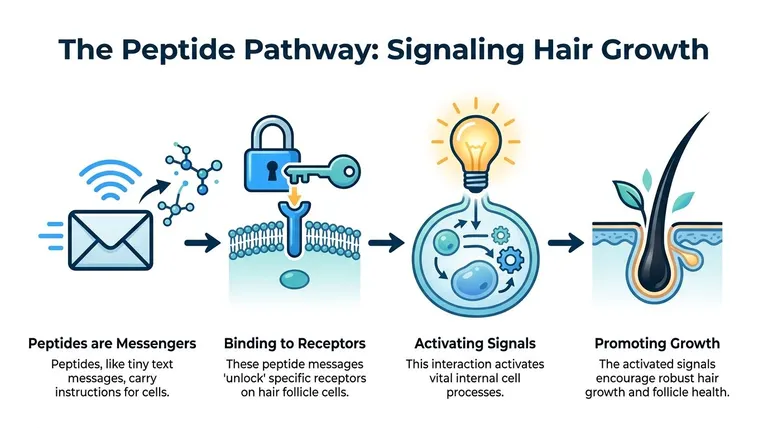
A useful way to think about peptides is as biological text messages. They’re short chains of amino acids, and their job depends on who receives the message. If the right peptide reaches the right receptor on the right cell, it can nudge that cell toward a certain behavior, such as growth, repair, or altered signaling.
Hair follicles are especially sensitive to signaling because they cycle through distinct phases. During anagen, the follicle is actively producing hair. During catagen, it transitions. During telogen, it rests. Hair thinning often reflects some disruption in that cycle, whether follicles spend too little time in anagen, too much time in telogen, or are affected by local stressors that reduce productive growth.
Where peptides can act
In hair biology, peptides are usually discussed for three potential actions.
- Anagen support: Some peptide strategies aim to keep follicles in the productive growth phase longer.
- Microenvironment support: Others may improve the local conditions around the follicle, including the tissue and signaling environment that supports growth.
- Vascular support: Better blood supply around the follicle can improve delivery of oxygen and nutrients to active cells.
A human example matters here. A randomized study in patients with telogen effluvium reported that biomimetic peptide treatment decreased hair loss by stimulating and prolonging the anagen phase, while also improving perifollicular vascularization in the scalp’s blood-supply network around follicles, according to the randomized telogen effluvium peptide study. Mechanistically, that’s more meaningful than a claim like “supports fuller-looking hair,” because it connects treatment to the actual biology of follicle cycling.
Why signaling alone doesn’t solve everything
Even when a peptide has a sound mechanism, two practical barriers remain.
First, the scalp is a barrier tissue. A peptide can look impressive on paper and still fail to reach its intended target in useful amounts. Second, follicles don’t all fail for the same reason. Stress-related shedding, androgen-sensitive miniaturization, inflammation, and nutritional problems can all look similar at the mirror but respond very differently to treatment.
A peptide can be biologically active and still be clinically disappointing if it never reaches the follicle or if the follicle’s real problem lies elsewhere.
That’s why the smartest way to approach peptides for hair growth isn’t to ask, “Which peptide is best?” It’s to ask, “What mechanism is being claimed, what evidence supports it, and does that mechanism fit the kind of hair loss I may have?”
A Guide to Leading Hair Growth Peptides
Most consumer-facing hair products repeat a small set of peptide names. Knowing what those names usually mean helps you read labels more critically and avoid giving too much credit to buzzwords.
Before looking at each one, keep one principle in mind. For many widely marketed peptide ingredients, the evidence is often preclinical, formulation-specific, or indirect. That doesn’t make them useless. It means you should resist treating them as clinically interchangeable with investigational compounds studied in formal trials.
Comparison of Common Hair Growth Peptides
| Peptide | Primary Proposed Mechanism | Level of Evidence |
|---|---|---|
| GHK-Cu | Supports scalp environment and follicle-related signaling; often discussed for repair-oriented and anti-inflammatory effects | Mostly preclinical and product-level extrapolation |
| Biotinoyl Tripeptide-1 | Often positioned as supporting keratin-related structure and hair anchoring | Mostly cosmetic and formulation-based claims |
| Acetyl Tetrapeptide-3 | Commonly marketed for supporting extracellular matrix around the follicle and reducing shedding | Mostly cosmetic and formulation-based claims |
A practical consumer overview of these names appears in discussions around understanding peptides for male baldness, but the key is not memorizing names. It’s learning how much proof sits behind each one.
GHK-Cu and copper peptides
GHK-Cu is the peptide widely recognized because copper peptides have been discussed for years in skin and hair care. The appeal is straightforward. GHK-Cu is associated with tissue-repair signaling, and in hair contexts it’s often framed as a way to support the scalp environment rather than merely forcing rapid follicle output.
That distinction matters. A healthier scalp environment may help hair quality and reduce local factors that interfere with growth, but that’s not the same as showing significant regrowth in people with patterned hair loss. Many claims around GHK-Cu come from mechanistic reasoning, in vitro work, or marketing built around adjacent biology.
That doesn’t make GHK-Cu irrelevant. It makes it a peptide that may be more credible as part of a supportive protocol than as a stand-alone answer for significant follicle miniaturization. If you’re trying to understand formulation math and protocol planning around this ingredient category, a GHK-Cu dosage calculator guide can help clarify how concentration and dose are often discussed.
Biotinoyl Tripeptide-1
This peptide shows up in many cosmetic hair serums because it fits neatly into a consumer story. The name sounds technical, it’s easy to combine with other actives, and it’s often associated with hair anchoring and support of follicular structure.
The issue is that buyers often mistake ingredient presence for treatment validation. A serum may contain Biotinoyl Tripeptide-1, but unless the finished formula has direct human evidence, the product is still leaning on ingredient theory. In practice, that means you should treat most claims around this peptide as suggestive, not conclusive.
If a brand highlights this ingredient, look for details it often avoids:
- Concentration transparency: Does the company tell you how much is included, or only list it in the ingredient deck?
- Formula context: Is it paired with penetration aids or delivery technology, or just dissolved into a basic serum base?
- Human outcomes: Does the brand cite testing on the actual product, not just on a supplier raw material?
Acetyl Tetrapeptide-3
Acetyl Tetrapeptide-3 is commonly linked to support of the extracellular matrix around hair follicles. In simpler terms, marketers position it as helping the structural environment that anchors and supports growing hair.
That’s a reasonable biological concept. Follicles don’t operate in isolation. Their surrounding matrix matters. But again, there’s a leap that many product pages make too quickly. They move from “this peptide may support the follicular environment” to “this product regrows hair” without presenting the type of evidence that would justify that stronger claim.
Useful skepticism: The more specific the mechanism sounds, the easier it becomes to overread weak evidence.
For consumers, Acetyl Tetrapeptide-3 is best viewed as a candidate supportive ingredient. It may have a role in a broader scalp-care strategy, especially in products designed for shedding or fragile hair anchoring, but you shouldn’t confuse that with proof of major regrowth.
How to read a peptide label
When you see a “multi-peptide” hair serum, read it in layers.
- Ingredient layer: Which peptides are present?
- Delivery layer: What helps those peptides get near the follicle?
- Evidence layer: Was the final product tested in humans?
- Diagnosis layer: Does the claimed mechanism fit your type of hair loss?
If a formula scores well only on the first layer, it’s mostly marketing.
Evaluating the Evidence Clinical Trials vs Marketing Hype
The strongest filter you can use is simple. Ask where the evidence sits on the ladder from cell study, to animal study, to human trial. Each rung can be useful, but they don’t mean the same thing.
A peptide that changes dermal papilla cell behavior in a dish has cleared only the first hurdle. It shows biological activity under controlled conditions. It does not show that the final product penetrates scalp tissue well, reaches follicles at an adequate dose, or produces visible improvement in actual users.

What stronger evidence looks like
A concrete example helps. A 2025 peer-reviewed overview in PMC reported that the peptide candidate PP405, which activates dormant hair follicle stem cells, produced statistically significant hair regrowth in a phase 2A trial in just 8 weeks, with 78 patients enrolled. The same overview reported that 31% of participants achieved more than a 20% increase in hair density over that short timeframe, according to the PMC overview of PP405 and peptide hair-loss research.
That doesn’t mean PP405 is now a universal answer to hair loss. It does mean something very important: a peptide-based mechanism has crossed into formal human evidence with a measurable, time-bounded outcome. That places it in a very different category from a cosmetic serum that cites supplier data or before-and-after photos.
“Statistically significant” matters because it suggests the result was unlikely to be due to chance within the study design. “Phase 2A” matters because it indicates a structured clinical development setting rather than informal product testing. Neither term guarantees real-world success, but both carry much more weight than ingredient storytelling.
When a peptide moves from theory to a controlled human trial, the conversation changes from “could this work?” to “under what conditions does this seem to work?”
A brief explainer can help if you want a general overview before digging into papers.
What marketing gets wrong
The biggest marketing mistake is evidence laundering. A brand takes a real finding from one context and indirectly implies it proves something broader.
Common examples include:
- Raw ingredient inflation: A supplier study on a peptide gets presented as proof that every serum containing that peptide works.
- Mechanism substitution: “Supports follicle signaling” becomes “clinically proven regrowth.”
- Visual overclaiming: Cosmetic improvement in hair appearance gets framed as true follicular recovery.
The practical question isn’t whether the brand uses scientific words. Almost all of them do. The primary question is whether the evidence matches the claim being made. If the answer is no, you’re looking at marketing dressed as translational science.
Application Methods Topical Serums vs Injections
Delivery changes everything with peptides. The same molecule can look modest in one format and much more plausible in another, because of how much reaches the intended tissue.
That’s why comparing topical serums and injections isn’t just about convenience. It’s about whether the delivery route matches the biological challenge.

Why topical delivery is hard
Topical products are easier to use, easier to stop, and generally easier to tolerate. They often represent the initial introduction to peptides. The catch is penetration. The scalp surface is not designed to let fragile bioactive compounds pass freely into deeper structures.
That’s where formulation starts to matter more than the peptide name itself. A peer-reviewed delivery study showed that co-encapsulating bioactive peptides in nanoliposomes increased uptake by dermal papilla cells and improved hair-growth outcomes versus free peptides in vitro, highlighting why carrier design can be central to topical efficacy in the nanoliposome peptide delivery study.
This is one of the most overlooked points in the entire category. Two products can list similar peptides and still perform very differently if one uses a follicle-targeted delivery strategy and the other doesn’t.
A useful way to compare topicals:
| Factor | Basic topical serum | Advanced topical formulation |
|---|---|---|
| Penetration logic | Often unclear | Usually a stated part of the design |
| Dependence on vehicle | High | High, but more intentionally addressed |
| Consumer convenience | High | High |
| Confidence in delivery | Often limited | Potentially stronger |
A peptide formula without a credible delivery strategy is often selling ingredient identity, not likely follicular exposure.
When injections change the equation
Injectable approaches, including clinic-based scalp protocols, try to bypass some of the delivery uncertainty by placing compounds closer to the target tissue. That can make the intervention feel more direct, but it also changes the risk profile. Sterility, depth, local reaction risk, and practitioner skill all become central.
In practical terms, injections may make more sense when someone is working with a clinician, using a protocol with clear rationale, and accepting that a more invasive route requires tighter safety controls. They make less sense as a casual escalation from an underperforming cosmetic serum.
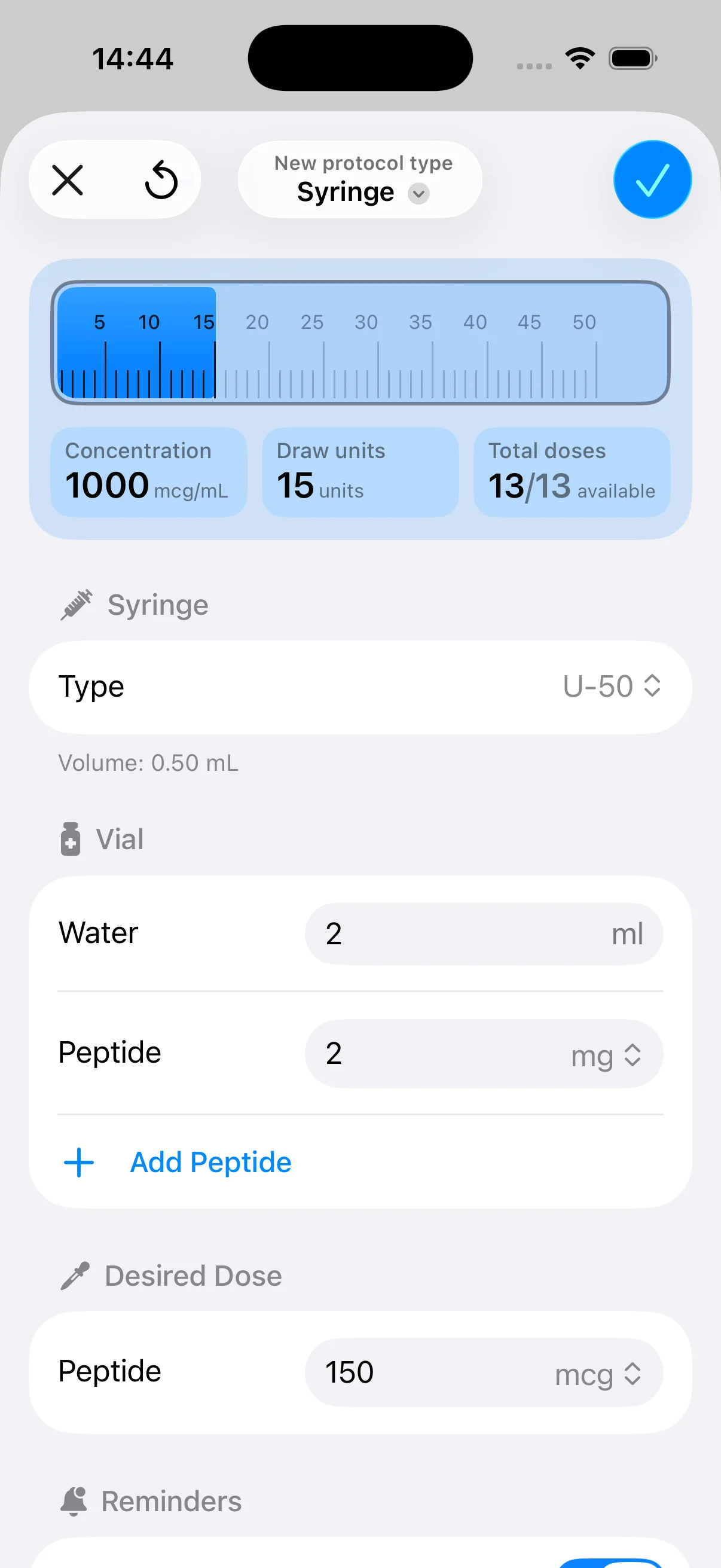
For people who are already managing structured peptide protocols, organization matters because the margin for error is smaller with injectable workflows than with topicals. Tools such as a peptide injection guide can help users understand preparation and handling concepts, and PepFlow is one example of an app built for dose calculation and schedule tracking rather than treatment selection.
Safety Side Effects and Regulatory Considerations
Safety gets blurry in the peptide market because products that sound medical are often sold in categories that aren’t fully medical. That mismatch can lead people to assume a level of oversight that may not exist.
Topicals are simpler but not risk free
For topical peptide products, the most obvious concern is local irritation. A peptide may be well tolerated in one base and irritating in another. Fragrance, preservatives, penetration enhancers, and botanical add-ons can cause as many problems as the peptide itself.
The other issue is false reassurance. A cosmetic product can sound advanced without being rigorously validated. That doesn’t automatically make it unsafe, but it means quality control and formulation integrity matter a lot.
- Check the labeling: Is the product sold clearly as a cosmetic, or is it implying drug-like outcomes without that level of evidence?
- Assess transparency: Reputable brands usually describe ingredients, intended use, and limitations plainly.
- Watch your scalp: If irritation builds, continued use can work against the healthy scalp environment you’re trying to support.
Injectables raise the stakes
Injectable peptides move into a different category of concern. Once a compound is injected, contamination, dosing mistakes, and local tissue reactions matter much more. Long-term effects may also be less certain, especially for compounds circulating in gray-market channels.
Regulatory language is another warning sign. Some peptide products are sold as “research use only” or “not for human use.” If a seller uses that language while customers clearly discuss self-administration, the burden of safety has effectively been shifted onto the buyer.
Products that live in a regulatory gray zone require more caution, not less.
If you’re weighing side effects across formats, a practical starting point is reviewing the broader issue of peptide side effects. The key takeaway is simple. The more invasive the protocol and the less clear the sourcing, the more conservative you should become.
Next Steps When to Consult a Professional
The biggest mistake people make with peptides for hair growth is treating them as a diagnosis. They’re not. They’re a treatment category, and a loosely defined one at that.
Hair thinning can come from androgenetic alopecia, telogen effluvium, inflammatory scalp disease, nutritional issues, hormonal shifts, or overlapping causes. A peptide that sounds promising for one mechanism may do little for another. That’s why the smartest next step isn’t buying the most advanced-looking serum. It’s getting clarity on what’s driving the loss.
A dermatologist or hair-loss specialist can help distinguish between shedding and miniaturization, check for scalp disease, and place peptides in context with treatments that have stronger evidence. That conversation is where peptides belong right now: not as a DIY first-line answer, but as a targeted topic in an informed treatment plan.
If you’re already following a peptide protocol and want help with the logistics rather than treatment claims, PepFlow can help you calculate doses, organize schedules, and track adherence with fewer manual errors.