Most advice about peptides for brain health starts from the wrong premise. It asks which compound is “best,” as if these molecules were comparable to caffeine, creatine, or a multivitamin. They aren’t. Peptides are signaling agents. Some are plausible drug leads. Some are research tools. Some are marketed far ahead of the evidence.
That distinction matters because the field contains real science and a lot of overreach. You can find articles that present Semax, Selank, Dihexa, or Cerebrolysin as established nootropics, even though the evidence base is uneven and often relies on animal work, mechanism papers, or small human datasets rather than strong clinical proof. If you don’t separate those tiers of evidence, it’s easy to mistake biological plausibility for demonstrated benefit.
A better starting point is this: peptide signaling already plays a known role in cognition. One of the clearest examples doesn’t come from a vial. It comes from exercise. A 2010 review of physical activity, IGF-1, and cognition summarized evidence that exercise improves cognitive function in animals and in older humans, with higher IGF-1 linked to better cognitive performance. That’s an important anchor because it shows peptide-related biology in brain health isn’t fringe. It’s part of mainstream physiology.
For readers considering peptides in practice, that’s also why medical context matters. There’s a difference between chasing online hype and exploring medically supervised peptide care where dosing, indications, and monitoring are handled more carefully.
Table of Contents
- Beyond the Hype The Real Science of Brain Health Peptides
- How Peptides Can Influence Brain Function
- A Realistic Look at Popular Brain Peptides
- Navigating Safety and Regulatory Considerations
- Principles for Structuring a Peptide Protocol
- Using a Tool for Dosing and Scheduling Accuracy
- Conclusion The Future of Peptides and Brain Health
Beyond the Hype The Real Science of Brain Health Peptides
The popular “limitless pill” framing fails because it treats cognition as a simple output problem. Increase one input, get more focus, memory, and mental speed. Biology doesn’t work that cleanly, and peptides make that especially obvious.
Peptides for brain health are better understood as context-dependent signaling molecules. They don’t act like a generic fuel poured into the brain. They bind to specific targets, alter signaling cascades, and produce effects that depend on tissue exposure, receptor biology, timing, and the state of the organism receiving them. That’s why two claims can both sound reasonable while only one survives scrutiny.
A useful reality check comes from exercise biology. The relationship between physical activity and cognition has been studied for years, and peptide-like growth factors sit inside that story. The review on physical activity, IGF-1, and cognition summarized evidence that exercise improves cognitive function across the lifespan in animals and in humans over 50, and that higher serum or plasma IGF-1 is associated with better cognitive performance in middle-aged and older men. It also described intervention studies in sedentary elderly humans where improved cognition occurred alongside increased IGF-1 after aerobic and resistance exercise.
That doesn’t prove that any commercial peptide product will sharpen memory. It proves something narrower and more important. Peptide-mediated effects on brain function are biologically credible. The leap from that statement to “this peptide stack works” is where most writing becomes careless.
The right question isn’t “Do peptides affect the brain?” It’s “Which peptide, by what mechanism, with what level of evidence, in which species, by which route, and with what outcome?”
That’s the standard intelligent readers should use. It forces a separation between mechanism, preclinical efficacy, early human signal, and true clinical validation. Most articles collapse those categories into one reassuring narrative. They shouldn’t.
How Peptides Can Influence Brain Function
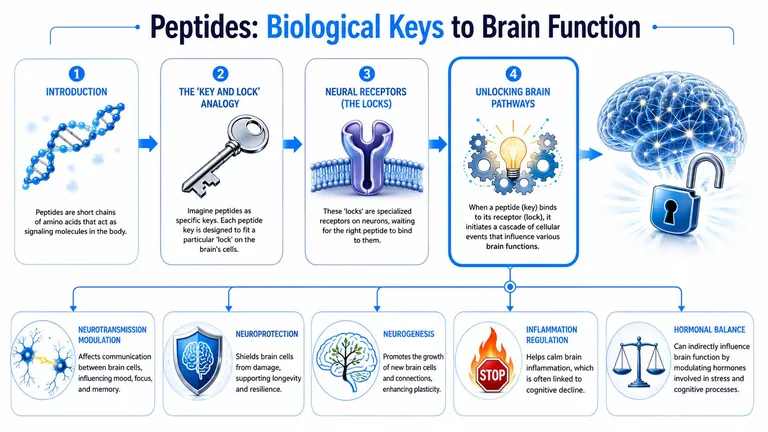
A peptide works less like a nutrient and more like a biological key. The key matters, but the lock matters too. If a peptide doesn’t fit the relevant receptor, or never reaches the tissue where that receptor sits, the rest of the story is mostly marketing.
Why delivery matters more than marketing
The first filter for any brain-directed peptide is the blood-brain barrier. A recent review on peptide transport and brain delivery notes that some hydrophobic peptide classes can cross the BBB by passive diffusion, while many peptides cannot. It also describes peptide shuttle strategies intended to move cargo into the central nervous system and explains why BBB permeability often determines whether a brain-targeted peptide can have meaningful downstream effects in vivo, as detailed in this review on peptide transport in the brain.
That means a claim like “supports neurotransmitters” is incomplete on its face. Before you ask what pathway a peptide influences, ask whether enough of it can plausibly reach the target tissue. If the answer is unclear, enthusiasm should drop sharply.
This issue also explains why people who care about focus or energy often do better by fixing low-tech inputs first. A reader looking for lower-risk ways to support alertness might get more practical value from comparing healthy Australian energy drink options than from jumping straight into poorly characterized peptide use.
Later in the pipeline, route of administration becomes part of the biology. Peripheral delivery, intranasal approaches, or other methods aren’t interchangeable details. They shape exposure.
Here’s a useful visual primer on receptor signaling and brain pathways:
The main pathways that deserve attention
The most credible mechanistic theme in this field is neurotrophic signaling. Reviews of neurocognitive peptides repeatedly point toward pathways involving BDNF, nerve growth factor, and synaptic plasticity. In plain language, the more plausible compounds don’t behave like instant stimulants. They appear to modulate repair, resilience, connectivity, or cellular stress responses.
Three broad mechanisms show up again and again:
- Neurotrophic support: Some peptides appear to influence pathways tied to BDNF, nerve growth factor, or synaptic plasticity. That makes them conceptually relevant to learning, memory, and neuronal survival.
- Inflammation and cellular stress modulation: The BBB review describes peptide sequences that reduced cognitive impairment in AD-model mice through anti-oxidative, anti-inflammatory, and anti-apoptotic pathways.
- Neurotransmission effects: Some peptide systems can influence acetylcholine-related signaling and other communication pathways that shape cognition indirectly.
Practical rule: If a peptide claim ignores BBB delivery, route of administration, and the difference between mechanism and outcome, the claim is too weak to trust.
One subtle point often gets missed. A mechanism can be real while the product claim is still unsupported. A peptide may bind a receptor, alter a pathway, and look impressive in cell culture or rodents. That still doesn’t establish meaningful benefit for a healthy human trying to improve concentration at work.
A Realistic Look at Popular Brain Peptides
The smartest way to evaluate peptides for brain health is not by asking which one sounds most advanced. It’s by asking which one has the strongest evidence in humans. By that standard, many popular names lose altitude fast.
A 2025 review on FRα-binding peptides captures the broader problem well. It describes a new peptide family that crossed the blood-brain barrier and improved cognition in aged mice, which is scientifically interesting but still preclinical, as discussed in this review of FRα-binding peptides and cognition. The same evidence gap applies more broadly. Online discussions often treat compounds like Semax or Dihexa as established nootropics when the support behind them is often animal data, small studies, or mechanism-heavy argument rather than reliable clinical outcomes.
The evidence gap in one table
| Peptide | Proposed Mechanism | Primary Evidence Level |
|---|---|---|
| Semax | Often discussed in relation to neurotrophic and neuromodulatory effects | Mostly animal data, mechanism claims, and small human studies |
| Selank | Often discussed for stress modulation and indirect cognitive effects | Mostly small human studies and mechanism claims |
| Dihexa | Commonly framed as a synaptic or neurotrophic candidate | Largely preclinical and mechanism-driven |
| Cerebrolysin | Marketed for neurotrophic and neuroprotective effects | Mixed literature, often discussed beyond what robust proof supports |
| FRα-binding peptide family | BBB-penetrant peptide family with cognitive effects in aged mice | Preclinical animal evidence |
A table like this is useful because it blocks a common cognitive error. Readers tend to group all “brain peptides” into one category and then transfer confidence from the strongest-looking mechanism to the weakest-supported product. That’s how speculation turns into perceived consensus.
What the table actually tells you
Semax and Selank occupy a strange place in public discussion. They’re too biologically specific to be dismissed as nonsense, but they’re often presented with a level of certainty the evidence doesn’t justify. If you read commercial descriptions, you’d think their benefits were settled. They aren’t.
Dihexa is an even clearer lesson in evidence discipline. It attracts attention because the proposed mechanism sounds potent and modern. But impressive mechanistic language doesn’t substitute for reliable human outcome data. A compound can be fascinating and still unproven.
Cerebrolysin adds another complication. It’s often discussed as if its clinical use in some settings automatically resolves questions about nootropic use in healthy or mildly impaired people. It doesn’t. Indication, population, formulation, and outcome measures all matter.
Two conclusions follow from this.
- First, mechanism is not proof. A peptide can make sense on paper and still fail the standard of demonstrated benefit.
- Second, species matters. Aged mice with neurodegenerative changes aren’t the same as healthy adults seeking better productivity or memory.
Don’t ask whether a peptide is “real.” Ask whether the claim being made about it is supported in the population you care about.
That single shift improves decision-making more than memorizing peptide names. It also reveals why some of the most scientifically interesting compounds may be the least ready for consumer use. A peptide that looks promising in dementia models may eventually become a serious therapeutic lead, but that doesn’t mean it belongs in a wellness stack today.
Navigating Safety and Regulatory Considerations
The safety conversation around peptides for brain health often becomes strangely binary. Advocates act as if “natural signaling molecules” implies safety. Critics act as if every peptide is automatically reckless. Neither position helps.
The market problem
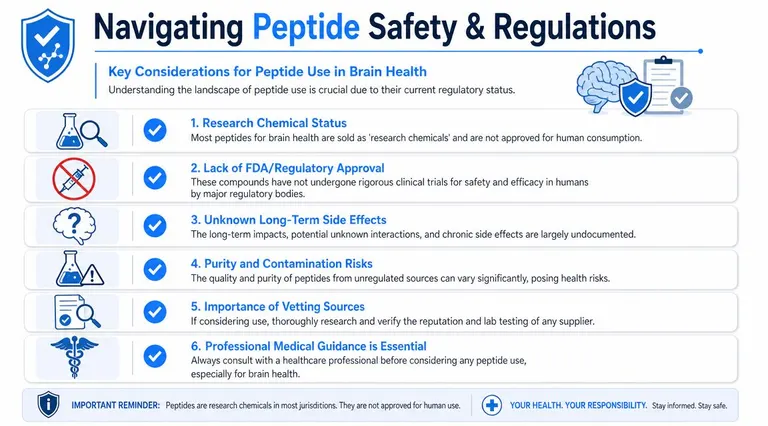
The practical risk is simpler. Many compounds marketed in this category sit in a gray zone between research use, medical use, and consumer experimentation. That means buyers may face uncertainty about identity, purity, sterility, storage conditions, and label accuracy.
For that reason, it helps to distinguish marketed peptides from compounds that have moved through formal regulatory pathways. A reference point is this overview of FDA approved peptide drugs, which makes clear how different approved drugs are from loosely sold research products.
The danger isn’t only adverse biology. It’s also bad inputs. If the material isn’t what the label says, even excellent protocol discipline won’t rescue the experiment.
What careful readers should verify
A safety-first approach means treating uncertainty as part of the risk profile.
- Identity matters: A peptide name on a website isn’t proof that the vial contains that compound.
- Purity matters: Contaminants or degradation products can matter as much as the intended peptide.
- Protocol context matters: Brain-directed compounds can interact with sleep, training load, mood state, and other interventions in ways users may misread.
- Time horizon matters: Long-term effects are often the least characterized part of the picture.
One principle is worth holding onto. “Research chemical” is not a synonym for “safe if used carefully.” It often means the evidence and oversight are both incomplete.
A cautious buyer should spend more time vetting source quality and less time chasing dramatic claims about cognition.
That’s not fear-mongering. It’s basic experimental discipline. If you’re dealing with signaling molecules that may affect brain-relevant pathways, uncertain sourcing isn’t a minor inconvenience. It’s a central variable.
Principles for Structuring a Peptide Protocol
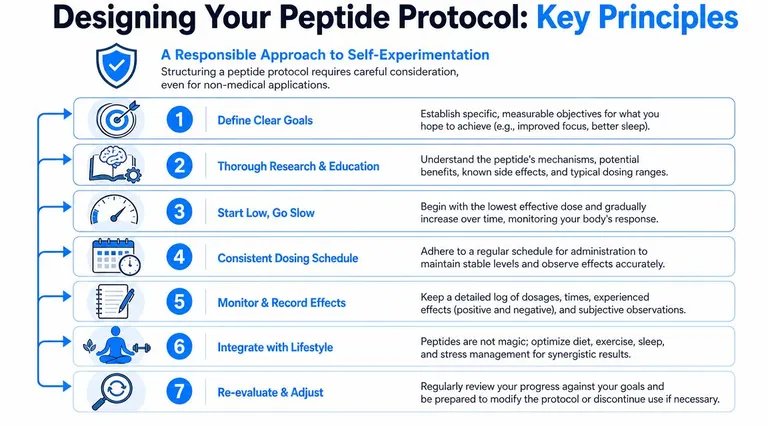
People often focus on the molecule and ignore the protocol. That’s a mistake. With peptides for brain health, protocol design isn’t an administrative detail. It shapes whether observations are interpretable at all.
Protocol design is part of the intervention
One useful framing comes from the mechanistic literature around neurotrophic signaling. The more credible brain-health peptides appear to act by amplifying endogenous repair signals such as BDNF-related pathways, and that implies effects are more likely to depend on sustained exposure and proper cycling than on a single large dose, as summarized in this discussion of neurocognitive peptides and functional medicine.
That has a practical consequence. If someone changes dose, timing, sleep, caffeine intake, and training volume all at once, they won’t know what caused what. The protocol becomes unreadable.
A practical framework for self-tracking
A reasonable structure is less glamorous than online peptide culture suggests:
-
Define one target outcome. Pick a measurable cognitive domain such as recall quality, sustained attention, or stress-reactive focus. Don’t bundle ten goals into one experiment.
-
Change one major variable at a time. If you add a peptide while also changing diet, sleep schedule, or stimulant use, your conclusions won’t mean much.
-
Start conservatively. The point of a low starting exposure isn’t timidity. It’s signal detection. You want to identify tolerability before you try to interpret benefits.
-
Use consistent timing. For signaling molecules, irregular use can obscure whether a compound has no effect or whether your schedule prevented stable exposure.
-
Build in washout thinking. If effects persist or fade gradually, a clean observation window matters.
For readers who want help organizing those calculations and schedules, a peptide dosage guide can be useful as a planning reference, especially when reconstitution and unit conversion start creating avoidable mistakes.
Good protocol design does two things at once. It reduces risk, and it protects you from fooling yourself.
That second function is underrated. Many self-experiments fail not because the compound is ineffective, but because the user never created conditions where effectiveness could be judged.
Using a Tool for Dosing and Scheduling Accuracy
The most overlooked source of error in peptide use is mundane. It isn’t receptor biology. It’s arithmetic, timing, and adherence.
Why logistics become a scientific issue
That sounds trivial until you look at how peptide research works. A 2024 MIT-associated report on a peptide targeting hyperactive CDK5 found dramatic reductions in neurodegeneration and DNA damage in treated mice, along with better performance on a water maze learning task, as reported by MIT’s Picower Institute. You can’t separate those results from administration precision. In research, dose and timing are part of the intervention.
The same logic applies to personal protocol management. If someone miscalculates reconstitution, misses doses, or drifts through an inconsistent cycle, they aren’t really testing the intended protocol.
What a dosing tool should actually do
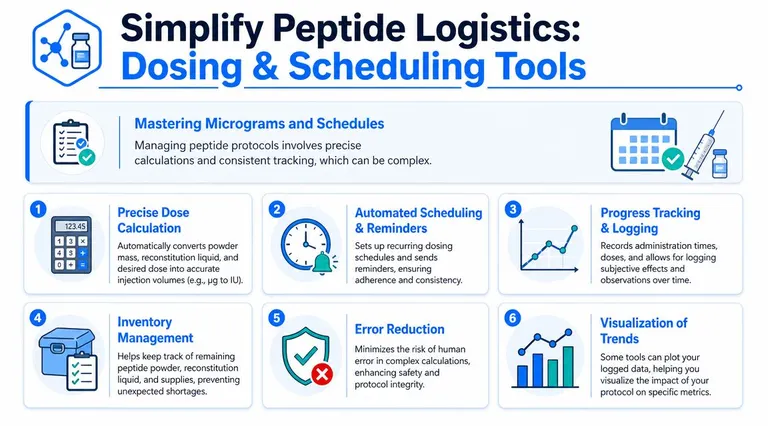
A useful tool should handle four jobs well:
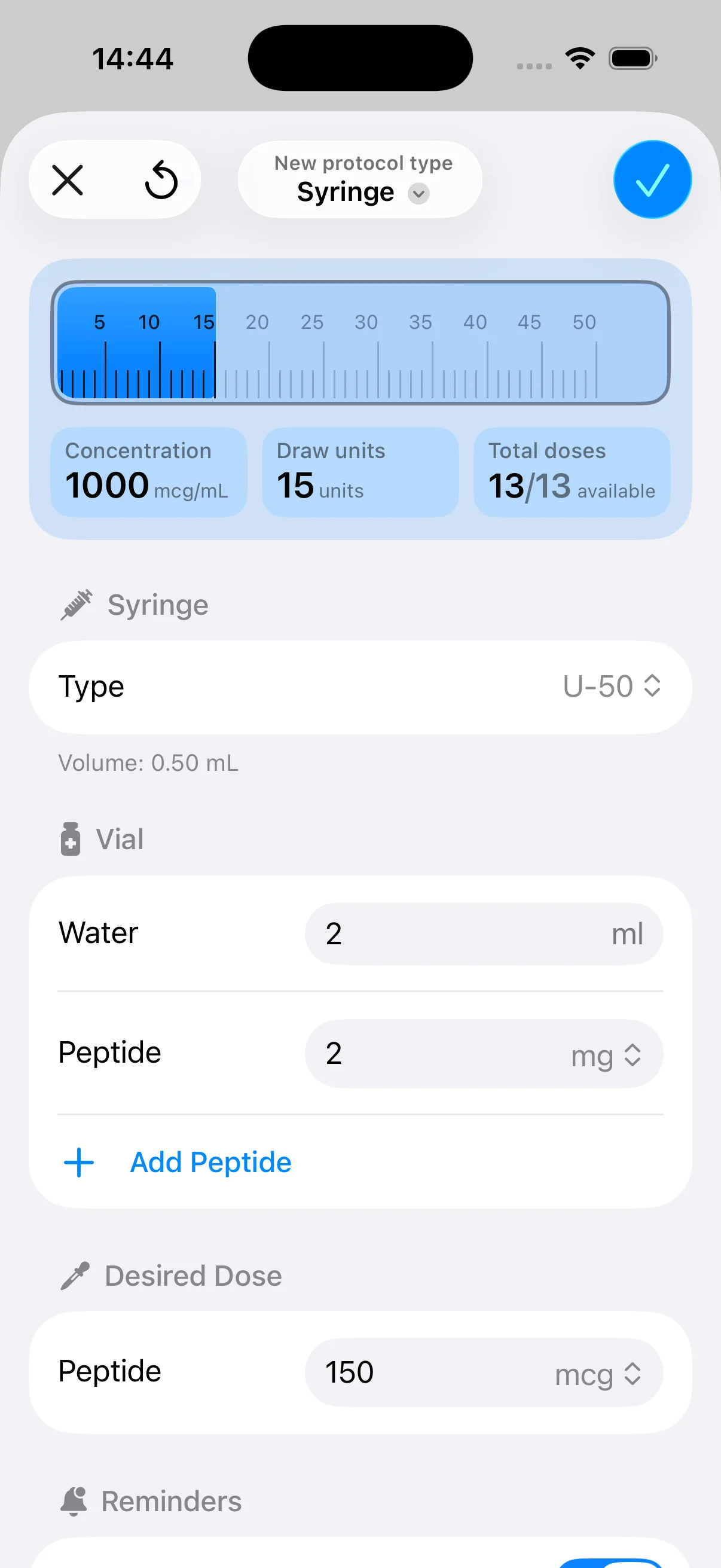
- Dose conversion: It should translate vial concentration and desired microgram exposure into practical measurement units.
- Scheduling: It should support recurring administration patterns, pauses, and cycle logic.
- Reminders: It should reduce forgotten doses without forcing users into manual calendar workarounds.
- Logging: It should keep a dated record of what was taken and when.
One example is PepFlow’s peptide calculator app, which is built for dose calculation, protocol scheduling, reminders, and logging. That doesn’t replace medical judgment, but it does reduce a category of preventable human error that can otherwise make a protocol unreliable.
For peptides aimed at cognition, that kind of precision isn’t obsessive. It’s the minimum needed to distinguish a biological effect from a badly executed routine.
Conclusion The Future of Peptides and Brain Health
The future of peptides for brain health is probably more serious, and less consumer-friendly, than hype suggests.
Serious, because the biology is compelling. Peptides can influence neurotrophic signaling, inflammation-related pathways, and in some cases brain pathology itself. The field has moved well beyond vague nootropic talk. Researchers are studying mechanism-driven interventions with clear neurological relevance.
Less consumer-friendly, because most of the strongest findings still sit in preclinical territory or in limited human evidence. That’s the core evidence gap. People want a simple shopping list. The science offers a much harder message: some compounds are promising, some are overstated, and many claims outrun the data.
The most useful mindset is cautious optimism. Treat peptides as potent biological tools, not as supplements with fancier branding. Ask what species the data came from. Ask whether the peptide crosses the BBB. Ask whether the outcome was a mechanistic signal, an animal behavior change, or a strong human clinical result. Then ask whether the protocol and sourcing are strong enough to make any real-world use interpretable.
That standard won’t make the field less exciting. It makes it more honest.
If you’re already running a structured peptide routine and want tighter control over reconstitution math, cycle scheduling, reminders, and dose logs, PepFlow is a practical option for keeping the logistics consistent. It’s a planning tool, not medical advice, but that kind of structure is often what separates a disciplined protocol from guesswork.