You’re probably seeing the word peptide everywhere right now. It’s on serum bottles, in collagen tubs, in “anti-aging” ads, and in ingredient lists that look like biochemistry homework. One brand tells you to pat peptides onto your face. Another tells you to stir them into coffee. Both imply you’re one purchase away from firmer, smoother skin.
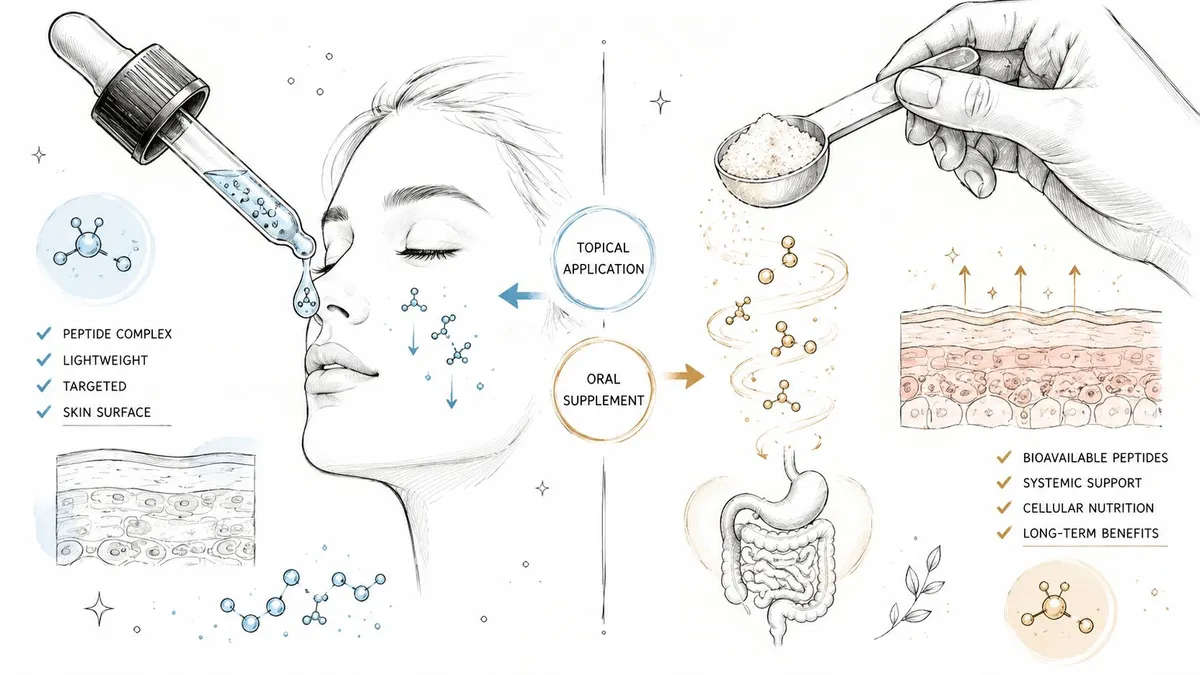
That confusion makes sense, because “peptides” in skin care aren’t one thing. They’re a category. Some are topical cosmetic peptides designed to signal skin cells at the surface. Others are oral collagen peptide supplements that you swallow and absorb through digestion. Those are different tools, with different evidence, different expectations, and different best-use cases.
If you want a practical answer instead of marketing fog, the useful question isn’t “Do peptides work?” It’s “Which kind of peptide product matches my actual goal?”
Table of Contents
- The Two Worlds of Skin Peptides
- What Exactly Are Peptides and Why Do They Matter
- Topical Peptides The Skincare Messengers
- Oral Peptides Building Skin from Within
- Decoding the Evidence What Really Works
- How to Choose and Use Peptide Products
- The Final Verdict on Peptides for Your Skin
The Two Worlds of Skin Peptides
The first thing to clear up is simple but important. A peptide cream and a collagen peptide supplement are not interchangeable.
The Linus Pauling Institute notes that bioactive peptides used for skin are generally synthetic peptides applied topically, where they’re used for cosmetic purposes and can modulate collagen and melanin homeostasis in skin cells, while oral collagen peptide supplements are a separate category entirely according to its skin peptides overview. That distinction matters more than most labels suggest.
Topical peptides work like local messages. You apply them directly where you want a cosmetic effect, such as fine lines, texture issues, or barrier support. Oral collagen peptides work more like systemic raw material plus signaling fragments after digestion and absorption. They aren’t targeting one forehead line or one crease beside your mouth. They act through a broader inside-out route.
Bottom line: When a product says “peptides for skin,” you still need to ask, “Topical or oral?”
That split also explains why peptide marketing can feel slippery. One ad may be talking about a copper peptide serum. Another may be talking about hydrolyzed collagen in a powder. Both use the same buzzword, but they belong to different evidence buckets.
A practical way to understand it:
| Product type | Main route | Typical goal |
|---|---|---|
| Topical cosmetic peptides | Applied to skin | Targeted cosmetic support for wrinkles, texture, repair, or tone |
| Oral collagen peptides | Swallowed and absorbed | Broader support for hydration and elasticity from within |
If you blur those together, the whole category stops making sense. If you separate them, peptide products become much easier to judge.
What Exactly Are Peptides and Why Do They Matter
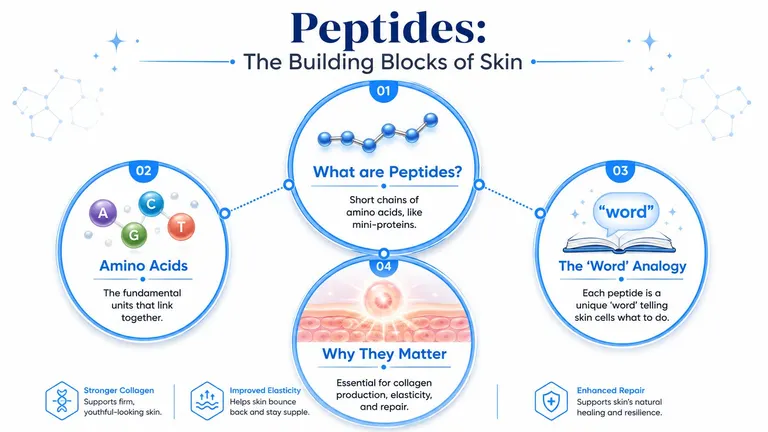
A peptide is a short chain of amino acids. Amino acids are the small units your body uses to build proteins. If a full protein is like a long sentence, a peptide is more like a short word or phrase. Small, but still meaningful.
That small size is part of why peptides matter biologically. Cells often respond to short amino-acid sequences as signals. In skin, that can mean messages related to repair, support, pigmentation, or collagen-related activity. Not every peptide does the same job, and that’s where a lot of people get tripped up. “Peptide” describes the structure, not the outcome.
Small molecules with specific messages
Think of peptides as tiny instruction slips. One peptide may encourage processes linked with firmness. Another may carry a mineral. Another may be used in a formula aimed at expression lines.
That’s why two products can both say “contains peptides” and still behave very differently. It’s a bit like saying two meals both “contain spices.” True, but not helpful unless you know which spices and why they’re there.
If you want a broader primer before getting deeper into supplements, this guide helps discover collagen’s benefits in plain language and is useful background for understanding why collagen peptides get so much attention.
Peptides are not the same as collagen itself
People often say “peptides” when they really mean “collagen peptides.” That’s only one subgroup.
Collagen is a structural protein already present in skin. Collagen peptides are smaller fragments derived from collagen, often used in supplements. Topical cosmetic peptides are usually selected for signaling or support roles in a formulation. Related idea, different application.
Here’s the simplest way to remember it:
- Amino acids are the letters
- Peptides are short words
- Proteins are long finished passages
- Collagen is one important structural protein your skin relies on
Once you see peptides as functional mini-messages, product labels start looking less mysterious.
Topical Peptides The Skincare Messengers
If oral collagen is an inside-out approach, topical peptides are an outside-in strategy. They’re usually found in serums, creams, and leave-on treatments meant to sit on the skin long enough to do something useful.
A good topical peptide product isn’t “better” than an oral collagen supplement. It’s just trying to solve a different problem. If your goal is a targeted cosmetic approach for visible skin concerns, topicals usually make more sense.
The four main peptide jobs
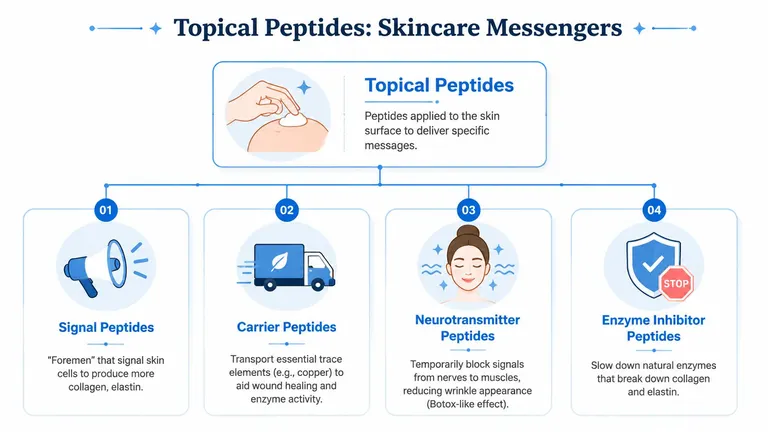
A helpful framework comes from the way peptides are grouped by mechanism. JoinMIDI describes four major categories: signal peptides that boost collagen-related activity, carrier peptides that deliver minerals such as copper for repair, enzyme-inhibitor peptides that slow collagen breakdown, and neurotransmitter-inhibitor peptides that target expression lines in its overview of peptides for skin.
That sounds technical, but the jobs are easy to picture.
- Signal peptides act like foremen on a construction site. They tell skin cells to increase certain repair or support activities.
- Carrier peptides act like delivery vehicles. Copper peptides are the classic example, carrying trace minerals relevant to skin processes.
- Enzyme-inhibitor peptides act more like brakes. They’re designed to slow some of the processes involved in collagen breakdown.
- Neurotransmitter-inhibitor peptides are the “expression line” category. They aim to soften the look of movement-related lines by affecting signal pathways tied to muscle activity.
Copper peptides are the most technically distinct subgroup because they’re not just sending a message. They’re also acting as a delivery system.
That’s why “peptide serum” by itself tells you almost nothing. You need to know the formula’s strategy.
For readers curious about the copper peptide side specifically, this guide to a GHK-Cu dosing calculator gives context on how that peptide is discussed in broader peptide circles, even though topical skin use is a different use case from injectable protocols.
How to read a peptide serum label
Ignore the front of the bottle for a moment. Turn it around.
You’re looking for actual peptide names, not just the word “peptides” in ad copy. Ingredient lists often include names like tripeptide, hexapeptide, palmitoyl peptide, or copper tripeptide. The exact name tells you far more than the marketing paragraph does.
A few practical clues help:
- Specific naming beats vague branding. “Contains peptides” is weak. Named peptides are stronger.
- Leave-on formulas matter. A serum or cream has more opportunity to work than a wash-off product.
- Packaging matters. Opaque, air-limiting packaging usually makes more sense for delicate actives than a wide-open jar.
- Target should match mechanism. Don’t buy a product aimed at “deep wrinkle lifting, barrier repair, brightening, acne, pore tightening, and contouring” all at once. That kind of scattershot promise usually means the strategy isn’t clear.
The smart buyer doesn’t ask, “Does it have peptides?” They ask, “Which peptide, for what goal, in what kind of formula?”
Oral Peptides Building Skin from Within
Oral peptide supplements for skin usually mean collagen peptides, sometimes called hydrolyzed collagen. This is the category people mean when they talk about putting a scoop into a smoothie or stirring a packet into tea.
The skeptical question is a fair one. If you swallow collagen, doesn’t digestion just break it apart?
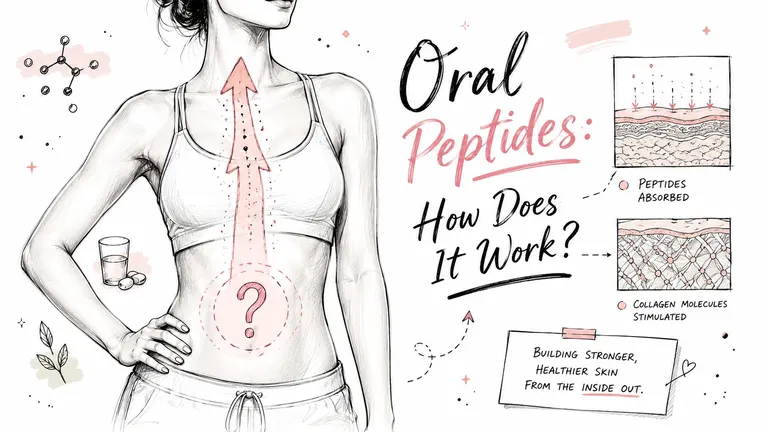
What happens after you swallow collagen peptides
Your digestive system does break collagen down into smaller components. That’s the point of using hydrolyzed collagen peptides rather than expecting an intact chunk of collagen to somehow lodge itself in your cheek.
Those smaller peptide fragments and amino acids are then absorbed and circulated. From there, the idea is not that the supplement becomes your skin in a one-to-one way. The more realistic view is that these absorbed components may support skin biology indirectly, including processes related to hydration and elasticity.
If you want a simple backgrounder on that category, this explanation of what collagen peptides are is a useful companion read.
Oral collagen doesn’t work like patching drywall. It works more like supplying materials and signals that your body may use where it’s useful.
That distinction matters because it keeps expectations realistic. Oral collagen is not a spot treatment. It’s a broader support strategy.
Who seems to benefit most
The conversation gets more interesting than most supplement ads.
A review summarized by Vitafoods Insights reported that oral collagen peptides improved skin elasticity, hydration, and roughness most consistently in people under 48, while in older adults the primary benefit was elasticity, suggesting a more favorable response window around ages 30 to 48 in that review summary. That’s a much more useful framing than “collagen works for everyone the same way.”
In plain English, baseline biology seems to matter. Younger skin that has begun to show early decline may respond differently from skin with more advanced age-related changes. That doesn’t mean older users get nothing. It means the pattern of benefit may shift.
A quick video can make the inside-out model easier to grasp:
If you’re deciding whether oral peptide supplements for skin are worth trying, the best use case is usually someone looking for general support, not a miracle fix for one crease or one month of neglect.
Decoding the Evidence What Really Works
This is the part where peptide marketing usually gets fuzzy. The science isn’t useless, but it’s also not a blank check for every jar or powder on the shelf.
The cleanest way to read the evidence is to separate ingredient-specific findings from broad category claims. Some peptides have measured outcomes in studies. That does not mean every product with “peptide complex” on the box has earned the same credibility.
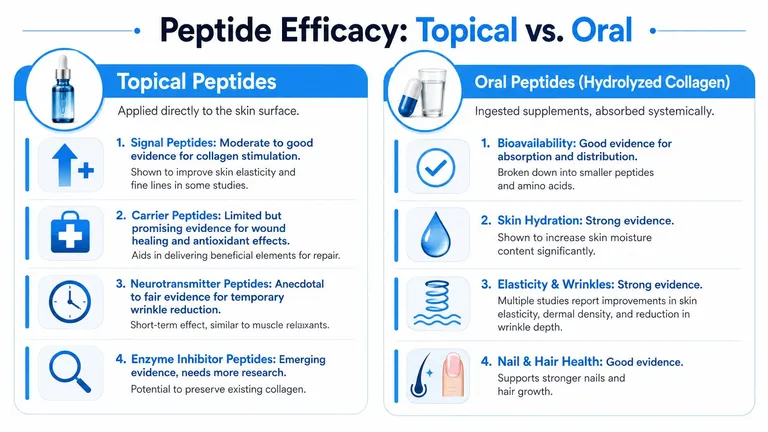
Where topical peptides have the clearest support
A 2024 review reported that in a 45-subject study, Tripeptide-3 improved fine lines in the forehead area by up to 52%, and the same review notes that collagen stimulation from topical peptides is generally modest and cumulative, which means regular use matters more than overnight expectations as described in the review on peptides in skin care.
That’s encouraging, but also a good reality check. The result is measurable. It is not magic.
The same review also described other ingredient-level findings, including wrinkle-related improvements in specific tripeptide formulations and multiple benefits linked to Copper Tripeptide-1, including reduced wrinkle depth, tighter-looking skin, UV-related cellular protection, wound-healing support, and anti-inflammatory effects. The catch is that outcomes are still formulation-dependent. A peptide’s name on an ingredient list is not the whole story. Concentration, vehicle, stability, and skin compatibility all affect the results.
If your main concern is addressing early signs of ageing, peptides can make sense as part of a broader plan, especially if you want something gentler than stronger actives.
How oral collagen evidence compares
Oral collagen evidence is broader in concept but less targeted in feel. You’re not usually getting “this peptide reduced this exact line on this exact zone.” You’re looking at general skin qualities such as hydration, elasticity, and roughness, with the age-response nuance covered earlier.
That difference creates a practical contrast:
| Question | Topical peptides | Oral collagen peptides |
|---|---|---|
| Best for | Local, surface-level cosmetic goals | Whole-skin support approach |
| Evidence style | Specific ingredient studies | Broader supplement response patterns |
| Expectation | Modest visible refinement with steady use | Gradual support from within |
If you’re exploring peptide options mainly for skin aging, this roundup of the best peptides for anti-aging is useful for seeing how different peptide families are discussed.
Peptides look strongest when you ask them to do modest, plausible jobs. They disappoint when you ask them to replace sunscreen, retinoids, or time.
That’s the fairest verdict. Useful, sometimes measurable, often subtle.
How to Choose and Use Peptide Products
Buying a peptide product gets easier once you stop treating “peptide” as a magic word. Your real task is matching the product format to the job you want done.
A topical serum and an oral collagen powder can both be reasonable. They just answer different questions.
If you want a topical peptide product
Start with the concern in the mirror.
If you want help with fine lines, texture, or a targeted cosmetic routine, a topical product usually makes more sense. Read the ingredient list and look for actual peptide names rather than vague phrases like “peptide blend” or “pro-collagen complex.”
Use this quick filter:
- Choose a leave-on product if your goal is visible skin change. Serums and creams beat cleansers.
- Look for a focused formula. A product built around peptides plus a few supportive ingredients is easier to judge than a chaotic “everything active at once” formula.
- Prefer stable packaging. Pumps and opaque containers are usually a better sign than open jars.
- Match your tolerance. If your skin is easily irritated, peptides may fit well because many people use them as a gentler complement to more aggressive actives.
If you want an oral collagen supplement
Think in terms of consistency and product quality, not hype.
You want hydrolyzed collagen peptides, clear labeling, and a brand that tells you what the product is. Since this section can’t rely on extra numeric claims beyond the verified evidence, the safest practical advice is qualitative.
A decent checklist looks like this:
- Clear identity. The label should say collagen peptides or hydrolyzed collagen, not just “beauty protein.”
- Simple formula. Fewer unnecessary add-ons makes it easier to judge what you’re taking.
- Third-party testing. This matters for confidence in purity and label accuracy.
- Realistic goal. Think support for hydration and elasticity, not dramatic reversal.
How to fit peptides into a real routine
For topical use, peptides usually fit well after cleansing and before heavier creams or sunscreen. Many people use them comfortably alongside moisturizers, retinoids, vitamin C, and acids, but routine design still matters. If your skin gets cranky, don’t launch every active at once and blame the peptide when your barrier gets upset.
A simple approach works best:
- Add one peptide product at a time
- Use it consistently
- Give it time before judging
- Keep the rest of your routine stable
For oral use, the same rule applies. Pick one product, use it consistently, and judge it against a calm baseline rather than while changing your diet, sleep, cleanser, and exfoliant all in the same month.
Practical rule: If you can’t tell what changed, you can’t tell what worked.
Peptides tend to reward patience, not product hopping.
The Final Verdict on Peptides for Your Skin
Peptides aren’t fake. They also aren’t one thing.
That’s the key idea most skin content misses. Topical cosmetic peptides are best understood as targeted skin-care tools. They’re designed to send local signals and support specific cosmetic goals such as texture, fine lines, or repair. Oral collagen peptide supplements are better understood as inside-out support for broader skin qualities like hydration and elasticity.
If you want the shortest useful answer, here it is:
- Choose topical peptides if you want a product aimed at a visible, local skin concern.
- Choose oral collagen peptides if you want more general support from within.
- Choose both only if you have a clear reason for each, not because the word “peptide” sounds advanced.
Neither category deserves miracle status. The evidence supports measurable but usually modest benefits, and results depend on the actual ingredient, the formulation, your baseline skin biology, and whether you stick with the routine long enough to judge it fairly.
A smart skin strategy still starts with fundamentals. Sunscreen. A tolerable routine. Moisture support. Evidence-based actives you’ll consistently use. Peptides can fit into that picture well. They just shouldn’t carry the whole load.
If you’ve been overwhelmed by peptide supplements for skin, the most useful shift is this: stop asking whether peptides are good or bad. Start asking which peptide approach fits your goal, your patience, and your skin.
If you’re also managing structured peptide routines beyond skincare, PepFlow helps simplify the math and scheduling. It’s built for people who want accurate dosing calculations, protocol planning, reminders, and easier adherence without juggling manual notes and guesswork.