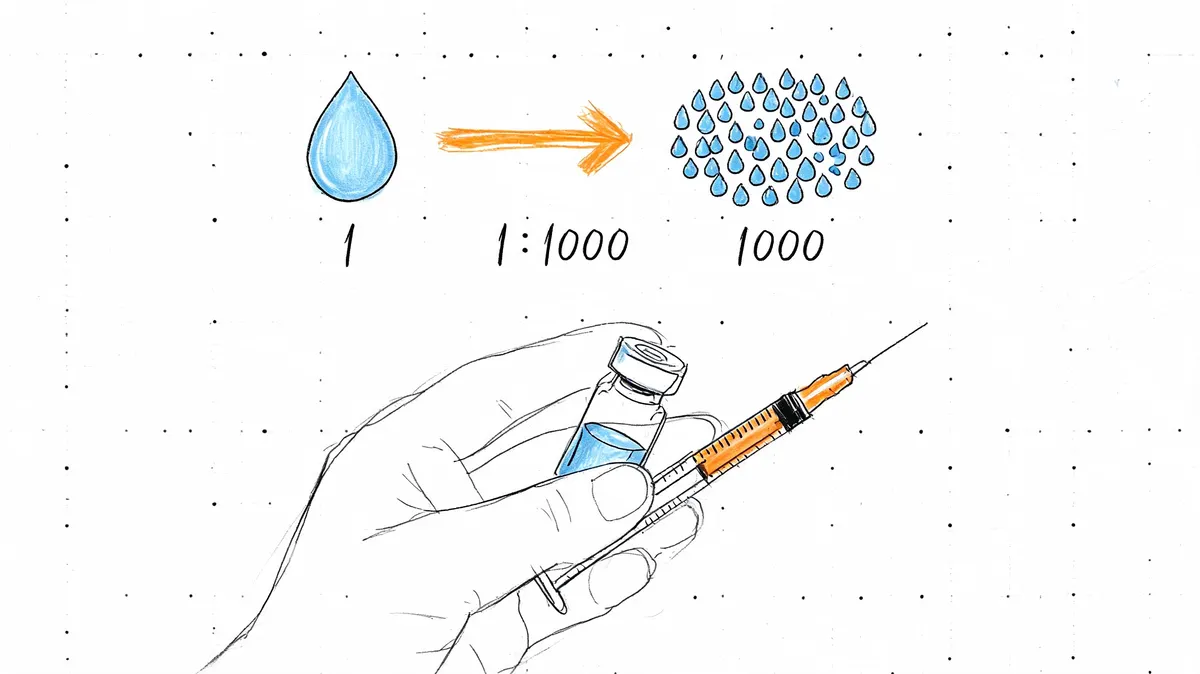
You’ve got a vial in one hand, a syringe in the other, and a dose target written down somewhere in mcg while the label on the vial is in mg. That’s the point where a lot of new peptide users freeze. Not because the math is impossible, but because the stakes feel real.
That feeling is justified. In peptide work, the simple mg to mcg conversion is only one part of the job. The bigger challenge is moving from a dry vial to a final injection volume without mixing up units, concentration, or syringe markings. Most people don’t need more hype. They need a clean process they can trust.
If you’re still getting comfortable with the physical side of administration, this peptide injection guide for new users helps frame the basics. The dosing side starts with one fixed rule, then builds into a repeatable workflow you can use every time.
Table of Contents
- The Moment of Truth Before Every Dose
- The Fundamental Conversion 1 Milligram to 1000 Micrograms
- Applying the Math A Peptide Dosing Walkthrough
- Common Dosing Mistakes That Go Beyond Simple Math
- Eliminate Errors With a Dedicated Peptide Calculator
- Your Blueprint for Accurate and Confident Dosing
The Moment of Truth Before Every Dose
A familiar scenario looks like this. You’ve chosen a protocol, checked the vial size, and now the target dose says 250 mcg while the vial says 10 mg. At that exact moment, most of the uncertainty isn’t about motivation. It’s about whether you can trust your own arithmetic.
New users often assume the hardest part is the injection itself. In practice, the harder part is usually the sequence leading up to it. You have to understand the vial amount, decide on reconstitution volume, work out concentration, convert units correctly, and then translate that result into a usable syringe draw.
Accuracy starts before the syringe touches the vial.
That’s why experienced coaches tend to treat dosing like a checklist, not a mental puzzle. The goal isn’t to become clever with numbers. The goal is to remove avoidable mistakes.
A good dosing workflow usually comes down to four questions:
- What’s in the vial: Is the label showing total peptide amount in mg?
- What did you add: How much diluent did you use during reconstitution?
- What dose do you want: Is your target written in mcg or mg?
- What volume matches that dose: How much liquid do you draw?
When those four answers are clear, confidence follows. When even one is fuzzy, people start guessing. Guessing is what causes trouble.
The Fundamental Conversion 1 Milligram to 1000 Micrograms
The core rule is simple, fixed, and absolute within the metric system.
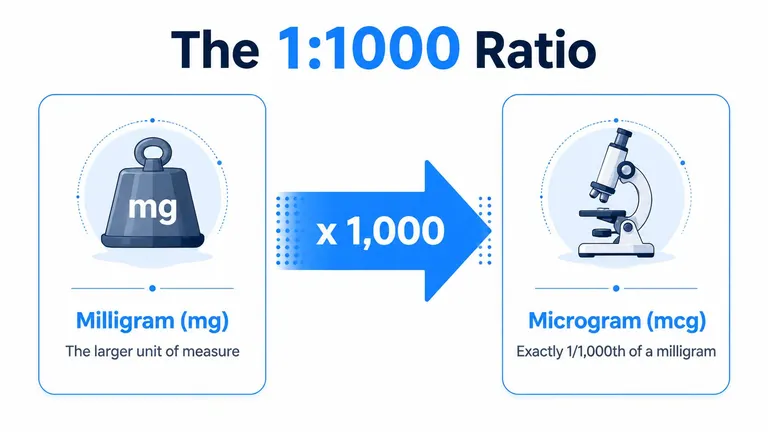
1 mg = 1,000 mcg
The metric system’s mg-to-mcg conversion ratio of 1:1,000 is fundamental to pharmaceutical dosing accuracy and standardized under SI units. To convert milligrams to micrograms, multiply by 1,000, and to convert micrograms to milligrams, divide by 1,000. Examples include 0.25 mg = 250 mcg and 500 mcg = 0.5 mg (Nurse.com explanation of mg and mcg conversion).
The fast way to remember it
If you’re going from mg to mcg, move the decimal three places to the right.
If you’re going from mcg to mg, move the decimal three places to the left.
A few practical examples make this stick:
- 0.1 mg becomes 100 mcg
- 0.25 mg becomes 250 mcg
- 1 mg becomes 1,000 mcg
- 5 mg becomes 5,000 mcg
That’s it. The ratio never changes.
Why this matters in peptide work
Peptide users often think the conversion itself is where precision begins. It begins one step earlier, with respecting the scale. A microgram is 1,000 times smaller than a milligram, which is exactly why small labeling mistakes become large dosing mistakes.
The distinction also matters when you’re cross-checking product labels, protocol notes, and calculators. Keep the unit logic explicit: divide micrograms by 1,000 to convert them to milligrams before moving on to concentration or volume.
When a protocol is written in mcg and the vial is labeled in mg, don’t estimate. Convert first, then continue.
For anyone managing repeated protocols, a peptide calculator app for vial and dose inputs can keep the units aligned from the start. That matters because once the unit foundation is wrong, every later step inherits the error.
Applying the Math A Peptide Dosing Walkthrough
At this point, people stop thinking about abstract unit conversion and start working through a real vial.
A common example is a 10 mg peptide vial with a desired dose of 250 mcg. The key is not to jump straight to syringe units. Start with the vial, then the liquid added, then the concentration, and only then the injection volume.
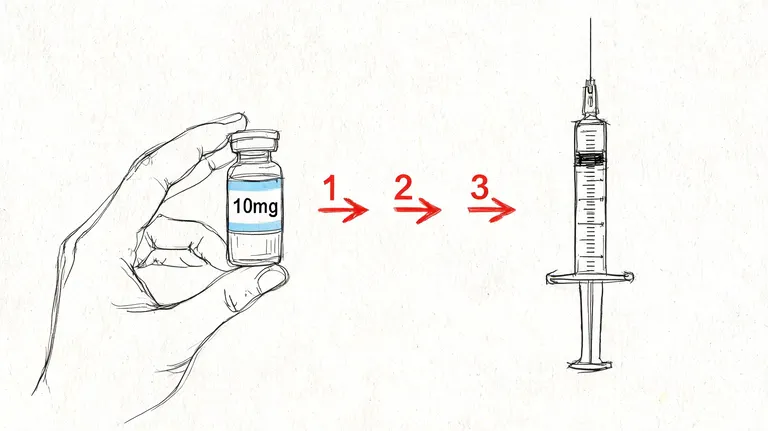
The distinction between milligrams and micrograms is central in peptide science because one microgram is 1,000 times smaller than one milligram, and understanding that 100 mcg equals 0.1 mg is essential for correct protocol scaling (Viridian Nutrition on milligrams and micrograms).
If you’re comparing compounds and contexts, this guide on peptides for men’s health is useful background reading because it helps users see where peptide protocols fit into broader wellness decision-making.
Read the vial and choose your reconstitution volume
Start with the vial label.
In this example, the vial contains 10 mg total peptide. That number refers to the whole vial, not to each mL. You only get concentration after you add liquid.
Now choose a reconstitution volume. A common example is adding 2 mL of bacteriostatic water. Once you do that, the full vial still contains 10 mg total, but it is now spread across 2 mL of liquid.
So the concentration is:
| Total peptide in vial | Total liquid added | Resulting concentration |
|---|---|---|
| 10 mg | 2 mL | 5 mg/mL |
That means every 1 mL of solution contains 5 mg of peptide.
If you want a more detailed prep refresher, this step by step guide on how to reconstitute peptides helps with the handling side before you calculate the dose.
Convert the concentration into the unit you actually use
Your target dose is 250 mcg, so it helps to express the concentration in mcg/mL.
You already know the solution is 5 mg/mL. Convert that concentration using the basic rule:
5 mg = 5,000 mcg
So the concentration becomes:
| Concentration in mg/mL | Converted concentration in mcg/mL |
|---|---|
| 5 mg/mL | 5,000 mcg/mL |
This is the point where the workflow becomes easier. You’re now comparing the same kind of units. Desired dose in mcg. Solution concentration in mcg per mL.
Calculate the injection volume
Now divide the desired dose by the concentration.
Desired dose: 250 mcg
Concentration: 5,000 mcg/mL
So:
250 mcg ÷ 5,000 mcg/mL = 0.05 mL
That means the injection volume is 0.05 mL.
If you’re using a typical insulin syringe, that volume is commonly read as 5 units on a 100 unit per mL syringe. What matters most is checking your syringe style before drawing anything. Syringe markings vary, and that’s where people get sloppy after doing the hard part correctly.
The math only works if the vial amount, liquid volume, target dose, and syringe scale all belong to the same calculation chain.
A practical workflow looks like this:
-
Read the vial total
Confirm the full amount of peptide in mg. -
Confirm reconstitution volume
Write down exactly how much diluent went in. -
Find concentration
Divide total mg by total mL. -
Convert units if needed
Match the concentration unit to the target dose unit. -
Calculate final draw volume
Divide desired dose by concentration.
That sequence works because each step depends on the one before it. Skip a step, and the whole setup gets harder to trust.
Common Dosing Mistakes That Go Beyond Simple Math
Most users don’t fail because they forgot that mg and mcg differ by a factor of 1,000. They fail because they mix that conversion into the wrong part of the dosing workflow.
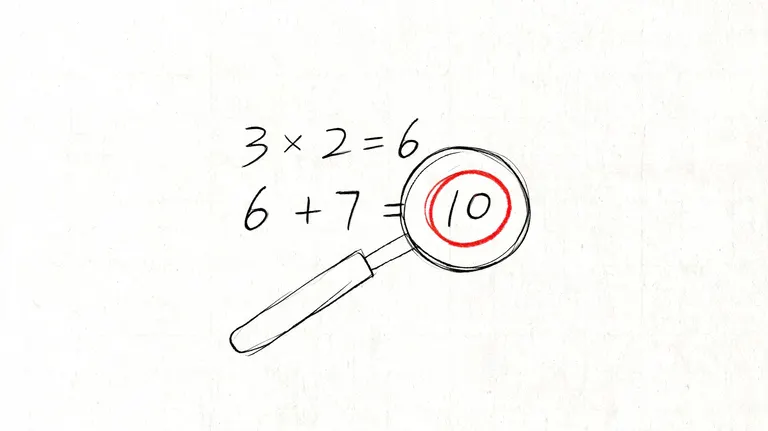
Industry data indicates that 18-22% of peptide dosing errors come from users sequencing the conversion incorrectly within larger workflows, rather than from the mg/mcg conversion itself. A major trap is applying the 1,000x factor to a concentration value at the wrong stage instead of to the intended dose quantity (BrightChamps discussion of mg to mcg workflow errors).
The workflow trap
The most common hidden mistake is treating every number on the page as equally ready for conversion.
It isn’t. The vial total, the concentration, the desired dose, and the injection volume all represent different things. If you convert the wrong one at the wrong time, the answer may still look neat, but it won’t describe a real dose.
A safer habit is to isolate each step on paper:
- First line: total vial amount
- Second line: reconstitution volume
- Third line: concentration
- Fourth line: desired dose
- Fifth line: final volume to draw
That layout sounds basic. It works because it stops your eyes from jumping between incompatible units.
The label trap
Another frequent error is confusing total vial content with concentration.
A vial labeled 10 mg does not mean each mL contains 10 mg. It only tells you how much peptide is in the vial before you account for the liquid you add. Once reconstituted, the concentration depends on the amount of diluent used.
A vial label tells you quantity. Reconstitution creates concentration.
People also get into trouble when they rely on memory. They think they added one volume of water, but used another. If the liquid amount is off, every later calculation is off too.
The syringe trap
The final mistake tends to happen after the arithmetic is already done. The user has the correct mL value but misreads the syringe.
That usually shows up in three ways:
- Wrong syringe assumption: Not every syringe scale maps the same way.
- Decimal blindness: Small volumes look similar at a glance.
- Rushed drawing: Users stop double-checking because they believe the hard part is over.
The safest approach is boring on purpose. Write the target dose, write the final volume, then compare both against the vial setup before drawing. Repetition reduces drama.
Eliminate Errors With a Dedicated Peptide Calculator
Manual math works when you’re calm, organized, and never rush. Real life doesn’t always give you those conditions.
Research in clinical pharmacy settings found that manual dose conversion errors occur in about 5-10% of cases when decimal placement is mishandled, while automated systems using fixed conversion ratios reduce errors to below 0.1% (Sciencing summary of dose conversion error rates).
That gap explains why a generic phone calculator often isn’t enough. A basic calculator can multiply and divide, but it won’t tell you whether you entered the wrong unit, skipped the concentration step, or confused vial total with mg/mL.
Why a generic calculator still leaves room for mistakes
A standard calculator is neutral. It doesn’t know what kind of workflow you’re in.
That matters because peptide dosing isn’t one equation. It’s a sequence. You need to keep the vial amount, reconstitution volume, target dose, and final injection volume in the correct relationship from start to finish.
The same pattern shows up in other health tracking tools. People often move from manual logging to structured tools for the same reason they move from scratch math to guided dosing. For example, AI-powered calorie tracking solutions help users reduce logging friction by turning a multi-step process into a cleaner workflow.
What a peptide specific tool should do
A useful peptide calculator should do more than convert mg to mcg.
It should prompt for the right inputs in the right order, preserve unit clarity, and output a result that maps to actual administration. That means the tool needs to understand the difference between total vial amount and concentration, not just arithmetic.
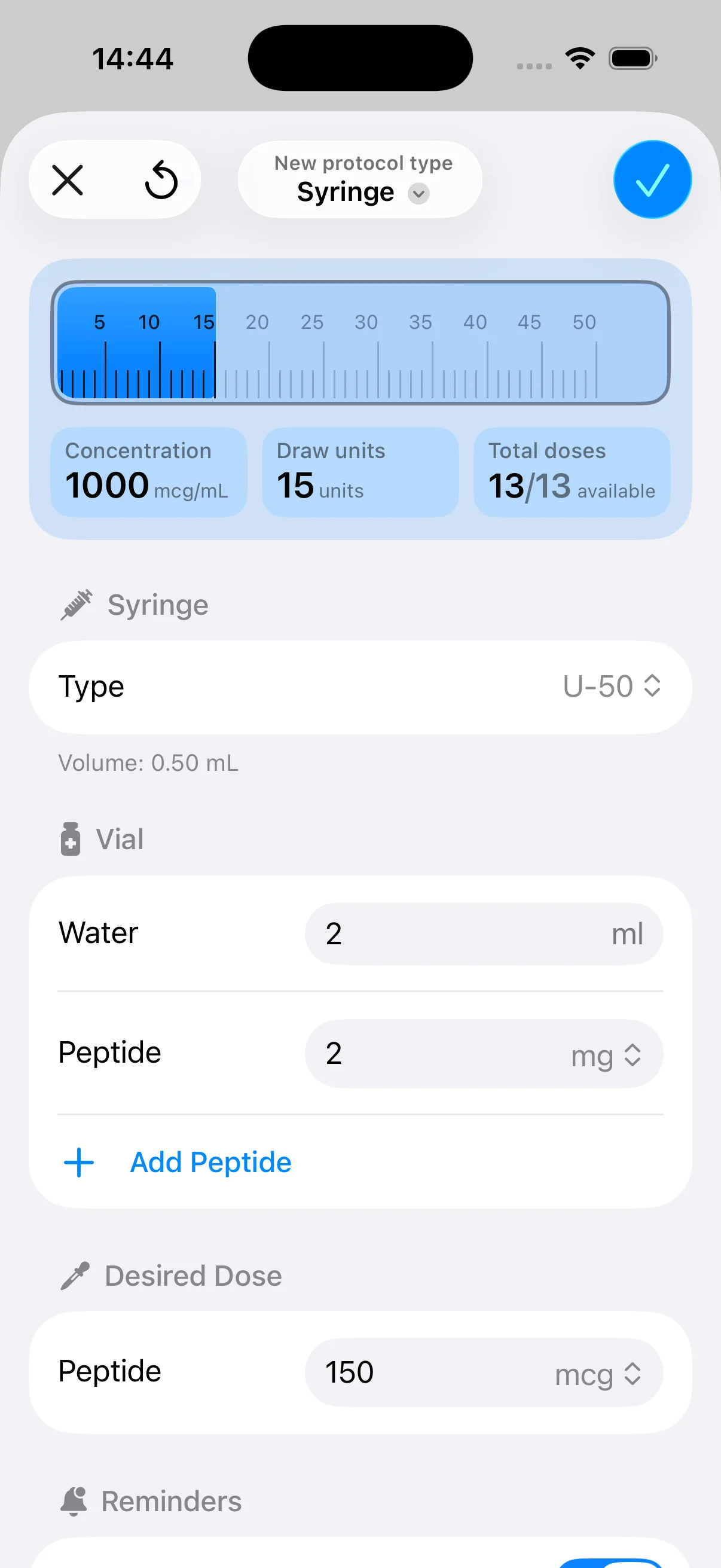
One practical example is PepFlow, which is built around peptide dosing and scheduling workflows. It lets users enter vial size, reconstitution volume, and target dose, then converts that into a usable draw amount while keeping the units visible throughout the process.
The value is less about convenience and more about guardrails. A dedicated tool reduces the chance that you’ll solve the wrong problem correctly.
This walkthrough shows what that kind of guided input looks like in practice:
If you coach others, this matters even more. A repeatable calculator gives clients a consistent method instead of asking them to remember every formula, every time, under different vial setups.
Your Blueprint for Accurate and Confident Dosing
Accurate dosing starts with a simple truth. 1 mg equals 1,000 mcg. That conversion is fixed. It doesn’t change by compound, brand, or protocol.
What does change is the workflow around it. You still need to know the vial’s total content, the amount of diluent added, the resulting concentration, and the exact volume that matches your target dose. That’s where most real-world mistakes happen.
A reliable process looks like this:
- Convert units cleanly: Match mg and mcg before you calculate volume.
- Work in sequence: Vial amount first, reconstitution second, concentration third, draw volume last.
- Check the syringe: A correct mL answer still has to be drawn correctly.
- Slow down on decimals: Tiny placement errors can turn a correct plan into the wrong dose.
Confidence doesn’t come from doing the math fast. It comes from doing it the same careful way every time.
If you approach peptide dosing like a system instead of a guess, it becomes far more manageable. The goal isn’t perfection through memory. The goal is consistency through clear steps, written checks, and tools that reduce preventable error.
If you want a simpler way to manage peptide math and protocol timing, PepFlow is built for exactly that workflow. It helps translate vial setup and desired dose into practical administration values, while also keeping schedules, reminders, and dose logs organized in one place.