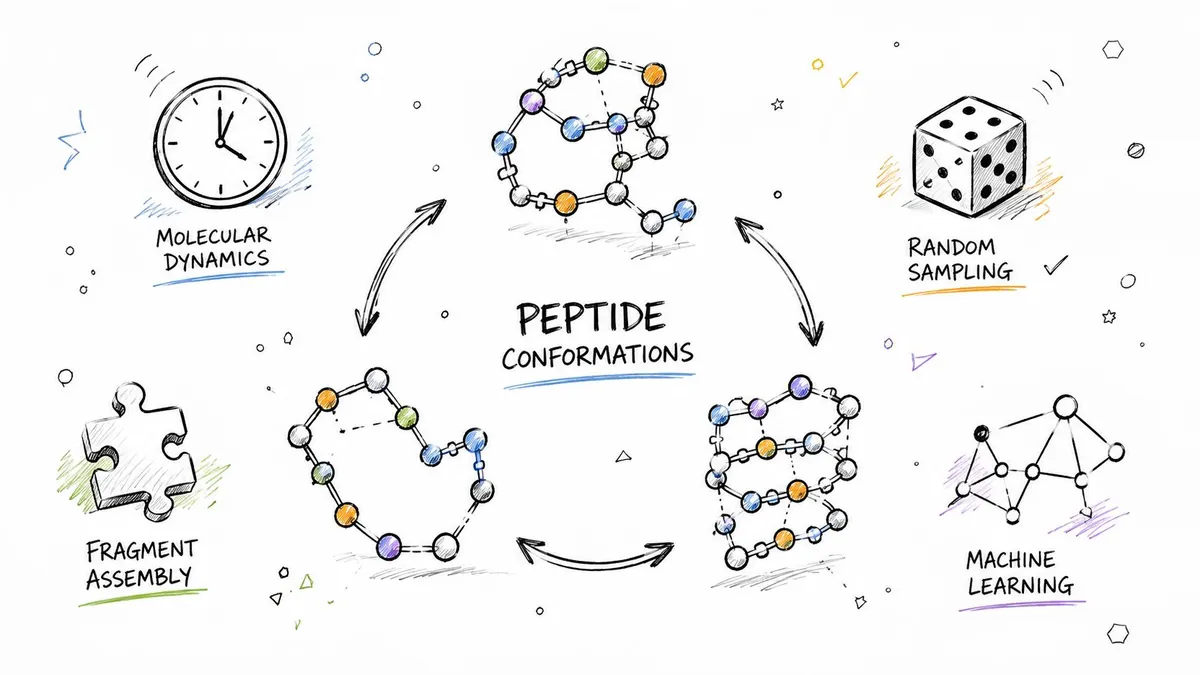
You’ve got a peptide sequence, a deadline, and a simple question that rarely has a simple answer, what shape does this thing take in solution? If you ask a static predictor for one clean structure, you may get a tidy answer back. The harder part is deciding whether that answer reflects a real, functionally relevant conformer or just one snapshot from a moving ensemble.
Table of Contents
- What Peptide Conformation Prediction Really Means
- The Four Main Method Families
- Why Single Models Often Mislead
- Reading the Numbers Without Fooling Yourself
- A Practical Workflow for Short Peptides
- Handling Cyclic and Modified Peptides
- Common Pitfalls and How to Validate Results
- Tools, Datasets, and Where to Go Next
What Peptide Conformation Prediction Really Means
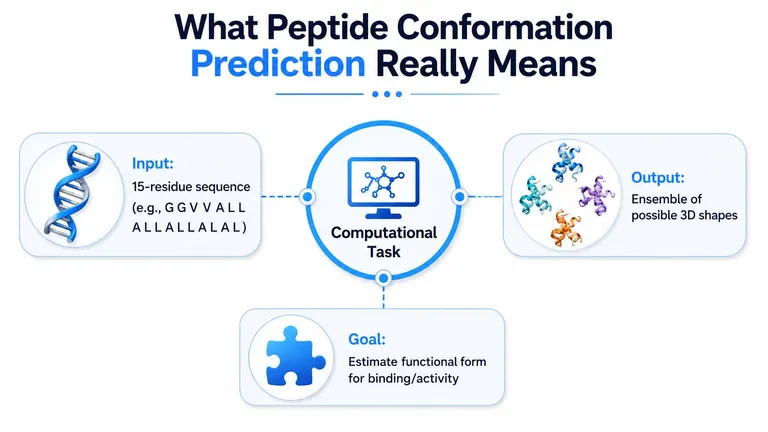
A researcher hands you a 15-residue peptide and asks what shape it adopts. That request sounds like standard structure prediction, but peptides are not mini proteins in the usual sense. They’re often more like a hinge than a locked joint, so the task is not to find one final pose, it’s to estimate the set of shapes the sequence can occupy under real conditions.
That’s the core of peptide conformation prediction. You take an amino acid sequence and use computation to estimate the peptide’s three-dimensional conformations, then ask which of those states are plausible in water, in a membrane, or when bound to a partner. The important distinction is between a model, which is one structure, and an ensemble, which is a family of structures with different populations.
A peptide can be bioactive without ever settling into a single rigid form. The same chain may flicker between helical, extended, kinked, or partially ordered states, and the “right” answer depends on the question you’re asking. If you’re building a docking hypothesis, a dominant conformer may be enough. If you’re trying to understand binding or spectroscopy, the ensemble is the primary object of interest.
In practice, the best workflows respect that flexibility from the start. That’s also why teams working on regulated or sensitive pipelines, including healthcare compliance engineering, often care as much about model traceability as model accuracy. A peptide prediction that can’t be explained, compared, or validated is just a picture, not a scientific result.
Practical rule: if your peptide is short, mobile, or chemically unusual, assume the prediction problem is “what conformations are likely?” before you assume it is “what is the structure?”
The Four Main Method Families
Molecular dynamics as a time-resolved movie
Molecular dynamics, or MD, is the closest thing to watching a peptide move frame by frame. Tools such as GROMACS and AMBER integrate Newton’s equations over time, so you start with a structure and let the system evolve in solvent, with ions, and with whatever restraints you choose. The payoff is physical detail. The cost is that you need a reasonable starting model, careful parameterization, and enough simulation time to sample something meaningful.
MD shines when a peptide already has a decent initial pose and you want to see whether it stays there, drifts, or opens up. It’s especially useful for flexible or disordered peptides, where a single predictor can overstate certainty. It’s less forgiving for heavily modified sequences if you haven’t chosen force-field parameters carefully.
Monte Carlo as guided wandering
Monte Carlo sampling doesn’t pretend to simulate every atom’s motion in real time. It proposes changes, scores them, accepts some, rejects others, and keeps exploring the energy terrain. A Rosetta-based Monte Carlo protocol is a good mental anchor here. It’s useful when you want broad sampling rather than one dynamical trajectory, especially for short peptides where the search space is still manageable.
That makes Monte Carlo attractive for conformer generation, clustering, and hypothesis building. If MD is a movie, Monte Carlo is a hiker testing different paths on the same mountain. It can find useful folds quickly, but its answer still depends on the scoring function you trust.
Fragment assembly as structure-by-reuse
Fragment assembly builds a peptide from pieces borrowed from known structures. PEP-FOLD is the classic anchor for this family, and its historical benchmark mattered because it showed that de novo peptide prediction could compete quantitatively with older servers on real peptide sets. Fragment methods are often strong for short peptides and helical motifs, because they benefit from recurring local geometry seen in reference structures.
The limitation is obvious once you understand the method. If the peptide’s behavior depends on unusual torsions, cyclization, or chemical modification, the fragments you reuse may not capture the right physics.
Machine learning as pattern recognition
Machine-learning predictors, including AlphaFold2-style approaches, look for geometric patterns learned from structure databases. They’re fast, convenient, and often surprisingly good on structured regions. In peptide work, they’re often the first thing people try, because the interface is simple and the outputs look authoritative.
That authority can be deceptive. These models are strongest when the peptide resembles familiar training examples, such as helical, beta-hairpin, or disulfide-rich motifs. They become less trustworthy as flexibility, chemical modification, or unusual topology increases.
Useful shortcut: use ML for a fast first pass, MD for physical relaxation, Monte Carlo for sampling, and fragment assembly when you want a known local geometry to guide the search.
Why Single Models Often Mislead
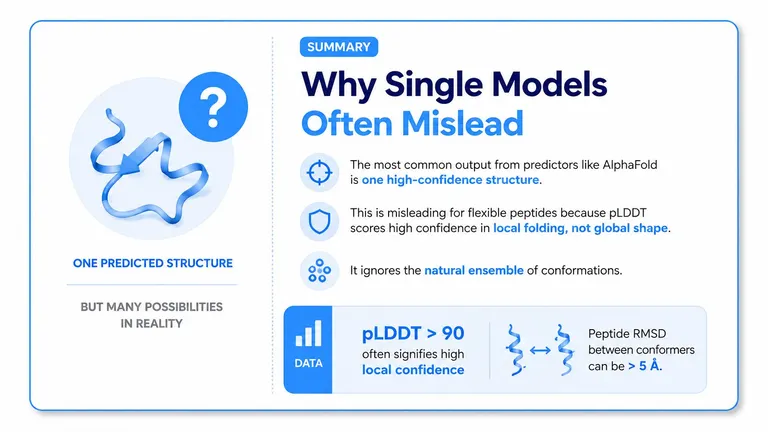
A single high-confidence structure can look convincing even when the peptide doesn’t behave that way in solution. That’s the trap. pLDDT and similar scores tell you how confident the model is about local geometry, but they don’t turn a flexible peptide into a rigid object.
A large 2024 benchmark on 557 peptides gives a more honest picture. In structured regions, AlphaFold2-style conformational ensemble prediction reached average RMSD under 2.5 Å and average RMSF differences under 1.5 Å. The same work reported a structured-region RMSD of 2.294 Å, a global ΔRMSF of 1.247 Å, more than 50% of predictions within 2 Å on both RMSD and RMSF, and nearly 75% within 3 Å. Those are strong numbers, but they’re not a license to ignore flexibility.
The important caveat is where the model works best. Structured segments are easier to pin down than coiled or highly mobile ones, and that’s exactly where binding, recognition, and conformational switching often happen. A model can be right about the helix core and still miss the part of the peptide that contacts the receptor.
This is why a peptide prediction should be read like a weather forecast, not a passport photo. You care about the likely range, the unstable zones, and the confidence in each region. If you only look at the best-looking frame, you can miss the conformational spread that governs function.
For readers who want a side-by-side way to compare this visual confidence problem with another class of models, compare cryogenic models offers a useful framing. Different structural methods can be impressive in their own way, but none of them erase the underlying ensemble behavior of a flexible peptide.
Reading the Numbers Without Fooling Yourself
What the common metrics actually tell you
RMSD is the average distance between matched atoms in two structures. For peptide backbones, sub-2 Å usually means the prediction is close, while 3 to 4 Å is better treated as qualitative agreement than a precise match. RMSF is different, it measures how much each residue moves across an ensemble or trajectory, so it tells you where the peptide is mobile rather than whether one frame is “correct.”
pLDDT is a local confidence score, not a guarantee that the whole peptide is right. A residue can have a strong pLDDT while the global arrangement of the chain still shifts between plausible states. TM-score is a topology check, more useful when you care about overall fold similarity than about fine peptide geometry.
| Metric | What it measures | Good range | When to be suspicious |
|---|---|---|---|
| RMSD | Average atom-to-atom deviation between two structures | Sub-2 Å for strong backbone agreement | When one region is rigid and another is highly mobile |
| RMSF | Residue-level flexibility across an ensemble | Lower values in structured segments are expected | When a single trajectory is treated as the full story |
| pLDDT | Local confidence in predicted geometry | High values can be useful in stable regions | When flexible loops or termini look overconfident |
| TM-score | Overall topology similarity | Useful for broad shape comparison | When small peptide motions matter more than topology |
| Ensemble cluster radius | Spread within a conformational family | Tight clusters suggest a dominant state | When clusters are broad but reported as one model |
| Population weight | How much of the ensemble occupies one state | Dominant states should be reported explicitly | When rare states are shown as if they’re typical |
A decision filter you can actually use
If your model is for a paper figure, ask whether the structure is publishable as a representative conformer. If you need it for binding or design, ask whether it’s usable, meaning the relevant regions are stable enough to support the downstream task. If the answer is no, the model needs another round of sampling or experimental restraint.
A second check helps a lot. Compare the conformer distribution against observable data, then decide whether the model captures the ensemble, not just one low-energy snapshot. If you’re building a data workflow around peptide properties, even something adjacent such as peptide purity testing can remind you that measurement always matters more than appearance.
A Practical Workflow for Short Peptides
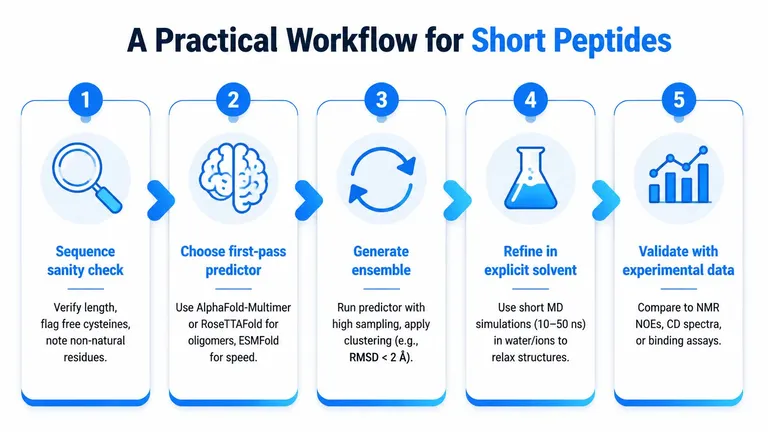
Start with the sequence, not the software
A short peptide workflow begins with a sanity check. Count the length, flag cysteines, and note any non-natural residues or terminal modifications before you choose a method. That sounds obvious, but many bad predictions come from using a generic predictor on a sequence that needs special handling.
If the peptide is plainly canonical and short, a first-pass predictor such as AlphaFold2, ColabFold, or PEP-FOLD can give you a starting ensemble. Don’t stop at one seed. Generate multiple runs so you can see whether the method is converging to one family of shapes or spraying you across several unrelated ones.
Decide whether to relax or resample
Once you have one or more candidate structures, decide what the next question is. If the model already looks coherent and the peptide is simple, a short MD relaxation in explicit solvent may be enough. If the peptide is flexible, disordered, or expected to switch states, you may need more aggressive sampling, such as replica-based or enhanced-sampling approaches.
Experimental priors help more than people admit. If circular dichroism suggests a helix, bias your seed selection toward helical candidates. If NMR chemical shifts already exist, use them as constraints or at least as a sanity check against the predicted backbone.
Practical rule: don’t ask one method to do everything. Let prediction generate candidates, let simulation weed out unstable ones, and let experiment arbitrate the rest.
The loop should stay iterative. Prediction feeds simulation. Simulation feeds interpretation. Experiment feeds the next prediction. That cycle is especially helpful when you’re managing peptide workflows through a tool like PepFlow, which is built for dosing and scheduling rather than structure work, but still reflects the same need for precise, repeatable handling. For lab prep workflows, it can be useful to pair that with a clean planning reference such as how to reconstitute peptides so the physical sample matches the model you’re trying to test.
Handling Cyclic and Modified Peptides
A six-cysteine cyclic peptide is where generic workflows start to wobble. The reason isn’t just shape, it’s connectivity. For cyclic, disulfide-rich peptides, the model has to know which cysteines pair up before the backbone search can be trusted, and that combinatorial ambiguity grows fast. A four-cysteine peptide has 3 possible connectivities, while a six-cysteine peptide has 15, so the search space isn’t just large, it’s structurally different.
A sensible hybrid workflow starts with the natural backbone, then adds the chemistry. That means you model the unmodified or minimally modified scaffold first, then impose cyclization, stapling, or other non-natural features, and only then simulate the result with a force field you trust for that chemistry. Another 2023 assessment noted that deep-learning methods such as AlphaFold2 are strong for natural sequences, but for non-natural modifications a better strategy is often to model the backbone first and then modify and simulate.
The main mistake here is to compare the wrong model to the wrong question. The structure with the lowest RMSD may not be the one with the highest pLDDT, and the highest-confidence snapshot may not be the one that best matches downstream binding behavior. If you care about contact geometry, use the metric that captures contact geometry. If you care about the ensemble, use the metric that captures the ensemble.
For a deeper look at cyclic peptide terminology and why these molecules need a different mental model, what is DAC in peptides is a useful reference point. The field is also moving toward hybrid cyclic-peptide workflows, including constraint-aware models and peptide-protein docking approaches that treat topology as part of the problem rather than an afterthought.
Common Pitfalls and How to Validate Results
Mistakes that show up again and again
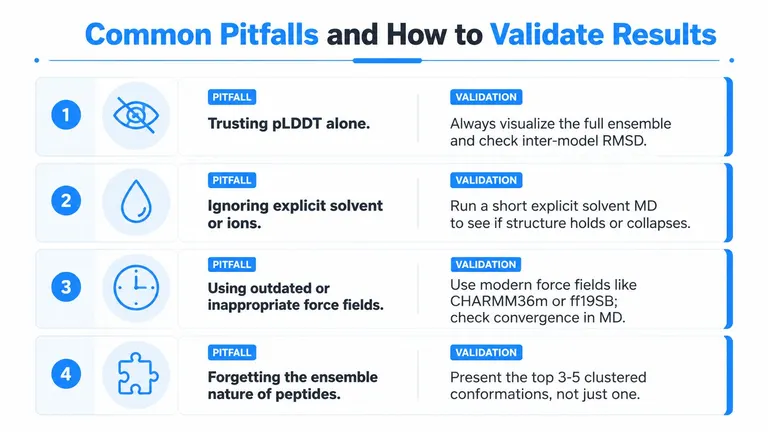
The first mistake is trusting pLDDT alone. A local confidence score can look great while the peptide still samples several states. The fix is simple. Run a second independent prediction, then compare the clustered conformations instead of the top-ranked one only.
The second mistake is ignoring explicit solvent and ions. Peptides often collapse, stretch, or reorient once water and charge screening are present. The fix is to put the model into a short explicit-solvent test and see whether it holds or falls apart.
The third mistake is using the wrong force field for a modified peptide. If the chemistry is unusual, an untested parameter set can give you a polished-looking artifact. Use a modern, benchmarked force field, then check whether the trajectory converges rather than drifting endlessly.
A compact pre-flight checklist helps:
- Visualize the ensemble, not just the best frame: compare the top clustered states and inspect inter-model RMSD.
- Check flexibility explicitly: calculate per-residue RMSF and look for the unstable termini or loops.
- Match chemistry to parameters: protonation, ions, and modified residues all need to fit the experimental context.
- Validate against observables: compare the model to CD, NMR, or a binding assay when those data exist.
- Treat one trajectory as one sample: if the system is floppy, use replicate runs or enhanced sampling.
The point isn’t to make prediction harder than it needs to be. It’s to stop a single pretty model from acting like evidence when it’s really just one sample from a broader conformational space.
Tools, Datasets, and Where to Go Next
If you want to learn this workflow in practice, start with a peptide-tuned predictor and a notebook, then move into GROMACS, AMBER, or OpenMM for short simulations. For structure generation and sampling, AlphaFold2, ColabFold, PEP-FOLD, RoseTTAFold, and PyRosetta cover most of the entry points. For data, look at PDB, PED, PepBDB, and the Cyclic Peptide Database, then validate against BMRB chemical shifts or DSSP annotations when they’re available.
If you think in ensemble terms, the analogy extends beyond chemistry. A good general explainer on that mindset is DataTeams AI insights, because peptide modeling gets easier when you stop expecting one model to do the work of many. The same idea underlies modern peptide prediction too, prediction is the start of the conversation, not the final answer.
If you want a simple way to keep peptide workflows organized while you move from sequence to validation, try PepFlow. It’s designed for precise peptide dosing and scheduling, and the same habit of careful planning carries over to conformational work, where a good starting point matters just as much as the final interpretation.