
The most popular advice about PEG-MGF peptide benefits often starts with a confident promise: better muscle repair, faster recovery, and more growth. The evidence doesn’t support that level of certainty. PEG-MGF is scientifically interesting because it preserves an MGF-like signal for longer than native MGF, but published randomized human trials have not established that it improves strength, hypertrophy, healing, or recovery in people. A 2026 evidence summary reports that no completed randomized controlled trials of exogenous MGF or PEG-MGF had been published in peer-reviewed journals.
That distinction matters before you spend money, change a training plan, or treat online testimonials as clinical evidence. The rational case for PEG-MGF comes from cell and animal research, not from validated human outcomes. Understanding that gap gives you a more useful question than “Does PEG-MGF work?” You can ask, “What does the compound appear to do in preclinical models, and what remains unknown in humans?”
Table of Contents
- Why PEG MGF Peptide Benefits Are More Theory Than Proof
- Understanding PEG MGF and How Pegylation Changes the Molecule
- Proposed Benefits for Muscle Repair and Recovery
- Comparing PEG MGF With Related Peptides
- Safety Considerations and Dosing Principles
- Making an Informed Decision About PEG-MGF
- Frequently Asked Questions About PEG MGF
Why PEG MGF Peptide Benefits Are More Theory Than Proof
PEG-MGF attracts attention because its proposed mechanism sounds plausible. Muscle injury and mechanical stress are associated with local growth-factor signaling, and MGF is studied as an IGF-1 splice variant connected with repair biology. Researchers have also reported findings involving satellite-cell activation, cell proliferation, and tissue-regeneration signals, which can sound like direct evidence of faster recovery.
They aren’t the same thing as a clinical benefit.
A cell may proliferate in a laboratory dish without producing stronger muscle in a person. A rodent may recover function after an induced injury without showing that an injectable peptide improves rehabilitation outcomes in humans. The bridge between those observations requires pharmacokinetic studies, safety research, controlled clinical trials, and reproducible endpoints. That bridge hasn’t been built for PEG-MGF.
What “benefit” means in preclinical research
In preclinical work, benefit often means that researchers observe a biological response under controlled experimental conditions. That response might include increased proliferation in cultured cells or changes in muscle structure after injury in an animal model.
Those observations help scientists form hypotheses. They don’t establish a safe dose, a suitable treatment schedule, or a predictable result for a human athlete or patient. The 2012 review in PMC describes synthetic MGF E-domain peptides activating satellite cells to replicate, while a related 2010 PMC paper reports increased proliferation in osteoblast-like cells exposed to MGF, its E-peptide variant, and IGF-1. These findings support biological interest, not proven human efficacy.
Evidence rule: A plausible mechanism can justify more research. It can’t substitute for a controlled human outcome.
The most defensible conclusion as of 2026 is therefore narrow. PEG-MGF may preserve an MGF-like signal long enough to make systemic preclinical research practical, but claims about muscle gain, injury healing, or recovery speed remain extrapolations. Independent summaries of PEG-MGF research likewise identify the unresolved issue, whether the proposed biology produces meaningful benefits in humans beyond theory.
Understanding PEG MGF and How Pegylation Changes the Molecule
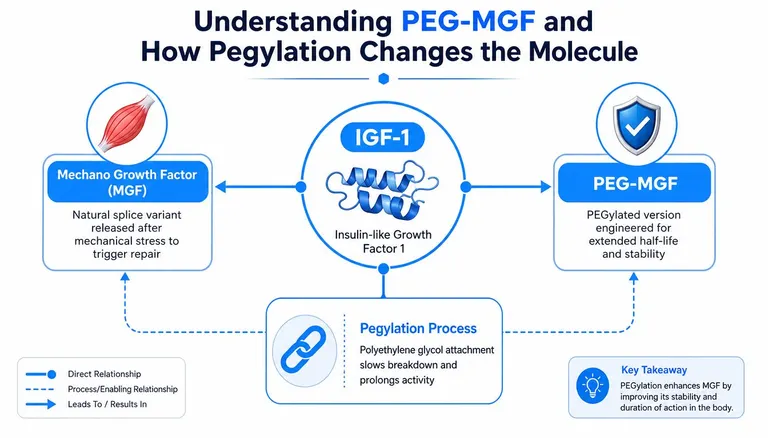
MGF, or mechano growth factor, is studied as a splice variant associated with the IGF-1 system. The body can produce different IGF-1-related forms, and the MGF form has been investigated in the context of local tissue stress and repair. Rather than thinking of MGF as a completely separate growth system, it helps to view it as one branch of a broader IGF-1 signaling network.
Native MGF is fragile in biological fluids. Its half-life is described in the literature as measured in minutes, which means enzymes and normal clearance processes remove it quickly. That short exposure makes it difficult to study as a sustained systemic signal.
The role of pegylation
Pegylation means attaching polyethylene glycol, usually called PEG, to a peptide or protein. The PEG component can act like a protective coating around a fragile message. It may reduce how quickly enzymes break the peptide down, allowing the compound to remain in circulation longer than the native form.
For PEG-MGF, the central research rationale is pharmacokinetic rather than a proven wellness effect. The available research summary describes pegylation as extending exposure from minutes to hours in preclinical reasoning. That longer presence could make it easier to investigate whether an MGF-like signal influences tissue-repair processes beyond a brief local pulse.
The modification doesn’t automatically preserve every property of native MGF. A synthetic pegylated molecule can have different distribution, receptor interactions, and clearance behavior. Human pharmacokinetics for PEG-MGF remain undefined, so researchers can’t confidently state how the compound behaves in a human body or whether longer circulation produces a useful tissue response.
A plain-language model
You can think of the difference this way:
- Native MGF resembles a short-lived local message released around stressed tissue.
- Pegylated MGF adds a stabilizing feature intended to keep the message present longer.
- The hypothesis is that prolonged exposure could support repair signaling.
- The missing evidence is whether that prolonged exposure improves a meaningful human outcome.
For a concise primer on the compound’s terminology and proposed biology, see what PEG-MGF is. The important takeaway is simple: pegylation changes exposure time, not the evidence standard. A longer-lasting molecule still needs human trials before anyone can call its benefits established.
Proposed Benefits for Muscle Repair and Recovery
The proposed benefits cluster around one idea, that PEG-MGF might maintain an MGF-like repair signal long enough to influence muscle regeneration. Researchers and vendors commonly connect that idea with satellite cells, muscle-fiber repair, hypertrophy, and rehabilitation. Each claim needs to be separated into what models have shown and what remains untested in people.
The most frequently discussed mechanism is satellite-cell activation. Satellite cells are muscle stem cells involved in repair and adaptation. The 2012 PMC review discusses synthetic MGF E-domain peptides in relation to satellite-cell replication, while other preclinical work has explored MGF-related signaling after mechanical injury.
What animal and cell models suggest
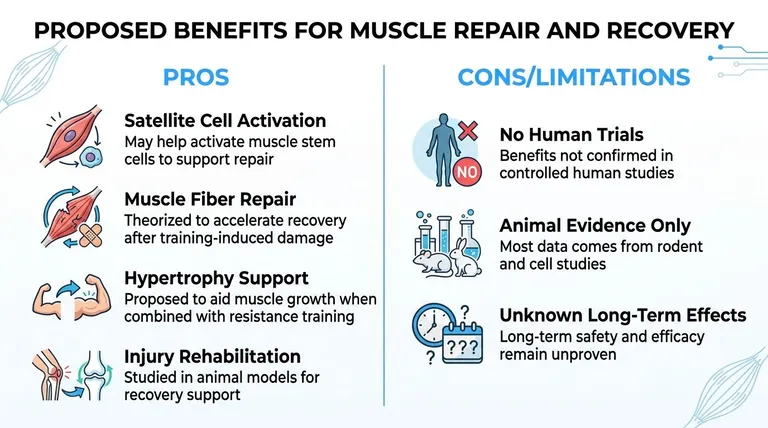
Independent summaries of animal findings report that PEG-MGF administered after muscle injury can increase muscle cross-sectional area, support fiber hyperplasia or hypertrophy, and improve functional recovery in rodent and other non-human models. The proposed explanation involves satellite-cell-mediated repair and reduced catabolic signaling, but the evidence is heterogeneous and remains preclinical. The animal-data overview emphasizes that these findings don’t establish human dosing, safety, or performance benefits.
Cell research offers another layer of support, but it also illustrates the limits of the argument. The 2010 PMC paper reports increased proliferation in osteoblast-like cells exposed to MGF, the MGF E-peptide variant, and IGF-1. That result may help explain interest in tissue-repair signaling, yet a change in cultured-cell proliferation isn’t the same as faster bone healing or stronger muscle in a patient.
The proposed benefits can therefore be categorized carefully:
- Satellite-cell signaling: Supported as a mechanistic research hypothesis, not established as a human treatment effect.
- Muscle-fiber repair: Observed in animal research contexts, with no controlled human confirmation.
- Hypertrophy support: Suggested by changes in animal muscle structure, but not demonstrated as a predictable human outcome.
- Injury rehabilitation: Related to functional recovery in non-human models, not validated as a clinical rehabilitation tool.
Mechanism versus outcome
A mechanistic endpoint tells you what may be happening inside a cell or tissue. A clinical endpoint tells you whether a person becomes stronger, heals sooner, returns to activity earlier, or experiences fewer complications.
That difference is the central issue. As of 2026, neutral summaries of PEG-MGF evidence report no published controlled human trials demonstrating hypertrophy, recovery, or healing outcomes. The literature therefore supports discussion of cell proliferation and repair signaling, not quantified human gains.
This is why a confident testimonial shouldn’t outweigh the evidence gap. Training changes, nutrition, sleep, rehabilitation, and expectation can all affect how someone feels after using an experimental product. Without a controlled comparison, you can’t identify PEG-MGF as the cause.
The video below offers additional visual context for the proposed muscle-repair mechanisms, but it shouldn’t be treated as human efficacy evidence.
Comparing PEG MGF With Related Peptides
PEG-MGF makes more sense when you compare its proposed role with related compounds. Similar names don’t mean identical biology, and a longer half-life doesn’t mean a stronger clinical evidence base. The useful comparison is about mechanism, exposure, and the quality of evidence, not about declaring one peptide universally superior.
| Peptide | Primary Mechanism | Half-Life | Human Trial Evidence | Typical Use Case |
|---|---|---|---|---|
| PEG-MGF | Pegylated MGF-like repair signaling studied in preclinical models | Longer than native MGF, with exposure described from minutes toward hours in preclinical summaries | No published randomized human efficacy trials | Research into muscle repair and systemic exposure |
| Native MGF | Short-lived MGF E-domain signaling associated with local repair biology | Measured in minutes | No established human efficacy evidence for exogenous use | Short-exposure laboratory studies |
| IGF-1 LR3 | Modified IGF-1 pathway signaling with an engineered structure | Not established here for human clinical use | No evidence supplied here establishing approved human performance benefits | Experimental IGF-1 pathway research |
| BPC-157 | Experimental peptide studied in tissue-repair research | Human pharmacokinetics and efficacy remain uncertain | No established human efficacy evidence supplied here | Preclinical repair investigations |
| TB-500 | Experimental thymosin-related compound discussed in repair research | Human pharmacokinetics and efficacy remain uncertain | No established human efficacy evidence supplied here | Experimental recovery research |
The table shows why product comparisons can mislead. PEG-MGF’s distinguishing feature is its pegylated exposure profile, while native MGF is discussed as a short-lived signal. IGF-1-related compounds operate within a wider growth-factor framework, but the presence of a familiar pathway doesn’t prove that an unapproved analogue is safe or effective.
Readers who are comparing growth-factor compounds should also understand that IGF-1 isn’t interchangeable with MGF. A practical explanation of the distinction appears in this guide to IGF-1 injections, but it shouldn’t be read as evidence that either compound is appropriate for self-administration.
Match the compound to the question
A legitimate research question might ask whether sustained exposure changes a repair marker in a defined model. A personal goal, such as gaining muscle or returning from an injury, requires evidence from human outcomes. Those are different questions, and a peptide that fits the first may not justify use for the second.
Avoid rankings such as “best recovery peptide.” Ask instead whether the compound has relevant human pharmacokinetic data, controlled efficacy trials, reliable product testing, and a legal pathway for the intended use. PEG-MGF currently falls short on those human validation criteria.
Safety Considerations and Dosing Principles
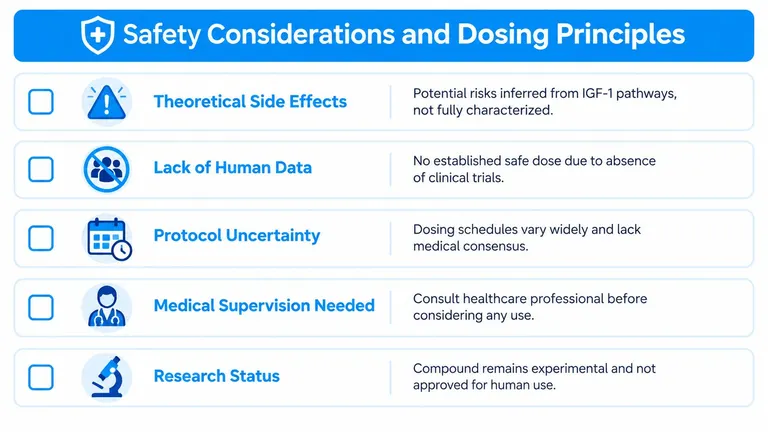
Dosing is where the evidence gap becomes a practical risk. If researchers haven’t established how PEG-MGF is absorbed, distributed, metabolized, or cleared in humans, then a dose copied from an online protocol can’t be treated as a clinically validated dose. The absence of reported harm isn’t proof of safety, especially when products are sold outside ordinary pharmaceutical quality controls.
Potential risks are partly theoretical and partly related to the product itself. Because PEG-MGF is connected to IGF-related signaling, researchers have reason to consider effects involving cell growth, glucose regulation, immune responses, and other pathway interactions. Those concerns don’t prove that a specific adverse event will occur, but they do show why casual experimentation is difficult to justify.
Why protocols aren’t interchangeable
Online discussions often present dosing schedules as if they were standard. In reality, research protocols vary by species, administration route, model, compound formulation, and experimental objective. A schedule designed for an animal study doesn’t provide a safe human instruction.
The core uncertainties include:
- Pharmacokinetics: Human absorption, tissue distribution, metabolism, and clearance haven’t been defined.
- Dose response: Researchers don’t have a validated human range linking exposure to benefit or harm.
- Product identity: Research-use products may not match the compound described in a paper.
- Long-term exposure: Long-term human safety and efficacy remain unproven.
- Interactions: The effect of combining PEG-MGF with other growth-factor or recovery compounds hasn’t been established.
The 2026 research overview states that human pharmacokinetics remain undefined and that no human clinical trials have been published. That makes precision in a calculator or syringe useful only for arithmetic. It can’t transform an uncertain protocol into a medically established one.
Harm reduction without false reassurance
Anyone considering an experimental peptide should speak with a qualified healthcare professional, particularly if they have a history of cancer, heart disease, metabolic illness, endocrine disorders, or immune problems. A clinician can also help distinguish an unresolved injury from ordinary training soreness and identify treatments with established evidence.
Product handling creates a separate hazard. A certificate of analysis may provide useful information about what a vendor claims to have tested, but it doesn’t guarantee sterility, accurate concentration, or clinical suitability. “Research use only” labeling also doesn’t authorize personal treatment.
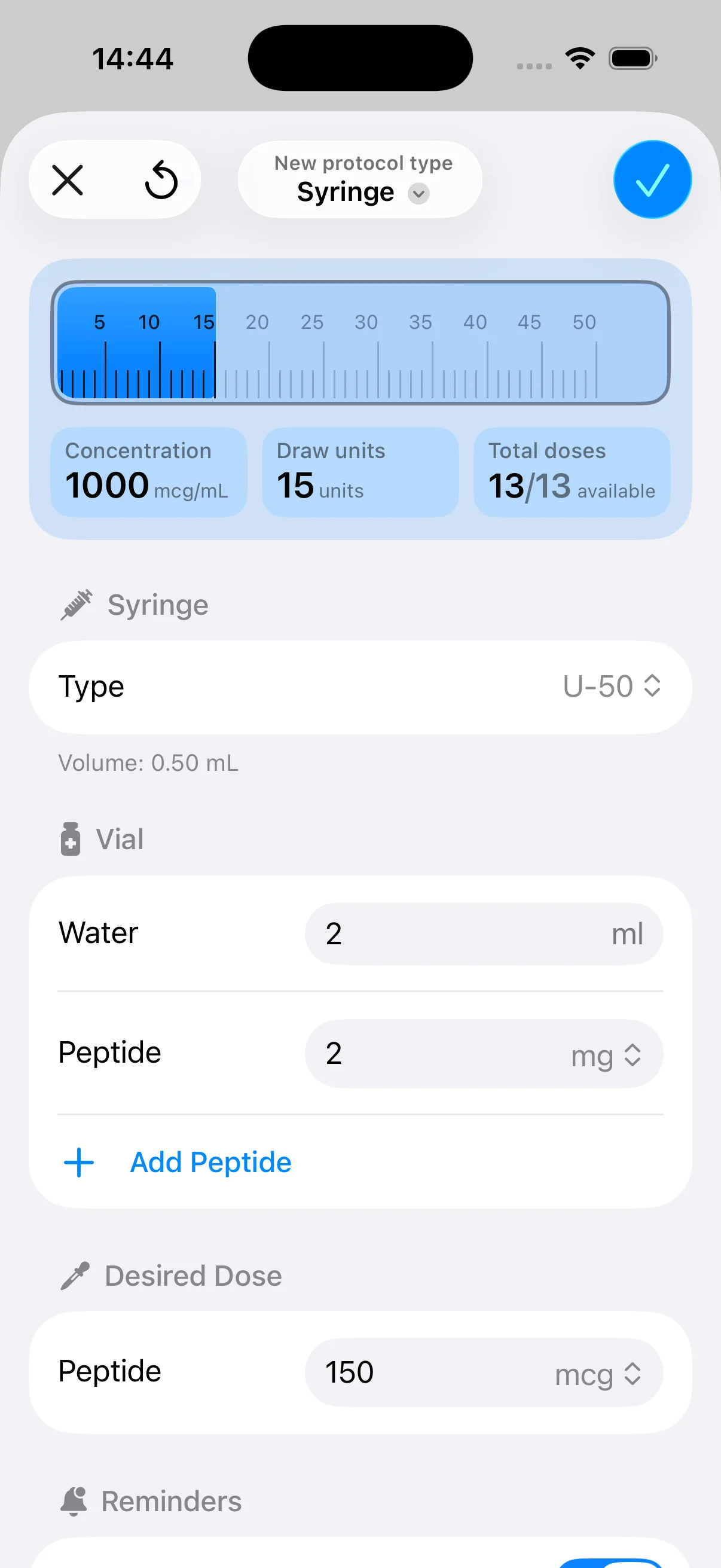
For readers who are already organizing a prescribed or legally supervised peptide schedule, the PEG-MGF dosage resource explains the planning problem in more detail. A scheduling tool such as PepFlow can calculate injection volume from a selected concentration and manage reminders, but it can’t supply missing safety data or replace medical supervision.
Practical boundary: Accurate measurement reduces arithmetic mistakes. It doesn’t reduce an unknown compound’s biological uncertainty.
Making an Informed Decision About PEG-MGF
A sensible decision starts by separating three questions that online marketing often blends together:
- Is the mechanism plausible? Yes, preclinical research provides a rationale involving MGF-like repair signaling.
- Has PEG-MGF produced reliable benefits in humans? Published randomized human efficacy evidence is absent.
- Can an individual safely choose a dose and product? Human pharmacokinetics, long-term safety, and product quality remain uncertain.
That framework doesn’t require you to dismiss the science. It asks you to label the science accurately. PEG-MGF may be valuable as a research subject while still being a poor choice for self-directed wellness use.

A practical decision checklist
Before treating claims about PEG-MGF peptide benefits as actionable, ask:
- What outcome do you want? “More recovery” is vague. Define whether you mean pain, range of motion, strength, muscle size, or return to sport.
- What evidence would change your mind? Look for controlled human outcomes rather than receptor diagrams or testimonials.
- What is the alternative? A qualified clinician may identify rehabilitation, nutrition, training-load changes, or an approved treatment with a clearer risk profile.
- What happens if the product is mislabeled? Consider identity, sterility, concentration, and contamination risk.
- Who is monitoring you? A professional should know about all compounds and supplements you use.
- Are you a tested athlete? MGF is treated as prohibited under the 2026 WADA framework described in the available research summary, so competition rules matter.
The strongest reason to pause isn’t that preclinical science has no value. It’s that the leap from a promising mechanism to a personal benefit is still unverified. A careful reader should treat PEG-MGF as experimental, not as a proven shortcut for muscle repair.
Frequently Asked Questions About PEG MGF
Is PEG-MGF legal for personal use?
Legal treatment varies by jurisdiction. In the United States, available summaries describe MGF as not FDA-approved and sold as a research-use compound, not as a prescription treatment. Check local regulations and competition rules before making assumptions.
Is it the same as HGH or anabolic steroids?
No. PEG-MGF is a synthetic, pegylated MGF-related peptide studied within IGF-1 biology. It isn’t identical to HGH or an anabolic steroid, and its proposed mechanism and evidence base differ.
Can it be stacked with other peptides?
There isn’t reliable human trial evidence establishing safe or effective combinations. Stacking increases uncertainty rather than solving it.
How should someone assess a supplier?
Look for independent identity, purity, concentration, and sterility documentation, but treat vendor paperwork as limited evidence. It doesn’t replace regulatory approval or clinical safety data.
PepFlow helps organize peptide schedules, calculate injection volumes from concentration and target amounts, and send reminders for structured routines. If you’re researching peptide planning or following a professionally supervised protocol, visit PepFlow to review its scheduling and dose-tracking tools.