You’ve got the vial in one hand, the syringe in the other, and a question that feels bigger than the label: what is this going to do to my body? That’s the right question. IGF-1 injection is not just a muscle or recovery topic, it’s a metabolic signal that can change glucose handling, tissue growth, and risk in the same window of time, which is why the details matter before anyone thinks about a protocol.
Table of Contents
- What IGF-1 Injection Actually Does in Your Body
- Native IGF-1 and the LR3 and DES Analogs
- How a Dose Moves Through the Body
- Practical Dosing Principles Without a Procedure
- Significant Safety Risks and Side Effects
- Monitoring That Catches Problems Early
- Legal Status Across Research, Prescription, and Sport
- How PepFlow Helps With Dose Math, Scheduling, and Adherence
What IGF-1 Injection Actually Does in Your Body
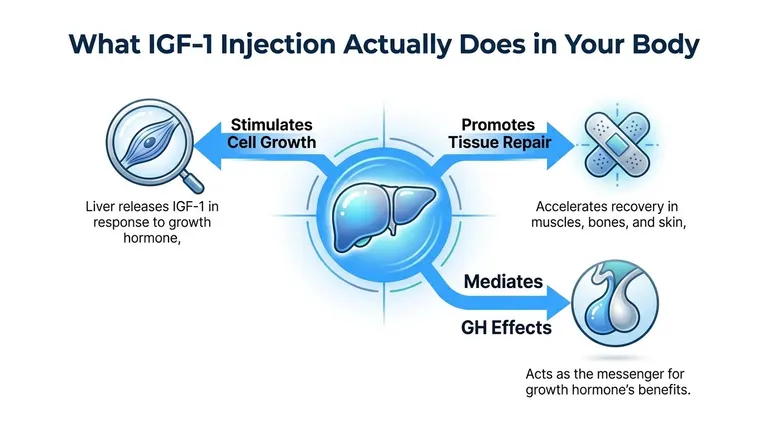
You’re staring at a vial, and the hard part is not the needle, it is the mental model. IGF-1, or insulin-like growth factor 1, is a hormone your body already makes in response to growth hormone, and injecting it pushes that same signal directly into circulation. In plain language, it tells tissues to act as if the body is in a growth-and-repair state, while also pushing insulin-like metabolic activity, which is why glucose can fall quickly after dosing.
IGF-1 injection works like a dose-dependent metabolic lever. A high-yield endocrinology review helps frame why that matters, because IGF-1 sits in the same broad hormonal conversation as growth signals and glucose control, even though it is not a steroid. Human data in healthy adults showed that recombinant IGF-1 produced rapid rises in circulating IGF-1 and a clear glucose-lowering effect within hours, so the signal is active enough to change body chemistry on a short clock, not just a long-term bodybuilding clock. That same dual action is why people focus on growth-related effects and why cautious users should think about blood sugar from the start.
Practical rule: if a compound can change growth signaling and glucose at the same time, it deserves the same respect you’d give a strong metabolic drug, not a casual supplement.
A useful internal guide to peptide mechanics is how peptide injections work, because the injection route matters as much as the molecule itself. Subcutaneous delivery puts the signal into the body in a way that can be predictable and unforgiving, especially once dose and timing start to matter.
Native IGF-1 and the LR3 and DES Analogs
Think of native IGF-1, IGF-1 LR3, and IGF-1 DES as siblings with the same family resemblance but very different work schedules. They all act through the same biological pathway, but the structural tweaks change how long they stay active and how broad that exposure becomes. That difference is the whole game, because the same receptor signal can feel very different depending on whether the molecule leaves quickly or lingers.
Independent technical guidance describes IGF-1 LR3 as having 13 added amino acids and an Arg substitution at position 3, changes that reduce binding to IGF-binding proteins and extend persistence to roughly 20 to 30 hours versus native IGF-1’s very short half-life (technical guide). In practice, that means the body sees a longer exposure window, which is one reason research use often shifts toward once-daily subcutaneous patterns. That longer window also makes glucose monitoring more important, because sustained insulin-like signaling can push blood sugar down if intake and timing don’t match the exposure.
Why the molecule matters before the protocol
Native IGF-1 is the reference point, but it’s not the only version people mean when they say “IGF-1 injection.” LR3 behaves more like a long-running signal, while DES is discussed as a shorter-acting, more acute analog. The useful takeaway isn’t just potency, it’s duration, because duration drives everything from dose spacing to how likely someone is to notice a blood sugar dip.
If you want a broader hormonal frame before getting lost in peptide jargon, a high-yield endocrinology review from Ace Med Boards is a helpful comparison point. It gives context for why peptide hormones can feel deceptively simple on paper and much more complex in the body.
How a Dose Moves Through the Body
A dose of IGF-1 injection is not a vague “today’s growth signal.” It is a timed metabolic event. In a foundational clinical pharmacology study in healthy adults, subcutaneous recombinant human IGF-1 produced rapid, dose-related rises in circulating IGF-1, with the lower dose raising plasma IGF-1 from 185 ± 17 ng/mL to 396 ± 21 ng/mL at 3 hours, and the higher dose raising it from 169 ± 14 ng/mL to 480 ± 27 ng/mL at 4 hours (PubMed study). That is the part many people expect, because it matches the growth story.
The body does not treat that rise as a quiet background shift. It responds like a control system receiving a fresh command, with hormone exposure, receptor activity, and downstream effects moving together over the same short window. A useful way to read this is to separate the signal from the side effect profile, because the anabolic message is only half of the picture.
The glucose curve is the part people miss
The same study showed a pronounced glucose-lowering effect. Blood glucose fell from 85 ± 2 mg/dL to 73 ± 3 mg/dL at 3 hours with the lower dose, and from 83 ± 1 mg/dL to 50 ± 4 mg/dL at 2 hours with the higher dose, with the two nadirs differing significantly (p < 0.001) (PubMed study). That means the higher dose did not just produce more IGF-1, it produced a deeper metabolic dip.
For someone tracking a research protocol, that dip is the part that deserves respect. A peptide can look simple in a vial and behave more like a moving lever in the body, especially when glucose intake is not matched to the exposure window. The practical question is not only whether the dose is active, but whether the person can see the low coming before it becomes a problem.
Clinical takeaway: if the dose creates a stronger glucose nadir, the meal schedule around it stops being optional.
That is also why timing tools matter. A tracking app such as how long peptides last is useful because it turns a fuzzy exposure window into something a person can follow, log, and compare against meals, symptoms, and repeat doses. Persistence changes more than convenience, it changes what the body is doing hour by hour.
Practical Dosing Principles Without a Procedure
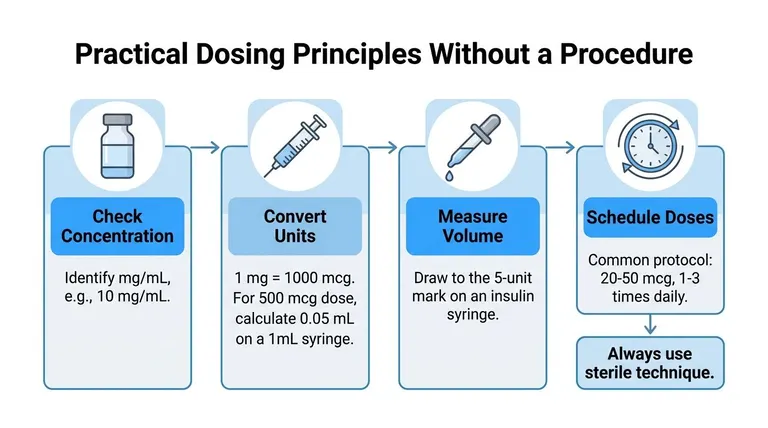
A vial can look simple and still carry a lot of room for error. With the approved recombinant IGF-1 drug mecasermin (INCRELEX), the labeled concentration is 10 mg/mL in a sterile aqueous solution for subcutaneous injection, and each 1 mL vial contains 10 mg of drug substance, stored at 2 to 8°C (FDA label). At that concentration, a small volume slip changes the delivered amount in a meaningful way, so a 0.01 mL syringe error equals 0.1 mg of IGF-1.
Math first, habit second
Syringes measure volume, not intent. Dose comes from mg/mL multiplied by mL drawn, which is why the concentration has to be known before anyone can say the dose is clear. If the vial was mixed or reconstituted incorrectly, the same volume can deliver a very different amount of drug, and that is where confusion starts.
A practical way to keep the arithmetic grounded is to move in order, concentration first, volume second, schedule third.
- Check concentration carefully: know whether the vial is 10 mg/mL or something else before any calculation starts.
- Translate mass to volume: a target dose in milligrams only becomes usable once it is matched to the vial’s concentration.
- Respect small errors: at high concentration, tiny syringe slips can change the delivered amount.
- Build around the clock: protocols are usually written around frequency and rest periods because the body experiences IGF-1 as a recurring signal, not a one-time event.
That last point matters because frequency and cycle structure shape exposure just as much as volume does. Daily low-dose patterns and higher-dose intermittent patterns do not just differ in convenience, they change the glucose burden and how easy it is to stay consistent. A planner has to answer more than “how much,” it also has to answer “how often, for how long, and with what recovery window.”
A dose log also needs to stay tied to the calendar. That is where a tracking app such as PepFlow can help, because it turns a loose exposure window into something a person can record, compare against meals, symptoms, and repeat doses, and review later without relying on memory.
Significant Safety Risks and Side Effects
A vial of IGF-1 injection can look tidy on a shelf. The body does not treat it that way. IGF-1 is a double-edged signaling molecule because the same pathway that can support tissue growth can also push glucose lower and raise concern about unwanted proliferation. Research aimed at clinicians and investigators keeps pointing to hypoglycemia, edema, headaches, jaw pain, and concern about cancer promotion and possibly shorter lifespan, while also noting that strong human evidence for wellness or bodybuilding use is lacking (research overview).
Short-term effects users notice first
Low blood sugar is the first problem many people run into, because this molecule has insulin-like activity. The body can shift from steady fuel use to a state that feels shaky, sweaty, dizzy, weak, or oddly flat before the person connects those symptoms to the injection. Edema, headaches, and jaw discomfort also show up often enough in the IGF-1 literature that they should be treated as warning signs, not as a normal adaptation to ignore.
A simple analogy helps here. A glucose-lowering signal works a bit like turning down the room thermostat too far, the change may be subtle at first, then symptoms show up quickly once the body crosses a threshold. That is why symptom tracking matters with IGF-1 the same way it matters with other medicines that can cause tremor or blood sugar shifts. The practical side-by-side symptom awareness described in Qaly albuterol symptom monitoring is a useful reminder that side effects are easier to manage when they are named early and recorded clearly.
Longer-term risk is not theoretical fluff
The FDA’s controlled-clinical-data review of human IGF-1 documented a mortality signal that became part of the drug’s regulatory history. In the randomized dataset, placebo patients had fewer deaths than the low-dose and high-dose groups, and risk ratios across survival analyses were greater than one, favoring placebo (FDA review). None of the analyses reached nominal statistical significance at p < 0.05, but one mortality analysis adjusted for baseline covariates produced a p-value of 0.03, again favoring placebo.
That history matters because it shows why “it’s just a peptide” is the wrong mindset. A growth signal that can move glucose and proliferation is not neutral, especially in healthy users who do not have a clear medical indication.
A practical tracking tool can help keep the risk visible. A log in PepFlow’s peptide side effect guide can tie symptoms, timing, and repeat doses together so patterns are easier to spot before a small problem turns into a missed warning sign.
Monitoring That Catches Problems Early
A responsible IGF-1 injection routine needs more than a vial and a calendar. It needs a way to tell the difference between a normal response, a bad dose, and a protocol that is drifting out of range. A glucose meter, symptom log, and lab review together work better than any single checkpoint. The IGF-1 blood test helps, but it also leaves room for confusion if someone wants a simple yes or no answer.
What testing can and can’t tell you
Clinical guidance notes that IGF-1 testing is used to evaluate growth hormone disorders, but interpretation is limited by assay variability and by the difficulty of separating true biologic change from normal variation (MedlinePlus). Timing, fasting state, and insulin sensitivity can all shape how a result looks, so one lab value does not prove that an injection is “working” in any clean, universal sense.
A lab number is like a snapshot in motion. It can show where things stand at one moment, but it cannot explain the whole route that led there.
Monitoring rule: if the result is not paired with symptoms, timing, and the rest of the protocol, it is only half a story.
A practical checklist is simple:
- Track fasting glucose trends: repeated lows or a new pattern of instability deserve attention.
- Log symptoms daily: shakiness, sweating, headaches, edema, jaw pain, and unusual fatigue are worth recording.
- Use periodic labs thoughtfully: one number does not settle the question, but a trend can reveal drift.
- Flag higher-risk history early: cancer history, unexplained hypoglycemia, and other insulin-sensitive states call for extra caution.
A peptide routine should also be treated like a living process, not a fixed recipe. If the log starts showing a pattern that does not match the intended plan, the safest move is to pause and review before the mismatch becomes harder to correct. A practical symptom checklist in PepFlow’s side effects of peptides guide can help organize those notes so timing, dose changes, and symptoms sit in one place instead of scattered across memory and messages.
A recent clinical study in children with severe primary IGF-1 deficiency also reinforces that IGF-1 treatment can be effective but requires continuous monitoring and dose adjustment. That does not translate into a consumer protocol, but it does show the biology is dynamic, not static.
Legal Status Across Research, Prescription, and Sport
IGF-1 injection lives in four different lanes, and they’re not interchangeable. Mecasermin is the approved prescription form used for severe pediatric IGF-1 deficiency, which is a very different context from compounded prescriptions, research-chemical sourcing, or athletic use. Each lane comes with a different level of oversight and a different standard for what counts as acceptable risk.
Compounded or research-only use sits in a gray zone because the product may exist without the same approval pathway or consistency safeguards as the labeled drug. Athletic use is the clearest boundary line. IGF-1 is on the WADA Prohibited List, so tested athletes should treat it as disqualifying, not as a grey-area wellness peptide.
The practical question is simple: are you dealing with an approved medicine, a compounded product, a research chemical, or a substance banned in sport? That answer changes everything about legal exposure, medical supervision, and whether the protocol even belongs in your situation. If the lane isn’t clear, the safest move is to stop and verify before any use.
How PepFlow Helps With Dose Math, Scheduling, and Adherence
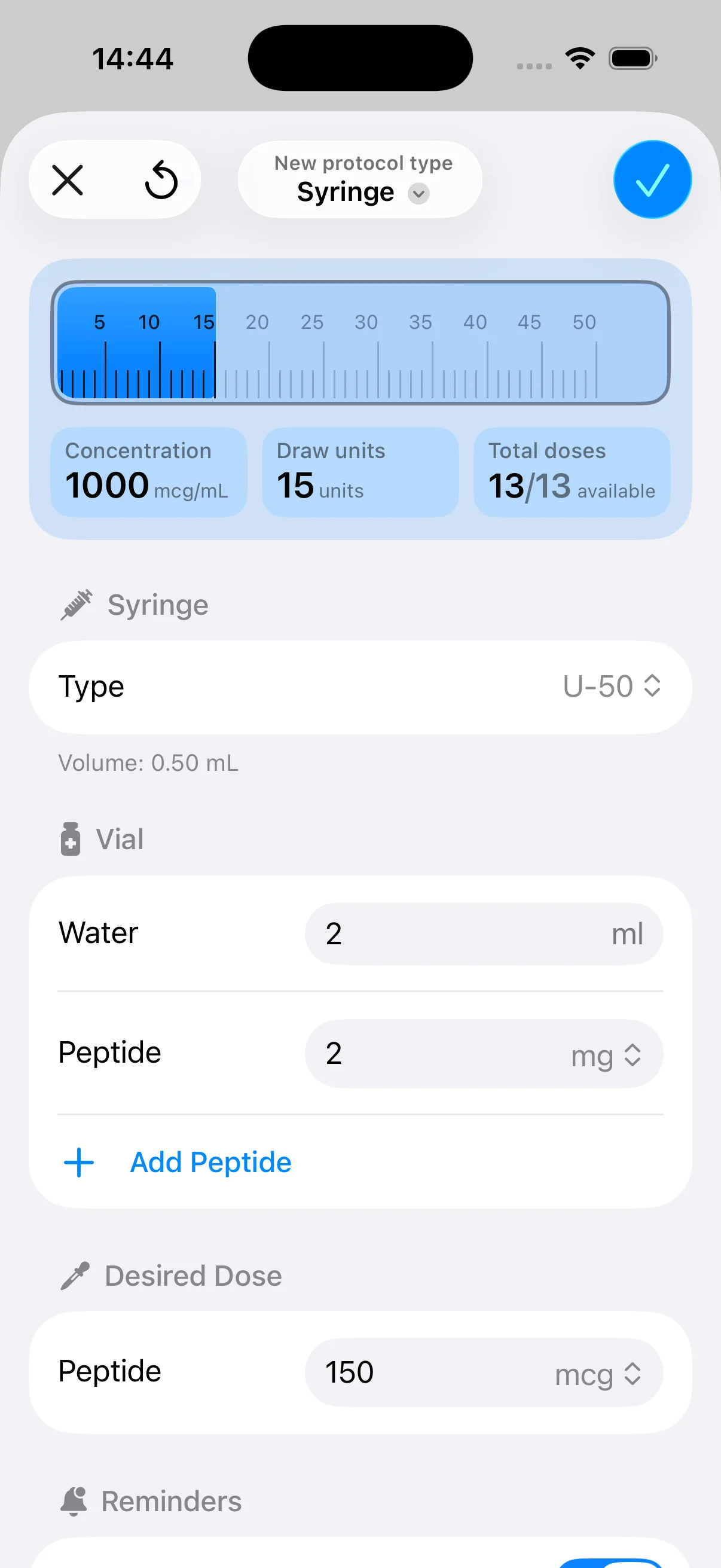
A small dosing mistake with IGF-1 injection often starts as a simple bookkeeping error. Someone misreads concentration, rounds the wrong way, skips a timed dose, or loses track of where they are in a cycle. PepFlow is built for those ordinary failure points, with a peptide dosage calculator that turns target microgram amounts into practical syringe measurements, plus a cycle builder for start dates, frequencies, and pause periods.
The reason that matters is straightforward. IGF-1 behaves like a metabolic lever, so small changes in volume can change exposure in a meaningful way, especially at concentrations like 10 mg/mL as noted earlier. It also works on a clock, with measurable effects on IGF-1 and glucose within hours, so timing is part of the dose, not an afterthought. A calculator helps with the first problem. Scheduling helps with the second.
PepFlow also gives users a place to log doses, set reminders, and keep live activities or widgets in view so the plan is not trapped in memory alone. That kind of structure does not replace medical judgment, and it is not medical advice. It does reduce the chance that a careful plan falls apart because someone had to do arithmetic while rushing out the door.
The next questions usually come down to practical risk. Is IGF-1 testing worth it? Yes, but only as part of a monitored picture, because the test has interpretation limits, as discussed earlier. Do mixing and reconstitution errors matter? Yes, especially with a 10 mg/mL product where a tiny volume error can change the dose materially. Can IGF-1 be stacked with other peptides? That is a risk question, not a convenience question, because combining compounds can increase glucose and safety problems. What should a beginner do first? Read the monitoring section, understand the legal lane, and do not start until the math and risk picture are both clear.
If you want a cleaner way to manage peptide math, schedules, and dose logs in one place, visit PepFlow and use it as a planning layer while you keep safety, timing, and accountability in view.