You’ve probably ended up here for one reason. Your training is decent, your food is mostly under control, and fat loss still feels stuck. Not completely broken, just stalled enough that you’re looking at mitochondrial peptides and trying to figure out whether MOTS-c is interesting science, expensive noise, or something that deserves a place in a protocol.
That’s the right frame. MOTS-c isn’t a magic appetite suppressant, and it isn’t a shortcut around poor habits. It’s a research peptide with a mechanism that makes it unusually relevant for people who are already doing the basics and want to improve how their body handles fuel. The practical question isn’t just what dose people throw around online. It’s how to run a protocol without wasting the cycle through bad timing, sloppy math, or unrealistic expectations.
Table of Contents
- What Is MOTS-c and How Does It Influence Weight
- Common MOTS-c Dosing Ranges for Weight Loss
- How to Calculate and Prepare Your MOTS-c Dose
- Example MOTS-c Schedules and Cycle Planning
- Tips for Maximizing Efficacy and Avoiding Pitfalls
- Safety Legality and Responsible Monitoring
What Is MOTS-c and How Does It Influence Weight
A common MOTS-c use case looks like this. Training is consistent, calories are not wildly off, but body weight stalls and workouts stop producing the same metabolic payoff they did a few months earlier. In that setting, the core question is not whether a peptide can force fat loss on its own. It is whether it can improve energy use enough to make the rest of the plan work better.
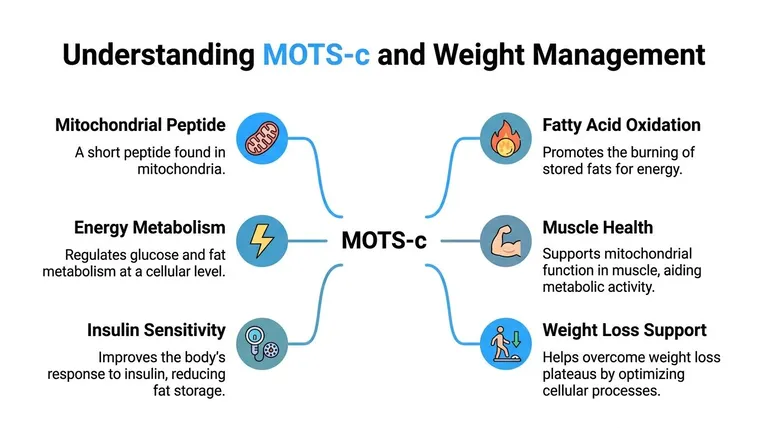
MOTS-c is a mitochondrial-derived peptide tied to cellular energy regulation. For weight loss discussions, the key point is that it appears to influence glucose handling, insulin sensitivity, and fuel selection in a way that resembles an exercise-responsive signal more than an appetite drug. That distinction is critical; it changes who is likely to benefit, how the protocol should be built, and why exercise timing becomes a practical issue instead of an afterthought.
Why MOTS-c gets attention
The preclinical signal that keeps MOTS-c relevant is not simple appetite reduction. In rodent work, researchers reported resistance to weight gain on a high-fat diet without a matching drop in food intake, along with improved insulin sensitivity in another model. That pattern suggests a shift in energy expenditure and substrate use, which is a different mechanism from the one people usually expect when they hear “weight loss compound” (Alzheimer’s Drug Discovery Foundation MOTS-c summary).
That is why execution matters so much with this peptide. If someone uses MOTS-c while staying sedentary, eating erratically, or miscalculating doses from a reconstituted vial, the expected effect can disappear into noise. The compound may have a reasonable metabolic rationale, but protocol sloppiness makes it hard to tell whether it helped at all. A solid grasp of peptide dosage calculations and reconstitution basics prevents a lot of those false negatives.
MOTS-c also sits in a different category from incretin-based drugs. If you are comparing mechanisms rather than looking for a winner, this breakdown of Mounjaro vs Ozempic for weight loss is a useful reference point.
MOTS-c is more plausible as a tool for improving metabolic response than as a standalone fix for overeating.
What it can and cannot do
Used in a well-built plan, MOTS-c may support better fuel partitioning, a stronger training response, and easier progress through a plateau. Used in a messy plan, it becomes another variable that confuses the picture.
A practical way to frame MOTS-c dosage for weight loss is this:
- It may support fat loss indirectly by improving metabolic signaling and substrate use.
- It does not replace calorie control if intake is the main reason weight is not moving.
- It is more logical with training in the plan, because the proposed mechanism appears to complement exercise.
- Human evidence is still limited, so confident claims about guaranteed fat loss are not justified.
That last point deserves some restraint. The mechanistic case is interesting, but early interest in MOTS-c has outrun the human data. The right approach is cautious experimentation, careful dose math, and enough consistency to judge whether the protocol is doing anything useful.
Common MOTS-c Dosing Ranges for Weight Loss
A workable MOTS-c protocol usually breaks down long before the peptide itself becomes the limiting factor. The failure points are more mundane: starting too high, copying a schedule without matching it to training, or miscalculating the actual milligrams drawn into the syringe.
For weight-loss oriented use, the range discussed most often in practice is 2.5 mg to 10 mg per subcutaneous injection. Many protocols start at the low end to check tolerability, then hold in the 5 mg to 10 mg range if the user is responding and the plan is being executed consistently. Frequency is often several injections per week rather than a single large weekly dose. That pattern reflects the way MOTS-c is usually framed in early metabolic protocols, where the goal is repeated signaling alongside training and diet adherence, not a one-off spike. The currently listed Phase 2a study is testing investigational MOTS-c over 12 weeks in adults with prediabetes and overweight or obesity, with participants randomized 1:1 against placebo and both groups receiving lifestyle counseling, which gives useful context for why many real-world protocols stay conservative rather than chasing aggressive dose escalation (NCT07505745 trial record).
Practical working range: begin low enough to confirm tolerability and injection consistency, then increase only if the rest of the protocol is stable.
That usually leads to two distinct phases:
| Phase | Typical approach |
|---|---|
| Starting phase | Lower dose to assess tolerability, injection comfort, and schedule adherence |
| Maintenance phase | Steadier dose once the user has a repeatable routine and a clear reason to continue |
If you want a stronger handle on concentration math before applying it to MOTS-c, this peptide dosage guide with dosing math and syringe basics is a useful reference.
Why the range stays broad
The spread exists for practical reasons, not because dose selection is arbitrary.
Human evidence is still limited, especially for fat loss as a primary endpoint. That means dosage ranges are being shaped by mechanism, early study design, and field practice more than by a mature set of outcome data. In plain terms, there is no strong basis for saying that pushing from a moderate dose to a high dose will reliably produce more fat loss.
Baseline context matters too. A person training regularly, eating predictably, and using MOTS-c near exercise may notice enough at a moderate dose to justify staying there. Someone expecting a stimulant-like effect often overshoots early, then concludes the peptide is ineffective when the underlying issue is poor protocol design.
Execution matters as much as nominal dose. Timing relative to exercise, injection frequency, and dosing accuracy can change the result more than adding a few extra milligrams.
A practical way to interpret the range:
- Lower end: best for checking tolerability and cleaning up execution
- Middle range: where many users settle if recovery, training, and adherence are in place
- Upper end: reasonable only when the protocol is already consistent and there is a clear rationale for increasing dose
The recurring mistake is simple. People focus on the headline dose and ignore whether they can reproduce the same schedule, timing, and measurement week after week.
How to Calculate and Prepare Your MOTS-c Dose
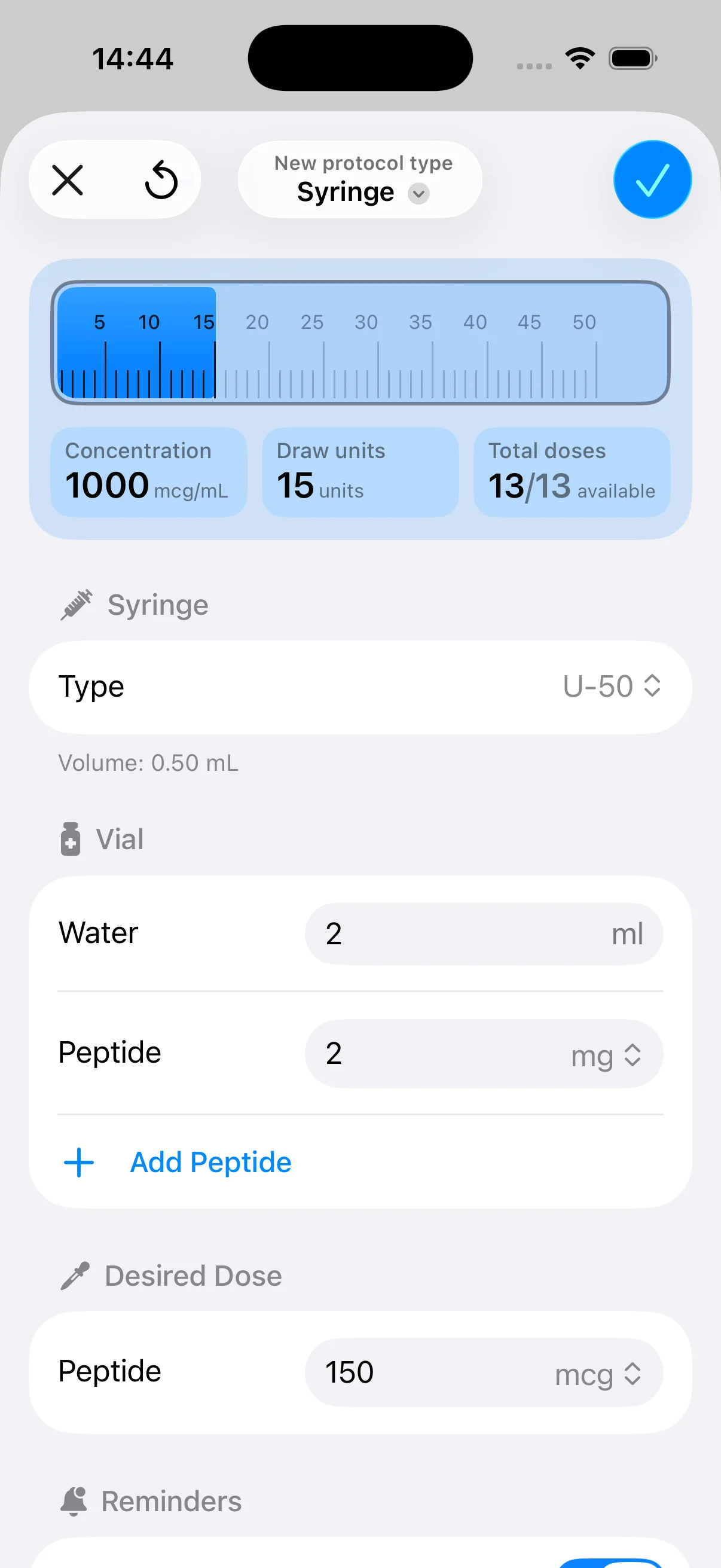
Most MOTS-c mistakes happen before the injection. They happen at the kitchen counter with a vial, bacteriostatic water, and shaky mental math.
That’s why preparation matters. If your concentration is wrong, every dose after that is wrong.

A simple vial math example
Use a clean example. Say you have a 10 mg vial of lyophilized MOTS-c and you reconstitute it with 2 mL of bacteriostatic water. That gives you a concentration of:
- 10 mg total peptide
- 2 mL total liquid
- 5 mg per mL
If your target dose is 2.5 mg, you’d draw 0.5 mL.
If your target dose is 5 mg, you’d draw 1 mL.
That’s straightforward on paper. It gets less straightforward when someone reconstitutes with a different volume than intended, forgets what they used, or switches syringes and starts translating units incorrectly.
Practical rule: write the final concentration on the vial immediately after reconstitution. Don’t trust memory.
If you want a deeper walkthrough of mixing technique before handling MOTS-c specifically, this guide on how to reconstitute peptides covers the basic process clearly.
Reconstitution habits that reduce mistakes
The physical steps aren’t complicated, but consistency matters.
- Clean both vial tops with an alcohol swab.
- Draw the bacteriostatic water you plan to use.
- Inject slowly along the vial wall, not directly blasting the powder.
- Gently swirl until dissolved. Don’t shake.
- Label the vial with concentration and date.
People get into trouble when they rush Step 3 and Step 5. Blasting water directly onto the powder isn’t careful handling, and failing to label concentration is how a 2.5 mg plan turns into guesswork by the third injection.
Drawing the right amount consistently
The key is to convert your desired milligram dose into the actual volume your reconstituted vial contains. Once you know the concentration, every draw becomes simple.
A few habits make a difference:
- Use one standard reconstitution method per cycle. Constantly changing dilution creates confusion.
- Keep a written log. Note vial size, water added, and target draw volume.
- Match the syringe to the math. Don’t switch measurement systems casually.
- Double-check before the first dose. Most protocol errors happen at setup, not midway through.
This short video is a useful visual refresher if you learn better by watching the process rather than reading it:
The reason I’m strict about calculation is simple. MOTS-c dosage for weight loss only means something if the prepared concentration is correct. Otherwise, discussions about optimal ranges are mostly fiction because the user may not be taking what they think they’re taking.
Example MOTS-c Schedules and Cycle Planning
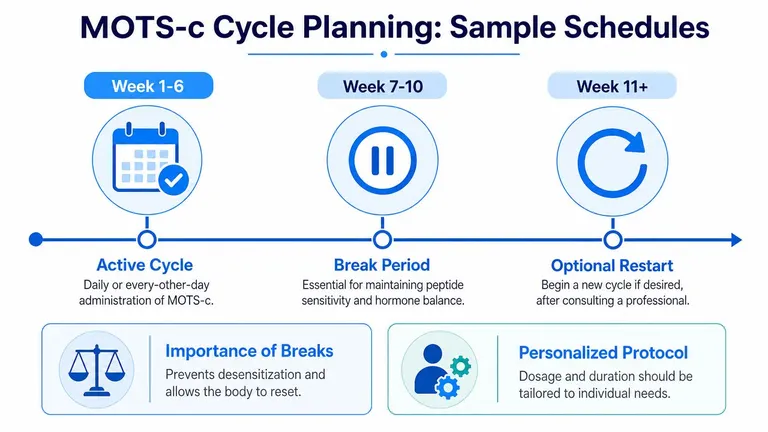
A MOTS-c cycle usually fails on execution, not on paper. The common breakdown is simple. The dose looked reasonable, but the schedule was too ambitious, the training days kept moving, and by week three the user no longer knew whether they were following a protocol or improvising one.
That is why I prefer cycle plans that are easy to audit. You should be able to look at the calendar, your log, and your vial concentration and confirm exactly what happened.
A sample titration table
One practical way to structure a trial run is a 12-week build. The goal is to start low enough to catch tolerance issues, then increase only if adherence, training consistency, and tracking are all in place. A commonly referenced framework uses Week 1 at 2.5 mg subcutaneously 3x/week, Week 2 at 2.5 mg 5x/week, Weeks 3 to 4 at 5 mg 5x/week, and Weeks 5 to 12 at 5 to 10 mg up to 5x/week, with progress tracked against body composition and labs rather than scale weight alone, as outlined in this MOTS-c dosage protocol guide.
| Week(s) | Dose per Injection | Frequency | Weekly Total |
|---|---|---|---|
| 1 | 2.5 mg | 3x/week | 7.5 mg |
| 2 | 2.5 mg | 5x/week | 12.5 mg |
| 3 to 4 | 5 mg | 5x/week | 25 mg |
| 5 to 12 | 5 to 10 mg | Up to 5x/week | 25 to 50 mg at 5 mg, or 50 mg at 10 mg 5x/week |
The table matters because five injections per week creates real friction. Travel, missed training sessions, and bad vial math show up fast at that frequency. If someone cannot execute week 2 cleanly, I would rather keep the dose lower and the schedule tighter than push upward just because the calendar says to.
For users comparing MOTS-c with other body-composition approaches, this guide to a peptide stack for weight loss is useful for understanding how people sequence compounds instead of stacking everything at once.
How to think about on cycles and off periods
Cycle length is only half of the plan. The stop date is part of the protocol, not an optional extra.
A practical approach is to define the full block before the first injection. That means your active phase, your review window, and your off period are all written down in advance. In real use, that reduces two problems: dose creep and vague self-assessment. If there is no planned pause, users often keep dosing while changing food intake, training volume, and sleep at the same time, which makes the outcome hard to interpret.
An off period gives you room to check whether the cycle produced anything meaningful in body composition, training tolerance, appetite, or glucose markers. It also exposes whether progress came from the peptide, the training block, or finally fixing basic adherence.
Plan the full cycle before opening the vial. Start date, training days, escalation points, and stop date should all be set in writing.
I also recommend matching the schedule to the life you have. A technically polished protocol that clashes with work travel or inconsistent gym access usually turns into skipped injections and bad notes. A simpler plan, followed precisely, produces cleaner data.
If fat loss has stalled despite a calorie deficit, it helps to review the bigger picture before extending the cycle. This article on fixing your weight loss plateau covers several reasons progress can flatten even when effort looks consistent.
Tips for Maximizing Efficacy and Avoiding Pitfalls
Most failed MOTS-c cycles aren’t failed because the peptide “didn’t work.” They fail because the user treated it like a passive fat-loss shot and ignored the context that makes it useful.
Exercise timing matters more than most people think
A key execution detail is timing. Injecting MOTS-c 30 to 60 minutes before exercise is often recommended because it aligns with the body’s natural AMPK activation, and because the peptide clears the system in hours, using it on rest days can produce weaker results when the goal is metabolic synergy, as described in this protocol timing guide.

That single point changes how I think about MOTS-c. I don’t see it as a standalone weight-loss aid. I see it as a signal that should be paired with work. If the training isn’t there, the protocol often becomes an expensive attempt to outsource adaptation.
For people stuck despite doing “all the right things,” it helps to review the broader reasons plateaus happen. This piece on fixing your weight loss plateau is useful because it frames the problem beyond just calories and willpower.
What tends to go wrong
The common mistakes are predictable.
- Skipping titration: Users jump straight into a full dose, then blame the peptide when tolerability is poor.
- Using rest-day dosing without a reason: That can undermine the exercise-linked mechanism people are trying to exploit.
- Expecting appetite suppression: MOTS-c isn’t best understood as a hunger-first compound.
- Running no real training plan: Random exercise doesn’t create much synergy.
- Tracking only scale weight: That misses body composition changes and metabolic response.
A smarter checklist looks like this:
- Pick a dose you can tolerate.
- Match injections to training sessions when possible.
- Keep food, training, and sleep stable enough that you can judge the result.
- Review body composition, not just body weight.
The fastest way to waste a cycle is to change five variables at once and then try to guess what worked.
Safety Legality and Responsible Monitoring
A common failure point shows up after the dose is mixed correctly and the schedule looks clean on paper. The user starts chasing faster fat loss, adds extra injections, changes training volume, and stops tracking anything except scale weight. At that point, even a well-planned MOTS-c protocol becomes hard to judge and harder to defend.
MOTS-c is still best treated as an experimental peptide with limited human evidence. That has practical consequences. Product quality may be inconsistent. Label claims may not match vial contents. Side effects and benefits can both be easy to misread if diet, training, sleep, and other compounds are changing at the same time. This article is informational only and not medical advice.
Risk management starts before the first injection
The first safety decision is sourcing, not dosage. “Research use only” labeling does not confirm purity, sterility, or suitability for self-experimentation. It usually means the burden shifts to the buyer.
The second safety decision is restraint. As noted earlier, early human observations are interesting but limited. They do not justify aggressive stacking, rapid escalation, or treating MOTS-c like a proven obesity drug. In practice, the people who get the cleanest read on a cycle are usually the ones running the simplest protocol.
That means one variable set at a time. One training plan. One nutrition target. One clear dosing schedule. Fewer moving parts make adverse effects easier to spot and outcomes easier to interpret.
What responsible monitoring actually looks like
Body weight alone is a poor control panel for this peptide. A responsible log should cover response, tolerability, and execution quality.
- Body composition: Waist measurement, progress photos, and one consistent method for tracking changes over time.
- Glucose-related markers: Fasting glucose or HbA1c, if testing is available through appropriate medical support.
- Training performance: Session quality, endurance, repeat effort capacity, and recovery between workouts.
- Tolerability: Injection-site irritation, GI symptoms, headaches, unusual fatigue, or anything that appears after a dose increase.
- Protocol adherence: Whether injections matched the intended training days, because poor timing can make a cycle look ineffective when execution was the primary problem.
That last point gets missed often. If someone doses randomly, trains inconsistently, and estimates reconstitution math from memory, they are not really testing MOTS-c. They are testing a messy protocol.
Legality and stop rules
Legal status depends on jurisdiction and intended use. Anyone considering MOTS-c needs to check local regulations and understand that availability through peptide vendors does not equal regulatory approval for personal treatment.
Stop rules should be decided in advance. If tolerability worsens after escalation, if injection reactions keep recurring, or if there is no measurable benefit after a reasonable observation window with stable training and diet, the practical move is to stop and reassess. Continuing a peptide cycle without a clear signal is not discipline. It is just sunk-cost thinking.
If you want help staying organized with reconstitution math, cycle timing, and dose reminders, PepFlow is a practical companion. It’s built for people who want cleaner peptide workflows, fewer manual calculation errors, and a schedule they can follow without turning every injection day into a spreadsheet exercise.